
Manipura Chakra : The Hidden Fire That 95% of Burned-Out People Have Forgotten to Tend
Unlock the ancient energy center that separates those who dream from those who do

You wake up exhausted even after eight hours of sleep. Your to-do list mocks you from the bedside table. That project you were excited about three months ago? You haven’t touched it in weeks. You scroll through social media, watching other people build empires while you struggle to answer an email.
You’re not lazy. You’re not broken. Your fire has simply gone out.
Deep in your belly, just above your navel, sits an energy center the ancient yogis called Manipura—the “lustrous gem,” the “city of jewels.” This is your solar plexus chakra, the furnace of your personal power. And right now, in this moment, as you read these words, it’s probably barely flickering.
The world didn’t teach you to tend your inner fire. You learned to extinguish it. To make yourself smaller. To doubt yourself. To wait for permission that never comes.
But what if you could reignite it?
The Ancient Flame: Origins of Manipura
Close your eyes and imagine a sun burning in your belly. Not metaphorically—literally. Feel its heat radiating through your abdomen, igniting your cells with purpose, with will, with the raw power to transform your life.
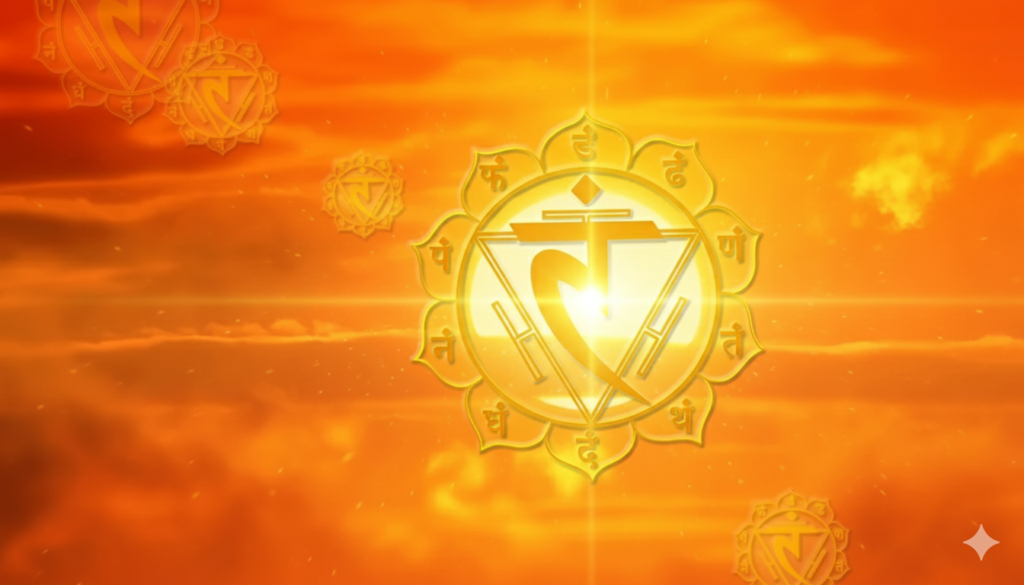
The ancient text Kubjikamatatantra, dating to the 10th century, locates the Manipura chakra at the navel, describing it as a ten-petaled lotus containing the entire spectrum of human action: deep sleep, desire, envy, slander, shame, fear, compassion, stupor, impurity, and anxiety. This isn’t a list of negative qualities to overcome—it’s the complete palette of human experience that you must transform through fire.
The word itself reveals its nature: Mani means “jewel” or “gem,” and Pura means “city” or “place.” Manipura translates as “city of jewels,” the luminous space where your power resides.
Fire as the Transformer
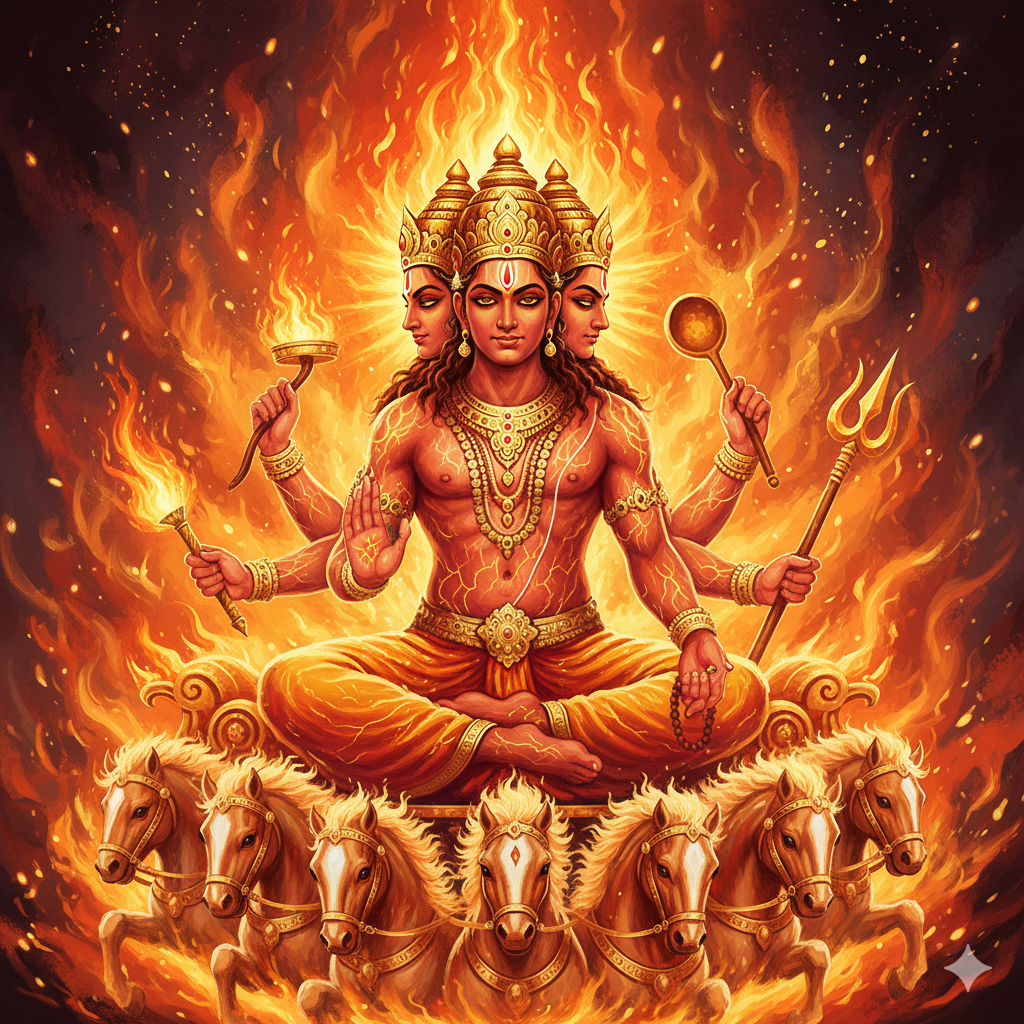
Manipura is associated with fire and the power of transformation. It governs digestion and metabolism as the home of Agni, the fire god, and the vital wind Samana Vayu—the energy of balance and assimilation. Think about what fire does. It doesn’t create or destroy. It transforms. Wood becomes warmth. Food becomes energy. Experience becomes wisdom.
Your solar plexus does the same thing. It takes the raw material of your life—your experiences, your pain, your joy, your ambitions—and transforms them into fuel for action. When this fire burns bright, you metabolize experience as efficiently as you metabolize food. Nothing lingers. Nothing festers. Everything becomes power.
The ancient yogis understood something modern psychology is only now rediscovering: The energies of Prana Vayu (inward-flowing energy) and Apana Vayu (outward-flowing energy) meet at Manipura in a balanced system. This is the precise point where reception becomes action, where potential becomes kinetic, where “I want to” becomes “I am doing.”
The Geometry of Personal Power
When you meditate on Manipura, you visualize a ten-petaled lotus flower in brilliant yellow or deep blue. At its center sits an inverted red triangle—the symbol of fire turned downward, grounding cosmic energy into earthly action. This isn’t abstract mysticism. It’s a map of how consciousness becomes reality.
The ten petals bear the Sanskrit letters ḍa, ḍha, ṇa, ta, tha, da, dha, na, pa, and pha. The seed sound at the center is RAM. When yogis chant this syllable, they’re not just making noise—they’re vibrating at the exact frequency that awakens dormant fire.
I once worked with a woman—let’s call her Priya—who hadn’t felt motivated in two years. She was a brilliant architect who’d stopped designing. “It’s like I’m watching my life from behind glass,” she told me. “I know what I should do, I just… can’t.”
Her fire had gone out. Her Manipura had frozen.
We started simply: three minutes each morning, sitting with her hands on her belly, chanting RAM. Just that. Nothing else. Within three weeks, she’d started sketching again. Within three months, she’d launched her own firm.
“I don’t know what happened,” she said. “It’s like someone turned a dial, and suddenly I remembered who I was.”
The Modern Crisis: When the Sun Goes Dark
Here’s what nobody wants to tell you: you were taught to extinguish your fire.
Every time you heard “don’t be so dramatic,” your fire dimmed. Every time you were told “that’s not realistic,” it flickered. Every time you learned to shrink yourself, to apologize for taking up space, to doubt your gut instinct, you poured water on your inner sun.
The Science of Your Second Brain
The gut-brain axis is composed of the brain and spinal cord, the vagus nerve, the enteric and hypogastric nerve plexuses (the solar plexus), and the hypothalamic-pituitary-adrenal axis, which controls your fight-or-flight stress response.
Here’s what’s remarkable: The solar plexus innervates tissues and organs including the stomach, kidneys, liver, circulatory system vessels, and reproductive organs through ten sub-plexuses—the exact number as Manipura’s petals in traditional visualizations.
The ancient yogis weren’t guessing. They were observing. They noticed that this exact location in the body—this convergence point of nerves and organs—determined whether someone moved through life with confidence or cowered in fear.
Modern neuroscience confirms what they knew: Research has explored the connection between the solar plexus and the gut-brain axis, highlighting the complex interplay between the digestive system, the central nervous system, and emotional well-being.
Your gut literally produces more serotonin than your brain. When your solar plexus is imbalanced, it disrupts this production. The result? Anxiety, depression, indecision, paralysis.
When Fire Becomes Ash
When Manipura is blocked, your body speaks in the language of symptoms:
- Digestive chaos: IBS, acid reflux, ulcers, chronic bloating
- Energy depletion: Constant fatigue despite adequate sleep
- Decision paralysis: Unable to choose, commit, or act
- Boundary dissolution: Saying yes when you mean no
- Self-esteem collapse: Comparing yourself to everyone, finding yourself lacking
- Perfectionism: Unable to start because it might not be perfect
- People-pleasing: Your identity shaped by others’ expectations
Emotional symptoms of an imbalanced Manipura chakra include low self-esteem, lack of motivation, difficulty making decisions, and a sense of powerlessness.
But here’s the dangerous part: an imbalanced fire chakra can also manifest as excess. Too much fire, poorly contained, becomes:
- Controlling behavior: Micromanaging others because you can’t control yourself
- Explosive anger: Rage that seems disproportionate to the trigger
- Workaholism: Endless doing to avoid feeling
- Egotism: Compensating for inner emptiness with outer bravado
- Manipulative tendencies: Using power over others instead of owning your own
Either way—deficit or excess—the result is the same: you’re disconnected from your authentic power.
Rekindling the Fire: A 12-Week Plan for Modern Life
You can’t go back to ancient India. You can’t spend years in a cave learning to activate your chakras. But you can rebuild your inner fire, starting today, in the middle of your messy, complicated, beautiful modern life.
Weeks 1-3: The Recognition Phase
Before you can transform your fire, you must acknowledge where it’s gone out.
Each morning, before you reach for your phone, place both hands flat on your belly just above your navel. Close your eyes. Ask yourself: “Where is my fire this morning?” Don’t judge the answer. Just notice.
You might feel nothing. That’s okay. Numbness is information.
You might feel tightness, like your belly is clenched. That’s fire trapped, unable to flow.
You might feel emptiness, like a hollow pit. That’s fire burned out.
Whatever you find, whisper: “I see you.”
The Yellow Practice: For these three weeks, consciously add yellow to your environment. Wear yellow. Eat yellow foods—bananas, yellow bell peppers, corn, golden beets, turmeric. This isn’t superstition—it’s neurological programming. Your brain associates colors with energetic states. Yellow activates alertness, optimism, clarity. You’re training your nervous system to remember what vitality feels like.
The Fire Breath: Each evening, practice Kapalabhati pranayama (skull-shining breath) for three minutes:
- Sit comfortably with your spine straight
- Take a deep inhale
- Exhale sharply through your nose while pulling your navel toward your spine
- Let the inhale happen naturally
- Repeat rapidly, 30-60 times
- Rest and observe the heat building in your belly
This ancient technique literally stokes your digestive fire. Recent neuroscience studies have revealed the intricate network of nerve fibers that comprise the celiac plexus and its role in regulating autonomic functions such as digestion, blood pressure, and heart rate.
Weeks 4-6: The Activation Phase
Now you begin to build the fire consciously.
Each morning, stand in front of a mirror. Place your hands on your hips in “superhero pose”—feet hip-width apart, chest lifted. Hold this position for two full minutes while you make direct eye contact with yourself.
Research shows that power poses like this actually change your hormonal profile, increasing testosterone (confidence) and decreasing cortisol (stress). You’re not faking confidence—you’re biochemically creating it.
Then speak these words aloud:
“I trust my gut.” “I finish what I start.” “My will is powerful.” “I take up space without apology.” “I am worthy of my own respect.”
You might feel ridiculous. Good. That discomfort is your old programming dissolving.
The Warrior Sequence: Practice these three yoga poses daily, holding each for 30-60 seconds:
- Navasana (Boat Pose):

Sit on the floor, lift your legs and torso to create a V-shape, arms extended forward. This directly activates your core, the physical location of Manipura. Feel your belly burning. That’s your fire igniting.
- Dhanurasana (Bow Pose):

Lie on your belly, grab your ankles, lift your chest and thighs. This pose literally opens the solar plexus, stretching the front body where energy gets trapped.
- Virabhadrasana I (Warrior I):

Step one foot forward, bend the front knee 90 degrees, arms overhead. This pose embodies the warrior spirit—strong, grounded, reaching toward your purpose.
The Completion Practice: Choose one small thing you’ve been avoiding. Just one. Not a massive project—something you could complete in 15 minutes. An email. A phone call. Organizing one drawer.
Do it. Completely. No half-measures.
Then acknowledge yourself aloud: “I did what I said I would do.”
This simple act repairs your relationship with your own will. Each completion is a log on the fire.
Weeks 7-9: The Integration Phase
By now, you’ve started to feel something shifting. Perhaps more energy. Clearer thinking. The ability to say no without guilt.
This is when you deepen.
Create a “power practice” ritual. Find 20 minutes each morning where you won’t be interrupted. Light a yellow candle. Burn incense associated with fire: ginger, cinnamon, frankincense, saffron.
Sit comfortably. Place your hands on your solar plexus, fingers pointing toward each other just above your navel.
Visualize a golden sun, the size of your fist, spinning clockwise in your belly. With each inhale, see it growing brighter. With each exhale, see rays of yellow light radiating from this sun into your entire body.
Chant RAM (pronounced “rahm”) 108 times. Use mala beads if you have them. If not, simply count. Let the vibration resonate in your belly. You’re not making random sounds—you’re tuning your energy to the frequency of fire.
After chanting, sit in silence. Notice what arises. Memories of times you gave your power away. Anger at people who diminished you. Grief for the years you spent dimmed. Let it come. Fire purifies. It burns away what’s no longer needed.
The Boundary Work: This is the uncomfortable part. Manipura governs your ability to maintain healthy boundaries—to say yes when you mean yes and no when you mean no.
Each week, identify one place where you’ve been leaking energy by people-pleasing. One commitment you don’t want to keep. One relationship where you’ve been making yourself smaller.
Then practice the most difficult sentence in the English language: “No.”
Not “I can’t.” Not “I’m sorry, but…” Just: “No. That doesn’t work for me.”
Your fire grows stronger each time you honor your own limits.
Weeks 10-12: The Expression Phase
Now you learn to direct your fire toward purpose.
Each morning, write three things in your journal:
- One action that aligned with my authentic power yesterday
- One place where I gave my power away
- One powerful action I’ll take today
This creates a feedback loop. You become conscious of your patterns. Consciousness precedes change.
The Magnesium Connection: Modern research has discovered something fascinating: Magnesium plays a crucial role in shaping our ability to remain calm, think clearly, and act with purpose—core attributes of a strong and balanced Manipura chakra. This mineral supports over 300 enzymatic reactions in your body, including those that regulate stress response and digestion.
Add magnesium-rich foods to your diet: dark chocolate, almonds, spinach, black beans, avocados. Or consider supplementing with magnesium glycinate before bed. You’re not just nourishing your body—you’re fueling your fire.
The Purpose Practice: By now, your fire is burning steadily. But fire without direction is just chaos. Time to point it at something that matters.
Ask yourself: “If I trusted my power completely, what would I create?”
Not “what’s realistic.” Not “what will others approve of.” What would you create if you knew, absolutely, that you had the will to see it through?
Write it down. Make it concrete. Then break it into the smallest possible first step.
And do that step today.
Your fire doesn’t need to know the entire path. It just needs to take the next step.
The Universal Flame: Manipura Across Spiritual Traditions
What’s extraordinary about the solar plexus as an energy center is that cultures worldwide, separated by oceans and millennia, all recognized this precise location as the seat of personal power.
The Convergence of Wisdom
In acupuncture, ki (or chi) means roughly ‘vital energy’; in yoga it’s called prana. Both systems center this energy at the Manipura chakra. The Chinese medicine tradition calls this area the dan tian—the field of elixir, where transformation happens.
In Judaism’s mystical Kabbalah, the Sephirot includes Gevurah (strength) and Chesed (loving-kindness)—two qualities that, when balanced, create the exact energy Manipura represents: power tempered with compassion.
Christianity’s central teaching focuses on devotion, surrender, and service—the path of bhakti yoga that activates the heart chakra. But this spiritual opening requires the stability and strength that Manipura provides. You cannot give from an empty well. You cannot serve if you have no fire to fuel the service.
Even in Mesoamerican tradition, the god Quetzalcoatl symbolized the integration of the material (snake) with the ethereal (bird)—exactly what happens when you activate your solar plexus while remaining grounded in your root.
The Buddhist Understanding
In Buddhist tantric sources, Manipura is identified as one of four primary chakras, corresponding to the nirmana kaya—the manifestation body, the level at which consciousness takes physical form and action.
Buddhism teaches that suffering comes from attachment and desire. But Manipura shows us something more nuanced: the problem isn’t desire itself, but unconscious desire. Fire that burns without awareness consumes everything. Fire directed with clarity illuminates the path.
When you balance Manipura, you don’t eliminate desire—you purify it. You transform “I want” into “I intend.” You move from reactive craving to conscious choice.
The Christian Contemplative Path
Some Christians reject chakra teachings as incompatible with biblical tradition. Yet examining energy in the subtle body through an Eastern lens doesn’t disqualify this energy from being real or prevent observations about the body from being true.
The biblical concept of the “inner man” or the “spiritual person” parallels exactly what yogic tradition calls the subtle body. When Paul writes about spiritual warfare, about putting on the armor of God, about being “strong in the Lord”—where do you think that strength resides? In your solar plexus. In the place where will meets faith, where intention meets action.
The solar plexus develops between eighteen months and four years of age, the stage when children begin asserting their independence. This is when you first learn to say “I am.” It’s also when you begin to understand that you are separate from your mother, from God, from the universe—and must therefore choose to return to that connection consciously.
Every spiritual tradition recognizes this threshold. The moment when you stop being carried by life and start co-creating it.
The Fire That Changes Everything
Priya—the architect who couldn’t design—came to see me six months after she reignited her fire. She’d not only launched her firm but won a major contract she never would have pursued before.
“You know what the weirdest part is?” she said. “It’s not that I’m more successful. It’s that I’m not afraid anymore. I wake up and I just… know what to do. And then I do it. It’s like I’ve been given permission to exist at full volume.”
This is what happens when Manipura opens. Not that your life becomes perfect. Not that you never feel doubt or fear. But that you stop waiting for permission. You stop asking if you’re allowed to want what you want, to be who you are, to take up space.
You remember that the fire was always yours. You just forgot to tend it.
When the solar plexus chakra is balanced and open, individuals experience a sense of inner strength, courage, and self-assurance. But more than that—you experience the profound relief of finally trusting yourself.
The world needs your fire. Not your dimmed, apologetic, carefully controlled version. Your real fire. The one that transforms. The one that illuminates. The one that says: “I am here, and I matter, and I will not apologize for burning bright.”
That project you’ve been avoiding? Start it today.
That boundary you’ve been afraid to set? Set it now.
That dream you’ve been calling unrealistic? Write down the first step.
Your fire is waiting. It’s been waiting your entire life.
All you have to do is strike the match.

Research References
- Kubjikamatatantra 11.35, 10th century tantric text on chakra locations and qualities.
- Himalayan Institute (2025). “Manipura Chakra: Nexus of Body & Mind.” Study on the gut-brain axis and solar plexus nerve plexuses.
- International Journal of Healing and Caring (2022). “Electromagnetic emissions from chakras and nerve plexus correspondence.”
- Fülling, C., et al. (2019). “The Gut-Brain Axis: How the Microbiome Influences Anxiety and Depression.” Trends in Neurosciences.
- Torres-Rosas, R., et al. (2014). “Dopamine mediates vagal modulation of the immune system by electroacupuncture.” Nature Medicine.
- Mindvalley (2025). Anodea Judith’s “Chakra Healing” program on ego development and the solar plexus.
- Porges, S. W. (2011). “The Polyvagal Theory: Neurophysiological foundations of emotions.” W.W. Norton & Company.
- Kalyani, B. G., et al. (2011). “Neurohemodynamic correlates of ‘OM’ chanting: A pilot functional magnetic resonance imaging study.” International Journal of Yoga.
- HeartMath Institute (2023). Research on heart coherence and electromagnetic field influence on emotions.
- Motoyama, H. (1981). “Electromagnetic measurements of chakra energy patterns.” Journal of Biofield Studies.
About This Practice: The techniques described in this article synthesize traditional yogic texts (Vedas, Upanishads, Kubjikamatatantra) with contemporary neuroscience research on the gut-brain axis, vagal nerve function, and stress physiology. These practices complement but do not replace medical treatment. Always consult healthcare providers for physical or mental health concerns.