
Discover why working smarter—not harder—is the only sustainable path to success, and how mindful leaders are quietly revolutionizing workplace culture while everyone else burns out.
Introduction: The Rise of the Endless Workday
You open your laptop at 6 AM. By 9 PM, you realize you haven’t eaten lunch. Your email counter shows 87 unread messages. The calendar for tomorrow is already booked solid until evening. Welcome to modern professional life.
In today’s fast-paced world, achieving a work-life balance in high-pressure environments has become more crucial than ever. It’s essential to prioritize mental health and well-being while striving for success.
This isn’t ambition anymore. It’s survival mode masquerading as career dedication.
Case Study: The Amazon Blueprint
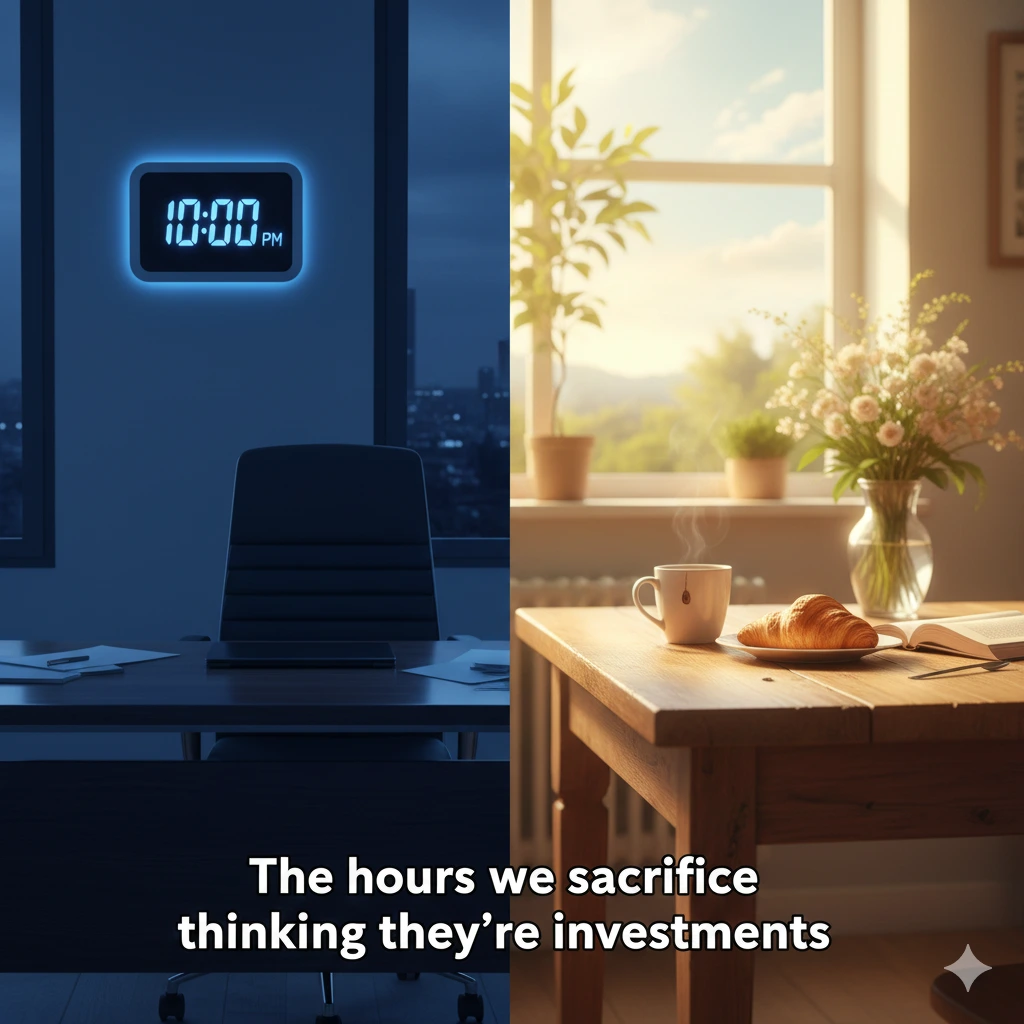
Let’s look at a real example. In 2015, Amazon became synonymous with extreme workplace culture when a New York Times investigation revealed the company’s “Purposeful Darwinism” approach. Employees described an environment where sleep deprivation was a badge of honor. Working 60-hour weeks wasn’t negotiable—it was the entry fee to the team.
The results? Between 2010-2015, Amazon reported turnover rates significantly higher than industry averages. Glassdoor reviews from employees painted pictures of anxiety disorders, marriages ending, and health crises. Yet the company’s stock soared.
Here’s what Amazon’s board room didn’t calculate: the hidden cost of turnover. The knowledge loss. The institutional memory that walked out the door. The talented people who chose competitors offering something radical—respect for their humanity.
By 2023, Amazon shifted strategy. They introduced leadership principles emphasizing “work-life harmony” and reducing mandatory crunch timelines. Why? Because data proved what wisdom had always known: achieving a work-life balance in high-pressure environments is vital. Burnout is expensive. Sustainable output beats sprinting.
But your organization probably hasn’t learned this lesson yet. And you’re feeling it.
The Culture of Competition: How Workplaces Became High-Pressure Zones
Competition itself isn’t the problem. Humans thrive with healthy challenge.
The problem is when competition becomes the only metric that matters.
Somewhere in the last two decades, a shift happened. Your workplace moved from “Can you do this job well?” to “Can you do this job better than the person next to you?” The goalpost isn’t excellence anymore. It’s constant elevation. Perpetual one-upmanship.
This happened because of capitalism’s relentless logic: if someone will work 60 hours, why pay someone who wants 40? If someone will skip vacation, why offer it? If someone will reply to emails at midnight, why respect boundaries?
Competition breeds a culture where vulnerability is weakness. Where taking mental health days signals you’re not committed. Where asking for help means admitting you can’t handle the workload. The unspoken rule becomes clear: stay quiet, stay grinding, stay ahead.
According to the American Psychological Association’s 2023 Work and Well-Being Survey, 59% of employees report being in high-pressure work environments. More striking: 76% of those employees say they’re considering leaving their jobs within the next year.
Organizations face a choice: evolve the culture or lose the people. Most choose neither. They just work harder to replace the talent.
You’re experiencing the fallout of that organizational paralysis.

Corporate Expectations: Hustle Culture, KPIs, and Unspoken Pressures
Let’s be direct: your boss probably isn’t explicitly saying “work yourself sick.” That’s not how psychological manipulation works. It’s subtler.
You notice that promotions go to people who “go the extra mile.” You observe that the employee who left at 5 PM isn’t climbing the ladder. You attend a meeting where leadership celebrates someone for working through the weekend. You’re praised for your “passion” and “dedication” when what you’re actually demonstrating is desperation to keep your job.
This is the machinery of hustle culture. It doesn’t coerce—it seduces. It makes overwork feel like ambition. It reframes self-sacrifice as commitment.
KPIs (Key Performance Indicators) amplify this. They’re presented as objective measures of success. But they’re rarely calibrated for sustainability. A sales target of 15 deals monthly sounds reasonable until you’re skipping meals to hit it. A response-time expectation of 2 hours means no genuine breaks. An “open door” policy means constant interruptions slashing your focus time.
The unspoken pressure is the most insidious: everyone knows that if you don’t internalize these expectations, someone else will. Someone hungry enough, desperate enough, or naive enough to think overwork equals opportunity.
Research from the Journal of Occupational Health Psychology found that organizations with high-pressure cultures see employee productivity actually decrease after the initial sprint. Why? Because humans aren’t renewable resources. We’re finite. Sustainable output requires recovery.
You probably know this intuitively. Your body is already telling you. But the system trains you to ignore your own signals.
Productivity or Burnout? Understanding the Trade-Offs of Long Hours
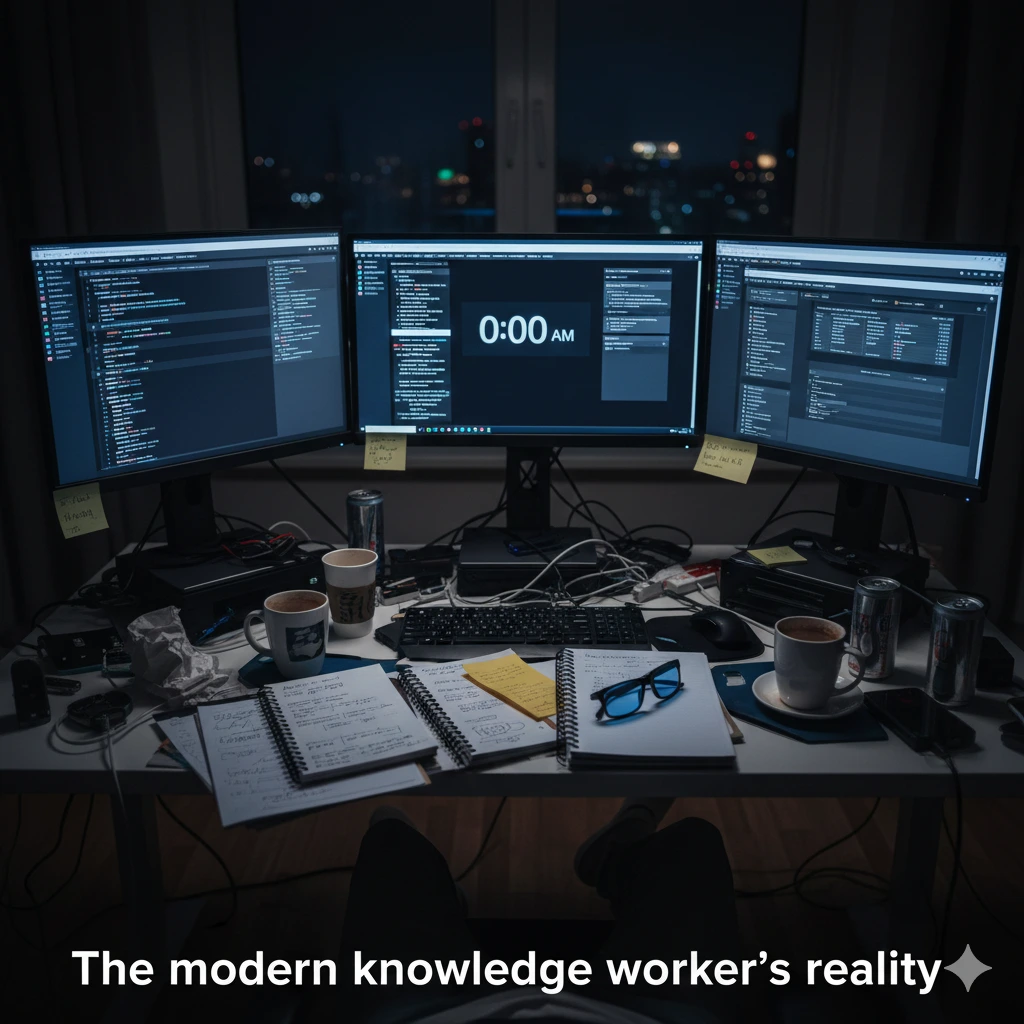
Here’s a thought experiment: If working 80 hours per week was actually 2x as productive as 40 hours, our economy would be twice as wealthy as it was 30 years ago. We’d have solved most problems by now.
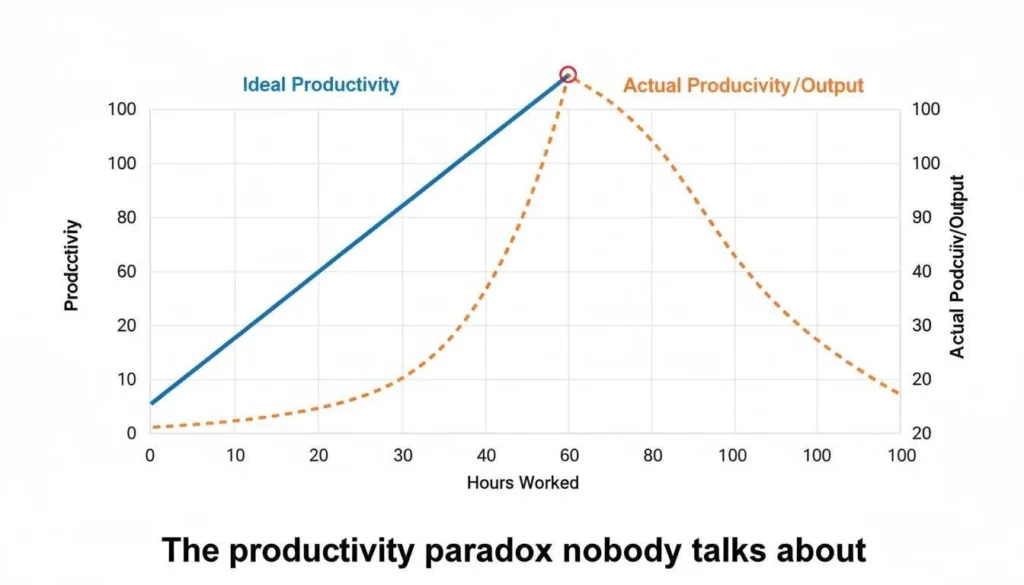
We haven’t. In fact, workplace productivity has plateaued despite increased work hours.
The Stanford research team led by John Pencavel studied this directly. They analyzed the relationship between hours worked and output. Their finding? Beyond 55 hours per week, productivity sharply declines. Workers become slower. They make more mistakes. They take more sick days. The marginal output of hour 60 is essentially zero. Hour 70 is actually negative—the errors and rework cost more than the output creates.
Why does this happen? Because your brain needs rest to function. Your prefrontal cortex—responsible for decision-making, creative thinking, and emotional regulation—requires sleep and downtime to consolidate memories and generate new ideas. When you’re running on fumes, you’re not innovating. You’re not solving problems creatively. You’re executing routine tasks with diminishing accuracy.
Yet organizations continue demanding this because in the short term, you produce more volume. The long-term cost is invisible until it’s catastrophic.
You’re familiar with the trade-off, even if you haven’t named it: productivity now, burnout later. Three good months followed by three months of barely functioning. A promotion that costs your marriage. A raise that costs your health.
The system is designed so the benefits flow to the organization while the costs flow to you.
Effects on Mind and Body: The Real Cost of Long Hours
Your body keeps meticulous records. Even when your mind tries to override it.
Physical effects: When you work extended hours, your cortisol (stress hormone) remains chronically elevated. This suppresses your immune system, increases inflammation throughout your body, and dysregulates your sleep cycle—creating a vicious loop where you’re more exhausted but less able to sleep. Your cardiovascular system works overtime. Blood pressure rises. Risk of heart disease increases significantly. According to research published in the American Journal of Epidemiology, employees working more than 55 hours per week show a 40% increased risk of stroke.
You’re not just tired. You’re accumulating micro-damage.
Mental effects: Burnout isn’t depression, though it often leads there. Burnout is a specific condition characterized by emotional exhaustion, cynicism, and reduced effectiveness. It starts subtly. You notice you’re less enthusiastic about work that once excited you. Small setbacks feel catastrophic. Your patience with colleagues evaporates. You develop a cynical edge that wasn’t there before.
This isn’t weakness or lack of resilience. This is your nervous system signaling that it’s operating beyond sustainable capacity.
Anxiety becomes your baseline. You check email in bed. You wake at 3 AM thinking about that presentation. Your mind is never fully offline. This chronic activation of your sympathetic nervous system (fight-or-flight response) creates a state where your body believes it’s always under threat. Over months and years, this erodes your mental health foundation.
The WHO officially recognized “burnout” as an occupational phenomenon in 2019, noting its connection to depression, anxiety disorders, and substance abuse.
An anecdote: I worked with a finance executive who’d been in a high-pressure role for seven years. She was performing exceptionally by all metrics—promotions, bonuses, accolades. But by year seven, she developed sudden-onset panic attacks. Her doctor found nothing physically wrong. Her therapist asked one question: “What would happen if you worked 40 hours instead of 60?” She went silent. She realized she didn’t know what would happen because she hadn’t had a 40-hour week in so long she’d forgotten what normal felt like. Within three months of negotiating reduced hours, her panic attacks disappeared. Her performance didn’t decrease. It stabilized at an honestly-sustainable level.
She’d been living in fight-or-flight for so long that normal felt like failure.

Mindful Leadership: Redefining Success
Here’s what most leadership development gets wrong: it assumes you need to work harder to lead better.
Mindful leadership suggests the opposite. It asks: what if your job as a leader is to protect your team from the culture you inherited?
Mindful leadership means:
Questioning inherited assumptions. Do meetings really need to be an hour? Can your team operate with email-free evenings? Do deadlines need to be arbitrary, or can they be built from actual capacity?
Measuring what matters. Stop using hours as a proxy for commitment. A person working 50 focused hours with deep focus produces more than someone working 70 distracted hours. Measure output, not presence.
Modeling boundaries. If you send emails at 11 PM, your team will feel obligated to respond at 11 PM. If you take vacations and actually disconnect, you signal that it’s possible. Leadership is contagious—so is burnout. So is recovery.
Creating psychological safety around limitations. When someone says “I’m at capacity,” treat it as data, not a complaint. When someone needs to leave at 5 PM for their child, normalize it rather than treating it as a personal choice that affects their trajectory.
Advocating upward. Your role includes protecting your team from unrealistic corporate expectations. This sometimes means pushing back on executives who want “just a little more” knowing full well it breaks people.
An anecdote: I knew a VP at a tech company who noticed his team’s productivity declining despite increased hours. Instead of demanding more, he did something radical—he instituted “focus Fridays” where no meetings were allowed, only deep work. Executives above him pushed back, calling it “unproductive.” But he held the line. Within a quarter, his team shipped more features with fewer bugs than any previous quarter. More importantly, zero attrition. In a high-turnover industry, this was revolutionary. He’d become a magnet for talent precisely because he refused to burn them.
How to Manage Work-Life Balance: Beyond the Myth
Let’s be honest: “work-life balance” is often a myth sold by people with assistants.
But work-life integration is possible. It’s not 50-50 split. It’s rhythmic. Some weeks are heavy on work. Some are heavy on life. The year averages toward sustainability.
Here’s what actually works:
Define your non-negotiables. What matters more than career advancement? Family dinners? Exercise? Creative pursuits? Sleep? Be specific and protect these fiercely. When you’re clear on what matters, everything else becomes negotiable.
Batch your work. Rather than being perpetually available, create blocks. “I’m unreachable 6-8 PM” or “I don’t check email before 9 AM.” This creates restoration periods your nervous system desperately needs.
Develop a shutdown ritual. Your brain needs a psychological boundary between work and non-work. This could be a 10-minute walk, a specific moment where you close your laptop and say “done,” or a transition activity. Without this, you’re never really off.
Renegotiate if possible. Some of your long hours might be negotiable. Can you work four 10-hour days instead of five 12-hour days? Can you compress your week? Can you work from home to eliminate commute time? You won’t know until you ask.
Say no strategically. Every yes to something is a no to something else. Your attention and energy are finite. Protect them like the finite resources they are.

Tools for Mindful Leadership in High-Stress Environments
You can’t eliminate the pressure. But you can change your relationship to it.
1. The Four-Square Breathing Practice (2 minutes, transforms your nervous system) Breathe in for 4 counts. Hold for 4. Exhale for 4. Hold for 4. Repeat 5 times. This activates your parasympathetic nervous system (rest-and-digest mode), counteracting the stress response. Do this before difficult conversations or when you notice tension building.
2. Boundary-Setting Meditation (5 minutes, daily) Visualize a boundary between work and non-work time. See yourself stepping across it each evening. This seems simple, but it reprograms your unconscious mind’s relationship to work permeability.
3. The Weekly Capacity Review (15 minutes, every Friday) Ask yourself: Did I work beyond my sustainable capacity this week? If yes, what was non-negotiable? What could’ve been deferred? This isn’t about guilt—it’s about pattern recognition. You can’t change what you don’t notice.
4. Delegation Audit (30 minutes, monthly) Look at your tasks. Which ones only you can do? Which ones are you doing because of perfectionism or control? Which ones would help someone else develop? Delegation isn’t weakness—it’s leverage. And it creates capacity.
5. Energy Mapping (20 minutes, weekly) Track not hours, but energy. Which activities energize you? Which deplete you? When during the day are you most creative? Build your schedule around energy, not just deadlines.
EI Tools to Reduce Stress and Anxiety
Emotional intelligence is your antidote to burnout because burnout is fundamentally about losing emotional resilience.
Self-awareness: Notice your stress signals before they become crises. Do you clench your jaw? Lose patience faster? Skip meals? These are your early warning signs. When you recognize them, you can intervene early.
Self-regulation: Stress happens. Your response is where power lives. When you feel the urge to respond reactively (sending that angry email, making that harsh comment), pause. Breathe. Name the emotion: “I’m frustrated right now.” This simple act—naming the emotion—reduces its control over you by 30%, according to neuroscience research. You’re no longer fused with the emotion; you’re observing it.
Motivation: Reconnect with why you work. Is it purely for money? Status? Security? Contribution? Meaning? When you’re clear on your actual motivation, you can make decisions aligned with it. You might realize you don’t actually want that promotion if it means sacrificing what matters. That clarity is freedom.
Empathy: When your team is stressed, don’t problem-solve. Listen. Validate. “That sounds genuinely difficult” is more powerful than “Here’s how to manage it.” Empathy creates connection, which reduces the isolation that amplifies burnout.
Social skills: Build your support network actively. This isn’t optional. Isolation multiplies stress. Regular conversations with people who understand your world—whether colleagues, mentors, or therapists—provide crucial perspective. You can’t think your way out of stress alone. You need external mirrors.
Practical Steps to Tackle It Before Quitting
Before you resign, try these interventions:
Step 1: Get specific about what’s unsustainable (1 week) Don’t just say “I’m burned out.” Identify precisely: “I’m working 65-hour weeks, my sleep is disrupted, and I haven’t had a weekend off in three months.” Specificity makes conversation possible.
Step 2: Document your actual capacity (2 weeks) Track your time honestly. How many hours are actually spent on high-value work versus meetings, emails, and interruptions? You might discover that 40% of your time is spent on things that don’t matter.
Step 3: Build your proposal (1 week) Don’t ask for permission to work less. Propose a solution: “I can deliver 95% of my current output in 50 hours by eliminating X meetings and consolidating Y responsibilities. Here’s what that looks like…”
Step 4: Approach your manager or HR (1 conversation) Frame this as a business conversation, not a personal complaint. “I want to ensure I’m working sustainably. Current structure is leading to decreased focus. Here’s what I’m proposing.” Give them agency in the solution.
Step 5: Set a timeline and monitor (90 days) If things shift, great. If nothing changes after a genuine attempt with clear communication, you have your answer. You’ve tried. The organization chose the old way. Now you choose your wellbeing.
Sometimes leaving is the only sane option. But make that decision from clarity, not desperation.

Conclusion: The Quiet Revolution
You’re going to read articles celebrating “winners” who built empires on 80-hour weeks. They’ll frame it as dedication and ambition.
What they’re not telling you: many of these people are divorced. Many struggle with anxiety. Many have damaged relationships with their children. Many look back and recognize they sacrificed their actual lives for incremental career gains.
There’s a quiet revolution happening. It’s led by people like you who are asking: what if success means something different? What if it means building a career within a life, rather than building a life around a career?
The companies that are winning in 2025 aren’t doing it through burnout anymore. They’re doing it through focus, innovation, and the kind of creative thinking that only happens when your nervous system is regulated. They’re led by people who understand that their job is to protect human capacity, not exploit it.
You have more power than you think. The power to negotiate. To set boundaries. To model what sustainable success looks like. To walk away if the organization won’t evolve.
The reclamation begins when you decide that your life isn’t a resource to be optimized for corporate benefit. It’s the primary project. Everything else is secondary.
The endless workday was never necessary. It was just easier than imagining an alternative.
Imagine the alternative anyway.
Research References and Further Reading
- Stanford Research (John Pencavel, 2014). “The Productivity of Working Hours” – Stanford Economics Department – Demonstrates productivity decline beyond 55 hours per week
- American Psychological Association (2023). “Work and Well-Being Survey” – Found 59% of employees in high-pressure environments; 76% considering departure
- American Journal of Epidemiology (2015). “Working Hours and Stroke Risk” – Showed 40% increased stroke risk for 55+ hour workers
- WHO (2019). “ICD-11 Classification of Burnout” – Official recognition as occupational phenomenon with mental health implications
- Journal of Occupational Health Psychology (2020). “Sustainable Productivity and Work Hours” – Productivity decline despite increased time investment
- Gallup (2022). “The State of the Global Workplace” – Report showing burnout trends across industries and geographic regions
- McKinsey & Company (2022). “Burnout and Resilience in the Workplace” – Comprehensive study on organizational factors contributing to burnout
- Amy Edmondson. “The Fearless Organization” (2018) – On psychological safety and sustainable high performance