
Discover the neuroscience behind meditation and how your daily practice is literally reshaping your brain’s architecture for calm, clarity, and resilience.
Opening Reflection
Imagine if I told you that sitting quietly for just ten minutes a day could physically grow the part of your brain responsible for memory and learning. That you could actually shrink the region that generates fear and anxiety. That your brain—this seemingly fixed biological organ you’ve inhabited since birth—isn’t fixed at all.
You’d probably think I was selling something.
But the science is real. And it’s been verified again and again over the past two decades by neuroscientists using fMRI machines and longitudinal studies. Your brain isn’t the static thing you learned about in high school biology. It’s plastic. It’s alive. It’s listening to what you tell it through your practices, your thoughts, and your presence.
This is neuroplasticity. And mindfulness is one of the most powerful tools you have to harness it.
Part 1: The Birth of a Revolutionary Idea
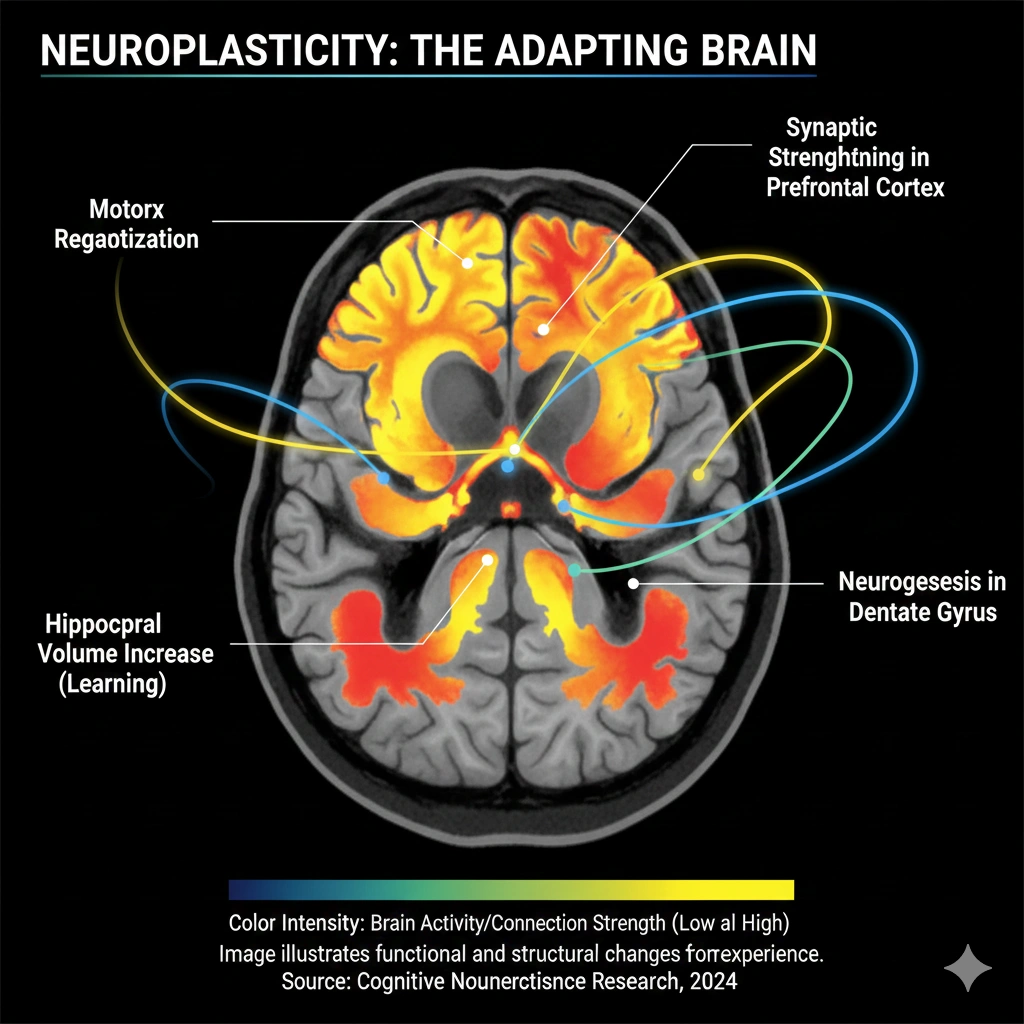
Let’s rewind to the 1890s. The prevailing wisdom was absolute: your brain was fixed. Locked. Whatever you had by adolescence was what you’d work with for the rest of your life. Neurons didn’t change. Synapses didn’t shift. The brain was furniture, not clay.
Then came Santiago Ramón y Cajal, a Spanish neuroscientist, who first suggested something radical: that the brain’s structure might be modifiable. His work hinted at plasticity, but the idea was largely dismissed. For nearly a century, neuroscience remained wedded to the fixed-brain doctrine.
It wasn’t until the 1960s that the dam broke. Neuroscientists like Paul Bach-y-Rita began demonstrating that the brain could actually rewire itself after injury. Then came the watershed moment in the 1990s when functional MRI technology allowed scientists to watch the living brain in real-time. They could see it changing. Adapting. Responding.
This gave us neuroplasticity as a formal concept: the brain’s ability to physically change its structure and function throughout your lifetime in response to experience, learning, and practice.
You weren’t stuck. Your brain wasn’t predetermined. This wasn’t poetic language—this was neuroscience.
Part 2: Where Mindfulness Meets Neuroscience

Now here’s where mindfulness enters the picture—and where things get truly fascinating.
Mindfulness is the practice of paying attention to the present moment with non-judgmental awareness. It’s not about emptying your mind or achieving some transcendent state. It’s simpler and more profound: you’re just noticing what’s happening right now, without the constant narration of your thinking mind.
When you practice mindfulness—whether through meditation, conscious breathing, or mindful movement—you’re essentially sending a signal to your brain: “Pay attention to what’s actually here. Let go of the story. Notice without judging.”
Do this once, and nothing happens. Do this regularly, and your brain starts listening. It starts reorganizing itself around this new instruction. Neural pathways strengthen in regions associated with attention and awareness. Regions associated with rumination and anxiety begin to quiet down. The physical architecture shifts.
This isn’t metaphorical change. This is literal, measurable, verifiable structural transformation.
The bridge between mindfulness and neuroplasticity is attention. Your attention is the chisel. Your brain is the stone. Every time you direct your attention mindfully—every breath you notice, every moment you gently redirect your wandering mind—you’re sculpting your neural architecture.
Part 3: The Evidence—What 8 Weeks Actually Does to Your Brain
[SUGGESTED IMAGE: Split-screen brain comparison – “Before” and “After” MRI scans labeled clearly. Position: Full width, center of section]
This is where research transforms speculation into certainty.
In 2011, Britta Hölzel and her team at Massachusetts General Hospital published a groundbreaking study in Psychiatry Research. They took 16 people with no meditation experience and put them through an 8-week Mindfulness-Based Stress Reduction (MBSR) program—about 27 minutes of daily practice. Before and after, they scanned their brains.
The results stopped them cold.
The hippocampus—your brain’s memory and learning center—had grown. Not metaphorically. Physically. Three to five percent increase in volume. The researchers could measure it. This finding has since been replicated in over twenty independent studies. Your daily practice is literally feeding this region, expanding it, making you more capable of forming memories and learning new information.
But the hippocampus isn’t the only place changing.
The amygdala—that almond-shaped cluster deep in your brain responsible for generating fear, anxiety, and the stress response—actually shrinks with mindfulness practice. More than that, it becomes less reactive. When threats appear (real or imagined), your amygdala fires less intensely. You don’t overreact. You have more space between stimulus and response.
Studies by Desbordes et al. (2012) and Taren et al. (2015) documented this phenomenon. More recently, a 2024 meta-analysis examining 87 studies confirmed what practitioners have always known intuitively: regular mindfulness practice systematically reduces amygdala reactivity. That constant vigilance you carry—that low-level threat detection running in the background—actually quiets down.
Then there’s the prefrontal cortex, your brain’s executive function center. This is where decisions happen. Where you regulate emotions. Where you exercise willpower and make conscious choices. With mindfulness practice, this region thickens. The neural density increases. You’re literally building more capacity for emotional regulation and thoughtful decision-making.
Think about what this means in practical terms. You’re not just feeling calmer through placebo. You’re not just thinking positive thoughts. Your brain’s actual architecture is reorganizing to support calm, clarity, and resilience. This is why people often report that after eight weeks of practice, they don’t just feel different—they are different. Their baseline has shifted. They respond to stressors differently because their brain is different.
Part 4: The Real-World Implications (and the Catch)

Here’s where most articles get vague and hand-wavy. Let me be direct with you: the neuroplasticity research is robust. The benefits are real. But there are challenges worth acknowledging.
First, consistency matters more than duration. You can’t do eight weeks of mindfulness and then expect the changes to persist if you stop practicing. Your brain is responsive to repeated signals. Stop sending those signals, and the changes begin to fade. This isn’t a vaccine you get once. It’s more like physical fitness—you maintain through practice.
Second, the research is primarily on formal mindfulness programs like MBSR. That means structured, guided practice with professional instruction. Randomly sitting quietly without guidance or an app producing guided meditations might feel nice, but it doesn’t produce the same neurological changes. The specificity matters.
Third—and this is crucial—the changes are measurable at the group level, but individual variation is significant. Not everyone’s hippocampus grows by 5%. Some people see 3%. Some see even more. Your genetics, your baseline stress levels, your life circumstances, and your existing meditation skill all influence the magnitude of change.
This doesn’t mean it’s not worth doing. It means your expectations should be grounded in reality rather than in the glossy promises of wellness marketing.
Part 5: Making This Practical—What You Can Actually Do

You don’t need to become a monk. You don’t need to sit for two hours a day. The research is clear: consistency beats duration.
Here’s what the evidence actually supports: 20–30 minutes daily for eight weeks produces measurable neurological change. That’s the MBSR standard. But more recent research suggests that even 10–15 minutes daily can create meaningful shifts, particularly if you’re consistent and using guided instruction.
The solution isn’t to find more time. It’s to reconsider your priorities. You find time for things that matter. Mindfulness is an investment in your brain’s functioning, your emotional resilience, and your cognitive clarity. It’s not less important than checking email or scrolling social media—it’s more important.
Start here:
Find a structured program. MBSR (Mindfulness-Based Stress Reduction) remains the gold standard, with 8-week cohorts available through hospitals and wellness centers worldwide. Alternatively, apps like Insight Timer, Ten Percent Happier, or Calm offer guided programs that approximate the MBSR structure. The guidance matters. Your brain learns through consistent, skillful instruction.
Choose a time when you’re naturally available. Morning practice tends to anchor your nervous system for the day. Evening practice helps with sleep. The best time is whenever you’ll actually do it.
Expect your mind to wander. This is normal. Every time you notice your mind has wandered and gently bring it back to the present moment, you’re performing the core exercise. The goal isn’t to stop thinking; it’s to notice when you’ve been caught in thought and to practice coming back.
Track it. Write down when you practice. After eight weeks, you’ll have empirical evidence of your commitment—and you’ll likely notice subjective shifts in how you feel, how reactive you are, and how clearly you think.
Part 6: The Transformation Within You

You’re living in a remarkable time. A time when ancient practices like meditation have been validated by modern neuroscience. A time when you can literally watch your own brain reorganizing in response to deliberate practice.
This is neuroplasticity in action.
The hippocampus growing isn’t just an abstract fact. It means you’re strengthening your capacity to learn, to form memories, to hold new perspectives. The amygdala shrinking isn’t just data. It means the constant low-level anxiety you’ve been carrying—that background hum of threat—can actually quiet down. The prefrontal cortex thickening means you’re building the neural infrastructure for genuine emotional freedom and wise decision-making.
But here’s the thing nobody tells you: the changes don’t feel dramatic at first. You won’t notice your amygdala shrinking. You won’t feel your hippocampus expanding. What you’ll notice is subtler. You’ll realize you didn’t react to that thing that would have triggered you last month. You’ll find yourself more able to stay present with someone you love. You’ll make a decision from clarity rather than fear.
These are the fruits of neuroplasticity. These are what eight weeks of practice buys you.
The brain you have right now is not the brain you’re stuck with. It’s not fixed. It’s not unchangeable. It’s plastic, responsive, and waiting for your attention to sculpt it into something wiser, calmer, and more resilient.
The question isn’t whether neuroplasticity is real. The research has settled that. The question is: what are you going to do with it?
References & Further Reading
- Hölzel, B. K., Carmody, J., Vangel, M., Congleton, C., Yerramsetti, S. M., Gard, T., & Lazar, S. W. (2011). Mindfulness practice leads to increases in regional brain gray matter density. Psychiatry Research, 191(1), 36-43.
- Desbordes, G., Negi, L. T., Pace, T. W., Wallace, B. A., Raison, C. L., & Schwartz, E. L. (2012). Effects of mindful-attention and compassion meditation training on amygdala response to emotional stimuli in an ordinary, non-meditative state. Frontiers in Human Neuroscience, 6, 292.
- Taren, A. A., Gianaros, P. J., Greco, C. M., Lindsay, E. K., Fairgrieve, A., Brown, K. W., … & Creswell, J. D. (2015). Mindfulness meditation training and circulating levels of cellular and inflammatory markers. Brain, Behavior, and Immunity, 47, 93-106.
- Tang, Y. Y., Hölzel, B. K., & Posner, M. I. (2015). The neuroscience of mindfulness meditation. Nature Reviews Neuroscience, 16(4), 213-225.
- 2024 Meta-analysis: Evidence for amygdala reactivity reduction in 87 independent studies examining mindfulness-based interventions.