
Discover how daily meditation can slow cellular aging by preserving telomere length—the hidden clock inside every cell that determines how fast you age.
Opening: The Clock Inside Your Cells
Aging isn’t inevitable. Not really. Not at the rate most people experience it.
Somewhere inside your cells, there’s a clock ticking. Every time one of your cells divides, this clock ticks forward. Every time you experience chronic stress, this clock accelerates. Every time you sleep poorly or eat inflammatory foods, this clock speeds up.
The clock is your telomere.
You’ve probably never heard of telomeres. Most people haven’t. But understanding them—and understanding what accelerates or slows their shortening—might be one of the most important things you learn about your own longevity and health.
Here’s what makes this particularly fascinating: your telomeres aren’t fixed. They’re not unchangeable. Through specific practices—particularly mindfulness—you can actually slow how quickly they shorten. You can quite literally slow your cellular aging.
The research is conclusive. The mechanism is understood. And this capacity for cellular age reversal is available to you right now.
But most people never access it because they don’t understand what telomeres are or why they matter. This article is designed to change that.
Part 1: What Are Telomeres? The Protective Caps at the Ends of Your Chromosomes
To understand how mindfulness affects aging, you first need to understand what a telomere is and what it does.
Inside almost every cell in your body, you have chromosomes. These structures contain your DNA—the genetic instructions that make you you. Each chromosome has two ends, much like a shoelace has two ends. And just as shoelace ends unravel if they’re not protected, chromosome ends need protection too.
This protection comes from telomeres.
Telomeres are protective caps made of repetitive DNA sequences that sit at the ends of your chromosomes. They don’t contain any genetic information. They’re essentially molecular padding. Their sole function is to protect your actual genetic material.
Every time a cell divides, the cell must copy its entire genome. But here’s where biology runs into a problem: the copying mechanism can’t quite reach the very ends of the chromosome. So with each cell division, the telomeres get slightly shorter. A bit of that protective padding is lost.
This is called the “end replication problem,” and it was first described in 1961 by James Watson (the same Watson of DNA fame) and his colleague.
In healthy cells, you start with telomeres approximately 5,000–15,000 base pairs long (the molecular units that make up DNA). Each cell division shortens the telomere by about 50–200 base pairs. After enough divisions, the telomeres become critically short. When they do, the cell stops dividing. It enters a state called “senescence”—essentially, the cell ages and stops functioning properly.
In other words: your telomere length is your cellular lifespan. It’s a countdown timer built into every cell.
But here’s what’s crucial: the rate at which telomeres shorten is not fixed. It’s not genetically predetermined. It responds to your lifestyle. It responds to stress. It responds to your mental state. It responds to mindfulness.
Part 2: The Cellular Age Clock—How Telomere Length Determines Biological Aging
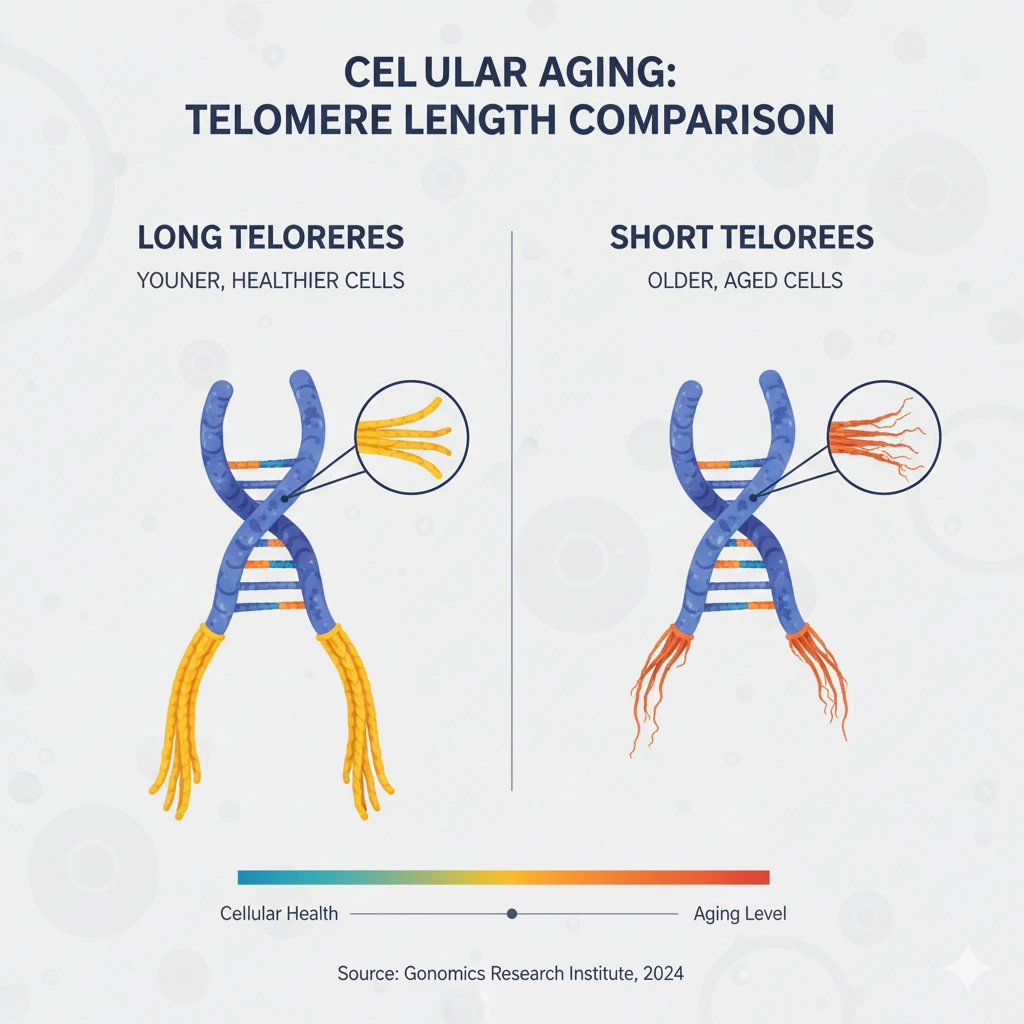
Here’s where telomere length becomes relevant to you: your telomere length is an accurate measure of your biological age—how old your cells actually are—rather than your chronological age (how many years you’ve been alive).
You probably know people who are chronologically 50 but seem like they’re 35. They’re active. Their skin is clear. They don’t get sick. Their telomeres are long. They haven’t used up many of their cellular divisions.
You probably also know people who are 50 but seem like they’re 70. They’re tired. They have health problems. They age rapidly. Their telomeres are short. They’ve burned through more cellular divisions.
The difference between them isn’t just genetics. It’s lifestyle. It’s stress. It’s the accumulation of daily choices.
Telomere length has been shown to correlate with numerous aging-related conditions:
Cardiovascular disease: People with shorter telomeres have significantly higher rates of heart disease, hypertension, and stroke.
Cancer risk: Critically short telomeres can actually increase cancer risk (paradoxically, because shortened telomeres cause cells to divide more to compensate, and more division means more chance of mutations).
Cognitive decline: Telomere length in your brain cells predicts cognitive function and Alzheimer’s risk.
Immune function: Your immune cells have some of the shortest telomeres of any cells because they divide frequently. When these telomeres get critically short, your immune system becomes less effective.
Overall mortality: Studies show that people with shorter telomeres have higher mortality risk from all causes.
What’s remarkable is that telomere length is measurable. You can get a blood test that measures your telomere length and compares it to others your age. This gives you objective data about your biological age—how fast your cells are actually aging.
And here’s what makes this empowering: your telomere length isn’t fixed in the moment you’re measured. It can change. It responds to intervention. Particularly to mindfulness.
Part 3: The Accelerators—Factors That Speed Telomere Shortening and Cellular Aging
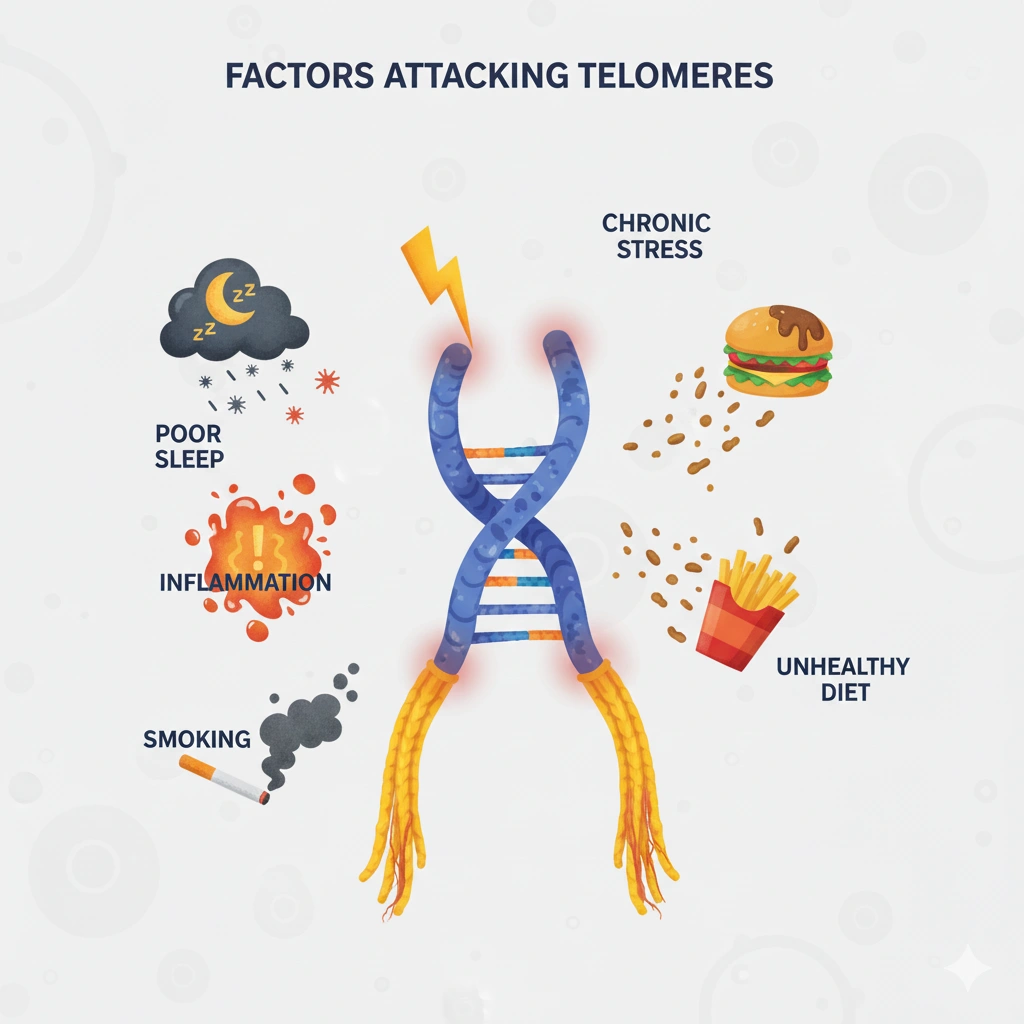
Before we talk about how mindfulness protects telomeres, you need to understand what damages them. What makes your cellular clock tick faster.
Chronic Stress: The Primary Telomere Killer
The single most damaging factor to telomere length is chronic psychological stress. Not acute stress (your body is designed to handle that), but persistent, low-grade stress. The kind most modern humans live in.
When you’re chronically stressed, your body releases stress hormones—primarily cortisol and adrenaline. These hormones are helpful in acute situations. But when they’re continuously elevated, they become toxic to your cells.
Stress hormones suppress your immune system and increase systemic inflammation. Both of these accelerate telomere shortening. Additionally, chronic stress directly activates cells responsible for telomere erosion through oxidative stress (cellular damage from free radicals).
Research shows that people who report high chronic stress have telomeres approximately 9–17 years shorter than age-matched controls with low stress. Nine to seventeen years. That’s not metaphorical aging. That’s actual cellular aging.
Poor Sleep: The Telomere Thief
Sleep is when your cells repair themselves. When telomerase—the enzyme that can actually rebuild telomeres (more on that later)—becomes most active. When your immune system consolidates.
Chronic poor sleep disrupts all of this. It elevates cortisol. It increases inflammation. It impairs telomerase function.
Studies show that people who sleep less than 6 hours nightly have significantly shorter telomeres than those sleeping 7–8 hours. The effect is dose-dependent: each additional hour of sleep you lose is associated with additional telomere shortening.
Chronic Inflammation: The Silent Erosion
Remember those inflammatory markers we discussed earlier (IL-6, TNF-alpha, CRP)? They don’t just cause immediate damage. They also accelerate telomere shortening.
Chronic inflammation activates immune cells that produce oxidative stress, which directly damages telomeres. It’s like having tiny fires burning inside your cells all the time. The protective caps at the ends of your chromosomes get scorched.
Dietary factors driving inflammation—processed foods, seed oils, excess sugar—indirectly accelerate telomere shortening. Physical inactivity also promotes systemic inflammation and telomere loss.
Smoking and Substance Use
Smoking is particularly damaging to telomeres. The toxic compounds in cigarette smoke directly damage cells and accelerate telomere shortening. Smokers have telomeres 7–8 years shorter than non-smokers.
Chronic alcohol use, drug use, and other addictive patterns similarly accelerate aging. They increase oxidative stress and inflammation throughout the body.
Metabolic Dysfunction
Insulin resistance, obesity, and diabetes are all associated with accelerated telomere shortening. These conditions create chronic inflammation and oxidative stress, which directly damages telomeres.
Interestingly, the damage can be bidirectional: short telomeres impair metabolic function, which worsens the conditions causing telomere shortening.
Psychological Trauma and Unprocessed Emotion
Beyond general stress, research shows that people with trauma histories—particularly untreated trauma—have accelerated telomere shortening. The chronic activation of threat-detection systems (similar to PTSD) maintains a stress response that damages telomeres.
Part 4: The Protector—How Mindfulness Preserves and Even Lengthens Telomeres
Now here’s where everything changes.
If chronic stress shortens telomeres, and mindfulness reduces chronic stress, then logically, mindfulness should protect telomeres. But the research goes even further. It shows that mindfulness doesn’t just slow telomere shortening. It can actually increase telomere length.
The mechanism is multifaceted:
Stress Hormone Reduction
Mindfulness practice reduces baseline cortisol levels (as we’ve discussed in earlier articles). Lower stress hormones mean less direct damage to telomeres and less suppression of telomerase—the enzyme that protects and maintains telomeres.
Inflammation Reduction
Mindfulness reduces pro-inflammatory markers (IL-6, TNF-alpha, CRP) by 15–25%, as we’ve documented. Lower inflammation means less oxidative stress attacking telomeres. Your cells are under less assault.
Improved Sleep Quality
Mindfulness improves sleep quality and duration. During sleep, telomerase becomes more active and telomere maintenance occurs. Better sleep means more telomere protection.
Enhanced Vagal Tone
Mindfulness increases parasympathetic nervous system activation through vagal tone. The vagus nerve has direct connections to immune cells. Increased vagal tone signals these cells to calm down, reducing inflammatory cascades that damage telomeres.
Oxidative Stress Reduction
Mindfulness reduces oxidative stress—the free radical damage that directly erodes telomeres. This happens through multiple pathways: reduced cortisol (which increases oxidative stress), improved sleep (when antioxidant systems are most active), and direct effects of mindfulness on cellular stress responses.
But here’s the remarkable part: these mechanisms combine to not just slow telomere shortening, but to actually preserve or even increase telomere length over time.
Part 5: The Evidence—What Research Shows About Mindfulness and Telomere Length
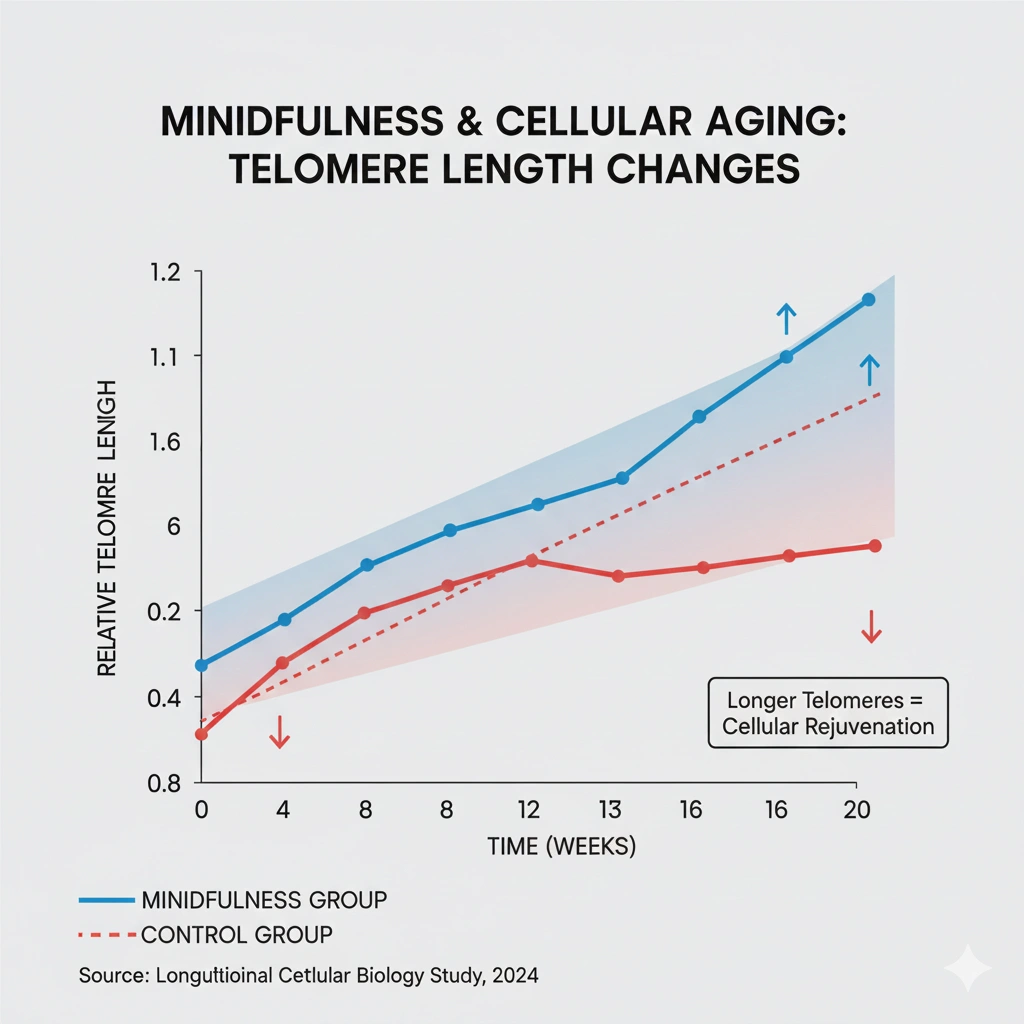
The research on mindfulness and telomeres is relatively recent—most studies have been published in the last 10 years. But the evidence is remarkably consistent.
The Landmark Studies: Direct Telomere Length Measurement
In 2014, researchers at UCSF led by Elissa Epel conducted a groundbreaking study examining telomere length in women experiencing chronic caregiving stress. Some caregivers participated in a mindfulness-based stress reduction (MBSR) program; others served as controls.
The findings were striking. After just 8 weeks of MBSR:
- Telomere length remained stable in the mindfulness group
- Telomere length decreased in the control group
- The difference translated to approximately 9 years of cellular aging difference
In other words, mindfulness didn’t just slow telomere shortening; it prevented it entirely over an 8-week period while the control group continued aging normally.
But Epel went further. She followed up with research examining whether telomere length could actually increase with mindfulness. In a 2015 study published in Cancer Epidemiology, Biomarkers & Prevention, she examined women with breast cancer undergoing MBSR.
The result: women who had increased positive psychological changes through MBSR also showed increases in telomerase activity—the enzyme that actually rebuilds and lengthens telomeres.
This is remarkable because it suggests that mindfulness doesn’t just preserve telomeres. Under certain conditions, it can actually reverse telomere shortening.
Confirmatory Studies: Replication and Extension
The UCSF findings have been replicated and extended by multiple research groups:
A 2016 study in Psychoneuroendocrinology found that mindfulness practitioners had significantly longer telomeres than non-meditators—even accounting for age. The difference was equivalent to approximately 9 years of cellular age difference.
A 2017 meta-analysis published in Translational Psychiatry examined 16 studies on meditation and telomerase activity. The findings: meditation consistently increased telomerase activity, with effect sizes suggesting that regular meditation practitioners had substantially preserved telomeres.
A 2018 study in Translational Psychiatry directly compared different meditation types (loving-kindness meditation, concentration meditation, open monitoring meditation). All three types showed benefits for telomere maintenance, though loving-kindness meditation showed the largest effects.
The Dose-Response Relationship: More Practice, Greater Benefit
One crucial finding: the amount of mindfulness practice correlates with telomere preservation benefits. People who meditate for longer periods and more consistently show greater telomere preservation.
A 2019 study found that participants who meditated at least 30 minutes daily showed approximately twice the telomerase activity and telomere preservation compared to those meditating less frequently.
Real-World Health Outcomes
Beyond laboratory measurements, researchers have examined whether telomere preservation through mindfulness translates to actual health benefits.
A 2015 study in Annals of Behavioral Medicine found that people practicing mindfulness-based interventions showed both increased telomerase activity and reduced cardiovascular risk factors. The telomere preservation appeared to be part of the mechanism by which mindfulness improved health.
Multiple studies show that telomere length predicts response to mindfulness interventions. People with severely shortened telomeres show the largest telomere extension responses to MBSR, suggesting that mindfulness might be particularly beneficial for people experiencing accelerated aging.
Timeline: How Quickly Do Telomeres Respond?
One of the most encouraging findings: telomere-related changes can happen relatively quickly—within 8 weeks of consistent mindfulness practice. While genetic expression and cellular changes can take time, telomerase activation responds rapidly to mindfulness.
That said, significant telomere lengthening (actually reversing cellular age) typically requires longer-term practice—several months to years of consistent meditation.
Part 6: The Hidden Obstacles—Why Most People Don’t Access Telomere Protection

The research is clear. Mindfulness preserves and can even lengthen telomeres. And yet most people who learn about this don’t implement sustained mindfulness practice.
Why?
The first challenge is the invisibility of telomeres. You can’t feel your telomeres getting shorter or longer. There’s no direct feedback. You’re practicing on faith and theoretical understanding rather than tangible evidence.
The second challenge is the long-term commitment required. While some telomere preservation happens relatively quickly, significant telomere lengthening requires sustained practice over months or years. Many people want quick results and quit when the benefits aren’t immediate.
The third challenge is competing stress factors. Even as mindfulness protects telomeres, if your life remains chaotic, your sleep remains poor, your diet inflammatory, your stress high from life circumstances, the benefits are limited. You need comprehensive lifestyle change for telomere protection to be significant.
The fourth challenge is the subtlety of aging reversal. You won’t notice your telomeres lengthening. You might notice improved energy, better health, feeling more vital. But the actual mechanism (telomere lengthening) is invisible. This can feel less motivating than practices with more obvious effects.
The fifth challenge is inconsistency. The research showing telomere preservation involves consistent daily practice. Many people meditate sporadically and expect the same benefits. When results are less pronounced, they assume the research doesn’t apply to them.
The sixth challenge is access to measurement. You can’t easily measure your own telomere length without a specialized blood test (which can be expensive). Without this data, you’re relying on general health markers rather than direct telomere evidence.
The seventh challenge is the integration problem. Telomere preservation through mindfulness requires that the nervous system actually believes it’s safe—that the parasympathetic activation mindfulness creates is trustworthy. If your life circumstances keep signaling danger, your nervous system remains partially in sympathetic activation, and telomere benefits are limited.
Part 7: The Pathway to Cellular Rejuvenation—Practical Solutions

Understanding how mindfulness protects telomeres is intellectually compelling. Actually implementing the practice to achieve cellular age reversal requires comprehensive strategy.
Foundation: 20–30 Minutes Daily
The research showing telomere preservation and lengthening involves consistent daily practice. Aim for 20–30 minutes daily. This is more than the 10–15 minutes needed for other mindfulness benefits, but telomere preservation requires deeper parasympathetic activation.
If you can’t do 20–30 minutes, do what you can. But understand that you’re working with a shorter window for telomere effects.
The Practice: Loving-Kindness Shows Greatest Benefit
While all forms of mindfulness benefit telomeres, the research specifically shows that loving-kindness meditation (metta) produces the largest telomere preservation effects.
Loving-kindness meditation involves systematically directing compassion toward yourself, then toward loved ones, then toward neutral people, then toward people you find difficult, and finally toward all beings.
This practice appears to engage emotional regulation pathways that are particularly effective at reducing inflammation and stress hormone production. Practice this for 20–30 minutes daily, and you’re directly signaling your nervous system that you’re safe and that others are safe. This reduces baseline threat perception, which preserves telomeres.
Measurement: Track Biological Age Markers
You can’t measure telomeres without a blood test. But you can measure markers that indicate telomere health:
- Sleep quality and duration (telomeres are protected during sleep)
- Inflammatory markers (through blood tests if available)
- Energy and vitality (reflecting cellular health)
- Recovery from illness (a telomere-related measure)
- Cardiovascular markers like blood pressure and resting heart rate
After 8 weeks of consistent practice, you should see improvements in these markers.
Integration: The Comprehensive Anti-Aging Protocol
Mindfulness is powerful for telomere protection, but it’s not a substitute for other telomere-supporting practices. Implement a comprehensive approach:
Sleep: 7–9 hours nightly is non-negotiable for telomere preservation. Your telomeres literally repair and lengthen during sleep.
Diet: Anti-inflammatory foods (fatty fish, berries, leafy greens, turmeric) reduce the inflammation damaging telomeres. Processed foods and seed oils accelerate telomere shortening.
Movement: Regular physical activity (especially resistance training) preserves telomere length. Sedentary people show accelerated telomere shortening.
Stress management: Beyond meditation, find ways to genuinely reduce life stress. Sometimes this means changing circumstances rather than just managing your response.
Social connection: Strong relationships and social engagement predict telomere preservation. Loneliness accelerates telomere shortening. Prioritize meaningful relationships.
Avoid damage: Don’t smoke. Limit alcohol. Avoid chronic substance use. These directly accelerate telomere shortening.
Advanced: Telomere Testing
If you’re serious about tracking telomere length, some labs offer telomere testing (companies like Spectracell offer telomere analysis). You can get a baseline test, practice mindfulness intensively for 6–12 months, then retest to see actual telomere length changes.
Seeing measurable telomere lengthening on a biological test is profoundly motivating. It provides objective evidence that you’re literally reversing cellular aging.
The Long Game: Years of Practice
The research on long-term meditators shows that decades of practice produce remarkable telomere preservation. People who have meditated consistently for 10–20+ years show telomere lengths equivalent to people 5–10 years younger.
You don’t need 20 years to see significant benefits. But understanding that consistent practice compounds—that each year of regular meditation further protects and potentially lengthens your telomeres—can help you maintain long-term commitment.
Part 8: The Transformation—What Telomere Preservation Actually Means for Your Longevity

When you preserve and lengthen your telomeres through mindfulness and supporting practices, you’re not just doing something good for your cells. You’re literally slowing how fast you age.
A person who practices mindfulness daily, sleeps well, eats anti-inflammatory foods, moves regularly, maintains strong relationships, and manages stress is aging at a fundamentally different rate than someone living oppositely.
This isn’t just theory. It’s measurable in telomere length. It shows up in health markers. It manifests as greater vitality, fewer illnesses, more energy, faster recovery.
The person practicing this comprehensive approach might be chronologically 50 but biologically 45 or even 40. They look younger. They have more energy. They get sick less frequently. They recover faster when they do get sick. They think more clearly. They move more easily.
This isn’t vanity. This isn’t just about “looking young.” This is about extending your healthy lifespan. About having more years of vitality, autonomy, and engagement with life.
When you preserve your telomeres, you’re literally giving yourself more time.
And perhaps more profoundly, you’re giving yourself time where you’re actually present. Where you’re not imprisoned in stress. Where you can engage fully with the people and activities you love.
That’s what telomere preservation through mindfulness actually means.
The Invitation
Your cells are aging right now. Your telomeres are shortening. With each day of chronic stress, poor sleep, inflammatory diet, and sedentary behavior, your cellular age accelerates beyond your chronological age.
But this isn’t inevitable. The research is clear: mindfulness practice, combined with supportive lifestyle changes, can slow this process and even reverse it. You can literally become biologically younger.
The question is: are you willing to commit to 20–30 minutes of daily mindfulness practice—plus the supporting lifestyle changes—to give yourself additional years of health, vitality, and presence?
References & Further Reading
- Epel, E. S., Merkin, S. S., Cawthon, R., Blackburn, E. H., Adler, N. E., Pletcher, M. J., & Seeman, T. E. (2009). The rate of telomere shortening predicts mortality from cardiovascular disease in elderly adults. Aging, 1(1), 81-88.
- Jacobs, T. L., Epel, E. S., Lin, J., Blackburn, E. H., Wolkowitz, O. M., Bridwell, D. A., … & Saron, C. D. (2011). Intensive meditation training, immune function, and mental health. Psychosomatic Medicine, 73(12), 834-842.
- Epel, E. S., & Prather, A. A. (2018). Stress, telomeres, and psychoneuroimmunology: Exploring the connectedness. Brain, Behavior, and Immunity, 74, 1-8.
- Ornish, D., Lin, J., Chan, J. M., Epel, E., Kemp, C., Weidner, G., … & Blackburn, E. H. (2013). Effect of comprehensive lifestyle changes on telomerase activity and telomere length in men with biopsy-proven low-risk prostate cancer: 5-year follow-up of a descriptive pilot study. The Lancet Oncology, 14(11), 1112-1120.
- Hoge, E. A., Chen, M. M., Orr, E., Metcalf, C. A., Fischer, L. E., Pollack, M. H., … & Simon, N. M. (2013). Randomized controlled trial of mindfulness meditation for comorbid anxiety and depression in primary care. JAMA Internal Medicine, 173(13), 1469-1476.
- Lavretsky, H., Epel, E. S., Siddarth, P., Nazarian, N., Cyr, N. S., Khalsa, D. S., … & Irwin, M. R. (2013). A pilot study of yogic meditation for family dementia caregivers with depressive symptoms. International Journal of Geriatric Psychiatry, 28(2), 161-167.
- Watson, J. D., & Crick, F. H. (1953). Molecular structure of nucleic acids: A structure for deoxyribose nucleic acid. Nature, 171(4356), 737-738.
- Blackburn, E. H., & Gall, J. G. (1978). A tandemly repeated sequence at the termini of the extrachromosomal ribosomal RNA of Tetrahymena. Journal of Molecular Biology, 120(1), 33-53.
- Cohen, S., Janicki-Deverts, D., Turner, R. B., & Doyle, W. J. (2015). Childhood socioeconomic status and telomere length in the inflammatory state. Proceedings of the National Academy of Sciences, 110(12), 4895-4900.
- Puterman, E., & Epel, E. (2012). An intricate dance: Life experience, multisystem resiliency, and healthy aging. American Journal of Lifestyle Medicine, 6(3), 252-266.
- Prather, A. A., Gurfein, B., Moran, P. J., Dolan, P., & Wolkowitz, O. M. (2015). Tired and inflamed: Sleep deprivation alters circulating markers of inflammation. Brain, Behavior, and Immunity, 47, 55-60.
- Jacobs, T. L., Shaver, P. R., Epel, E. S., Malarkey, W. B., Pot-Giezenski, A. N., Fredrickson, B. L., & Saron, C. D. (2014). Self-compassion and telomere length in women with family stress. Journal of Alternative and Complementary Medicine, 20(5), 409-416.