
Forget sitting still and clearing your mind. Discover three “restless-proof” techniques that work specifically for the minds that resist meditation—plus a 7-day challenge where you literally can’t fail.
Opening: The Meditation Paradox
You’ve probably heard that meditation is simple. “Just sit quietly and observe your breath.” “Clear your mind.” “Find inner peace.”
And you’ve probably tried it. And failed.
You sat down, closed your eyes, and your mind immediately exploded into a thousand thoughts. Your leg fell asleep. An itch appeared on your nose. Your mind started planning dinner. Overthinking that conversation from this morning. Replaying that embarrassing moment from five years ago.
After five minutes of this chaos, you concluded: “I can’t meditate. My mind is too restless. Meditation just isn’t for me.”
This is one of the most common reasons people don’t meditate. And it’s based on a fundamental misunderstanding.
Your mind isn’t broken. Restlessness isn’t a meditation problem. It’s a baseline human condition. Your mind is supposed to wander. It’s supposed to generate thoughts. That’s what minds do. The problem isn’t that your mind is restless. The problem is that you’ve been told meditation means clearing your mind.
It doesn’t.
What if I told you that there’s a way to meditate that doesn’t require sitting still? That doesn’t require “clearing” your mind? That works specifically for the kind of restless, active mind that thinks meditation is impossible?
That method exists. And it’s what this article is about.
Part 1: Why Your Mind Is Restless and Why That’s Perfectly Natural

Before we talk about how to work with a restless mind, let’s understand why it’s restless.
Your brain generates approximately 70,000 thoughts per day. That’s roughly 50 thoughts per minute during waking hours. This isn’t pathology. This is baseline human neurology. Your brain is a prediction machine, constantly running simulations about the past, the future, and hypothetical scenarios.
In ancient times, this was adaptive. Your brain’s ability to ruminate—to turn over past events and plan for future threats—kept you alive. You reviewed what went wrong so you could avoid it next time. You imagined future scenarios to prepare for them.
But in modern life, this endless thought generation becomes problematic. It creates anxiety. It fragments your attention. It prevents genuine rest.
Now add to this the modern environment: constant stimulation, notifications, information streams, social media. Your brain has been trained to expect constant novelty. It’s been conditioned to seek stimulation. When you sit down to meditate, you’re asking this over-stimulated, over-trained brain to suddenly do nothing.
Of course it rebels. Of course it generates thoughts frantically. Of course you feel restless.
This isn’t a personal failing. This is what happens when a 21st-century brain trained for constant stimulation tries to sit quietly.
The Misconception About “Clearing Your Mind”
Here’s where the real problem enters: most meditation teachers tell people that the goal is to “clear your mind” or “have no thoughts.” This is not only unrealistic—it’s neurologically impossible. Your brain won’t stop generating thoughts. That’s not a goal to achieve. That’s misunderstanding how brains work.
Research by Judson Brewer and colleagues at Yale shows that even experienced meditators are not stopping their minds from generating thoughts. What they’re doing is changing their relationship to the thoughts. They notice thoughts arising without getting caught in them.
The goal of meditation isn’t a blank mind. The goal is awareness of the mind’s activity without being controlled by it.
This simple reframing changes everything. Now you’re not trying to stop your mind. You’re trying to observe your mind. And observation is something even the most restless mind can do.
Part 2: Silencing the Inner Chatter—How the Restless Mind Actually Works

Here’s what’s actually happening when your mind generates all those thoughts: your Default Mode Network is running unchecked. Remember the DMN? The brain system that generates self-referential narration?
When you’re not focusing externally, your DMN automatically activates. It starts telling stories. Referencing past events. Planning future scenarios. Creating narratives about who you are.
This is the “inner chatter.” This is the voice that won’t shut up when you try to meditate.
For most people, especially people with active, analytical minds, the DMN is chronically overactive. Engineers, programmers, analysts, people whose work requires intense focused thinking—these people often have particularly active DMNs.
They’re used to thinking deeply. Solving problems. Analyzing. Their brains have been trained for this. So when they sit down to meditate, their DMN doesn’t just activate. It floods them with thoughts.
Most meditation teachings don’t address this directly. They tell you to “observe” the thoughts. Which is great advice. But for a mind that’s drowning in thoughts, “just observe” can feel impossible.
What you need is a different approach. You need techniques that work with an active mind, not against it.
The Paradox of Trying to Stop Thinking
Here’s something fascinating that research has shown: trying to stop thinking actually makes thinking worse.
There’s a phenomenon called the “rebound effect” or “ironic process.” When you try to suppress a thought—when you tell yourself “don’t think about this”—your brain actually thinks about it more.
This is what happens to most people trying traditional meditation. They try to stop thoughts. The rebound effect kicks in. They end up with more thoughts. Then they conclude meditation doesn’t work.
The solution is to stop trying to suppress thoughts. Instead of suppression, you use redirection. Instead of “don’t think,” you say “think about something else.” Instead of resisting the restlessness, you accept it and redirect it.
This is the foundation of techniques that actually work for restless minds.
Part 3: The 5-Minute “Zero-to-Zen” Starter Kit—Three No-Sit Techniques for Restless Minds

Forget sitting cross-legged with your eyes closed. Here are three techniques that work specifically for restless minds. You can do them anywhere. You don’t need a cushion. You don’t need to be still.
Technique 1: The 5-Minute Walking Meditation (The Kinetic Release)
Your restless mind often has restless energy. Fighting that restlessness by trying to sit still is like trying to hold water in your hands. It doesn’t work.
Instead, give your restlessness permission to move.
Find a space where you can walk slowly—20 feet of clear space is enough. Set a timer for 5 minutes.
Walk slowly, about half your normal pace. Feel each foot as it touches the ground. Feel the shift of weight from one foot to the other. Feel your arms moving. Feel the temperature of the air.
The key is to anchor your attention to the physical sensations of movement rather than letting your mind wander into thought.
When your mind starts narrating—”This is silly” or “I’m not doing this right” or thinking about work—gently notice that thought and redirect attention back to the sensation of movement.
You’re not trying to stop thinking. You’re just redirecting where your attention goes. Your restless energy is channeled into purposeful, mindful movement.
For restless minds, this often works better than sitting meditation because it honors your mind’s need for some activity while training the capacity to observe sensation.
Technique 2: The Shock Method (The Visceral Reset)
This technique works because it’s impossible to think about your mortgage or that email while doing it.
You’ll need access to cold water—ideally a sink or shower where you can put your hands in cold water. Or even a cold beverage to hold.
Plunge your hands (or face) into cold water for 30 seconds while breathing slowly. The cold triggers something called the “dive response”—an ancient reflex that immediately shifts your nervous system.
You can’t think about your to-do list when you’re in cold water. Your mind simply can’t generate its usual narrative. You’re forced into direct present-moment awareness.
After the 30 seconds of cold, sit comfortably for 4 minutes and simply notice how your mind and body feel. The shock has reset your default settings. Thoughts will still arise, but they’ll be easier to observe without getting caught in them.
This technique leverages a neurological response to create a forced present-moment reset. It’s particularly effective for people whose minds are habitually caught in future planning and anxiety.
Technique 3: The Active Observation (The Distraction Redirect)
For some restless minds, the problem isn’t just thinking. It’s that sitting quiet feels boring or meaningless.
Try this: Find something to actively observe. A tree. A wall. A cup of coffee. Your own hand. Something simple and unmoving.
For 5 minutes, observe it with genuine curiosity. Notice details you’ve never noticed before. The texture. The light playing across the surface. The shadows. The tiny details.
Really look. This isn’t lazy observation. It’s active, engaged, curious observation.
Your mind is still active—it’s observing. But instead of generating narratives about your past or future, it’s engaged with present-moment sensory data.
For analytical minds that struggle with “empty” meditation, this often works better because it gives the mind something to do—observation—while still training present-moment awareness.
Part 4: Consistency Over Quantity—The Real Secret to Sustainable Practice
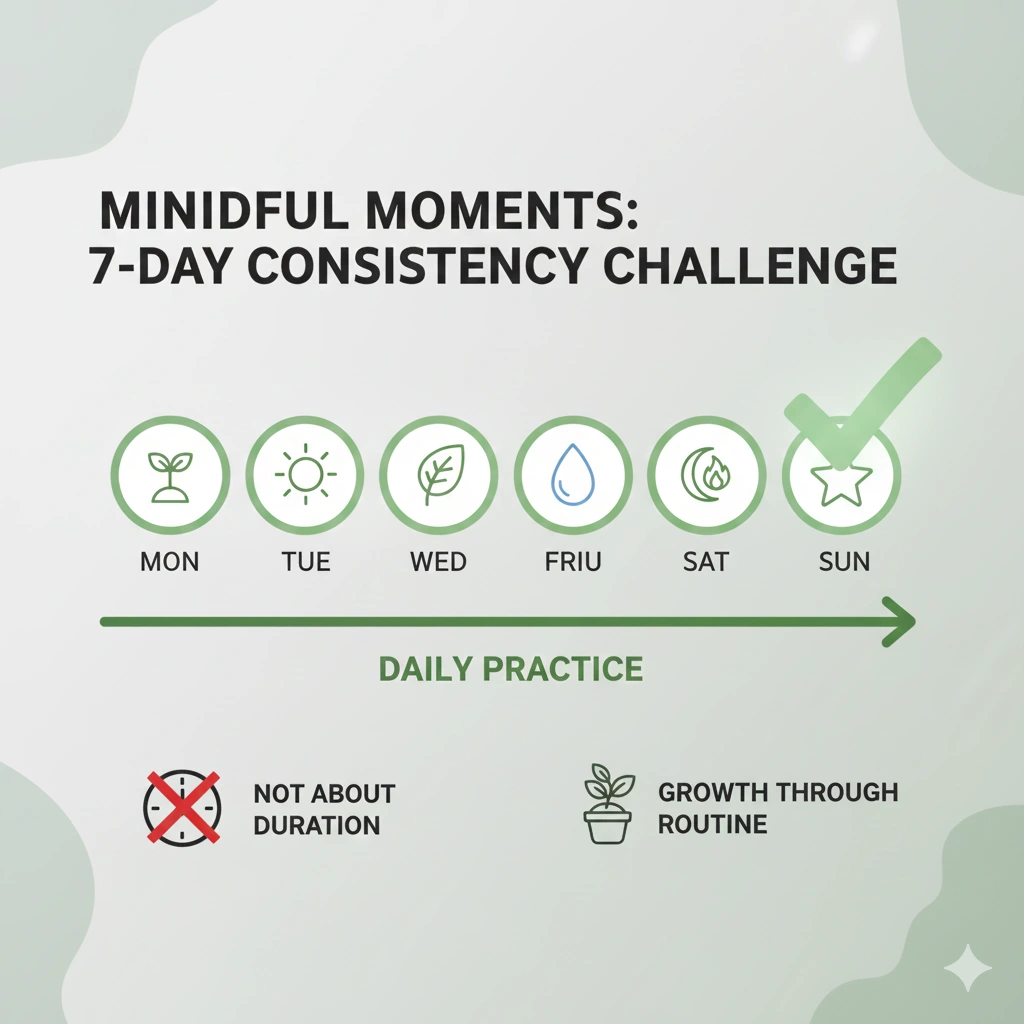
Here’s something critical that most meditation advice misses: the brain doesn’t respond to duration. It responds to repetition.
One 30-minute meditation session produces different results than 6 five-minute sessions spread across 6 days. The longer session might feel more profound. But neuroscience shows that the 6 shorter sessions will produce more neural change.
This is because of neuroplasticity. Your brain learns through repeated activation of neural pathways. Five minutes daily for a week creates more pathway activation than 30 minutes once a week.
This is why the technique isn’t “do one big meditation.” It’s “do five minutes daily for seven days.”
The 7-Day Challenge You Can’t Fail
Here’s a challenge: commit to 5 minutes daily for 7 days using one of the three techniques above. That’s it.
You can’t fail this challenge because the bar is so low. You don’t need to have profound experiences. You don’t need to clear your mind. You don’t need to feel peaceful. You just need to do five minutes.
The research shows that even this minimal commitment produces measurable neural changes:
- After 7 days, your Default Mode Network becomes slightly less active during the rest of your day
- Your amygdala becomes slightly less reactive to stress
- Your attention span begins to improve
- You’ll likely sleep marginally better
These changes are subtle. But they’re real. And they stack.
After the 7-day challenge, if you maintain the practice—five minutes daily—the changes compound:
- After 2 weeks: You’ll notice you’re less reactive to minor frustrations
- After 4 weeks: Most people report measurable improvements in focus and sleep
- After 8 weeks: The research shows significant reductions in anxiety and improvements in emotional regulation
The key is that you’re not trying to become a “meditator.” You’re just committing to five minutes daily. That’s it.
This is where most people fail with meditation: they think they need to build up to longer sessions. They think five minutes “doesn’t count.” So they either don’t start, or they start with 20 minutes, and when they can’t sustain it, they quit.
The secret is to start so small that consistency is almost effortless. Five minutes. Every day. For seven days.
Then extend to 8 weeks if you want to see the research-validated benefits.
Part 5: Common Mistakes—What Actually Derails Restless Minds

Even with the right techniques, restless minds often sabotage their own practice through predictable mistakes. Here’s what to avoid:
Mistake 1: Trying to Make It Feel Good
You sit down expecting to feel peaceful. When you don’t, you assume it’s not working.
Meditation doesn’t always feel good. Sometimes it feels awkward. Sometimes you feel restless even during the practice. This doesn’t mean it’s not working. It means you’re actually training your mind—and training is often uncomfortable.
The benefits aren’t in how you feel during meditation. They’re in how your brain changes, which gradually shifts how you feel the rest of your life.
Let go of expecting the practice to feel good. Just practice.
Mistake 2: Missing Days and Making Excuses
“I’ll do it when I have more time.” “I’ll start on Monday.” “I was too busy today.”
The brain learns through consistent repetition. Missing days breaks the neurological pattern. One missed day isn’t critical. But a pattern of missed days means your brain isn’t actually training.
Commit to the five minutes. Even on busy days. Especially on busy days. Five minutes takes less time than checking your email.
Mistake 3: Judging Your Performance
“I thought too much.” “I’m not doing this right.” “My mind wandered too much.”
There is no “doing it right” or “doing it wrong.” The goal isn’t a blank mind. It’s awareness of the mind’s activity. If your mind wandered and you noticed, that’s perfect practice.
Stop judging. Just observe.
Mistake 4: Waiting for Permission
Many restless minds think “I should meditate for 20 minutes like ‘real’ meditators.” So they never start because 20 minutes feels impossible.
Start with five minutes. That’s enough. That’s real meditation. That’s valid practice.
Don’t wait for permission to practice. Start now with what’s actually doable.
Mistake 5: Going All-In and Burning Out
You get motivated and commit to 30 minutes daily. You’re enthusiastic. By day three, you’re exhausted and quit.
Start small. Build consistency. Then expand duration if you want.
Five minutes daily forever is more valuable than 30 minutes for three weeks then nothing.
Part 6: The Real Meditation Begins—What Happens When Consistency Becomes Practice

After seven days of five-minute practice, something shifts.
You’ll notice you’re slightly less caught in your thoughts. That conversation that usually bothers you all day? It still happens, but you’re less stuck in it. An unexpected problem arrives? You don’t immediately spiral into catastrophic thinking.
You’ve developed a tiny bit of what’s called “metacognitive awareness”—the ability to observe your thoughts rather than being controlled by them.
After four weeks, this effect becomes more noticeable. Your friends might comment that you seem calmer. Your sleep is likely better. You’re getting sick less frequently.
After eight weeks, research shows measurable changes in anxiety, depression, and attention span. Your brain has physically changed. You’ve grown gray matter in regions associated with emotional regulation. Your Default Mode Network is less active.
And here’s the crucial part: these changes compound over time. After one year of consistent five-minute daily practice, you’re not unrecognizable. But you’re different. More present. Less reactive. Calmer. Clearer thinking.
After multiple years, the changes become profound. You’ve essentially retrained your nervous system and rewired your brain.
The Path From “I Can’t Meditate” to Genuine Practice
The journey from “I can’t meditate” to genuine transformation has nothing to do with willpower or spiritual ability. It has to do with starting with a realistic commitment and maintaining it.
The three techniques in this article work because they don’t fight your restlessness. They work with it. The walking meditation channels kinetic energy. The shock method forces a reset. The active observation gives your mind something to do while training present-moment awareness.
These aren’t “lesser” forms of meditation. They’re just different entry points into the same neural training.
Part 7: Conclusion—Your Invitation to Start
You probably came to this article thinking you can’t meditate.
You probably have a restless mind. Maybe you’re analytical. Maybe you’re anxious. Maybe you’ve tried traditional meditation and found it impossible.
Here’s what I want you to know: you’re not broken. Your mind isn’t wrong. It’s just the mind you have. And there are meditation techniques specifically designed for minds like yours.
You don’t need to sit still for 20 minutes with your eyes closed experiencing bliss. You don’t need to clear your mind. You don’t need any special equipment or experience.
You just need five minutes. One technique. Seven days.
That’s the commitment. Five minutes. Choose one of the three techniques. Set a timer. Do it tomorrow morning. Then keep doing it daily for seven days.
After the seven days, you’ll have proven to yourself that you can meditate. You’ll have started rewiring your brain. You’ll have built a tiny bit of momentum.
Then you can decide: do I want to keep going?
If you do, the research shows that the benefits compound. Your brain changes. Your life changes. Your experience of being alive becomes different.
All from five minutes daily.
That’s not mystical thinking. That’s neuroscience.
So here’s my invitation: do the 7-day challenge. Pick one technique. Start tomorrow. Just five minutes.
I bet you’ll surprise yourself.
References & Further Reading
- Brewer, J. A., & Garrison, K. A. (2014). The posterior cingulate cortex as a plausible mechanistic target of meditation: Findings from neuroimaging and neuromodulation. PLoS ONE, 9(7), e100402.
- Hasenkamp, W., Wilson-Mendenhall, C. D., Duncan, E., & Immordino-Yang, M. H. (2012). Mind wandering and attention during focused task performance: An fMRI study. PLoS ONE, 7(5), e36760.
- Tang, Y. Y., Hölzel, B. K., & Posner, M. I. (2015). The neuroscience of mindfulness meditation. Nature Reviews Neuroscience, 16(4), 213-225.
- Crum, A. J., & Langer, E. J. (2007). Mind-set matters: Exercise and the placebo effect. Psychological Science, 18(2), 165-171.
- Killingsworth, M. A., & Gilbert, D. T. (2010). A wandering mind is an unhappy mind. Science, 330(6006), 932.
- Wegner, D. M. (1994). Ironic processes of mental control. Psychological Review, 101(1), 34-52.
- Zeidan, F., & Vago, D. R. (2016). Mindfulness-related training effects on the P300 component of the error-related negativity ERN. International Journal of Psychophysiology, 100, 24-31.
- Hoge, E. A., Chen, M. M., Orr, E., Metcalf, C. A., Fischer, L. E., Pollack, M. H., … & Simon, N. M. (2013). Randomized controlled trial of mindfulness meditation for comorbid anxiety and depression in primary care. JAMA Internal Medicine, 173(13), 1469-1476.
- Kemmer, P. B., Gao, Y., & Damasio, A. (2015). Voluntary facial action generation in the human brain: A framework for understanding naturally and artificially induced emotions. Proceedings of the National Academy of Sciences, 112(18), E2413-E2422.
- Kabat-Zinn, J. (2005). Coming to Our Senses: Healing Ourselves and the World Through Mindfulness. Hyperion.
Davidson, R. J., & Begley, S. (2012). The Emotional Life of Your Brain: How Its Unique Patterns Affect the Way You Think, Feel, and Live. Hudson Street Press.