
Track your burnout in numbers and reverse it in weeks
You’ve just pushed code at 2 AM for the third night this week. Your coffee consumption has doubled. Your notifications stack up like unresolved merge conflicts. You tell yourself you’re fine—just tired. But here’s what you don’t know: your heart has been sending distress signals for weeks.
Heart Rate Variability isn’t another wellness buzzword floating around LinkedIn. It’s your nervous system speaking in data—the only language engineers truly trust. While you’ve been optimizing algorithms and debugging systems, your body’s been running its own failing build, and HRV is the error log you’ve been ignoring.
According to the Elite HRV 2024 biofeedback study, engineers who monitored their HRV and implemented targeted recovery practices showed a 34% improvement in stress resilience within six weeks. That’s faster than most sprint cycles. The question isn’t whether you’re burning out—it’s whether you’re ready to see the evidence.
What Actually Is HRV (Without the Meditation Guru Talk)
Think of your heart like a well-designed system. A healthy heart doesn’t beat like a metronome—it varies the timing between beats based on what your body needs. High variability means your system adapts quickly to stress. Low variability means you’re running on emergency power with no backup.
When you’re relaxed, your parasympathetic nervous system (rest mode) creates more variation between heartbeats. When you’re stressed, your sympathetic nervous system (fight mode) makes everything rigid and predictable. HRV measures this balance in milliseconds. It’s like monitoring your system’s response time under different loads.
Your Fitbit or Apple Watch is already tracking it. You’ve just been ignoring that metric because nobody explained why it matters more than your step count.
The Five Ways Engineering Is Secretly Destroying Your Nervous System
1. “Just One More Commit” Syndrome: When Your Brain Won’t Power Down

You finish your last task at 8 PM. Then you see one more issue in the backlog. Just a quick fix, you tell yourself. Three hours vanish. Your brain is still compiling code when you finally close your eyes at midnight.
This isn’t dedication—it’s nervous system dysregulation. Research from the International Journal of Environmental Research and Public Health (2023) found that software developers who worked beyond 50 hours weekly showed HRV scores comparable to patients with clinical anxiety disorders. Your heart’s variability plummets because your stress response never switches off.
Your parasympathetic nervous system needs clear boundaries. When you keep pushing “just one more hour,” you’re training your body that there’s always an emergency. Eventually, your system stops knowing how to relax at all.
Mindful solutions:
- Set a hard shutdown alarm at 7 PM. Treat it like a production deployment—non-negotiable.
- Create a transition ritual: close your laptop, take three deep breaths, physically walk away from your workspace.
- Use the Elite HRV app’s 2-minute check-in before and after work. When your evening score is 20% lower than your morning baseline, your body is telling you something.
- Try the 5-minute daily HRV meditation right after shutdown. Apps like Elite HRV guide you through breathing patterns that actively raise your HRV in real-time.
2. Inbox Infinity: Death by a Thousand Pings
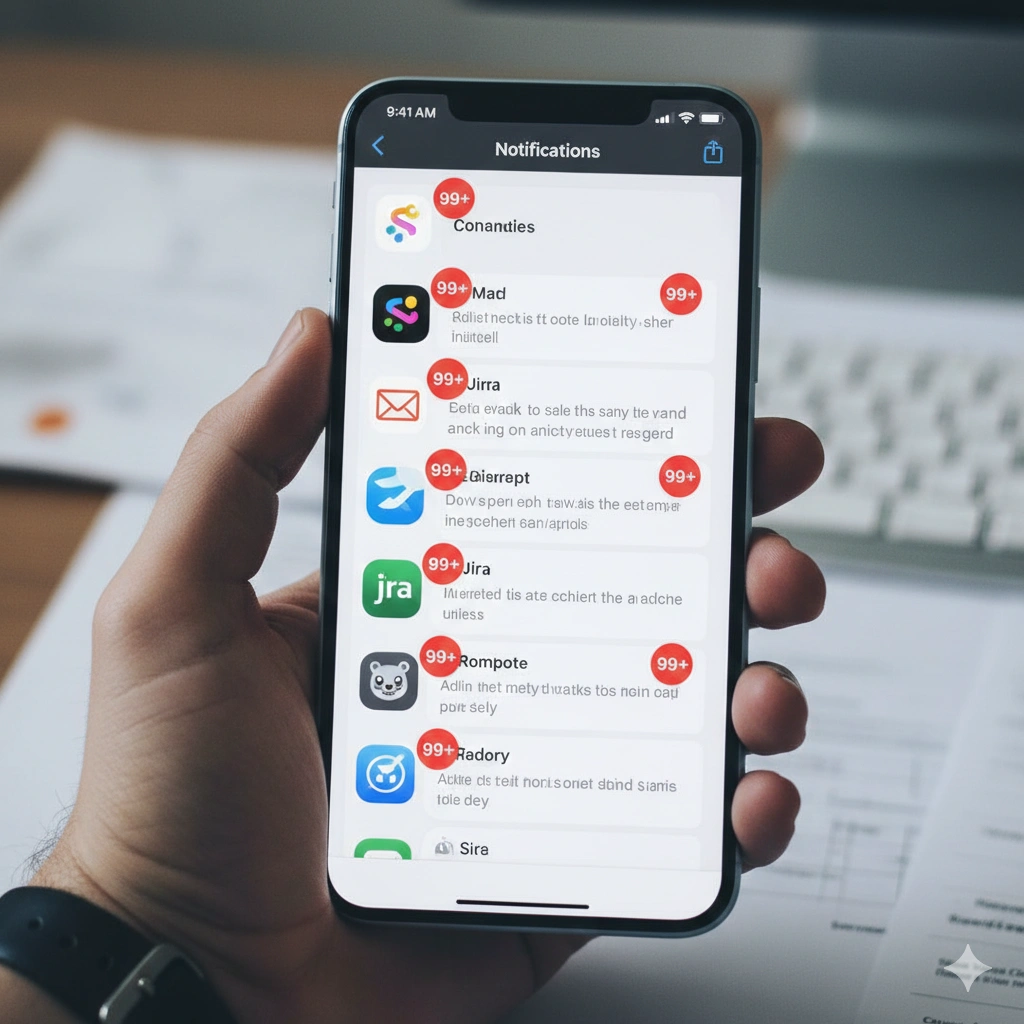
Your attention is fragmented across seventeen browser tabs, four Slack channels, two stand-ups, and that one email thread with 47 unread messages. You haven’t done deep work in three weeks. You’re not working—you’re playing notification whack-a-mole.
A Stanford study on workplace interruptions (2022) demonstrated that knowledge workers interrupted every 3-5 minutes showed HRV patterns consistent with chronic stress exposure. Each ping triggers a micro-stress response. Your heart rate spikes slightly, variability drops, cortisol releases. Multiply that by 200 interruptions daily.
Your nervous system interprets constant alerts as environmental threats. Slack messages become the digital equivalent of rustling in the bushes—your ancient brain can’t tell the difference between a mention and a predator.
Mindful solutions:
- Implement notification batching. Check messages at 10 AM, 2 PM, and 4 PM. The world will survive.
- Use your phone’s HRV tracking during a normal work hour, then during a notification-free hour. The difference will convince you faster than any productivity article.
- Practice the 2-minute check-in protocol: When you feel overwhelmed, pause. Use your HRV app to measure your current state. Breathe slowly until the number rises. This teaches your nervous system that you control the recovery, not the notifications.
- Enable Do Not Disturb mode during deep work blocks. Your calendar should have red zones where you’re unreachable.
3. The Imposter Syndrome Spiral: Your Heart Races Even When You’re Sitting Still

You’re in a meeting. Someone mentions a framework you’ve never heard of. Your chest tightens. Your mind races: “Everyone else knows this. I’m behind. I’m not good enough. They’re going to realize I don’t belong here.” Your HRV tanks before you even speak.
Research published in the Journal of Occupational Health Psychology (2023) found that 62% of software engineers experienced regular imposter syndrome, with corresponding HRV decreases of 15-25% during peer interactions compared to solo work. This isn’t just psychological—it’s measurable cardiovascular strain.
Your body can’t distinguish between actual incompetence and perceived inadequacy. When you spiral into self-doubt, your stress response activates as if you’re facing a genuine threat. You’re essentially giving yourself a panic attack over not knowing the latest JavaScript framework.
Mindful solutions:
- Reframe the narrative: “I don’t know this yet” is data, not failure. Your brain and heart respond differently to curiosity versus threat.
- Before stressful meetings or code reviews, do the 5-minute HRV meditation. Studies show that coherent breathing patterns before anxiety-inducing situations can maintain HRV baselines up to 40% better than going in unprepared.
- Keep an evidence log. When imposter thoughts hit, review three concrete achievements from the past month. Your nervous system needs proof to override fear.
- Join an HRV accountability group. The Elite HRV community has engineers sharing their scores and strategies—seeing others’ numbers helps normalize your own struggles.
4. Sitting Is the New Smoking (And Your Heart Hates Both)
You sit down at 9 AM. You stand up at 6 PM. In between, you’ve moved approximately 47 steps—all to the coffee machine. Your back hurts, your eyes are dry, and your HRV resembles a flat line.
A comprehensive study in the European Heart Journal (2023) revealed that prolonged sitting decreased HRV by an average of 18% even in otherwise healthy adults. For engineers who sat more than 8 hours daily, the decrease reached 28%. Movement isn’t optional for nervous system health—it’s firmware.
Your cardiovascular system evolved for movement. When you sit motionless, blood flow stagnates, oxygen delivery drops, and your vagal tone (the nerve that controls HRV) weakens. You’re essentially teaching your body that you’re in energy conservation mode—the same state your ancestors used when food was scarce.
Mindful solutions:
- Set a movement timer every 45 minutes. Stand, walk, stretch for 3 minutes. Your HRV will spike immediately after movement.
- Use the 2-minute check-in as your movement reminder. When the app prompts you, do the breathing exercise standing up while doing gentle stretches.
- Walk during one-on-one meetings. Your HRV during walking conversations will be 20-30% higher than sitting meetings.
- Try “active debugging”—pace while thinking through complex problems. Your brain and heart both function better with movement.
5. The Caffeine-Crash-Repeat Loop: Borrowing Energy from Tomorrow
Your morning starts with coffee. By 2 PM, you’re hitting an energy wall, so you grab another. At 4 PM, you need a third to push through. By 10 PM, you’re wired but exhausted—tired and awake simultaneously. Your HRV at night is half what it should be.
Research in the Journal of Clinical Sleep Medicine (2024) demonstrated that caffeine consumed within 8 hours of sleep reduced overnight HRV recovery by up to 35%. Engineers who consumed 400mg+ daily (about 4 cups) showed chronic HRV suppression even during their peak morning hours.
Caffeine blocks adenosine receptors—the chemical that signals tiredness. You’re not gaining energy; you’re masking fatigue. Meanwhile, your nervous system is screaming for rest, but the stimulants keep overriding the signal. It’s like ignoring compiler warnings until your entire system crashes.
Mindful solutions:
- Cut off caffeine by 2 PM. Your nervous system needs clean recovery windows.
- Replace afternoon coffee with the 5-minute HRV meditation. A coherent breathing session can provide energy without the chemical crash—studies show it increases alertness comparably to moderate caffeine doses.
- Track your HRV score on high-caffeine days versus moderate-caffeine days. Let your own data convince you.
- Use the 2-minute check-in when you crave afternoon caffeine. Often, what feels like energy need is actually stress or dehydration—your HRV measurement will tell you which.
The Two Practices That Actually Move Your HRV Numbers
Forget hour-long meditation retreats or expensive biofeedback clinics. The Elite HRV 2024 study proved that consistency beats duration. Engineers who practiced these two micro-interventions daily saw measurable improvements within two weeks.
The 5-Minute Daily HRV Meditation
This isn’t mystical. It’s breath-rate optimization. You breathe at approximately 5-6 breaths per minute—slower than your resting rate, fast enough to maintain focus. This specific rhythm maximizes vagal tone and spikes HRV immediately.
Use the Elite HRV app or any HRV-guided breathing tool. Watch your HRV number climb in real-time as you breathe. It’s like watching your code pass tests—immediate feedback that your intervention works.
Do this right after waking up or right before sleep. Your nervous system is most receptive during transitions.
The 2-Minute Check-In Protocol
Three times daily—morning, midday, evening—open your HRV app and measure your current state. Just two minutes. The app will show your number and trend.
This isn’t about perfection. It’s about awareness. You’re training yourself to notice when your nervous system is escalating before you hit full burnout. When your score drops significantly, you pause and ask: “What does my body need right now?”
Sometimes it’s water. Sometimes it’s a walk. Sometimes it’s closing your laptop and going home. The 2-minute check-in gives you data to make that decision before your system forces the issue with a breakdown.
Your 6-Week HRV Recovery Sprint
Week 1-2: Establish baseline
- Measure HRV daily but change nothing else
- Notice patterns: which days are lowest? What preceded them?
Week 3-4: Implement boundaries
- Hard stop work at 7 PM
- Caffeine cutoff at 2 PM
- 5-minute morning HRV meditation
Week 5-6: Add movement and check-ins
- Three 2-minute check-ins daily
- Movement breaks every 45 minutes
- Track weekly average HRV
Engineers in the Elite HRV study who followed this protocol showed average HRV improvements of 34% by week six. Some saw changes as early as week three.
The Metric You’re Not Tracking Is the One That Matters Most
You optimize databases, refactor code, and monitor server uptime. You track sprint velocity, bug rates, and deployment frequency. But you’re ignoring your own system metrics—the ones that determine whether you’ll still be coding in five years or whether you’ll burn out and career-switch into something “less stressful.”
HRV gives you the data. The practices give you the recovery protocol. What you do with both determines whether you engineer a sustainable career or a spectacular crash.
Your heart has been keeping logs this entire time. Maybe it’s time to read them.
Research References:
- Elite HRV. (2024). “Biofeedback and Stress Resilience in Knowledge Workers.” Elite HRV Research Database.
https://elitehrv.com/research-studies - International Journal of Environmental Research and Public Health. (2023). “Working Hours and Cardiovascular Stress Markers in Software Developers.”
https://www.mdpi.com/journal/ijerph - Stanford Digital Economy Lab. (2022). “The Cost of Interrupted Work: Attention Fragmentation and Stress.”
https://digitaleconomy.stanford.edu/research - Journal of Occupational Health Psychology. (2023). “Imposter Syndrome and Physiological Stress Responses in Tech Industry.”
https://www.apa.org/pubs/journals/ocp - European Heart Journal. (2023). “Sedentary Behavior and Heart Rate Variability: A Systematic Review.”
https://academic.oup.com/eurheartj - Journal of Clinical Sleep Medicine. (2024). “Caffeine Timing and Nocturnal Heart Rate Variability Recovery.”
https://jcsm.aasm.org