
One year in juku, family shame if you fail again
The clock reads 2 AM. You’re sitting in a cramped prep school classroom in Tokyo, surrounded by 80 other faces that mirror your own exhaustion. Outside, the neon signs of Shibuya still glow, but you haven’t seen them in daylight for months. You failed the Todai entrance exam once. This is your ronin year—your year as a “masterless samurai,” your year to redeem yourself or become a cautionary tale.
And the weight of that reality is crushing you slowly, day by day.
Welcome to the world of Japanese ronin students, where approximately 100,000 young people each year enter a liminal space between failure and hope, spending 12-16 hours daily in preparation schools called juku, haunted by one question: “What if I fail again?”
The statistics paint a devastating picture. Research reveals that 57.9% of ronin students experience symptoms of depression, with 19.8% suffering from severe depression. More than 40% report chronic physical symptoms including headaches, stomach pain, and persistent fatigue. This isn’t just academic pressure—it’s a mental health crisis hiding in plain sight.
Research Reference
The Ronin Reality: Five Daily Struggles That Define the Year of Second Chances
1. “The Masterless Samurai Complex” — Living in Identity Limbo
The Reality
You’re not a high school student anymore. You’re not a university student yet. You’re ronin—literally translated as a samurai without a master. In modern Japan, this means you exist in a social void.
When relatives ask at family gatherings, “Which university do you attend?” the silence that follows your explanation echoes louder than any answer. You’re 19 years old, and your entire identity has become defined by what you failed to achieve.
The cultural weight of the term “ronin” carries centuries of shame. Historically, masterless samurai were seen as failures, wanderers who lost their purpose. That stigma hasn’t disappeared—it’s just been transferred to educational failure.
The Toll
You develop what psychologists call “liminal depression”—the sense that your life is on pause while everyone else moves forward. Friends are starting university, posting photos of campus life and club activities. You’re memorizing vocabulary lists in the same classroom you’ve sat in for 300 days straight. Your sense of self becomes inseparable from your academic status. The question “who am I?” has only one answer: “someone who failed.”
Mindful Solutions
- 3-Minute “Ronin Resilience” Visualization: Close your eyes. Imagine yourself as that historical ronin, not as a failure, but as someone between chapters. Ronin samurai often became great teachers, artists, and innovators precisely because they stepped outside rigid structures. Breathe deeply and repeat: “I am not failing. I am preparing. This pause is not punishment—it’s preparation.” Visualize yourself one year from now, having passed, looking back on this time as the crucible that forged your resilience.
- Weekly “identity anchoring”: Write down three things about yourself that have nothing to do with academics. A quality you admire in yourself. A way you help others. A passion that existed before exams consumed your life. Read this list every morning before juku.
- Reframe “ronin” as transformation: Japanese history is full of ronin who became legendary—Miyamoto Musashi, for instance. Your ronin year isn’t a void; it’s an initiation. You’re learning discipline, perseverance, and self-knowledge that your peers who passed immediately will never develop.

Research Reference
2. “The 16-Hour Groundhog Day” — When Every Day is the Same Crushing Routine
The Reality
Your juku schedule reads like a prison sentence. 7 AM wake-up. Study until noon. Quick lunch. Study until 6 PM. Brief dinner. Evening lectures until 10 PM. Review notes until midnight. Sleep. Repeat. 365 days.
The Japanese entrance exam system is merciless: one day, one test, one chance per year. Unlike Western systems where you can apply to multiple universities, Japanese ronin students typically focus on retaking the exam for the same institution they failed to enter. There’s no backup plan. There’s only this year, this juku, this endless repetition.
Time loses meaning. Winter becomes spring becomes summer becomes fall, but your world remains unchanged: the same classroom, the same fluorescent lights, the same practice tests. Your life contracts to a single point: February’s exam day.
The Toll
Chronic monotony creates what researchers call “learned helplessness”—the brain begins to believe that nothing you do matters, that you’re trapped in an unchangeable loop. Depression isn’t just about sadness; it’s about the absence of hope, the inability to imagine a different future. Physical symptoms multiply: your sleep schedule deteriorates, your appetite vanishes, headaches become constant companions.
Mindful Solutions
- 2-Minute “micro-variation practice”: Before each study session, change one small thing. Sit in a different position. Light a different scent of incense. Play one song you love. These tiny variations tell your brain: “Life is not frozen. Change is possible.”
- Weekly “joy appointment”: Schedule one hour per week—non-negotiable—for something that brings you pleasure unrelated to studying. A walk in a park. A conversation with a friend. A hobby you’ve abandoned. This isn’t “wasting time”; it’s preserving your humanity.
- Evening “transition ritual”: When you finish studying for the day, don’t collapse immediately into sleep. Spend 5 minutes doing something that signals “transition”—stretch, write one sentence about your day, make tea. This helps your brain recognize that life has phases, not just endless sameness.

3. “When Your Parents’ Dreams Become Your Nightmare” — The Unbearable Weight of Family Expectations
The Reality
Your parents didn’t just pay for juku. They restructured their entire lives around your second attempt. Your mother quit her part-time job to prepare your meals and ensure you focus only on studying. Your father works overtime to afford the juku fees (often costing ¥800,000-1,000,000 per year). Your younger siblings walk on eggshells around you.
Research shows that having parents who disagree about your first-choice university is an independent risk factor for severe depression among ronin students. But even when parents agree, their unified pressure can be suffocating. You’re not carrying just your dreams—you’re carrying theirs, plus the financial burden they’ve sacrificed for.
The unspoken message: “We’ve given up so much. You cannot fail again.”
The Toll
You develop what therapists call “achievement-based worth”—you believe love and acceptance are conditional on passing that exam. Every practice test becomes not just academic evaluation but a referendum on whether you deserve your family’s investment. Guilt compounds anxiety. Fear of disappointing them becomes more paralyzing than fear of personal failure.
Mindful Solutions
- 2-Minute “Shame Soothe” Practice: When guilt overwhelms you, place both hands on your heart. Feel the warmth. Say aloud (even whispered): “I am worthy of love regardless of exam results. My parents’ sacrifices come from love, not transaction. I am enough, pass or fail.” Repeat until your heartbeat slows. This counteracts the shame spiral.
- Honest conversation framework: If safe, tell your parents: “I know you’ve sacrificed so much. I’m working as hard as I can. But I need you to know that your love matters more to me than any university admission. If I don’t pass, I need to know we’ll be okay.” This terrifying conversation often reveals that parents fear your suffering more than your “failure.”
- Gratitude with boundaries: Write down three things you’re grateful to your parents for. Then write: “I’m allowed to struggle. I’m allowed to be afraid. I’m allowed to be human.” Holding both truths simultaneously is advanced emotional work, but it prevents resentment and preserves relationships.

Research Reference
High Risk, No Reward: Unpacking Gender Disparities at Japanese Universities
4. “The Somatic Rebellion” — When Your Body Screams What You Can’t Say
The Reality
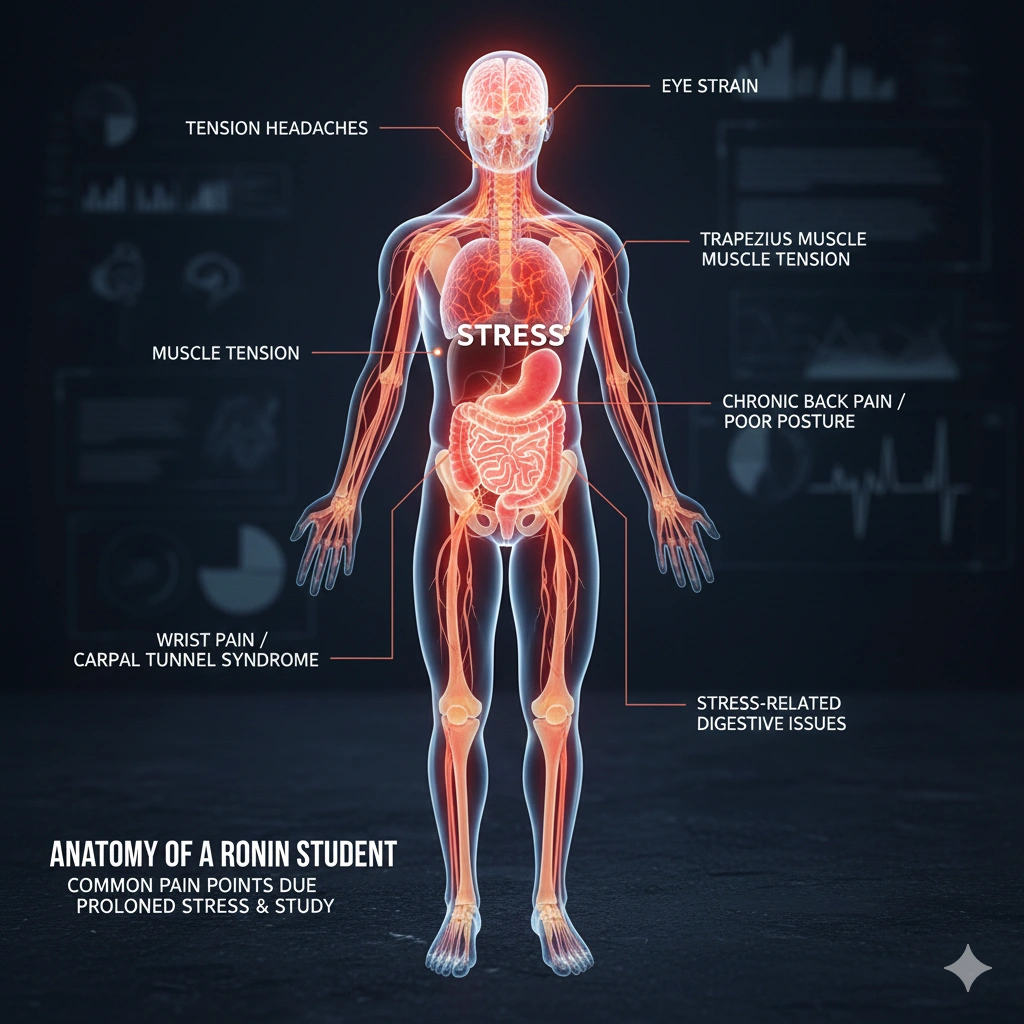
More than 40% of ronin students report persistent headaches. Over 40% suffer chronic stomach pain or digestive issues. Constant fatigue, shoulder pain, and listlessness plague the majority. These aren’t random symptoms—they’re your body’s way of expressing what you can’t articulate.
In Japanese culture, discussing mental health openly carries stigma. But physical complaints are acceptable. So your anxiety manifests as stomachaches before practice tests. Your depression appears as crushing fatigue. Your stress crystallizes into tension headaches that no medication relieves.
Your body is keeping score of the emotional toll, even when you try to ignore it.
The Toll
Chronic physical symptoms create a vicious cycle: pain makes concentration harder, which increases anxiety about studying, which worsens physical symptoms. Sleep deprivation from late-night studying weakens your immune system. Irregular meals from constant studying disrupt your metabolism. Your body becomes another source of failure—it won’t cooperate even when you demand it to.
Mindful Solutions
- 5-Minute “body scan with gratitude”: Lie down. Start at your toes. Instead of looking for pain, thank each body part: “Thank you, feet, for carrying me to juku.” Move upward slowly. “Thank you, stomach, for trying to digest food despite stress.” This shifts from body-as-enemy to body-as-ally.
- “Movement as meditation”: Even 10 minutes of walking outdoors, focusing solely on physical sensations—feet touching ground, air on face—can interrupt the stress-pain cycle. Movement doesn’t have to be exercise; it can be gentle, intentional presence in your body.
- Strategic rest: When physical symptoms spike, take a 20-minute complete rest (not sleep, not studying—just lying down with eyes closed). This isn’t weakness; it’s strategic recovery. Your brain consolidates learning during rest, making this break actually productive.
5. “The Silent Suffering Society” — No One to Talk To, Nowhere to Turn
The Reality
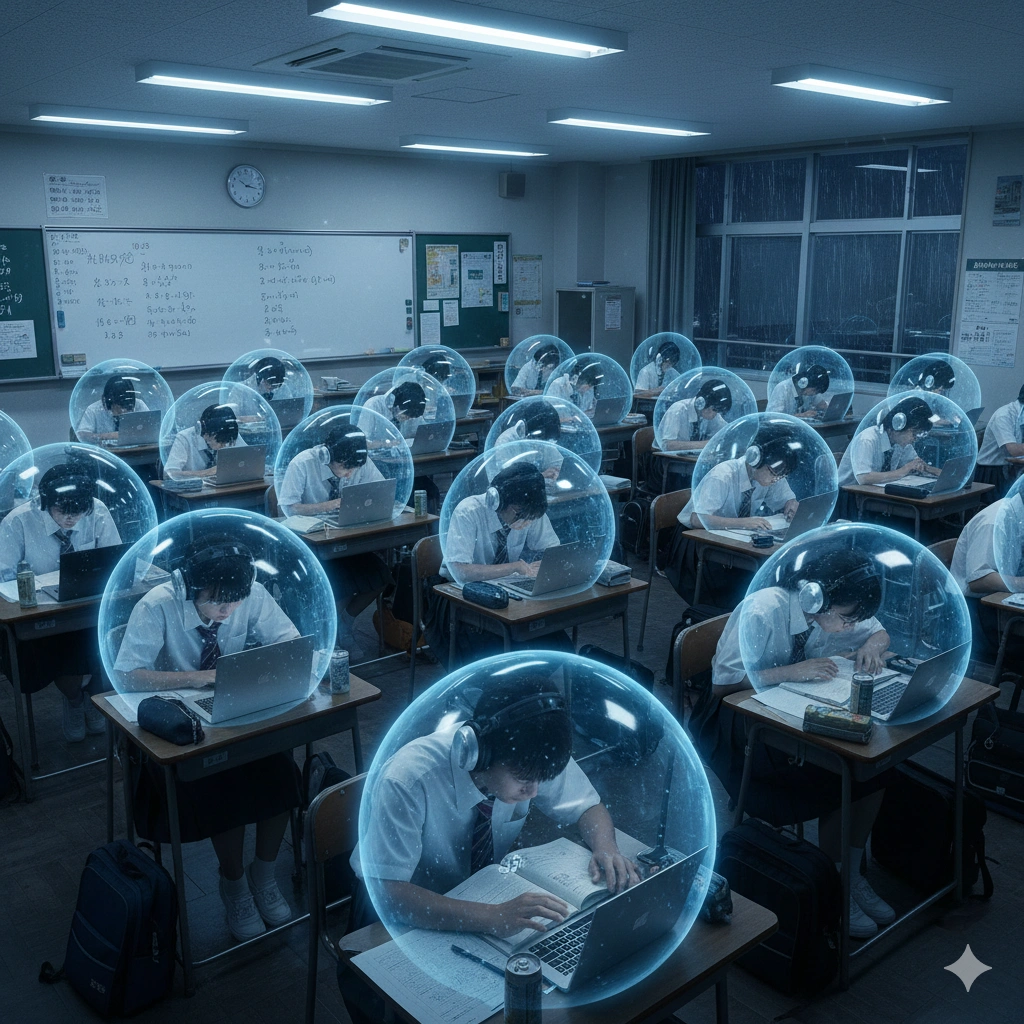
Research identifies “having no one to talk to about worries” as an independent risk factor for depression among ronin students. You’re surrounded by 80 other students in juku every day, but everyone is drowning in their own struggles. There’s no time for friendship, no energy for connection.
You can’t talk to your parents—they’re already sacrificing so much, and you don’t want to add burden. You can’t talk to your former classmates—they’re living university life, and your worlds have diverged. You can’t talk to other ronin—they’re competitors aiming for the same limited slots.
Isolation becomes complete. And in that isolation, dark thoughts grow unchallenged.
The Toll
Social isolation doesn’t just cause loneliness—it fundamentally alters brain chemistry. Without human connection, your brain’s threat-detection system stays hyperactive, treating everything as dangerous. You lose perspective. Small setbacks feel catastrophic. The exam becomes not just an academic challenge but an existential threat, because you’re processing it entirely alone.
Mindful Solutions
- “Scheduled vulnerability”: Once a week, reach out to one person (former classmate, family member, online community) and share one true thing about your experience. Start small: “I’m tired.” This maintains your connection to shared humanity.
- Juku solidarity practice: Before class, make eye contact with one other ronin and offer a small nod—a silent acknowledgment: “I see you. We’re in this together.” Don’t underestimate the power of witnessed struggle.
- Professional support normalization: Many juku now have counselors. Using this service isn’t weakness—it’s strategic mental health maintenance. Think of it like going to a doctor for a physical injury. Your mental health deserves the same care.
Research Reference
Quick Mindfulness Practices for Ronin Students
1. The 3-Minute “Ronin Resilience” Visualization
When: During moments of identity crisis or when comparing yourself to university students
How:
- Find a quiet spot, close your eyes
- Take three deep breaths, counting to 4 on inhale, 6 on exhale
- Imagine yourself as a historical ronin—not as failure, but as transformation
- Picture ronin samurai who became legendary teachers, artists, innovators
- Visualize yourself one year from now, having passed, looking back on this year with pride
- Say silently: “I am not failing. I am preparing. This pause is my power.”
- Open your eyes slowly, carrying this reframe forward
Why it works: This practice rewires the shame narrative by recontextualizing ronin status from failure to intentional preparation, activating your prefrontal cortex (planning/identity) rather than your amygdala (fear/shame).
2. The 2-Minute “Shame Soothe” Practice
When: When guilt about family sacrifices or fear of failing again becomes overwhelming
How:
- Stop whatever you’re doing
- Place both hands over your heart
- Feel the warmth and steady beat beneath your palms
- Take slow breaths, imagining warmth spreading from your heart throughout your body
- Say aloud or whisper: “I am worthy of love regardless of results. I am enough as I am.”
- If emotions arise, let them. Breathe through them without judgment.
- Repeat 3-5 times until your heartbeat slows
Why it works: This activates your parasympathetic nervous system while using self-compassion language to interrupt shame spirals. Physical touch (hands on heart) releases oxytocin, countering cortisol from chronic stress.
The Wisdom No One Tells Ronin Students
Here’s what you need to know, even though the juku system will never say it:
Your worth is not determined by Todai or Kyoto University. These institutions are gatekeepers to certain career paths, yes. But they are not gatekeepers to a meaningful life, to happiness, to contribution, or to self-respect.
The skills you’re developing as ronin are remarkable. Discipline. Perseverance in the face of repeated failure. The ability to sit with discomfort. Self-directed learning. These capacities will serve you far longer than any degree.
Failure is not fatal. Japan’s greatest innovators often speak about their failures as turning points. Soichiro Honda failed his engineer job application at Toyota before founding Honda Motors. Masayoshi Son’s path was far from linear. Your ronin year might be the detour that leads you somewhere better than you imagined.
You are allowed to change your mind. If, deep in your soul, you realize Todai isn’t actually what you want—just what you’ve been told to want—that realization is worth more than any acceptance letter. Your authentic path matters more than the prestigious one.
Breaking the Silence: Resources and Next Steps
If you’re reading this and recognizing yourself in these struggles, your awareness itself is courage. Simply admitting “I’m not okay” is a radical act in a culture that demands stoic endurance.
Immediate support resources in Japan:
- TELL Japan (Tokyo English Life Line): 03-5774-0992 – Free, anonymous counseling in multiple languages
- Inochi no Denwa (Lifeline): 0570-783-556 – 24-hour suicide prevention hotline
- Your juku counselor: Most preparation schools now have professional mental health staff. This service exists because administrators know the toll is real.
For more mindfulness practices designed for high-pressure academic situations, visit Mindful Engineer where you’ll find resources on:
- High-Achieving Student Burnout
- Post-Layoff Identity Crisis (surprisingly relevant to ronin identity struggles)
- Job-Hunt Burnout and Staying Human
A Letter to Your Future Self
Years from now, when you look back at your ronin year, what will matter?
Will it be whether you passed or failed? Or will it be how you treated yourself during the hardest year of your young life? Whether you preserved your humanity in a system designed to extract it? Whether you learned that your value exists independently of institutional approval?
The exam will end. February will come and go. The results will arrive. And then what?
You’ll still be you—the person who survived this crucible. The person who got up every morning despite crushing pressure. The person who kept trying when it would have been easier to quit.
That person—the resilient, determined, exhausted, brave person reading this right now—that person is already successful, regardless of what any university decides.
Your ronin year is not your whole story. It’s one chapter. A difficult one, yes. But you are the author, and the story continues far beyond this test.
Write yourself a version worth living.
Final Thought: The Question That Reframes Everything
In Japanese, the character for “crisis” (危機) contains two elements: danger (危) and opportunity (機).
Your ronin year is both. It is dangerous to your mental health, yes. But it is also an opportunity to discover a strength you didn’t know you possessed. To learn that you can survive what you thought would break you. To develop compassion for yourself and others who struggle.
The danger is real. But so is the opportunity.
Which one you focus on doesn’t change the external reality—but it changes everything about how you experience it.
Choose wisely. Choose mindfully. Choose yourself.
Research Sources Cited
- Psychiatry and Clinical Neurosciences – Ronin-Sei Depression Study (2014)
- PubMed – Ronin Student Mental Health Study (2014)
- Harvard Epicenter – Japanese University Gender Disparities (2024)
- GaijinPot Health – Mental Health in Japan (2025)
- Frontiers in Public Health – Japanese Student Mental Health (2024)
- TIME Magazine – Japanese Examination Hell (1982)
- Facts and Details – University Entrance Exams in Japan
- TV Tropes – Tokyo University Cultural Context
- Japan Healthcare Info – Mental Health Resources (2024)
- Interac Network – Mental Health Support Guide (2025)