Algorithm anxiety, hate comments, and the pressure to “stay relevant”
It’s 3 AM. You’re editing your fifth take of the same 15-second intro. The lighting was wrong. Your energy felt off. The algorithm prefers videos under 8 minutes now—or was it over 10? You can’t remember. You haven’t slept properly in six days.
Your last video got 12,000 views. The one before got 120,000. You have no idea what changed. The comments section is a warzone of opinions you didn’t ask for. Someone created a hate thread about you on Reddit. Your brand deal fell through because your engagement rate dropped 2%.
You’re making content for a living, but you’re not living—you’re performing. And the show never ends.
Welcome to creator burnout, the mental health crisis hiding behind ring lights and brand deals.
According to research tracking social media influencer mental health, 78% of creators report experiencing burnout, with 66% stating it directly impacts their mental health. This isn’t just fatigue—it’s a full-scale psychological crisis happening in real-time while the world double-taps and scrolls past.
1. The Algorithm Anxiety: When an Invisible Force Controls Your Income
Or: I Haven’t Slept Because YouTube Changed Something and Won’t Tell Me What
You wake up to check your analytics before you check if you’re still breathing. Your subscriber count is your blood pressure. Your view duration is your pulse. And somewhere, an algorithm you’ll never meet is deciding if you eat this month.
A stunning 65% of creators identify algorithm changes as the single most mentally taxing aspect of their profession. That’s not “most stressful”—that’s “mentally taxing.” The distinction matters. Stress is acute. Mental taxation is cumulative, corrosive, and compounding.
YouTube’s 2024 Impact Report proudly announced that the platform contributed $55 billion to the U.S. GDP while supporting 490,000 jobs. But here’s what they won’t tell you: only 3 million creators are monetized out of millions uploading content. The average creator earns approximately $8,000 annually—and that includes outliers like MrBeast who reportedly made $85 million.
The Research Says
A 2024 study published in the journal Digital Health found a significant association between extended social media use and heightened negative emotions among influencers. The research discovered that those earning less than $10,000 annually from their content experience worse mental health outcomes than higher earners—likely because the work demands remain constant while rewards stay uncertain. The psychological burden of algorithm dependency creates what researchers call “episodic acute stress,” where creators exist in perpetual states of fight-or-flight awaiting the next metrics update.
Research Study
Beyond the filter: Impact of popularity on the mental health of social media influencers
Mindful Solutions
1. The “Analytics Sabbath”
Choose one day per week where analytics don’t exist. No checking views, likes, comments, or subscriber counts. Your worth isn’t data. Your creativity needs rest from measurement.
2. 2-Minute “Like Detox”
When you feel the urge to check metrics, pause. Take two minutes to list three things you created this week that made YOU proud—regardless of performance. Write them down. This recalibrates your internal validation system.
3. Diversification as Mental Health Strategy
Build income streams the algorithm can’t touch—Patreon, courses, consulting, products. The less financially dependent you are on any single platform’s whims, the less power it has over your nervous system.
2. The Content Treadmill: When Your Brain Becomes a Content Factory That Never Closes
Or: I Filmed My Breakdown for Content and It Got More Views Than Anything Else
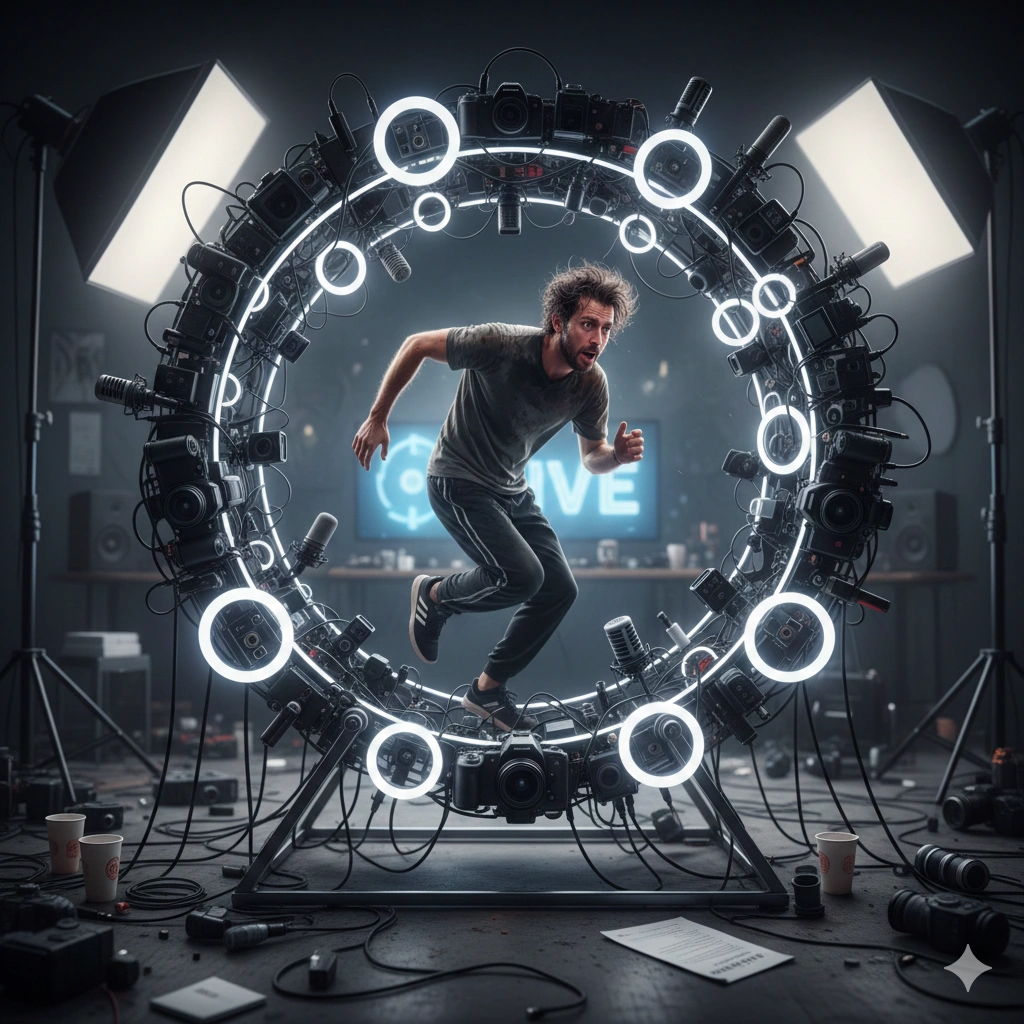
You’re at dinner with friends, but you’re mentally storyboarding how to film it. Your relationship became content. Your mental breakdown became content. Your recovery from burnout became content about burnout.
You can’t turn it off because the algorithm rewards frequency. Miss a week? Your reach plummets. Take a vacation? Your audience “forgets” you exist. The pressure to post regularly isn’t just professional—it’s existential.
Research from the Awin Group surveying over 300 creators found that 71% identify Instagram as the primary platform driving their burnout, with over half reporting significant burnout levels. Meanwhile, 53% admit their passion for content creation has decreased in the past year. You started this because you loved making videos. Now you make videos because the algorithm demands it.
The Research Says: A comprehensive study on influencer burnout published in 2024 examined 161 creators and found that those spending more than five hours daily on social media platforms experienced significantly worse mental health outcomes. The constant demand for regular, high-quality content creates what psychologists call “creative fatigue”—a state where idea generation becomes forced labor rather than inspired expression. The research emphasized that many creators lack clear boundaries between professional and personal life, especially those working from home where workspace and living space blur together.
Research Study
Influencer Burnout Is on the Rise: The Quiet Mental Health Struggles of Content Creators
Mindful Solutions
1. “Batch and Breathe” System
Film multiple pieces of content in dedicated sessions, then schedule release dates. Create separation between production mode and living mode. You’re allowed to exist without documenting.
2. 5-Minute “Content Pause” Ritual
Before creating any content, spend five minutes asking: “Am I creating this because I want to, or because I fear what happens if I don’t?” If the answer is fear, pause. Take the day off. The algorithm can wait.
3. The “Off-Camera” Practice
Dedicate specific activities that are NEVER content. A hobby, a meal, a conversation—something sacred that exists only for you. This preserves your humanity outside the brand.
3. The Comment Section Battlefield: When Strangers’ Opinions Become Your Self-Worth
Or: Someone Called Me “Mid” and I Spiraled for Three Days
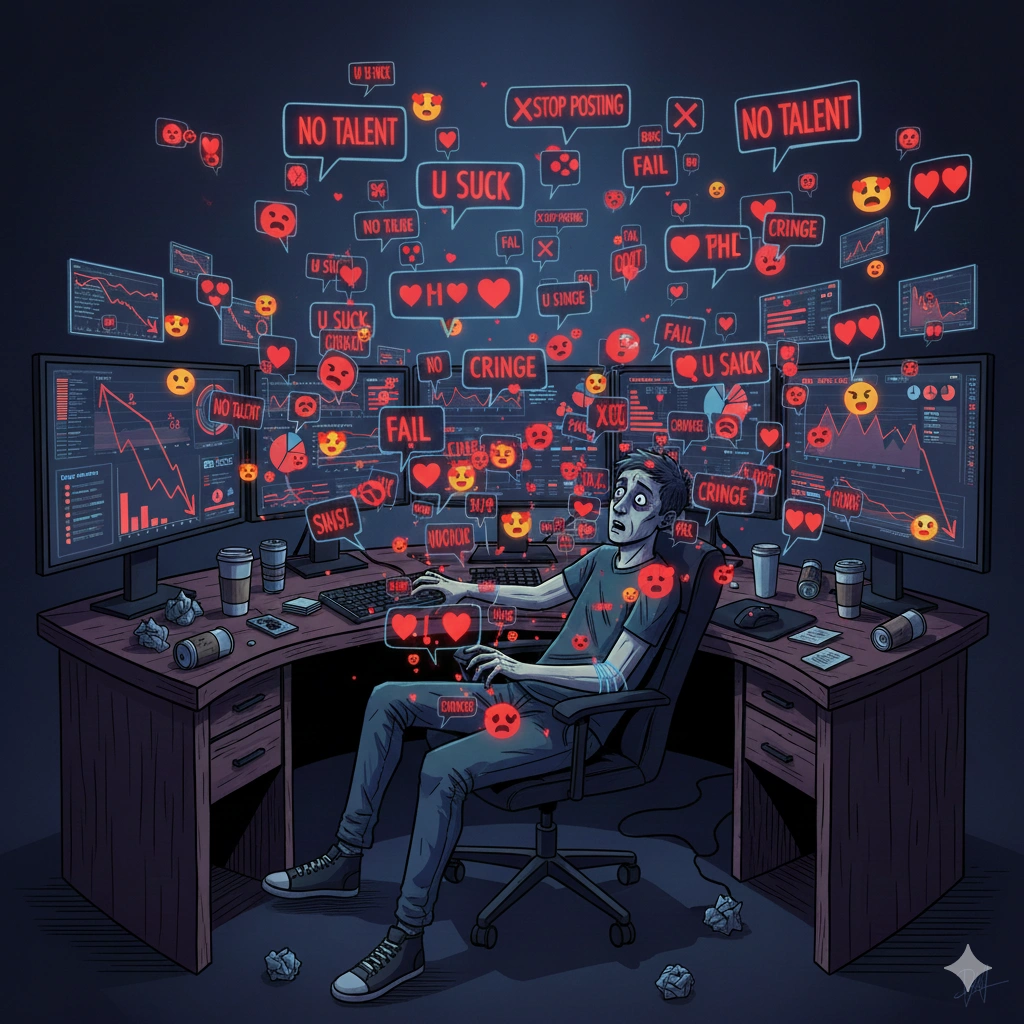
You published a video about your favorite books. Within an hour, someone commented: “This is the most basic take I’ve ever seen.” Another said your voice is annoying. A third created a 10-minute video essay about why you’re “problematic.”
You tell yourself to ignore it. You can’t. You refresh the comments every five minutes. You write responses in your notes app that you never send. You lie awake at 2 AM replaying the criticism, wondering if they’re right.
Here’s the brutal truth: 42% of creators cite hate and online bullying as major contributors to burnout. But the damage isn’t just from direct attacks—it’s from the cumulative weight of existing under constant public judgment.
The Research Says: Research examining the unique stressors of social media influencers found that cyberbullying and constant public scrutiny lead to anxiety, depression, and compromised self-esteem. A 2024 survey revealed that 19% of creators live in fear of backlash and “cancel culture,” knowing that one misstep could destroy years of work. The study emphasized that many influencers develop what psychologists call “online persona disorder”—a disconnect between their authentic self and their public identity, leading to profound feelings of inadequacy and impostor syndrome (reported by 29% of creators).
Research Study
Creator Burnout Is Real. A New Report Uncovers Why
Mindful Solutions
1. The “72-Hour Rule”
Never respond to negative comments immediately. Wait 72 hours. Most criticism that feels devastating in the moment loses power after three days. If it still feels worth addressing, you’ll respond from clarity instead of reactivity.
2. Curate Your Comment Ecosystem
Use moderation tools aggressively. Block, mute, and filter without guilt. Your comment section is your digital home—you decide who gets to speak there.
3. “Ratio Reframe” Practice
For every negative comment you read, intentionally read three positive ones. Your brain’s negativity bias will fixate on criticism—manually override it. Balance isn’t automatic; it’s intentional.
4. The Relevance Panic: When “Staying Visible” Means Losing Yourself
Or: I Changed My Entire Personality Because a Trend Said So
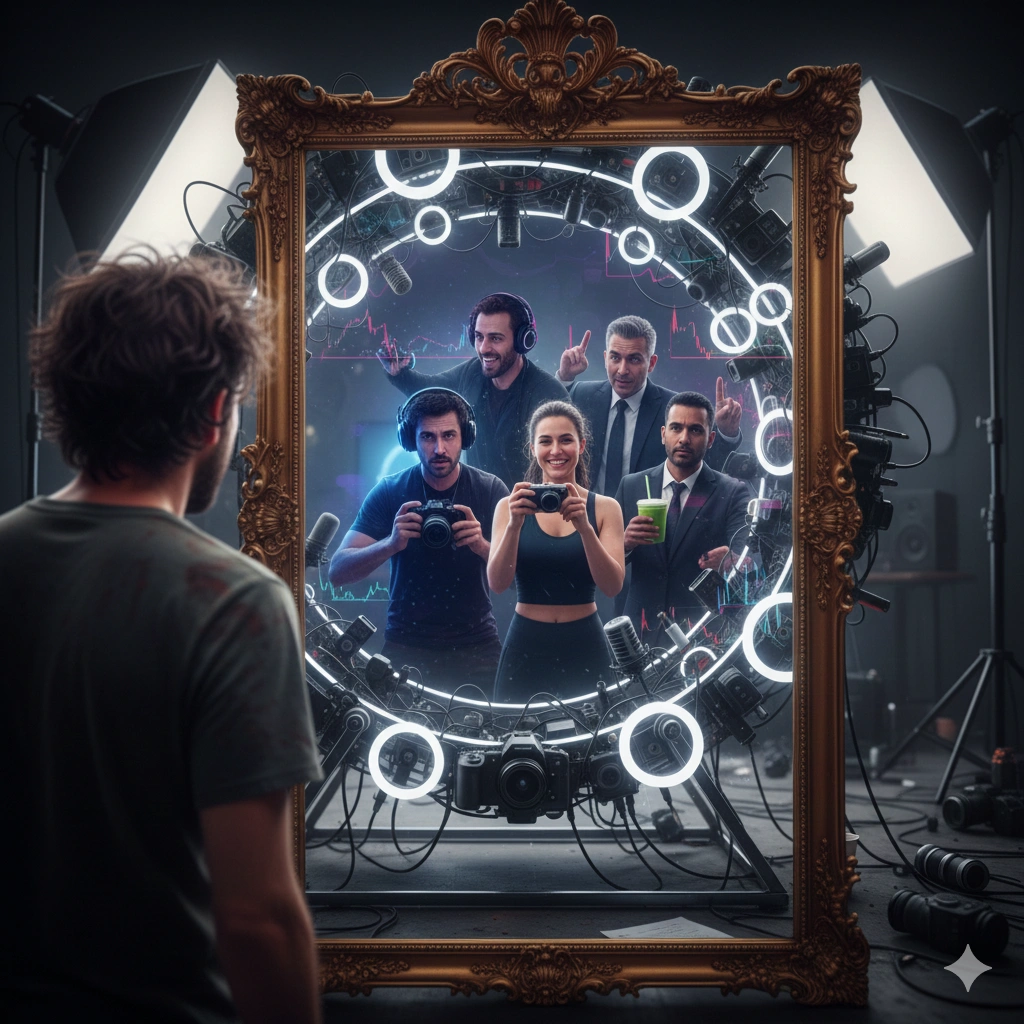
Three months ago, you were a tech reviewer. Then gaming content started performing better, so you pivoted. Then wellness content went viral, so you tried that. Now you’re doing reaction videos to trending topics you don’t care about because that’s what gets views.
You look at your channel and don’t recognize it. Worse, you look at yourself and don’t recognize who you’ve become.
The pressure to stay relevant isn’t just about views—it’s about survival. When your income depends on visibility, and visibility depends on following trends, authenticity becomes a luxury you can’t afford. Or so you think.
The Research Says
A 2024 research study on creator mental health found that 51% of creators report anxiety about constantly generating new ideas and adapting to new platforms. The study revealed that this pressure forces many creators to produce content or adopt behaviors that don’t align with their values—purely to maintain follower counts and engagement. This misalignment between authentic self-expression and algorithmic demands creates cognitive dissonance, where creators experience psychological distress from acting against their own beliefs and interests for professional survival.
Research Study
78% of influencers admit to suffering burnout
Mindful Solutions
1. Define Your “Creative North Star”
Write down the three core themes or values that originally drew you to content creation. Before chasing any trend, ask: “Does this align with my North Star?” If not, skip it—no matter how viral it is.
2. The “Authenticity Audit”
Monthly, review your last 10 pieces of content. How many genuinely excited you? How many felt obligatory? If more than half feel forced, you’re in dangerous territory. Recalibrate.
3. “Slow Growth” Permission Slip
Give yourself permission to grow slowly with integrity rather than rapidly without it. Write this down: “I’d rather have 10,000 engaged followers who know the real me than 100,000 who know a performance.” Believe it.
5. The Loneliness Paradox: When You’re “Connected” to Millions But Isolated from Everyone
Or: I Have 500K Followers and Nobody to Talk To
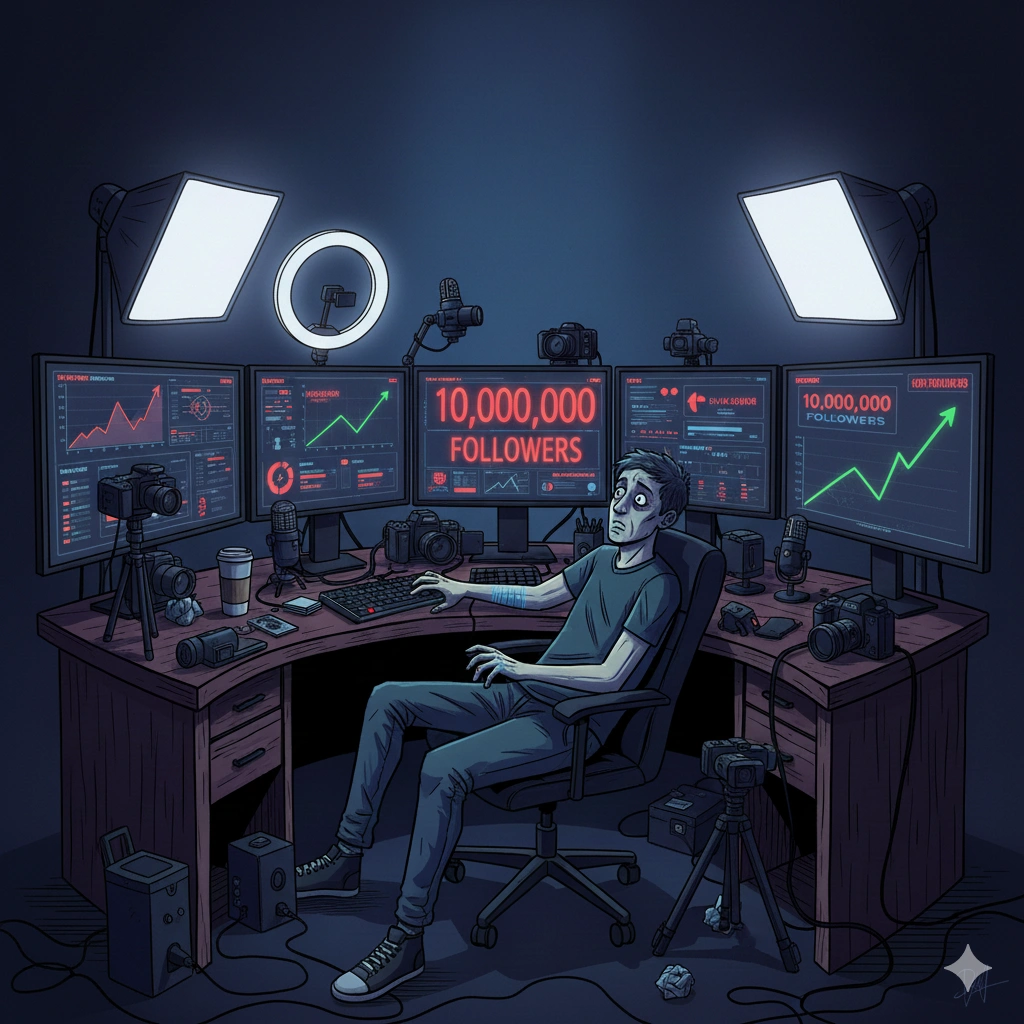
Your DMs are full. Your comments are flooded. You have 500,000 followers across platforms. And you’ve never felt more alone.
Because none of those followers know that you’re struggling. They know your editing skills. They know your on-camera personality. They don’t know that you haven’t left your apartment in four days because filming content exhausted you so completely that existing in public feels impossible.
Content creation is uniquely isolating. You work alone, often from home. Your “colleagues” are competitors. Your “audience” are strangers who feel entitled to your time and energy. And admitting struggle feels like professional suicide because vulnerability might make you seem “less successful.”
The Research Says
CNN’s investigation into YouTube burnout documented how creator isolation compounds mental health challenges. The research found that creators often work without the benefits of traditional employment—no HR departments, paid leave, or health insurance. A significant portion experience what psychologists call “parasocial loneliness”—the phenomenon of being surrounded by people who feel they know you intimately while you remain fundamentally unknown. Studies show this dynamic creates a particularly painful form of isolation where connection is constant but intimacy is absent.
Research Study
YouTube burnout is real. Creators are struggling to cope
Mindful Solutions
1. Build a “Creator Support Circle”
Find 3-5 other creators at similar stages who commit to honest check-ins. Not networking—real support. Share struggles, not just strategies. Vulnerability builds the connections metrics never will.
2. Separate “Creator You” from “Human You”
Create clear boundaries. When the camera’s off, you’re not a brand. Practice saying “I’m off the clock” even to yourself. Your human needs matter more than your content calendar.
3. The “Real Connection Quota”
For every hour you spend creating content “for” your audience, spend 20 minutes in genuine, off-camera connection with real people in your life. Balance parasocial relationships with actual intimacy.
The Numbers Behind the Filters
Let’s talk about what the industry won’t say clearly:
- 78% of content creators experience burnout
- 66% report burnout directly impacting mental health
- 49% rely on alternative income streams to alleviate stress
- 56% acknowledge the pandemic increased burnout levels
- 53% admit their passion for creation has decreased
These aren’t minor concerns—they’re evidence of a systemic crisis in how the creator economy functions.
YouTube contributed $55 billion to the U.S. economy in 2024. But nobody’s measuring the psychological cost.
The Algorithm Doesn’t Care About Your Mental Health
Here’s what you need to understand: platforms optimize for engagement, not wellbeing. Algorithms identify what keeps you scrolling—fear, outrage, comparison—and amplify it. They’re not malicious; they’re amoral. Profit-driven systems with no capacity for compassion.
Research on algorithmic anxiety reveals that AI-driven platforms create feedback loops where emotionally charged content reinforces stress and emotional reactivity. For creators, this means the very systems you depend on for income actively work against your mental health.
The platforms won’t fix this because burnout doesn’t hurt their bottom line. Burned-out creators quit? There are a million more waiting to take their place.
Your recovery is your responsibility—not because it should be, but because it is.
Your 60-to-300 Second Survival Kit
These aren’t productivity hacks. They’re sanity preservers.
The 2-Minute “Like Detox” (Breaking Validation Addiction)
- Feel the urge to check metrics? Stop
- Set a timer for 2 minutes
- List three things you created this week that made YOU proud
- Forget views—what did you actually enjoy making?
- This rewires your brain from external to internal validation
The 5-Minute “Content Pause” (Pre-Creation Reset)
- Before filming/posting anything, pause for 5 minutes
- Ask honestly: “Am I creating this because I want to, or because I fear what happens if I don’t?”
- If the answer is fear, don’t create today
- Give yourself permission to exist without producing
- The algorithm can wait—your mental health can’t
The 3-Minute “Humanity Reclaim” (Daily Off-Camera Practice)
- Choose one daily activity that’s NEVER content
- A meal. A walk. A conversation with loved ones
- For 3 minutes, practice being fully present without documenting
- Notice how it feels to experience life without performing it
- This preserves your human self outside the creator persona
The Uncomfortable Truth About Sustainable Creation
You cannot create content at algorithmic speed indefinitely. The human brain wasn’t designed for it. Your nervous system will eventually revolt.
Here’s what sustainable creation actually looks like:
Quality over frequency. One meaningful video per week beats seven mediocre ones. The algorithm might disagree in the short term. Your mental health will thank you in the long term.
Boundaries aren’t negotiable. Set work hours. Honor them. The content can wait. Your breakdown can’t be scheduled around upload deadlines.
Diversify or die. Build income streams the algorithm can’t touch. Your financial security shouldn’t depend entirely on platforms that could change their minds tomorrow.
Community over audience. Cultivate real relationships with other creators. Support systems matter more than subscriber counts.
Therapy is professional development. If you’re serious about this career, invest in mental health support. It’s not a luxury—it’s infrastructure.
Building Your Support System
Links to Mindful Engineer Resources:
Understanding creator burnout requires looking at similar high-stress professions:
- Job-Hunt Burnout: The Identity Crisis – When your worth depends on external validation
- Caregiver Fatigue: Compassion Burnout – Giving everything until you’re empty
- First Responder Stress: Adrenaline Management – High-pressure performance environments
- High-Achieving Student Burnout – The pressure to constantly perform
These resources offer frameworks for managing professional stress while maintaining humanity.
What the Industry Owes Creators (But Won’t Provide)
Transparency about algorithm changes. Mental health resources. Fair compensation structures. Protection from harassment. Healthcare. Retirement planning.
You won’t get these things by waiting for platforms to develop consciences. You get them by organizing, advocating, and building alternative systems.
The Creator Guild and similar organizations are fighting for creator rights. Join them. Support them. Demand better.
Because the current system is unsustainable—and the industry knows it.
The Question Nobody Wants to Ask
Is this worth it?
Not “can you make money?” Obviously some can. Not “is it possible?” Obviously millions try.
Is it worth your mental health? Your relationships? Your sense of self?
Only you can answer that. But ask honestly.
The Choice at 3 AM
It’s 3 AM again. You’re still editing. Your analytics are still disappointing. The algorithm is still mysterious. The comments section is still brutal.
But this time, you have a choice.
You can keep refreshing metrics, chasing relevance, performing humanity for strangers who’ll never truly know you.
Or you can close your laptop.
You can put your legs up the wall for two minutes.
You can write in your journal for five.
You can remember that you are not your subscriber count, not your engagement rate, not your brand deals or your analytics dashboard.
You are a human being who makes things.
And human beings need rest.
RESEARCH CITATIONS & REFERENCES
- YouTube 2024 US Impact Report – Oxford Economics
- URL: https://blog.youtube/news-and-events/2024-us-youtube-impact-report/
- Key Finding: $55 billion U.S. GDP contribution, 490,000 jobs supported
- Digital Health – Beyond the Filter: Influencer Mental Health Study (2024)
- URL: https://pmc.ncbi.nlm.nih.gov/articles/PMC11504076/
- Key Finding: Significant association between extended social media use and negative emotions
- Awin Group Creator Burnout Survey (2023)
- URL: https://www.awin.com/us/news-and-events/industry-news/creator-burnout-survey
- Key Finding: 78% of creators suffer burnout, 66% report mental health impact
- Bitdefender – Influencer Burnout Research (2024)
- URL: https://www.bitdefender.com/en-us/blog/hotforsecurity/influencer-burnout-is-on-the-rise-the-quiet-mental-health-struggles-of-content-creators
- Key Finding: Influencers spending 5+ hours daily on social media feel significantly worse
- ION – Vibely Creator Burnout Report (2022)
- URL: https://www.ion.co/90-percent-of-content-creators-report-experiencing-burnout-vibely
- Key Finding: 65% cite algorithm changes as most mentally taxing aspect
- Agility PR Solutions – Content Creator Mental Health Survey
- URL: https://www.agilitypr.com/pr-news/public-relations/influencer-inhibitors-4-out-of-5-of-content-creators-are-burnt-out-struggle-with-mental-health/
- Key Finding: 71% identify Instagram as primary burnout driver
- CNN Business – YouTube Creator Burnout Investigation (2019)
- URL: https://www.cnn.com/2019/12/18/tech/youtube-creator-burnout/index.html
- Key Finding: Creators face constant pressure to produce endless content streams
- WIRED – CreatorCare Mental Health Service Launch (2025)
- URL: https://www-wired-com.translate.goog/story/influencer-burnout-mental-health-service-creativecare/
- Key Finding: Creators earning under $10K annually experience worse mental health
- Stanford HAI – Social Media Algorithms and Mental Health
- URL: https://hai.stanford.edu/news/psychiatrists-perspective-social-media-algorithms-and-mental-health
- Key Finding: Algorithms keep nervous systems in activation states through variable rewards
- Grit Daily – Algorithm Impact on Mental Health (2024)
- URL: https://gritdaily.com/social-media-algorithms-and-mental-health-exploring-the-impact/
- Key Finding: Algorithms designed for engagement, not wellbeing
- Social Media Today – YouTube Economic Impact Analysis (2025)
- URL: https://www.socialmediatoday.com/news/youtube-report-us-economic-impact-creators-2024/750359/
- Key Finding: Only 0.12% of YouTube users monetize content, average payout $8K annually
- Carusele – Understanding Creator Burnout (2023)
- URL: https://blog.carusele.com/understanding-creator-burnout-and-mental-health-in-influencers
- Key Finding: Constant scrutiny and negativity contribute to burnout over time