Site Visits in 45°C Heat + AutoCAD Deadlines + Parental Pressure
It’s 11 AM. You’re standing on a construction site where the temperature gauge reads 45°C (113°F). Your hard hat feels like it’s cooking your brain. You’ve got a site report due tomorrow that requires analyzing what you’re observing right now—except you can barely think through the heat exhaustion. Your AutoCAD assignment is due in six hours. Your parents just called asking why you’re not top of the class. And somewhere in this chaos, you’re supposed to be “learning.”
Welcome to civil engineering education, where the combination of physical extremes, crushing academic pressure, and cultural expectations creates a perfect storm that’s systematically burning out students before they even graduate.
According to ASCE’s 2023 research on engineering student mental health, engineering students report significantly increased rates of mental health distress compared to students in other disciplines. Studies show that the engineering workload is overwhelmingly described as a major stressor, with research confirming that the culture in engineering academia encourages students to prioritize academic goals over self-care needs—resulting in reduced well-being.
Research from the International Journal of STEM Education reveals three critical themes in engineering stress culture: engineering workload as a defining stressor, specific barriers that prevent help-seeking, and normalization of suffering as part of the engineering identity. Students skip meals, don’t sleep for days, and feel they don’t have time to take care of basic needs.
But here’s the devastating truth: the construction industry—where you’re headed—has one of the highest suicide rates of any sector, four times higher than the general population according to OSHA. The burnout you’re experiencing now isn’t preparation for resilience—it’s the beginning of a career-long mental health crisis.
The Five Daily Battles No Professor Acknowledges
1. “The Heat Stroke Hazing” – When Site Visits Become Survival Challenges
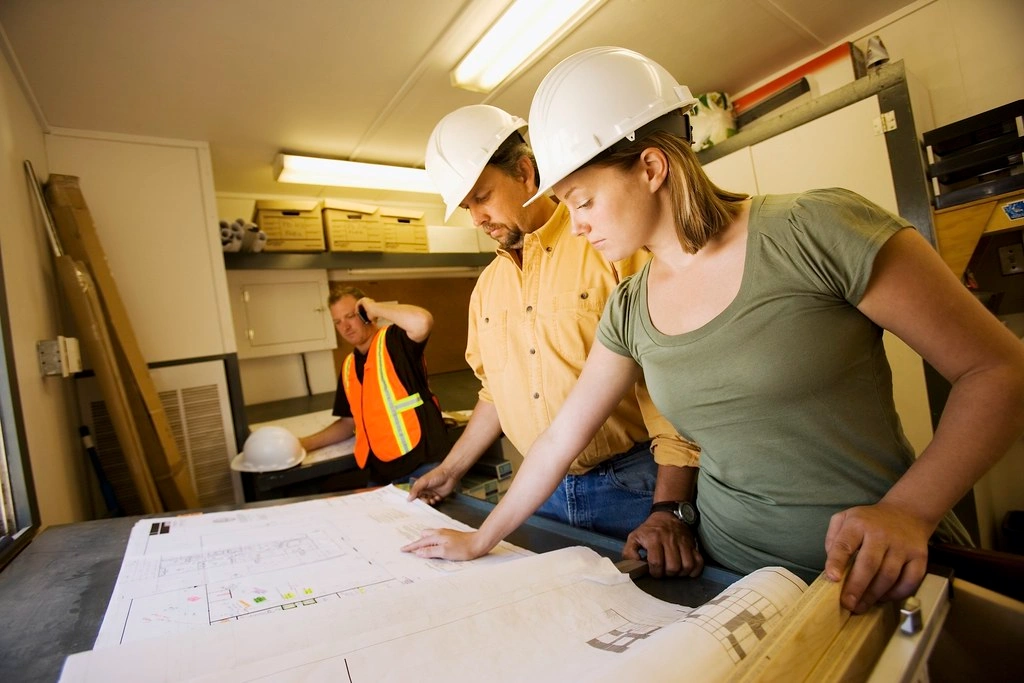
Here’s what they don’t tell you in the air-conditioned classroom: civil engineering isn’t a desk job. You’re required to spend hours on construction sites in extreme weather conditions—45°C heat, freezing cold, monsoon rains—with minimal protection and no acknowledgment that these conditions are legitimately dangerous to your health.
Research on construction heat stress confirms that working in hot environments causes heat-related illnesses that can be fatal. Studies show that construction workers experience heat stress and heat-related injuries including dizziness, slowed response time, impaired thinking, sweaty slippery hands, muscle fatigue, and vision impairment from fogged eyewear. Research reveals that heat stress causes fine motor performance to deteriorate even in acclimatized individuals, and injuries increase by 0.5% per 1°C rise in temperature.
For students, this is worse. You’re not acclimatized like construction workers who spend months adjusting. You’re thrown into extreme conditions for “educational site visits” with inadequate preparation, insufficient hydration breaks, and pressure to not appear “weak” by complaining. Studies show that a high proportion of heat-related fatalities occur during the first days on a new job—students on occasional site visits are at maximum vulnerability.
What makes this particularly brutal? Research confirms that extended exposure to extreme outdoor conditions causes heat stroke, dehydration, and respiratory complications. Your body is experiencing physiological stress while your brain is expected to absorb technical information, make observations for reports, and maintain professional behavior. This is neurologically impossible—your prefrontal cortex (thinking brain) shuts down during heat stress to protect your body.
Mindful Solutions
- The 3-Minute “Heat Wave Ground” Practice: During or immediately after extreme heat exposure site visits, find shade or an air-conditioned space. Remove your hard hat. Sit or stand with both feet flat on the ground. Close your eyes. Take slow breaths for three minutes—inhale cool air through your nose for 4 counts, exhale heat from your body for 6 counts. With each exhale, visualize releasing the physical stress and heat your body absorbed. This practice helps your autonomic nervous system transition from survival mode back to learning mode.
- Pre-Site Hydration Protocol: Drink 500ml of water 2 hours before site visits, another 250ml 30 minutes before. Bring electrolyte drinks, not just water. Carry a cooling towel. Advocate with professors for mandatory hydration breaks and shortened site visits during extreme temperatures—research shows even professionals need adjusted schedules in extreme heat.
- Post-Site Recovery Ritual: After site visits in extreme conditions, take 30 minutes for physical recovery before attempting academic work. Cool shower, electrolyte replacement, rest in cool environment. Your brain cannot process complex information while your body is in heat stress recovery.
- Collective Advocacy: Organize with classmates to request site visit scheduling during cooler times (early morning) and shorter durations during extreme weather. Present OSHA heat stress guidelines to faculty showing that even construction professionals limit exposure—students deserve the same protections.
2. “The Software Slavery” – When AutoCAD Deadlines Destroy Your Sleep

It’s 2 AM. You’ve been working on this AutoCAD drawing for eight hours straight. Your eyes burn from staring at the screen. Your back aches from hunching over the desk. The software just crashed and you haven’t saved in an hour. And you still have three more drawings due tomorrow, plus a structural analysis assignment, plus studying for a hydraulics exam.
This isn’t education. This is systematic sleep deprivation disguised as rigor.
Research from the International Journal of STEM Education confirms that engineering students experience work-life conflicts and demanding workloads as major stressors. Studies show that engineering culture encourages students to skip meals, go without sleep for days, and believe they don’t have time for self-care. The normalization of extreme workload creates what researchers call “engineering stress culture”—shared expectations that suffering is proof of dedication.
The software component makes this worse. Studies show that learning complex technical software while managing multiple assignments creates cognitive overload. Civil engineering students must master AutoCAD, Revit, STAAD Pro, SAP2000, and other specialized software simultaneously—each with steep learning curves—while also learning fundamental engineering principles. Research confirms this dual cognitive load (learning software + learning concepts) creates significantly higher stress than either task alone.
The deadline clustering is intentional and destructive. Research shows that engineering programs deliberately create overwhelming workloads to “weed out” weaker students, perpetuating a culture where burnout is framed as lack of dedication rather than pedagogical failure. Studies document that this approach causes significant mental health distress, reduces actual learning, and drives talented students out of engineering.
Mindful Solutions
- The 2-Minute “Blueprint Breath” for Screen Fatigue: Every 60 minutes during software work, pause completely. Look away from the screen. Stand up. Place both hands over your eyes, blocking all light. Take ten deep breaths. With each breath, allow your eyes to relax, release the tension in your neck and shoulders. This brief reset prevents cumulative physical and cognitive fatigue.
- Pomodoro with Boundaries: Work in 45-minute focused blocks followed by mandatory 15-minute breaks. During breaks, move your body—walk, stretch, step outside. Research shows that forced breaks increase productivity and reduce errors, even when it feels counterintuitive during deadline pressure.
- Sleep Non-Negotiable: Protect minimum 6 hours of sleep, even if it means submitting incomplete work. Research confirms that sleep-deprived cognitive function is equivalent to intoxication—you’re not learning effectively on no sleep, you’re just suffering. One night of adequate sleep improves next-day performance more than four hours of additional studying while exhausted.
- Collective Deadline Negotiation: When multiple professors assign major projects with overlapping deadlines, petition as a class for staggered due dates. Present research on cognitive load theory showing that simultaneous complex tasks reduce learning quality. Frame it as improving educational outcomes, not reducing rigor.
3. “The Parent Expectation Prison” – When Family Pressure Meets Academic Reality

Your parents sacrificed for your education. They expect excellence. They compare you to cousins who topped their class. They don’t understand why you’re struggling—”it’s just studying, how hard can it be?” They’re terrified you’ll fail and waste their investment. And every phone call becomes an interrogation about grades, rankings, and future job prospects.
This pressure isn’t motivating. It’s crushing.
Research on engineering student stress identifies family expectations as a significant stressor, particularly in cultures where engineering is seen as the only “respectable” career path. Studies show that students from families with high achievement expectations experience significantly higher anxiety, depression, and feelings of inadequacy. The fear of disappointing parents compounds academic stress, creating a dual burden students carry silently.
What makes this particularly toxic? Research shows that parental pressure based on misunderstanding of engineering difficulty creates shame cycles. When students struggle, they blame themselves rather than recognizing that the workload is objectively overwhelming. Studies document that students from high-pressure families are less likely to seek mental health support because admitting struggle feels like admitting failure.
The cultural component is documented in research. In many cultures, engineering is viewed as a guaranteed path to stability and prestige. Parents who don’t understand the field’s demands place impossible expectations on students. Research shows that cultural norms valuing family honor and filial piety make it nearly impossible for students to set boundaries or communicate their genuine struggles without feeling they’re betraying family.
Mindful Solutions
- Reality-Based Communication: Schedule one conversation with parents where you present concrete data—show them actual assignments, explain course difficulty, share that the average GPA in your program is significantly lower than they assume. Frame struggles as normal within the context, not personal failure. Most parents’ expectations are based on ignorance, not cruelty—accurate information can recalibrate expectations.
- Boundary-Setting with Compassion: Practice phrases like “I appreciate your support. I need you to trust that I’m working hard, even when grades don’t reflect it immediately.” or “Comparing me to others increases my stress without improving my performance.” Set boundaries on how often you’ll discuss grades—once per semester, not every week.
- Find Advocate within Family: Identify one family member (aunt, uncle, older sibling) who might understand better and enlist them to help communicate with parents. Sometimes the message is received better from someone within the family system than from the struggling student.
- Self-Compassion Practice: Daily, spend 3 minutes acknowledging: “My parents’ expectations come from love and fear, not malice. I’m doing my best in a genuinely difficult situation. I deserve compassion, not shame.” This internal reframing prevents internalizing external pressure.
4. “The Theory-Practice Chasm” – When Nothing You Learn Makes Sense in Reality
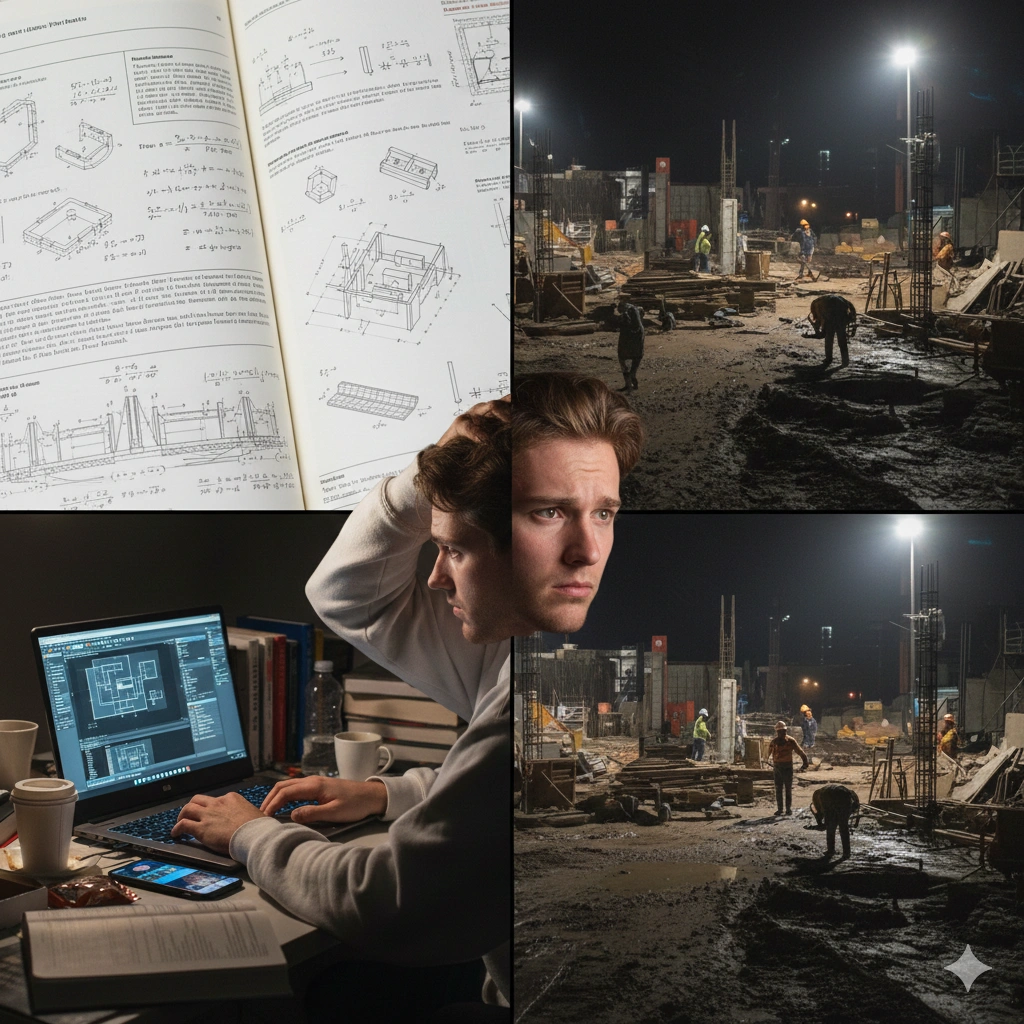
The textbook shows a perfectly symmetrical beam with evenly distributed loads. The construction site shows chaos—materials piled incorrectly, measurements that don’t match plans, contractors ignoring specifications, and safety violations everywhere. You’re supposed to connect theory to practice, except they seem like completely different universes.
This cognitive dissonance is more than frustrating—it’s psychologically destabilizing.
Research on engineering education shows that the gap between theoretical instruction and practical application creates significant student stress. Students report feeling that classroom learning doesn’t prepare them for real-world challenges, leading to imposter syndrome and self-doubt. Studies confirm that when students recognize this disconnect, they question the value of their education and their ability to succeed professionally.
The construction site reality compounds this. Research shows that students observing professional construction work often witness code violations, safety shortcuts, and practices that contradict everything they’re learning academically. This creates moral distress—knowing the “right” way while watching professionals do it “wrong” with no consequences. Studies document that this ethical ambiguity causes significant anxiety for students forming their professional identity.
The practical skills gap is real. Research confirms that engineering programs focus heavily on theoretical calculations while providing minimal hands-on construction experience. Students graduate able to design structures on paper but unable to read blueprints on site, communicate with contractors, or understand material properties practically. This creates anxiety about employability—you’re academically prepared but practically incompetent.
Mindful Solutions
- Reframe as “Multiple Knowledges”: Theory and practice aren’t conflicting—they’re complementary knowledge systems. Theory provides principles; practice provides adaptation. Both are necessary. Recognizing this reduces the distress of perceived inconsistency.
- Seek Mentorship: Find practicing engineers willing to explain how theoretical knowledge translates (or doesn’t) to real projects. Understanding the “why” behind the gap reduces anxiety. Many professionals remember this confusion and are happy to help bridge it.
- Document the Disconnect: Keep a learning journal where you note discrepancies between classroom teaching and site observations. This external validation acknowledges the gap is real, not your failure to understand. Review it to recognize patterns—you’re learning to navigate complexity, not failing to grasp simplicity.
- Practical Skill Development: Seek opportunities for hands-on learning—internships, volunteer construction projects, university lab work. Studies show that even brief practical experience significantly reduces the anxiety of theory-practice disconnect.
5. “The Failure-Is-Not-An-Option Myth” – When One Bad Grade Feels Like Career Death
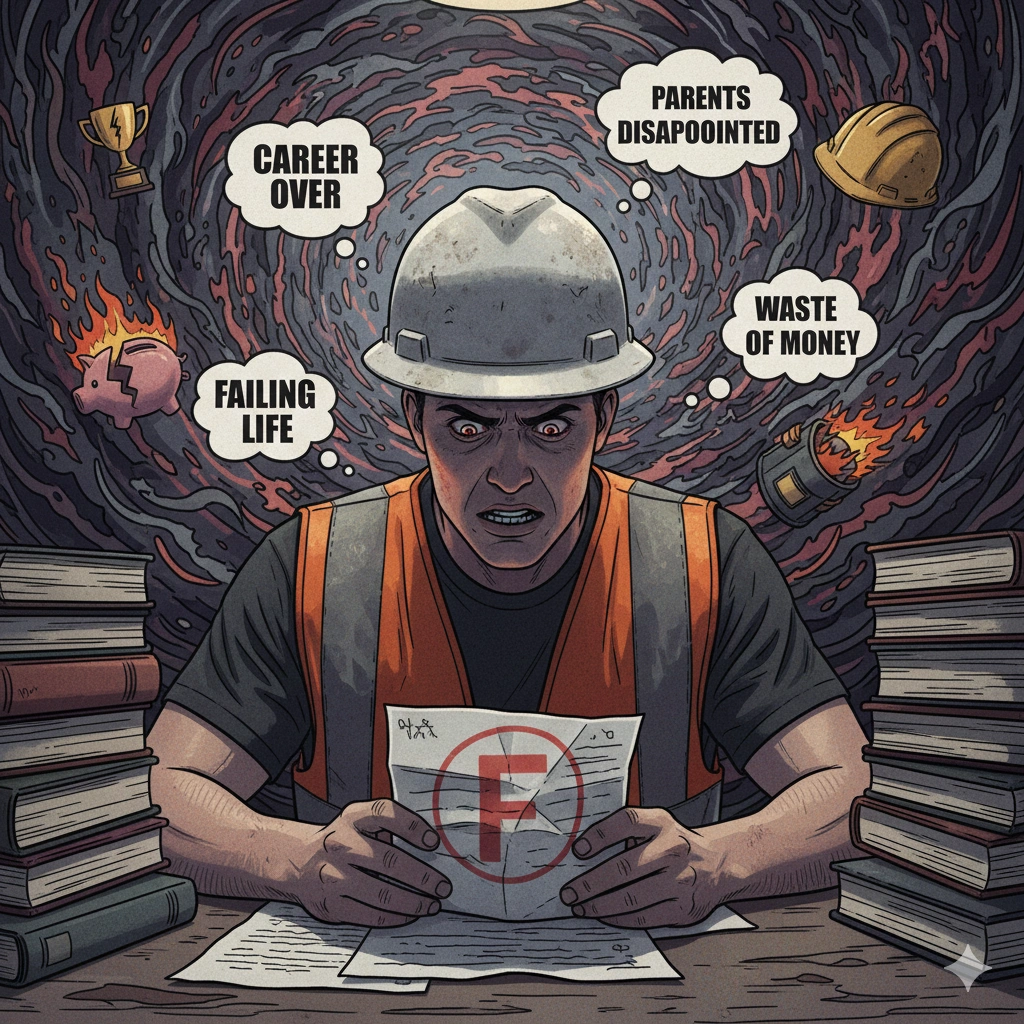
You failed the midterm. Or you got a C when you needed an A. Or your GPA dropped below 3.0. And suddenly, your entire brain is convinced your engineering career is over before it started. You’re a failure. You’ve wasted everyone’s time and money. You’ll never get a job. You should quit now.
This catastrophic thinking is a symptom of toxic engineering culture, not reality.
Research from ASCE on engineering student mental health confirms that perfectionism and fear of failure are defining features of engineering stress culture. Studies show that engineering programs create environments where anything less than excellence is framed as inadequacy. This all-or-nothing thinking causes severe anxiety, depression, and consideration of leaving engineering despite genuine capability.
The reality contradicts the fear. Research shows that employers care far more about practical skills, communication ability, and problem-solving capacity than GPA. Many successful civil engineers had mediocre academic records but excelled professionally. Studies confirm that academic performance correlates weakly with career success in engineering—yet the culture continues perpetuating the myth that grades determine everything.
The construction industry specifically values different skills. Research shows that successful civil engineers need project management, interpersonal communication, adaptability, and practical problem-solving—skills rarely reflected in exam grades. Studies document that many “average” students become exceptional engineers because professional success requires different competencies than academic success.
Mindful Solutions
- Evidence-Based Reality Check: When catastrophic thinking spirals, pause. Write down five engineers you know or have read about who had academic struggles but successful careers. External evidence counteracts internal catastrophizing.
- Grade Perspective Practice: After receiving disappointing grades, spend 5 minutes writing answers to: “Will this grade matter in 5 years? Does this one assessment reflect my total capability? What did I actually learn, regardless of the grade?” This cognitive reframing prevents single data points from defining your identity.
- Failure-as-Learning Reframe: Engineering is iterative. Bridges fail in design before they’re built safely. Your academic “failures” are design iterations for your learning process. Research shows that students who embrace failure as information rather than judgment develop stronger problem-solving skills.
- Career Counseling Access: Talk with university career services or practicing engineers about hiring realities. Concrete information about what employers actually seek reduces anxiety based on assumptions. Most students are surprised to learn how little GPA matters compared to other factors.
Your Daily Survival Mindfulness Kit
Practice 1: The 2-Minute “Blueprint Breath” for Screen Fatigue and Cognitive Overload
When drowning in AutoCAD deadlines and software work, this practice resets your visual and cognitive systems.
How to practice
- Set a timer every 60 minutes during computer work
- When the timer goes off, pause completely—save your work and step away
- Stand up and place both hands over your closed eyes, blocking all light
- Take ten slow, deep breaths—inhale for 4 counts, exhale for 6 counts
- With each exhale, consciously release tension from your eyes, neck, and shoulders
- Visualize your mind as a computer rebooting—clearing cache, refreshing memory
- Remove your hands, open your eyes slowly, and return to work with renewed focus
Why it works
Research on screen fatigue shows that continuous computer work causes visual strain, neck tension, and cognitive exhaustion. Brief breaks significantly improve performance and reduce errors. Studies confirm that the combination of darkness (resting eyes), deep breathing (activating parasympathetic nervous system), and physical movement (releasing muscular tension) creates comprehensive recovery in minimal time. This practice prevents the cumulative fatigue that leads to all-nighters and project errors.
Practice 2: The 3-Minute “Heat Wave Ground” for Physical Recovery After Site Visits
After extreme heat exposure during construction site visits, this practice helps your body transition back to normal function.
How to practice
- Immediately after site visits in extreme heat, find shade or air-conditioned space
- Remove safety equipment (hard hat, vest) and sit or stand comfortably
- Place both feet flat on the ground, feeling the earth supporting you
- Close your eyes and take slow breaths for three minutes
- Inhale cool air through your nose for 4 counts, feeling it chill your body
- Exhale slowly for 6 counts, visualizing heat and physical stress leaving your body like steam
- With each breath cycle, mentally acknowledge: “My body protected me. I am safe now. I can recover.”
- After three minutes, hydrate with water or electrolyte drink before attempting academic work
Why it works
Research on heat stress recovery shows that the body needs transition time between extreme exposure and normal function. Immediate cognitive work while in heat stress prevents both physical recovery and effective learning. This practice engages the parasympathetic nervous system’s recovery mechanisms while creating conscious separation between physical survival mode and academic learning mode. Studies confirm that brief cooling and breathing interventions significantly reduce heat-related symptoms and improve subsequent cognitive performance.
When Mindfulness Isn’t Enough: Recognizing Serious Crisis
Let’s be absolutely clear: breathing exercises don’t fix systemic problems or cure serious mental health conditions. If you’re experiencing any of these, professional help is essential:
- Thoughts of self-harm or suicide
- Complete inability to function (can’t attend class, can’t complete basic tasks)
- Panic attacks that interfere with daily life
- Persistent depression lasting more than two weeks
- Substance dependence to cope with academic stress
- Eating disorders triggered or worsened by engineering culture
- Physical health problems from chronic stress (severe insomnia, digestive issues, chronic pain)
According to ASCE research, the construction industry has a suicide rate four times higher than the general population. Engineering students are at significantly higher risk for mental health distress. This isn’t personal weakness—it’s a documented occupational hazard that begins in school.
Critical Resources
- Campus Counseling Services: Most universities offer free mental health support specifically for students
- ASCE Mental Health Resources: https://www.asce.org/topics/health-and-safety (provides industry-specific support)
- National Suicide Prevention Lifeline: 988
- Crisis Text Line: Text HOME to 741741
- Consider taking a leave of absence if needed—your mental health matters more than graduation timelines
The Truth About Your Education
Research from the International Journal of STEM Education confirms that engineering education is characterized by narratives of suffering, where hardship and rigor are venerated as proof of worthiness. Studies show that engineering students report significantly higher stress than students in other disciplines, with workloads that actively prevent self-care.
ASCE research reveals that the construction industry—where you’re headed—has one of the highest suicide rates of any sector. The burnout you’re experiencing now isn’t building resilience—it’s creating the foundation for career-long mental health struggles.
But here’s what research also shows: the system can change. Studies confirm that engineering programs can maintain rigor while promoting student wellbeing. Workload reform, mental health integration, and dismantling suffering-as-virtue culture improve both learning outcomes and student mental health.
Moving Forward: You’re Not Failing, The System Is
You’re not weak for struggling. Research confirms you’re facing documented, measurable, extreme educational stress. The combination of physical extremes (heat, site conditions), cognitive demands (complex software, theoretical concepts), cultural pressure (family expectations, perfectionism), and systemic design (normalized suffering, overwhelming workload) would break anyone.
Start with one practice this week. The 2-minute Blueprint Breath during software marathons. The 3-minute Heat Wave Ground after brutal site visits. Simply acknowledging that what you’re experiencing is real and documented, not personal failure.
You chose a profession that builds the world. Bridges, roads, water systems, buildings—civilization functions because of civil engineers. Your work will matter.
But you cannot build the world if you’re broken. You cannot serve society if you can’t survive school.
Take care of yourself. Engineering needs engineers who can remain whole.
You’re worth fighting for. And the world needs the structures you’ll create—but it needs you healthy enough to create them.
Stay safe. Stay whole. Keep building.
Research References
- ASCE – From Stress to Strength: Mental Health in Civil Engineering (2023): https://www.asce.org/publications-and-news/civil-engineering-source/civil-engineering-magazine/issues/magazine-issue/article/2025/01/from-stress-to-strength
- International Journal of STEM Education – Undergraduate Student Perceptions of Stress and Mental Health in Engineering Culture (2023) https://stemeducationjournal.springeropen.com/articles/10.1186/s40594-023-00419-6
- International Journal of STEM Education – Stressors and Normalized Stress in Undergraduate Engineering Education Culture (2025) https://stemeducationjournal.springeropen.com/articles/10.1186/s40594-025-00540-8
- PMC – Undergraduate Student Perceptions of Stress and Mental Health in Engineering Culture https://pmc.ncbi.nlm.nih.gov/articles/PMC10123580/
- ASCE – Strategies for Mitigating Stress in Civil Engineers (Podcast, 2022) https://www.asce.org/publications-and-news/civil-engineering-source/podcasts/podcast/2022/04/19/strategies-for-mitigating-stress-in-civil-engineers
- ASCE – Health and Safety Resources for Engineers https://www.asce.org/topics/health-and-safety
- Everant Journal – Stress Levels among Civil Engineering Students https://everant.org/index.php/etj/article/download/1867/1382/5327
- PMC – Heat Stress Prevention in Construction: Systematic Review and Meta-Analysis (2024): https://pmc.ncbi.nlm.nih.gov/articles/PMC11675740/
- OSHA – Working in Outdoor and Indoor Heat Environments https://www.osha.gov/heat-exposure
- CDC NIOSH – Heat Stress in Construction (2020) https://blogs.cdc.gov/niosh-science-blog/2020/05/21/heat-stress-construction/