
Lab Accidents, Toxic Fumes, and the Terror of Viva on Reaction Mechanisms
The fume hood alarm goes off. You’re not sure if you added the reagent in the correct order. The solution is turning a color it definitely shouldn’t be. Your lab partner just knocked over a beaker of corrosive acid. And tomorrow, you have a viva where your professor will grill you on reaction mechanisms you barely understand while you’re still processing whether today’s lab accident could have killed you.
Welcome to chemistry and biotech education, where the combination of physical danger, crushing academic pressure, and perpetual fear creates a mental health crisis nobody wants to acknowledge—because admitting you’re struggling might mean you’re “not cut out for science.”
According to research from Penn State published in ACS
Publications, graduate students are more than six times as likely to experience depression and anxiety compared to the general population, with 41% showing signs of anxiety and 39% moderate to severe depression. Studies on biomedical doctoral students reveal high levels of burnout, depression, and anxiety, with burnout significantly associated with thoughts of dropping out.
Research from the American Chemical Society confirms that chemistry students face unique stressors beyond typical academic pressure: exposure to hazardous chemicals, fear of lab accidents, intense safety protocols, high-stakes practical exams, and the cultural expectation that suffering is proof of scientific worthiness.
But here’s what nobody tells you: the “weeding out” culture in chemistry education isn’t building resilience—it’s systematically destroying the mental health of students before they ever enter the profession.
The Five Daily Battles Destroying Chemistry Students
1. “The Explosive Anxiety” – When Every Lab Session Could Be Your Last
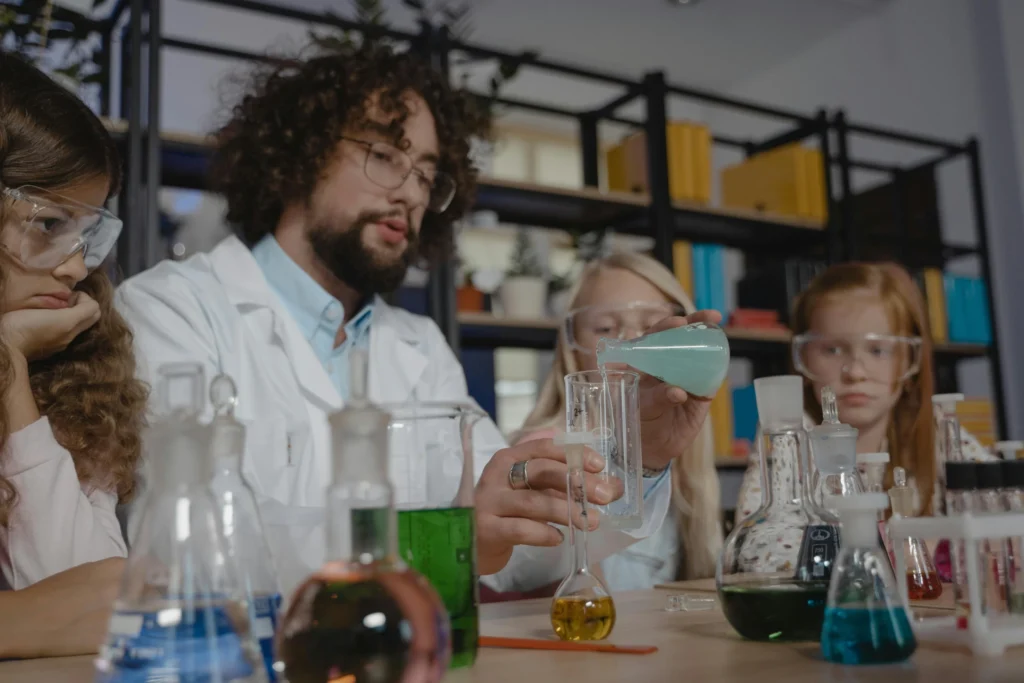
Let’s address the elephant in the lab: chemistry is legitimately dangerous. You’re working with substances that can burn, explode, poison, or permanently damage you. And while safety protocols exist, accidents happen—sometimes because you made a mistake, sometimes because equipment failed, sometimes because another student didn’t follow procedures.
Research from the ACS Center for Lab Safety confirms that laboratory incidents cause significant anxiety among chemistry students. Studies show that students report fear of causing accidents, anxiety about inhaling harmful chemicals, worry about spills and fires, and hypervigilance around lab equipment. The ACS’s RAMP framework (Recognize hazards, Assess risks, Minimize risks, Prepare for emergencies) acknowledges that chemistry laboratories require constant risk management.
What makes this particularly psychologically damaging? Research shows that working in environments where mistakes can have severe physical consequences creates chronic stress. Studies on safety culture in academic chemistry confirm that students experience persistent low-level anxiety during lab work, interrupted by acute fear during near-misses or actual incidents. This chronic threat-response activation takes a severe toll on mental health.
The fear is justified by data. Research documents that lab accidents, while often preventable, do occur and can cause serious injury. The ACS maintains records of laboratory incidents specifically to prevent future accidents, acknowledging that the risk is real. For students, knowing that one moment of inattention could result in serious harm creates a cognitive load that extends far beyond learning chemistry—you’re learning to manage existential risk while mastering complex scientific concepts.
Mindful Solutions
- The 90-Second “Fume Hood Focus” Practice: Before beginning any lab procedure, especially with hazardous chemicals, stand at your station for 90 seconds. Place both hands on the bench. Take five slow, deep breaths. With each breath, mentally review: “What am I doing? What are the hazards? What safety measures am I using? What’s my emergency plan?” This practice transforms vague anxiety into specific, manageable risk assessment—replacing panic with prepared focus.
- Post-Lab Decompression Ritual: After completing lab work, especially if it was stressful or involved a near-miss, take five minutes before leaving. Remove safety equipment mindfully. Wash hands. Take three deep breaths and consciously acknowledge: “I followed safety protocols. I managed risks appropriately. I am safe now.” This creates conscious transition from high-alert to normal functioning.
- Safety Concern Documentation: If you observe repeated safety violations or inadequate protocols, document them and report to your department. Your anxiety might be detecting real systemic problems, not personal weakness. Advocacy for better safety improves conditions for everyone.
- Normalize Safety Anxiety: Talk openly with lab partners about safety concerns. Research shows that safety culture improves when students feel comfortable expressing fears without being labeled “paranoid” or “not cut out for chemistry.” Your concerns are valid professional risk assessment, not weak
2. “The Mechanism Madness” – When Organic Chemistry Breaks Your Brain

Memorize hundreds of reactions. Understand electron movement. Predict products. Explain mechanisms. Master stereochemistry. And do it all while your professor implies that if you can’t see the patterns intuitively, you’re just not “thinking like a chemist.”
This isn’t education—it’s cognitive hazing disguised as rigor.
Research on STEM education stress confirms that chemistry students face particularly intense cognitive demands. Studies show that organic chemistry specifically creates significant student anxiety due to the requirement to visualize abstract three-dimensional molecular interactions, memorize vast amounts of information, understand complex multistep mechanisms, and apply knowledge to novel scenarios under time pressure. Research reveals that organic chemistry has among the highest failure and withdrawal rates of any undergraduate course.
What makes this worse is the cultural narrative. Research shows that chemistry education often perpetuates the myth that some people “naturally” understand chemistry while others don’t—creating what researchers call “fixed mindset” beliefs that increase anxiety and reduce persistence. Studies confirm that when students believe intelligence is innate rather than developed, struggles with difficult content trigger identity threats rather than normal learning challenges.
The viva examination component compounds this stress. Research on oral exams shows that being questioned on complex material while under observation creates severe performance anxiety. Studies reveal that chemistry students report vivavs as among their most stressful academic experiences, combining fear of public failure, pressure to think spontaneously, and high-stakes evaluation.
Mindful Solutions
- The 5-Minute “Reaction Release” for Study Overwhelm: When studying mechanisms becomes overwhelming, stop completely for five minutes. Close your textbook. Stand up. Place both hands on a wall and lean gently, stretching your shoulders and back. Take slow breaths. With each exhale, mentally release one fact, one mechanism, one piece of information. After five minutes, acknowledge: “I’m learning complex material. Struggle means I’m growing, not failing.” Return to studying with reduced pressure.
- Growth Mindset Reframing: When you don’t understand something immediately, practice this internal dialogue: “I don’t understand this YET. My brain is building new neural pathways. This discomfort is normal learning.” Research shows that explicit growth mindset practice reduces chemistry anxiety and improves persistence.
- Concept Mapping Instead of Memorization: Instead of memorizing individual reactions, create visual concept maps showing patterns and relationships. Research shows that understanding conceptual frameworks reduces cognitive load compared to rote memorization. This also transforms passive studying into active processing.
- Study Group Vulnerability: Create study groups where it’s safe to say “I don’t understand this.” Research shows that students who admit confusion and collaboratively problem-solve learn better than those who pretend to understand. Normalize struggle as part of learning.
3. “The Perfectionism Poison” – When One Failed Synthesis Feels Like Career Death
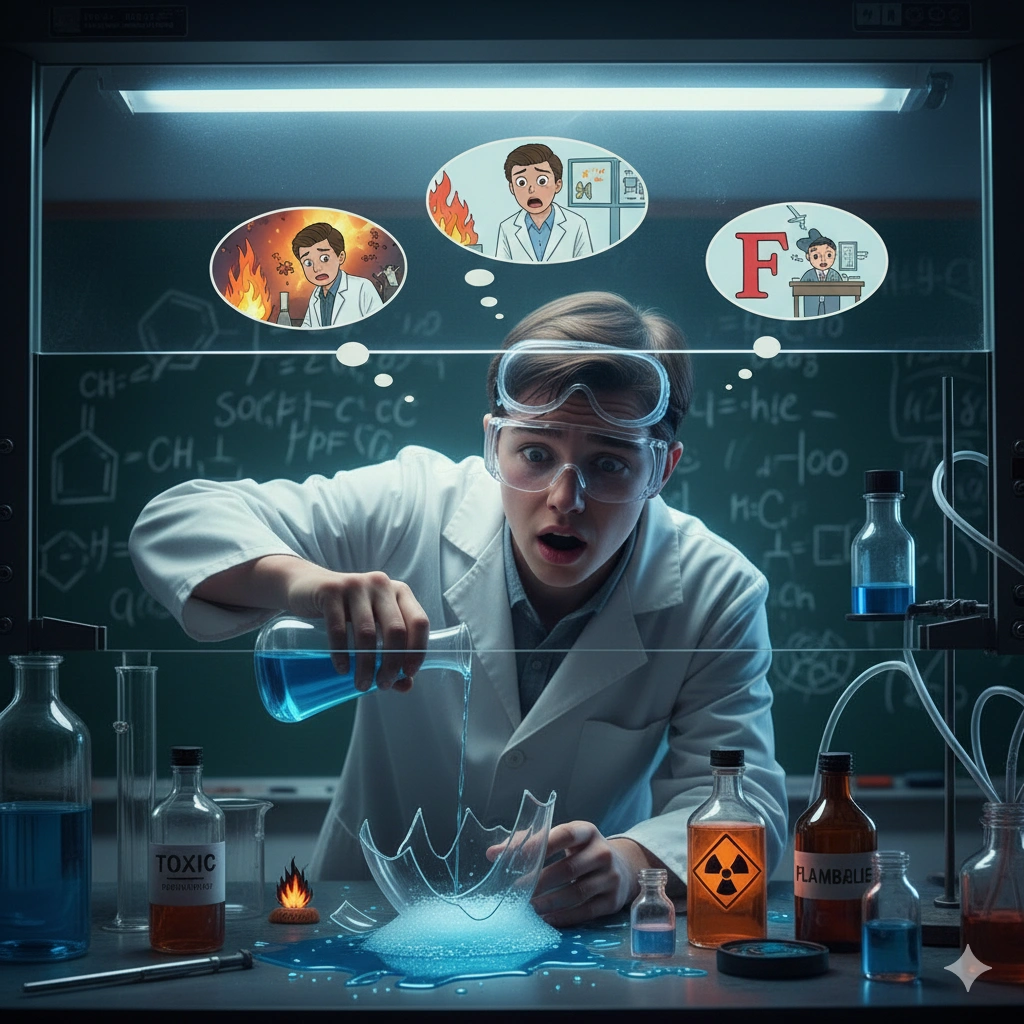
Your synthesis failed. The yield was 12% instead of 80%. Your product isn’t pure. Your results don’t match the literature. And suddenly, your brain is convinced you’re not smart enough for chemistry, you’ve wasted everyone’s time and money, and you should quit before you fail out.
This catastrophic thinking isn’t personal weakness—it’s the predictable result of a culture that treats failure as incompetence rather than data.
Research from Penn State on mental health in STEM shows that perfectionism is rampant in chemistry education. Studies reveal that the culture in chemistry programs often venerates suffering, normalizes extreme workload, and frames struggle as personal inadequacy rather than pedagogical challenge. Research confirms that this creates what psychologists call “maladaptive perfectionism”—where anything less than perfect feels like total failure.
The research on biomedical doctoral students shows the consequences of this mindset. Studies document that high levels of burnout, depression, and anxiety are significantly associated with thoughts of dropping out and decreased life satisfaction. Research reveals that students internalize failure as evidence they’re “not meant for science” rather than recognizing that experimental work inherently involves failure.
What makes this particularly toxic? Research shows that actual scientific work involves constant failure—most experiments don’t work as planned, synthesis often requires multiple attempts, and hypotheses are frequently wrong. But chemistry education often hides this reality, presenting science as a smooth progression of successes. Studies confirm that when students encounter the messy reality of research, they experience it as personal failure rather than normal scientific process.
Mindful Solutions
- Failure Reframe Practice: After failed experiments, spend three minutes writing: “What did this experiment teach me? What variables can I adjust? What did I learn about the chemistry?” Research shows that reframing failure as data significantly reduces anxiety and improves persistence. Scientists succeed by learning from failure, not avoiding it.
- “Failure File” Documentation: Keep a private log of failed experiments and what you learned from each. Review this when catastrophic thinking strikes—evidence shows you’re learning constantly, even through failure. This external validation counteracts internal negative narratives.
- Peer Failure Sharing: Create informal spaces with classmates where everyone shares their biggest lab failures and what they learned. Research shows that learning that everyone struggles normalizes failure and reduces shame. Failure feels isolating when hidden, communal when shared.
- Realistic Success Metrics: Define success as “following good scientific process” rather than “getting perfect results.” Research shows that process-oriented goals reduce anxiety compared to outcome-oriented goals. You control your methods; you can’t always control results.
4. “The Publish-or-Perish Preview” – When Undergrad Research Reveals the Future Nightmare

You joined a research lab to get experience. What you got was a preview of the academic career nightmare: working 60-hour weeks, having your work criticized constantly, watching grad students sacrifice their health for publications, and realizing that if you continue in science, this is your future.
Research from the Journal of Chemical Education confirms this pattern. Studies on chemistry graduate student mental health show that increasing pressure to carry out novel research, publish articles, learn a broad range of skills, and look for career opportunities has led to rising levels of stress, anxiety, and depression. Research reveals that 41% of graduate students show signs of anxiety and 39% show moderate to severe depression.
What’s devastating for undergraduates? You’re witnessing this before you’ve even committed to the career. Research shows that undergraduate research experiences, while valuable for learning, also expose students to academic culture’s dark side. Studies document that undergrads observe the stress, overwork, and mental health struggles of grad students and postdocs—creating anxiety about their own potential futures in science.
The biotech industry preview is equally concerning. Research from a 2022 Biotechnology Innovation Organization survey found that 62% of biotech professionals reported experiencing burnout, while 45% struggled with work-related anxiety. Students entering biotech see an industry characterized by high pressure, job instability, and chronic stress—hardly an appealing career prospect.
Mindful Solutions
- Career Reality Assessment: Have honest conversations with grad students and postdocs about their experiences. Ask direct questions about work-life balance, mental health, and whether they’d choose this path again. Making informed decisions reduces later regret and resentment.
- Multiple Path Planning: Recognize that chemistry trains valuable skills applicable beyond academia or biotech. Industry research, science communication, patent law, regulatory affairs, teaching, and other careers offer chemistry expertise without academic culture toxicity. Research shows that knowing you have options reduces the pressure of feeling trapped.
- Boundary-Setting Practice: If doing undergraduate research, set clear boundaries on your time. Research shows that students who maintain work-life balance during undergrad research have better mental health outcomes. Learning to set boundaries now prepares you for healthier career management later.
- Mentor Selection: Seek research advisors known for supporting student wellbeing, not just those with the most prestigious labs. Research confirms that mentor relationships significantly impact mental health outcomes. A supportive mentor in a smaller lab beats a neglectful one in a famous lab.
5. “The Imposter Syndrome Lab” – When Everyone Seems to Understand Except You
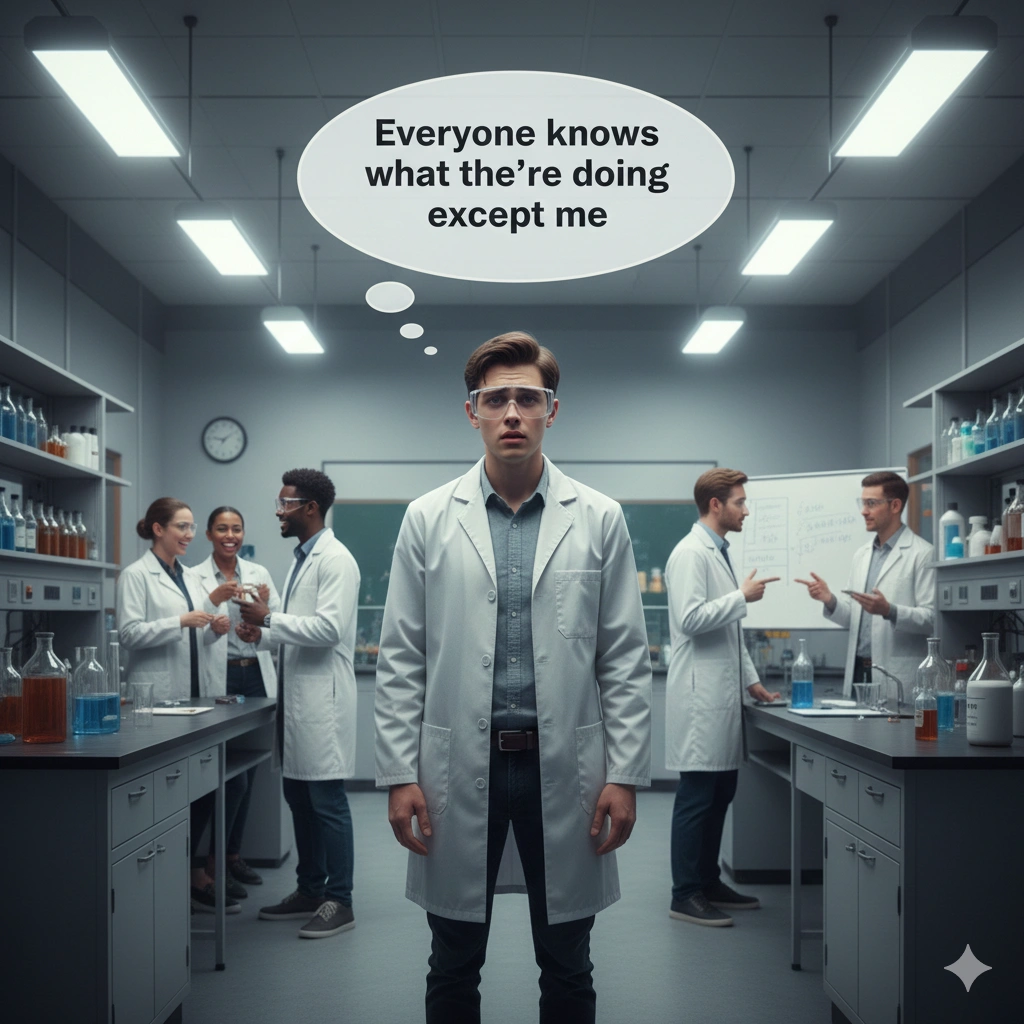
Your classmates seem to understand the lecture immediately. They ask sophisticated questions. They finish lab procedures quickly. They discuss research papers fluently. And you? You’re still trying to figure out what half the words mean, pretending you understand when you’re utterly lost.
Welcome to imposter syndrome—the overwhelming feeling that you’re faking your way through and everyone’s about to discover you don’t belong in chemistry.
Research on STEM mental health confirms that imposter syndrome is rampant in chemistry programs. Studies show that chemistry students frequently feel they’re not truly competent despite evidence to the contrary, believe they’re only in the program due to luck rather than ability, fear being “exposed” as frauds, and assume everyone else understands better. Research reveals that imposter syndrome is associated with increased anxiety, depression, and consideration of leaving science.
What fuels this particularly in chemistry? Research shows that the “weed-out” culture in chemistry programs creates environments where students constantly compare themselves to peers in high-stakes competitive contexts. Studies confirm that chemistry courses are often explicitly designed to be “difficult enough to separate” those who “belong” from those who don’t—a pedagogical approach that guarantees widespread imposter syndrome even among capable students.
The silence compounds it. Research shows that students rarely admit when they don’t understand, assuming everyone else grasps the material. Studies reveal that this creates a collective illusion where everyone is pretending to understand while secretly feeling lost—but because no one admits it, everyone assumes they’re the only one struggling.
Mindful Solutions
- Reality Testing Practice: When imposter feelings strike, write down three pieces of objective evidence of your competence: grades you’ve earned, problems you’ve solved, skills you’ve gained. Research shows that external evidence counteracts internal impostor narratives. Your feelings say you’re incompetent; your evidence proves otherwise.
- Normalize Confusion: Practice admitting when you don’t understand. Say “Can you explain that again?” or “I’m not following this step.” Research shows that students who vocalize confusion learn better and discover that many peers share their confusion. Your questions often represent what others are thinking but won’t ask.
- Comparison Awareness: Notice when you’re comparing your behind-the-scenes struggle to others’ polished performances. Remind yourself: “I’m comparing my rough draft to their final presentation. This isn’t accurate.” Research shows that metacognitive awareness of comparison patterns reduces their emotional impact.
- Seek Specific Feedback: Ask professors or TAs: “What are three specific strengths you’ve observed in my work?” Concrete positive feedback counteracts vague impostor feelings. Research confirms that specific praise is more effective than general encouragement for reducing imposter syndrome.
Your Lab-Survival Mindfulness Kit
Practice 1: The 90-Second “Fume Hood Focus” for Pre-Lab Anxiety Management
Before any hazardous lab procedure, this practice transforms vague anxiety into focused risk awareness.
How to practice
- Before beginning lab work, especially with dangerous chemicals, stand at your workstation
- Place both hands flat on the lab bench, feeling the solid surface
- Take five slow, deep breaths—inhale for 4 counts, exhale for 6 counts
- With each breath cycle, mentally review one aspect of your procedure:
- Breath 1: “What chemicals am I using?”
- Breath 2: “What are the specific hazards?”
- Breath 3: “What safety equipment am I wearing?”
- Breath 4: “What’s my emergency procedure if something goes wrong?”
- Breath 5: “I am prepared. I can do this safely.”
- Begin your work with focused attention rather than vague anxiety
Why it works
Research on safety culture shows that specific risk assessment reduces anxiety more effectively than general worry. This practice channels nervous energy into productive safety awareness. Studies confirm that brief mindfulness interventions before high-stakes tasks improve focus and reduce errors—critical for safe lab work.
Practice 2: The 5-Minute “Reaction Release” for Study Overwhelm
When studying complex chemistry becomes cognitively overwhelming, this practice provides comprehensive mental reset.
How to practice
- When you notice study overwhelm (brain fog, frustration, information overload), stop all studying immediately
- Close your textbook and put down your pen
- Stand up and walk to a wall
- Place both hands flat on the wall and lean gently forward, stretching shoulders and back
- Take slow, deep breaths for five minutes—no counting, just natural rhythm
- With each exhale, mentally release one piece of information, one mechanism, one fact—just let it go
- After five minutes, remain standing and place one hand over your heart
- Silently acknowledge: “I’m learning extremely complex material. Struggle means I’m growing, not failing. I’m doing my best.”
- Return to studying with reduced cognitive pressure
Why it works
Research on cognitive load shows that the brain has limited working memory capacity. When overwhelmed, adding more information causes cognitive collapse. This practice creates mental space by deliberately releasing pressure. Studies confirm that physical movement combined with conscious breathing reduces cortisol and improves subsequent learning. The self-compassion component prevents shame spirals that compound cognitive overload.
When Mindfulness Isn’t Enough: Recognizing Serious Crisis
Let’s be absolutely clear: breathing exercises don’t cure clinical mental health conditions. If you’re experiencing any of these, professional intervention is essential:
- Thoughts of self-harm or suicide
- Panic attacks in lab that prevent you from conducting experiments
- Complete avoidance of chemistry courses or lab due to anxiety
- Substance dependence to cope with academic stress
- Persistent depression lasting more than two weeks
- Physical symptoms from chronic stress (severe insomnia, digestive problems, chronic pain)
- Dissociation or detachment during lab work (dangerous for safety)
According to research from Penn State published in ACS Publications, graduate students are six times more likely to show depression and anxiety than the general population, with 41% showing anxiety signs and 39% moderate to severe depression. Research on biomedical doctoral students reveals high levels of burnout significantly associated with thoughts of dropping out.
Critical Resources
- Campus Counseling Services: Most universities offer free mental health support
- ACS Center for Lab Safety Resources: https://institute.acs.org/acs-center/lab-safety.html
- National Suicide Prevention Lifeline: 988
- Crisis Text Line: Text HOME to 741741
- Consider taking a leave of absence if needed—your mental health matters more than graduation timelines
Additional support
The Truth About Chemistry Education
Research from Penn State confirms that the culture in STEM academia encourages students to prioritize academic goals over self-care needs, resulting in reduced wellbeing. Studies show that chemistry students face work overload as a defining stressor, with specific barriers that prevent help-seeking and normalization of suffering as part of scientific identity.
The American Chemical Society acknowledges that laboratory safety extends beyond physical hazards to include psychological wellbeing. Research confirms that chronic exposure to dangerous chemicals, fear of accidents, and high-stakes academic pressure create unique mental health challenges for chemistry students.
But here’s what research also shows: this system can change. Studies confirm that chemistry programs can maintain rigor while supporting student mental health. Departments that prioritize student empowerment, provide mental health resources, and dismantle suffering-as-virtue culture see improved outcomes without sacrificing academic quality.
Moving Forward: You’re Not Failing Chemistry—Chemistry Education Is Failing You
You’re not weak for struggling. Research confirms you’re facing documented, measurable extreme stress. The combination of physical danger (chemical exposure, accident risk), cognitive demands (complex abstract concepts, massive memorization), cultural toxicity (perfectionism, weed-out mentality), and career uncertainty would overwhelm anyone.
Start with one practice this week. The 90-second Fume Hood Focus before lab. The 5-minute Reaction Release during study overwhelm. Simply acknowledging that what you’re experiencing is real, valid, and documented—not personal inadequacy.
You chose a field that explores the fundamental building blocks of matter. Your work will contribute to medicine, materials, energy, and countless innovations that improve human life. Chemistry matters.
But you cannot contribute if you’re broken. You cannot discover if you can’t survive the training.
Take care of yourself. Science needs scientists who can remain whole.
You’re worth fighting for. And the discoveries you’ll make? The world needs them—but it needs you healthy enough to make them.
Stay safe. Stay whole. Keep discovering.
Research References
- American Chemical Society – ACS Center for Lab Safety https://institute.acs.org/acs-center/lab-safety.html
- American Chemical Society – Safety in Academic Chemistry Laboratories (8th Edition) https://www.acs.org/content/dam/acsorg/about/governance/committees/chemicalsafety/publications/safety-in-academic-chemistry-laboratories-students.pdf
- Penn State – On the Importance of Mental Health in STEM (ACS Publications, 2023) https://pmc.ncbi.nlm.nih.gov/articles/PMC10416320/
- PMC – Burnout and Mental Health Problems in Biomedical Doctoral Students: https://pmc.ncbi.nlm.nih.gov/articles/PMC6755223/
- Journal of Chemical Education – Stress and Mental Health in Graduate School (2018): https://pubs.acs.org/doi/10.1021/acs.jchemed.8b00188
- Hello Bio – How to Manage Stress & Anxiety in the Lab (2024) https://hellobio.com/blog/how-to-manage-stress-and-anxiety-in-the-lab.html
- PMC – Psychological Distress, Burnout, and Academic Performance in First Year College Students https://pmc.ncbi.nlm.nih.gov/articles/PMC8953100/
- PMC – Stress, Burnout and Coping Strategies in Preclinical Medical Students https://pmc.ncbi.nlm.nih.gov/articles/PMC4791902/
- PMC – Student Burnout: A Review on Factors Contributing to Burnout Across Different Student Populations https://pmc.ncbi.nlm.nih.gov/articles/PMC11852093/
- NewsRx – The Challenge of Mental Health in Science – Stress and Burnout (2021) https://ideas.newsrx.com/blog/the-challenge-of-mental-health-in-science-stress-and-burnout
- PharmaDiversity Blog – Addressing Mental Health in the High-Pressure Biotech World https://blog.pharmadiversityjobboard.com/?p=331
- ACS Solutions Center – ACS Essentials of Lab Safety for General Chemistry https://solutions.acs.org/solutions/institute/acs-essentials-of-lab-safety-for-general-chemistry/