How entering flow regularly doesn’t just make you more productive—it benefits your brain for creativity, happiness, and longevity

I’ll be honest with you: I used to think “flow state” was just fancy jargon for “being really focused.” You know, the kind of buzzword that gets thrown around in self-help books alongside “synergy” and “paradigm shift.”
Then I actually started tracking what happened on days when I experienced flow versus days when I was just grinding through my to-do list. The difference wasn’t subtle. It was like comparing running downhill with the wind at your back versus trudging through mud uphill. Same effort on paper. Radically different outcomes in reality.
Here’s what the research—and my own brutal honesty with myself—revealed: flow states aren’t just about getting more done. They’re about fundamentally upgrading how you experience work, creativity, relationships, and even your own health.
As my friend Sarah, a product designer, puts it: “Flow state is like finding a cheat code for your brain. Except instead of making the game easier, it makes you enjoy playing so much you forget you’re even trying to win.”
Let me walk you through the nine core benefits that research has validated—and more importantly, how you can actually access them through mindful, practical techniques starting today.
1. Productivity on Steroids (Without the Crash)
Let’s start with the obvious one because it’s what got most of us interested in flow in the first place.
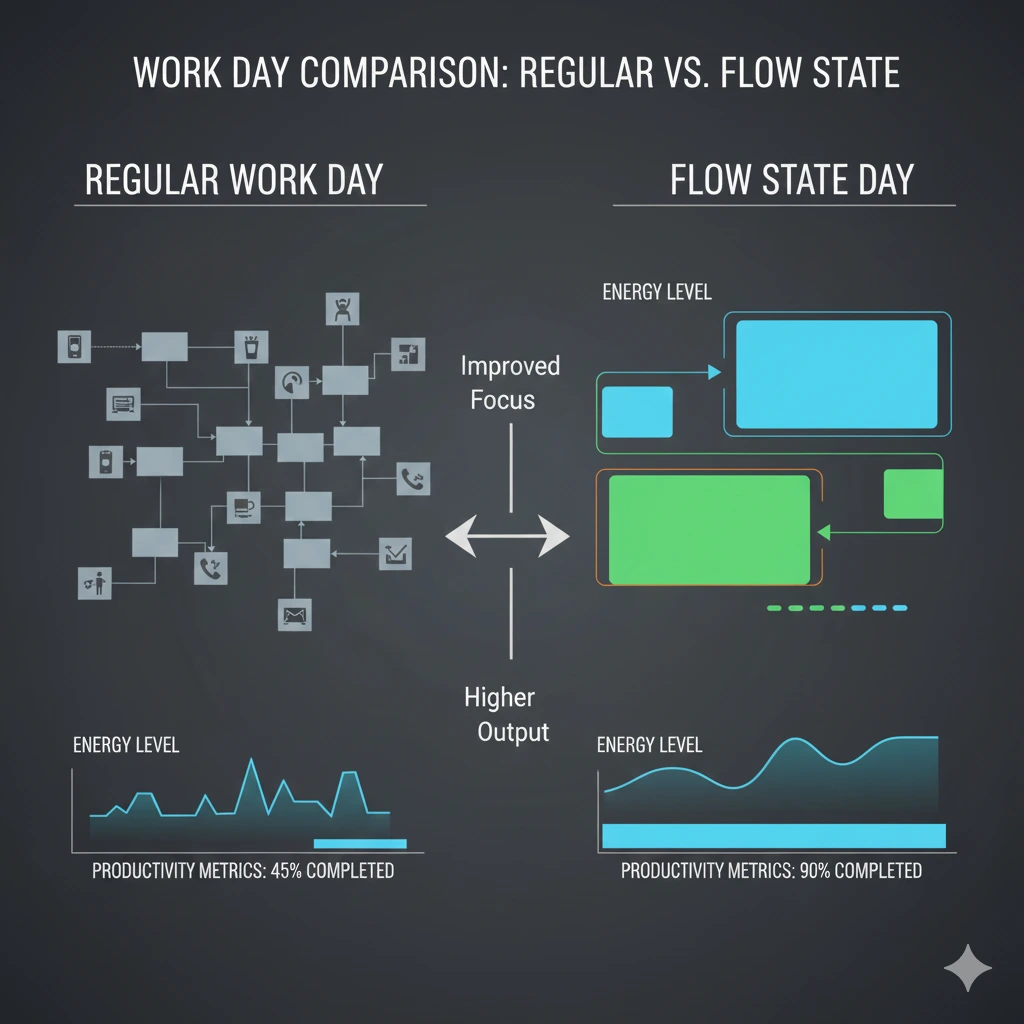
When you’re in flow, productivity doesn’t just increase incrementally—it skyrockets. Research by McKinsey found that executives in flow are five times more productive than their baseline state. Five times. That’s not a typo.
But here’s what makes flow different from just “working really hard” or chugging your third espresso: you don’t crash afterward. In fact, you often finish a flow session feeling energized rather than depleted.
Why? Because flow operates on intrinsic motivation rather than willpower. You’re pulled forward by engagement rather than pushed by discipline. It’s the difference between forcing yourself to run on a treadmill and chasing your dog through a park—same physical output, completely different psychological experience.
The mindful technique: Set crystal-clear goals before each work session. Not vague aspirations like “work on the project,” but specific, measurable targets like “complete the user authentication module” or “write 500 words of the introduction section.”
Clarity eliminates decision fatigue and gives your brain a clear target to lock onto. Ambiguity is flow’s kryptonite.
(Dive deeper: How to Structure Your Day for Maximum Flow)
A developer I know jokes: “Before I learned about flow, I thought productivity meant how many tabs I could keep open. Now I realize it’s about how few I need.”
2. Creativity That Actually Surprises You
Here’s something I didn’t expect when I started deliberately cultivating flow: my creative output didn’t just increase in quantity—it increased in quality and originality.
During flow states, your brain does something fascinating. The prefrontal cortex—the part responsible for self-criticism and overthinking—temporarily quiets down. This phenomenon, called “transient hypofrontality,” essentially turns off your inner critic.
Without that nagging voice asking “Is this good enough?” or “What will people think?”, you access more unconventional connections and creative solutions. Research published in Psychological Science found that positive mood states associated with flow significantly enhance creative problem-solving abilities (Isen et al., 1987).
I’ve noticed this personally. My best ideas never come when I’m “trying to be creative.” They emerge when I’m deep in flow, working on something else, and suddenly a solution to an unrelated problem just… appears. Like my subconscious has been working on it in the background and finally gets a chance to speak up.
The mindful technique: Build immediate feedback loops into your creative work. If you’re writing, set a word count tracker visible on your screen. If you’re coding, run tests frequently. If you’re designing, get quick reactions from a trusted colleague.
Flow thrives on knowing whether you’re on track or need to adjust. Immediate feedback keeps you engaged and provides the dopamine hits that sustain the flow state.
(Related: The Creative Flow Protocol for Engineers)
My writing mentor once told me: “Creativity isn’t about having more ideas. It’s about getting your critic drunk enough to stop killing the good ones before they fully form.”
3. Happiness That Doesn’t Depend on Outcomes
This one surprised me the most, and it’s backed by decades of research from Csíkszentmihályi himself.
Flow states are intrinsically rewarding. You don’t need external validation, achievements, or outcomes to feel good—the experience itself is the reward. In their comprehensive review, Nakamura and Csíkszentmihályi (2009) found that people consistently report flow experiences as among the most satisfying moments of their lives.
Think about that. Not winning the award, not hitting the milestone, not getting the promotion—but the actual process of being fully engaged in challenging work.
I used to chase outcomes obsessively. Every project needed to “matter.” Every effort needed visible ROI. I was miserable because most projects don’t have immediate, measurable impact, and I was robbing myself of enjoying the only part I actually controlled: the work itself.
Now? I still care about outcomes, but I’ve learned to derive deep satisfaction from well-executed flow sessions regardless of external results. It’s made me simultaneously more peaceful and more effective—which feels like cheating, but I’ll take it.
The mindful technique: Practice gratitude journaling specifically about your process, not your outcomes. At the end of each day, write down one moment when you felt fully engaged, regardless of what you accomplished.
This trains your brain to value the quality of your attention and effort, not just the results. Over time, you become intrinsically motivated by the work itself.

(Learn more: Building Intrinsic Motivation Through Mindfulness)
As the Buddhists say: “Before enlightenment, chop wood, carry water. After enlightenment, chop wood, carry water.” Flow is finding enlightenment in the chopping itself, not waiting for someone to validate your firewood pile.
4. Learning Acceleration That Feels Effortless
When I’m in flow while learning something new, information doesn’t just stick better—it integrates faster and more deeply.
Research by Engeser (2012) demonstrates that flow states enhance learning outcomes across multiple domains. The mechanisms are clear: heightened attention, enhanced dopamine (which aids memory consolidation), and reduced cognitive load from self-doubt all contribute to superior learning efficiency.
But here’s what the research doesn’t fully capture: learning in flow feels completely different. There’s no strain, no “I should be studying” guilt, no battle with distraction. You’re just… absorbed. Hours pass. Concepts click. Connections form naturally.
I’ve learned more about machine learning in three-hour flow sessions than in weeks of forcing myself through tutorials. Not because I’m working harder, but because my brain is actually in an optimal state for encoding new information.
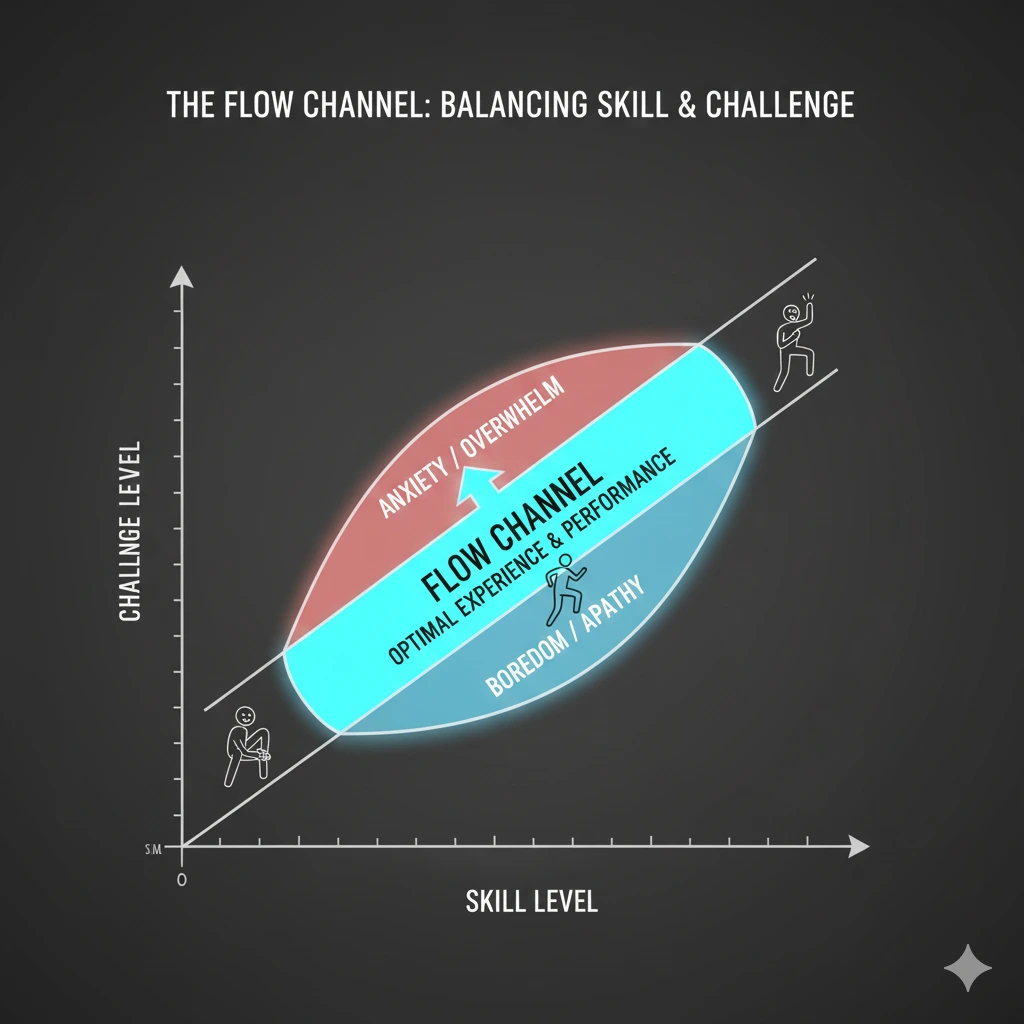
The mindful technique: Match challenge to skill level precisely. Too easy, and you’re bored (no flow). Too hard, and you’re anxious (also no flow). Flow exists in that sweet spot where the task stretches you about 4% beyond your current ability.
Break learning into appropriately sized challenges. If you’re learning a new programming language, don’t start with “build a complete app.” Start with “write a function that does X”—something achievable but not trivial.
A friend learning guitar told me: “I used to practice for an hour and feel exhausted. Now I practice until I realize three hours have passed, and I’m annoyed I have to stop. That’s how I know I’ve found the right difficulty level.”
5. Stress Resilience You Can Actually Feel
Here’s something counterintuitive: regular flow states don’t just make you feel good during them—they build lasting resilience to stress.
A study in the Journal of Happiness Studies found that individuals who regularly experience flow report significantly lower levels of stress and higher levels of psychological well-being, even when measured outside of flow states (Engeser & Baumann, 2016).
Why? Flow trains your nervous system to handle high cognitive load without triggering fight-or-flight responses. You’re teaching your body that intense focus and challenge are safe, even enjoyable. This recalibrates your stress response system.
I used to experience intense anxiety before big presentations or challenging projects. Not anymore. Regular flow states have essentially desensitized me to performance pressure. My body has learned: “Oh, we’re doing something hard? Cool, this is where we thrive.”
The mindful technique: Create a pre-flow ritual that signals to your nervous system “we’re entering a safe challenge space.” Mine is simple: two minutes of box breathing (4-count inhale, hold, exhale, hold), setting my phone to airplane mode, and stating my clear goal out loud.
This Pavlovian conditioning works. Over time, the ritual itself starts triggering the physiological state conducive to flow.

(More techniques: Building Stress Resilience Through Flow)
My therapist once asked: “What if anxiety isn’t the problem, but your relationship with challenge is?” That question changed everything. Flow taught me that challenge can feel like opportunity instead of threat.
6. Time Perception That Gives You Back Your Life
One of the most commonly reported aspects of flow is time distortion—hours feel like minutes. But here’s what’s deeper and more meaningful: regular flow states fundamentally change how you experience time in general.
People who regularly experience flow report feeling like they have more time in their lives overall, not just during flow itself. This seems paradoxical—you’re not getting more hours—but the subjective experience is real and validated by research (Csíkszentmihályi, 1990).
Why? Because flow eliminates the constant mental chatter of “How much longer until this is over?” When you’re not checking the clock every five minutes, time expands subjectively.
I used to feel perpetually rushed, like I never had enough time. Now, even though I’m busier by any objective measure, I feel like I have abundance of time. The difference? I’m actually present in what I’m doing instead of living in anticipation of being done.
The mindful technique: Remove all visible clocks and time indicators during your flow sessions. Put your phone face-down. Cover your computer’s clock. Use a timer that vibrates when your session ends, but doesn’t show elapsed time.
This single change dramatically increases your chances of achieving time distortion. Your brain stops tracking duration and fully commits to the present task.

(Explore: The Time Perception Paradox of Flow States)
As someone wise once said: “Time you enjoy wasting isn’t wasted time.” Flow takes this further: time you’re fully present for isn’t limited time.
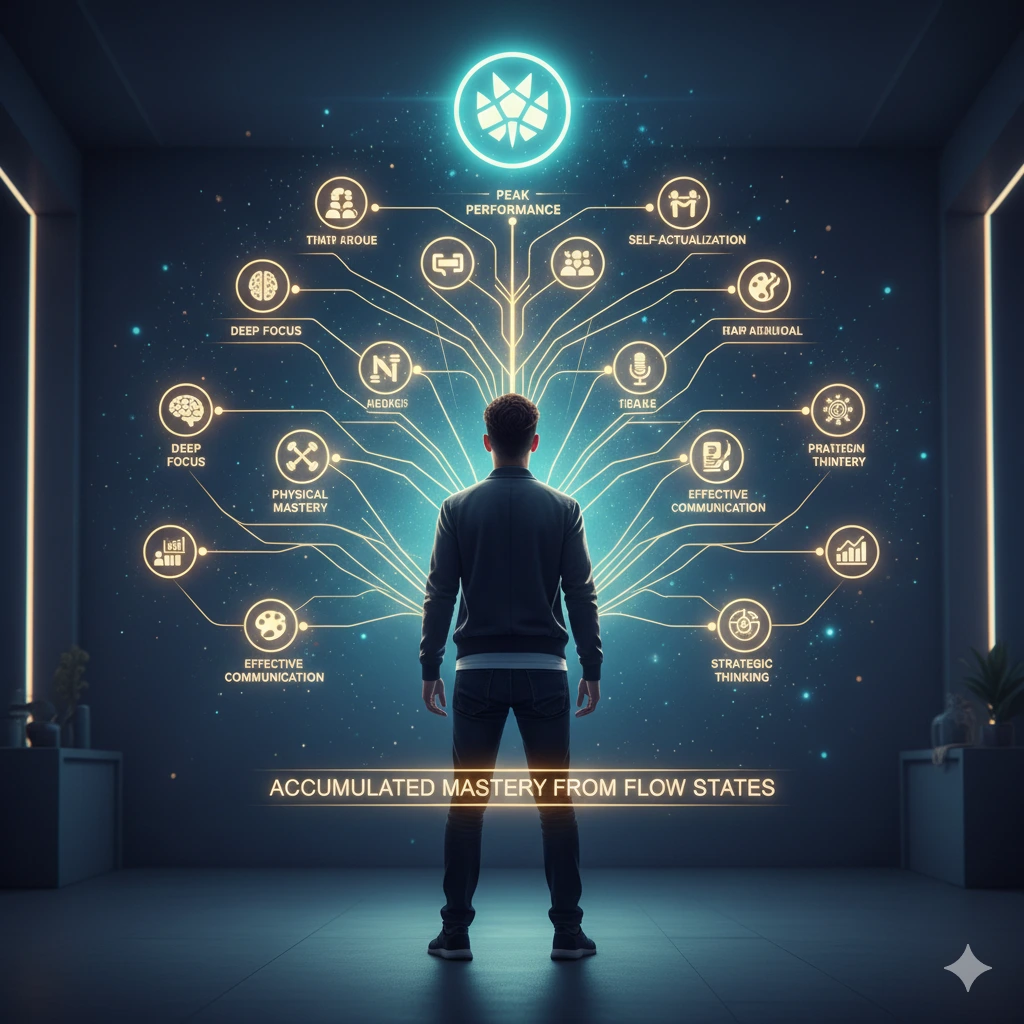
7. Enhanced Self-Confidence (The Earned Kind)
This isn’t the fake-it-till-you-make-it confidence from affirmations. This is the deep, unshakeable confidence that comes from repeatedly proving to yourself that you can handle challenging situations.
Every flow session is evidence that you’re capable of sustained, high-level performance. Your brain keeps receipts. Over time, this builds genuine self-efficacy—the belief in your ability to execute tasks and reach goals (Bandura, 1977).
Research shows that individuals who regularly experience flow in their work report significantly higher levels of self-confidence and self-esteem compared to those who don’t (Engeser, 2012).
I’ve noticed this in myself. I no longer catastrophize before difficult projects. I have a track record—stored in my own memory—of entering flow and handling complexity. My brain knows: “We’ve done hard things before. We can do this one too.”
The mindful technique: After each flow session, take 60 seconds to acknowledge what you accomplished. Not in a self-congratulatory way, but as factual observation: “I sustained focus for 90 minutes on a complex problem. I adjusted my approach when needed. I produced meaningful output.”
This isn’t ego. It’s building an internal database of competence your brain can reference when imposter syndrome or self-doubt tries to take the wheel.
(Build confidence: From Self-Doubt to Self-Efficacy Through Flow)
My martial arts instructor says: “Confidence is just competence recognized by its owner.” Flow forces you to recognize your competence in real-time.
8. Physical Health Benefits You Can Measure
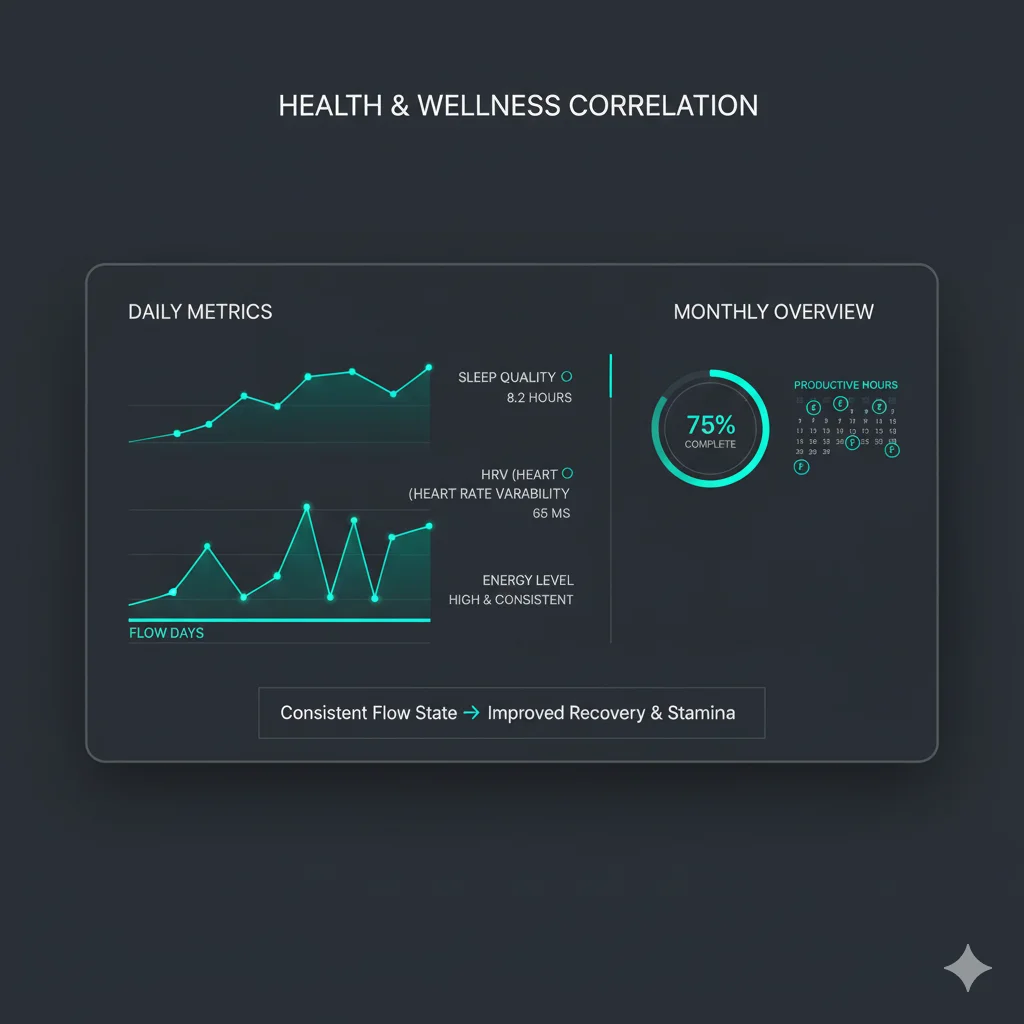
This one sounds too good to be true, but the research is compelling: regular flow states correlate with measurable improvements in physical health markers.
Studies have found that flow experiences are associated with:
- Reduced cortisol (stress hormone) levels
- Enhanced immune function
- Improved cardiovascular health markers
- Better sleep quality
- Reduced inflammation markers
The mechanism isn’t fully understood, but the leading theory involves the parasympathetic nervous system activation during and after flow, combined with reduced chronic stress load (Peifer et al., 2014).
Personally? I sleep better on days I’ve experienced flow. My resting heart rate has dropped. I get sick less often. I didn’t change my diet or exercise routine—I just started prioritizing flow-conducive work conditions.
The mindful technique: Track your subjective energy levels and sleep quality alongside your flow experiences. Use a simple 1-10 scale. You’ll likely notice correlations that motivate you to prioritize flow-friendly conditions.
When you see the data that “days with 2+ hours of flow” correspond to “slept great and woke up energized,” you start treating flow states as essential to your health, not optional productivity hacks.
(Health connection: The Mind-Body Benefits of Regular Flow)
A doctor friend jokes: “If I could prescribe flow states like I prescribe statins, I would. But insurance doesn’t cover ‘finding work you love’ yet.”
9. Meaning and Purpose (The Reason You Keep Going)
Here’s the benefit nobody tells you about because it sounds too philosophical for a productivity article: regular flow states give your life meaning.
I don’t mean this in some woo-woo, abstract sense. I mean that when you regularly experience deep engagement with your work, when you lose yourself in challenging pursuits, when you look up from what you’re doing and realize hours passed in what felt like minutes—you’re experiencing what makes life feel worth living.
Nakamura and Csíkszentmihályi’s (2009) extensive research found that people who regularly experience flow report significantly higher levels of life satisfaction and sense of meaning. Flow isn’t just about getting things done—it’s about feeling alive while doing them.
Viktor Frankl wrote that we find meaning through creating, experiencing, and choosing our attitude toward unavoidable suffering. Flow is the experience of creating and fully engaging with life. It’s the opposite of merely existing or going through the motions.
Before I understood flow, I was perpetually asking: “What’s the point of all this?” Now I rarely ask that question. The point is right here, in this moment of full engagement with a challenge that matters to me.
The mindful technique: Gratitude journaling (mentioned earlier, but worth emphasizing here). At the end of each day, write one sentence about when you felt most engaged, most alive, most yourself.
Over time, you’ll notice patterns. Certain activities consistently produce flow. Certain environments. Certain times of day. This isn’t just data—it’s a map to your most meaningful life.

(Explore meaning: Finding Purpose Through Flow and Mindfulness)
As Joseph Campbell said: “Follow your bliss.” I’d add: if you don’t know what your bliss is, pay attention to when you experience flow. That’s your bliss waving at you, trying to get your attention.
The Practical Framework: Accessing These Benefits Starting Today
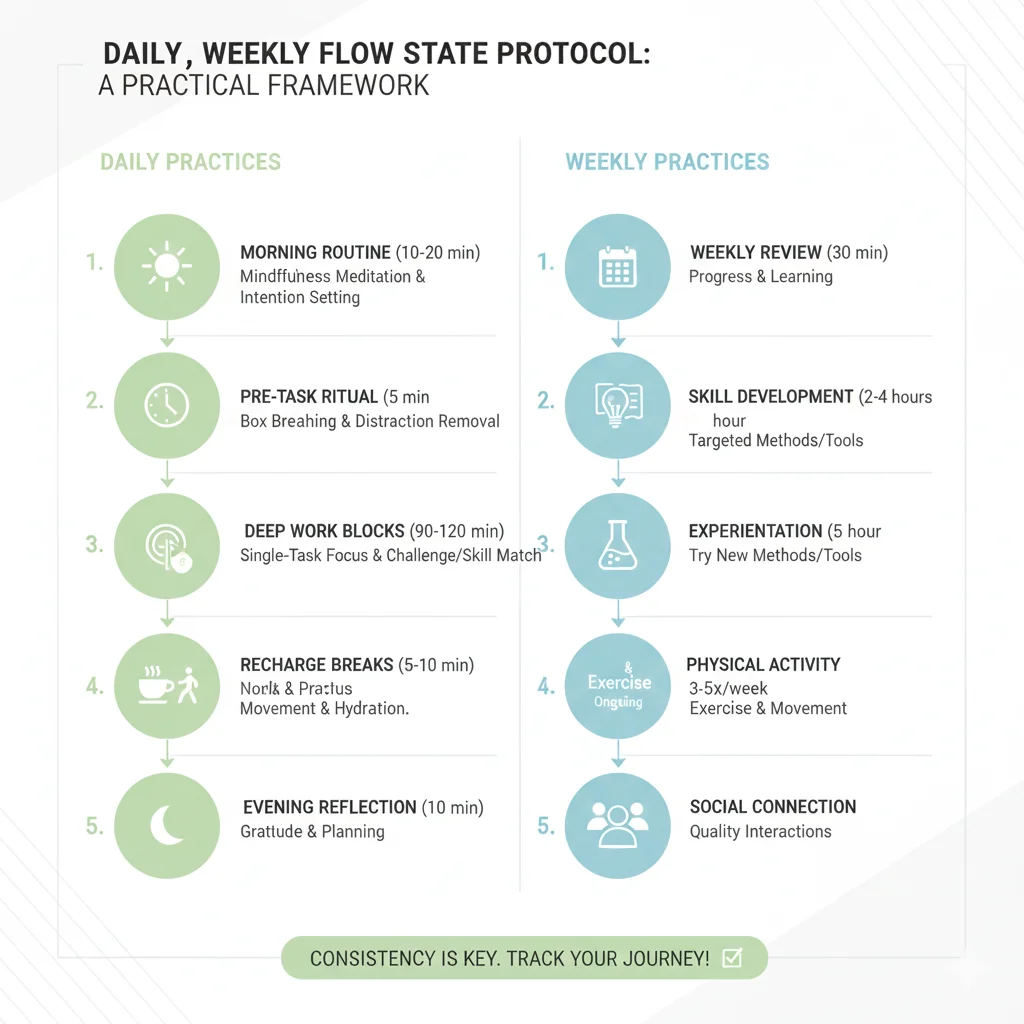
Reading about flow benefits is nice. Actually experiencing them is transformative. Here’s your practical, mindful framework for making flow a regular part of your life:
Step 1: Design Clear Goals (5 minutes before each work session)
- Write down exactly what you intend to accomplish
- Make it specific enough that you’ll know when you’re done
- Ensure it’s challenging but achievable with your current skills
Step 2: Create Immediate Feedback Loops
- Set up mechanisms that tell you if you’re on track
- For coding: frequent test runs
- For writing: word count trackers or peer reviews
- For creative work: quick check-ins with stakeholders
- The faster the feedback, the deeper the flow
Step 3: Practice Daily Gratitude Journaling
- End each day with 2-3 minutes of reflection
- Write about moments of engagement, not just accomplishments
- Notice what conditions preceded your best flow experiences
- Adjust your environment and schedule accordingly
Step 4: The Weekly Flow Audit
- Every Sunday, review your week
- Count hours spent in flow (be honest—you know the difference)
- Identify flow blockers (interruptions, unclear goals, wrong difficulty)
- Schedule flow blocks for the coming week like important meetings
Your 30-Day Challenge:
- Week 1: Practice clear goal-setting before each major task
- Week 2: Add immediate feedback mechanisms to your work
- Week 3: Start daily gratitude journaling about engagement
- Week 4: Conduct your first weekly flow audit and optimize
(Get the toolkit: Complete Flow State Toolkit and Tracker)
A productivity coach I respect says: “Systems beat goals every time.” This isn’t a goal to ‘achieve flow’—it’s a system for creating flow-conducive conditions. Show up to the system, and flow shows up for you.
The Meta-Benefit: You Stop Living for Someday
Here’s the benefit that encompasses all the others: when you regularly experience flow, you stop postponing your life.
You’re not living for retirement, for the weekend, for when you finally achieve X. You’re experiencing deep engagement and satisfaction right now, in the process of becoming who you’re meant to be.
The nine benefits I’ve outlined—productivity, creativity, happiness, learning, resilience, time perception, confidence, health, and meaning—they’re not future promises. They’re present realities you can access through mindful practice starting today.
Flow states aren’t reserved for elite athletes or creative geniuses. They’re available to anyone willing to align their challenges with their skills, set clear goals, create feedback loops, and approach their work with full presence.
The research is overwhelming. The techniques are straightforward. The benefits are transformative.
The only question is: will you prioritize creating conditions for flow, or will you keep waiting for motivation, inspiration, or perfect circumstances to strike?

Your move. The flow is waiting.
References
Bandura, A. (1977). Self-efficacy: Toward a unifying theory of behavioral change. Psychological Review, 84(2), 191-215.
Csíkszentmihályi, M. (1990). Flow: The Psychology of Optimal Experience. Harper & Row.
Engeser, S. (Ed.). (2012). Advances in Flow Research. Springer Science & Business Media.
Engeser, S., & Baumann, N. (2016). Fluctuation of flow and affect in everyday life: A second look at the paradox of work. Journal of Happiness Studies, 17(1), 105-124.
Isen, A. M., Daubman, K. A., & Nowicki, G. P. (1987). Positive affect facilitates creative problem solving. Journal of Personality and Social Psychology, 52(6), 1122-1131.
Nakamura, J., & Csíkszentmihályi, M. (2009). Flow theory and research. In S. J. Lopez & C. R. Snyder (Eds.), Oxford Handbook of Positive Psychology (2nd ed., pp. 195-206). Oxford University Press.
Peifer, C., Schulz, A., Schächinger, H., Baumann, N., & Antoni, C. H. (2014). The relation of flow-experience and physiological arousal under stress—Can u shape it? Journal of Experimental Social Psychology, 53, 62-69.