
How watching your thoughts like clouds can unlock the divergent thinking your next big idea desperately needs

You know that feeling when you’re staring at a blank screen, willing your brain to produce something—anything—original, and instead it serves up the mental equivalent of a loading screen that never quite loads?
I’ve been there. We’ve all been there.
Here’s what nobody tells you about creativity: it’s not actually blocked. Your brain isn’t broken. You’re just trying to force-feed it through a tunnel when what it really needs is an open field.
Enter Open Monitoring (OM) meditation—the practice that neuroscience is finally catching up to, and the one that might just save your next brainstorming session from death by PowerPoint template.
What Your Brain Actually Does During Open Monitoring (Spoiler: It’s Weird and Wonderful)
Open Monitoring meditation is like being a sky that watches clouds pass by, except the clouds are your thoughts, and you’re not frantically trying to organize them into neat little cumulus formations.
Unlike Focused Attention meditation—where you’re essentially doing mental push-ups on a single object like your breath—OM meditation asks you to keep your awareness wide open. You’re the bouncer at the club of consciousness, but instead of checking IDs and deciding who gets in, you’re just… noticing everyone who shows up.
Research by Colzato and colleagues (2012) found something fascinating: people who practiced OM meditation showed significantly enhanced divergent thinking—the kind of thinking that generates multiple creative solutions rather than zeroing in on one “correct” answer. This wasn’t just a feel-good finding. We’re talking measurable improvements in creative task performance.
“My brain during focused meditation: drill sergeant. My brain during OM meditation: friendly park ranger saying ‘oh, a thought! how interesting.'”
But here’s where it gets really interesting. Lippelt et al. (2014) discovered that OM meditation doesn’t just make you more creative—it makes you more adaptable. Your brain literally becomes better at switching between different ways of thinking. In a world where your morning might involve debugging code, designing a presentation, and figuring out why your teammate is passive-aggressively using exclamation points in Slack, that adaptability is currency.
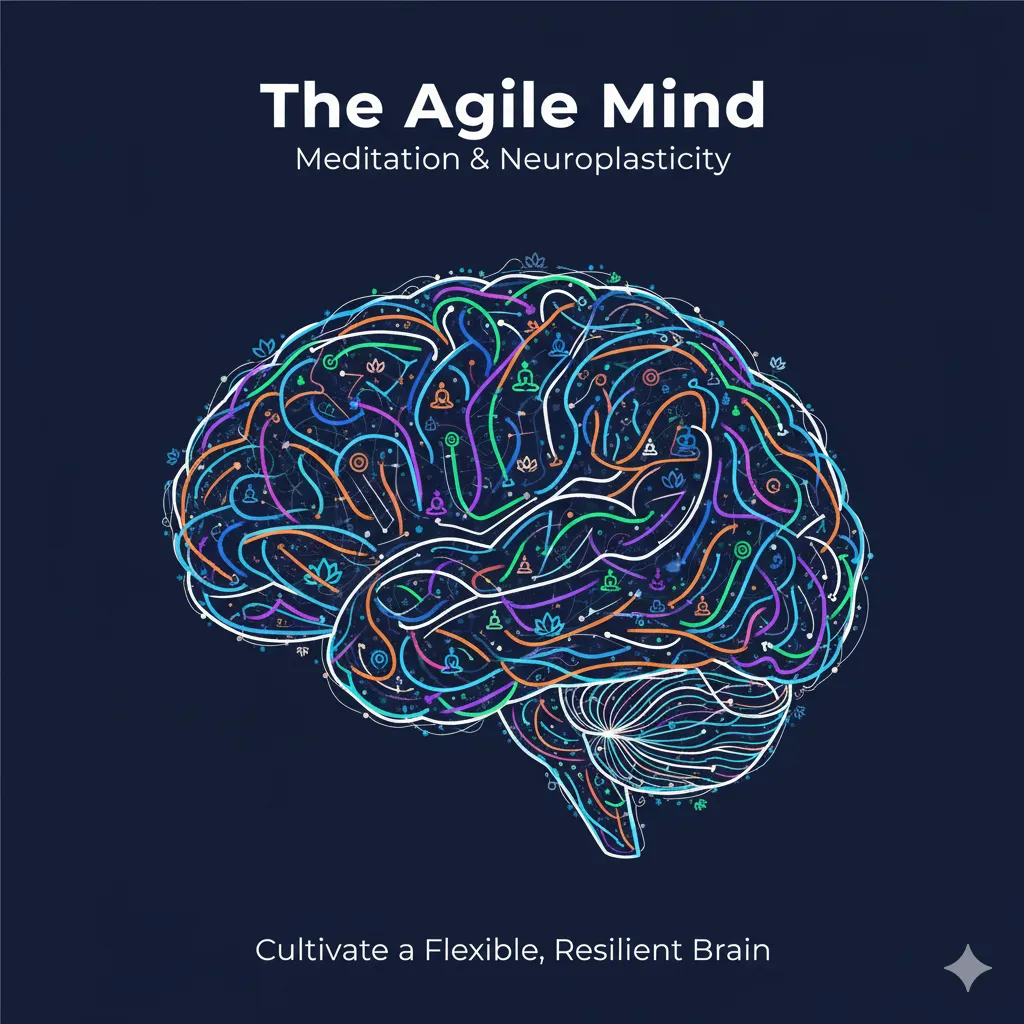
The Meta-Awareness Superpower You Didn’t Know You Needed
Let’s talk about meta-awareness, because this is where OM meditation earns its creative credentials.
Meta-awareness is awareness of awareness. It’s stepping back from your thoughts enough to notice that you’re thinking them. It’s the difference between “I’m terrible at this” and “Oh, I’m having the thought that I’m terrible at this.”
That gap? That tiny space between you and your thought? That’s where creative flow lives.
When you’re locked in a death grip with your thoughts—believing every catastrophic prediction, following every tangent down its rabbit hole—you’re operating from inside the snow globe. Meta-awareness lets you pick up the snow globe and give it a gentle shake. Suddenly you’re not trapped in the blizzard; you’re watching it with curiosity.
This matters for creativity because most creative blocks aren’t actually creative problems. They’re anxiety problems disguised as creative problems. The ideas are there, but they’re buried under layers of “this isn’t good enough,” “someone’s already done this,” and “what if everyone thinks I’m an idiot?”
OM meditation trains you to notice these thoughts without climbing aboard their particular catastrophe train. You become the station platform instead of the passenger.
“Meditation teacher: ‘Just observe your thoughts.’ My thoughts: a full theatrical production of every embarrassing thing I’ve ever said, complete with costume changes.”
The Actual Practice: Non-Judgmental Noting, Thought-Cloud Watching, and Spacious Awareness
Enough theory. Let’s get practical, because knowing about meditation without practicing it is like reading a cookbook and expecting to taste the food.
Phase 1: Non-Judgmental Noting (Weeks 1-2)
Start here. This is your training wheels.
How to do it:
- Find a comfortable seat. You don’t need a cushion handcrafted by Tibetan monks. Your desk chair works fine. I’ve done this in airport bathrooms. (Don’t judge my life.)
- Set a timer for 10 minutes. Later you can go longer, but we’re building a habit, not auditioning for a monastery.
- Close your eyes or soften your gaze toward the floor.
- Notice what shows up in your awareness. Sounds. Sensations. Thoughts. Emotions. All of it.
- When you notice something, mentally note it without commentary. “Thinking.” “Hearing.” “Feeling.” “Planning.” Not “overthinking again, classic me” or “why is that car alarm so loud, don’t people care about noise pollution?”—just simple, one-word labels.
- Let the thing dissolve back into awareness and wait for the next thing.
The noting part is crucial. It’s like gently tapping each thought on the shoulder and saying “I see you” before letting it move along. You’re building the muscle of meta-awareness—the ability to notice what you’re noticing.
Common trap: Getting frustrated that you’re not “good at it.” Friend, if you’re noticing that you’re frustrated, congrats—you’re doing it right. That’s the practice. Notice the frustration: “Frustration.” Then notice what comes next.
For more on building sustainable meditation habits that actually stick, check out The Engineer’s Guide to Starting Meditation Without Losing Your Mind.
Phase 2: Thought-Cloud Watching (Weeks 3-4)
Once noting feels somewhat natural (it never feels completely natural, that’s okay), you’re ready to drop the labels and just watch.
How to do it:
- Same setup as before. Comfortable seat. Timer. Eyes closed or soft gaze.
- This time, imagine your awareness as a vast sky. Thoughts, feelings, and sensations are clouds drifting through.
- Instead of noting each cloud, just watch them form, move, and dissolve. Some clouds are wispy. Some are storm clouds. Some are those weird mammatus clouds that look like the underside of bubble wrap.
- The key: you’re not trying to change the clouds or make them go away. You’re not “good at meditation” if you have fewer clouds. You’re simply watching the weather of your mind.
- When you realize you’ve been daydreaming or planning or mentally writing your autobiography, that’s fine. That’s not failure—that’s the moment you wake up. Notice you were caught in thought, appreciate the moment of waking, and return to sky-watching.
This phase builds the creative muscles. You’re training your brain to hold multiple possibilities at once without immediately judging or collapsing them into a single “right” answer. Every thought is just another cloud. Every idea is welcome to float by.

“Me: ‘I am the vast, spacious sky.’ Also me: ‘Is that my stomach growling or the neighbor’s plumbing?'”
Connection to creativity: This is where divergent thinking starts to unlock. When you can hold an idea without immediately critiquing it, judging it, or comparing it to that brilliant thing your colleague did last quarter, you create space for unexpected connections. Your brain starts playing with possibilities instead of defending against them.
Phase 3: Spacious Awareness (Week 5+)
This is the deep end. This is where the magic happens.
How to do it:
- By now, the setup is second nature. Seat. Timer. Soft eyes.
- Drop the cloud metaphor entirely. Drop any technique.
- Simply rest in awareness itself. Not awareness of something. Just awareness. Open. Spacious. Receptive.
- Whatever arises—thoughts, sounds, sensations, emotions, impulses—let it all arise and pass within this spacious awareness. Nothing needs to be noted. Nothing needs to be watched. You’re simply being the space in which experience happens.
- This sounds mystical and weird, and honestly, it kind of is. But it’s also incredibly simple. You’re not doing anything. You’re being aware of being aware.
This is where the research shows the real creative payoff. When you can rest in this kind of open, non-directive awareness, your brain’s Default Mode Network—the network associated with creative thinking, self-reference, and making novel connections—lights up like Times Square.
You’re giving your brain permission to make weird associations. To connect the code you wrote yesterday with the conversation you had with your partner last week with the article you skimmed about fungal networks with the problem you’ve been stuck on for three days. Your conscious mind isn’t driving anymore; you’re letting the vast, weird, associative unconscious do its thing.
For a deeper dive into how meditation rewires your creative brain, see The Neuroscience of Flow States: What Your Brain Actually Does.
“Spacious awareness is just sitting there doing nothing, which I used to think meant I was lazy but now I call it ‘optimizing my neural network for non-linear problem-solving.'”
What This Actually Looks Like in Your Creative Work
Let’s get concrete. How does watching thought-clouds translate to better brainstorming?
Before OM meditation:
You’re in a meeting. Someone suggests an idea. Your brain immediately serves up seventeen reasons why it won’t work, three examples of similar ideas that failed, and a full risk assessment complete with charts. The idea dies before it takes its first breath. Repeat for every subsequent idea. Meeting ends. Everyone agrees to “think about it” (which means “quietly give up”).
After regular OM meditation:
Same meeting. Same suggestion. This time, you notice the critical thought arise—”that won’t work because…”—but you recognize it as just another cloud. You don’t grab it. You don’t believe it. You let it drift by while keeping your awareness open to other possibilities.
Suddenly there’s space. Someone builds on the idea. You notice a connection to something else. Someone asks “what if we…” and instead of shooting it down, you stay curious. The idea evolves. It gets weirder. It gets better.
This isn’t about positive thinking or forcing yourself to love every bad idea. It’s about creating enough spaciousness that good ideas have room to breathe before your inner critic performs a drive-by shooting.
Research backs this up. Colzato’s 2012 study showed that even brief OM meditation practice improved performance on the Alternative Uses Task—a standard measure of divergent thinking where you generate creative uses for common objects. Participants who practiced OM meditation came up with more uses and more original uses than control groups.
Lippelt’s 2014 research added another layer: OM meditation improved cognitive flexibility, meaning people could more easily switch between different approaches to a problem. In creative work, this is gold. Sometimes you need to zoom in on details; sometimes you need to zoom out to see patterns. OM meditation makes those transitions smoother.
Building This Into Your Actual Life (Not Your Fantasy Meditation Life)
Here’s where most meditation advice goes to die: the implementation.
“Just meditate for 45 minutes every morning before your 5 AM workout!” Sure, and while I’m at it, I’ll learn Mandarin and take up woodworking.
Let’s be real. You’re reading this on your lunch break or while procrastinating on something else or while waiting for your code to compile. You don’t need another thing to feel guilty about not doing.
Start stupidly small:
- Week 1: 5 minutes, three times a week. That’s it. You can find 5 minutes. Use a meditation app timer, or just set your phone timer.
- Week 2-3: Same duration, but try for five times a week.
- Week 4+: If it’s sticking, gradually increase to 10 minutes, then 15. If it’s not sticking, stay at 5 minutes but make it daily.
Anchor it to something you already do:
- After your morning coffee
- Before lunch
- During your commute (if you take public transit—obviously not while driving)
- After you close your laptop for the day
Make it so easy you can’t say no:
- Already sitting at your desk? Close your eyes for 5 minutes right there.
- Use the same seat every time—your brain loves ritual.
- Don’t try to make it “perfect” or sacred. This isn’t about transcendence; it’s about practice.
For more practical implementation strategies that actually work with your chaotic schedule, visit The Realistic Practitioner’s Guide to Daily Meditation.
Track it without being weird about it:
- Put a check mark on a calendar. Physical is better than digital for this.
- Aim for 80% completion, not 100%. Life happens. Perfectionism kills practice.
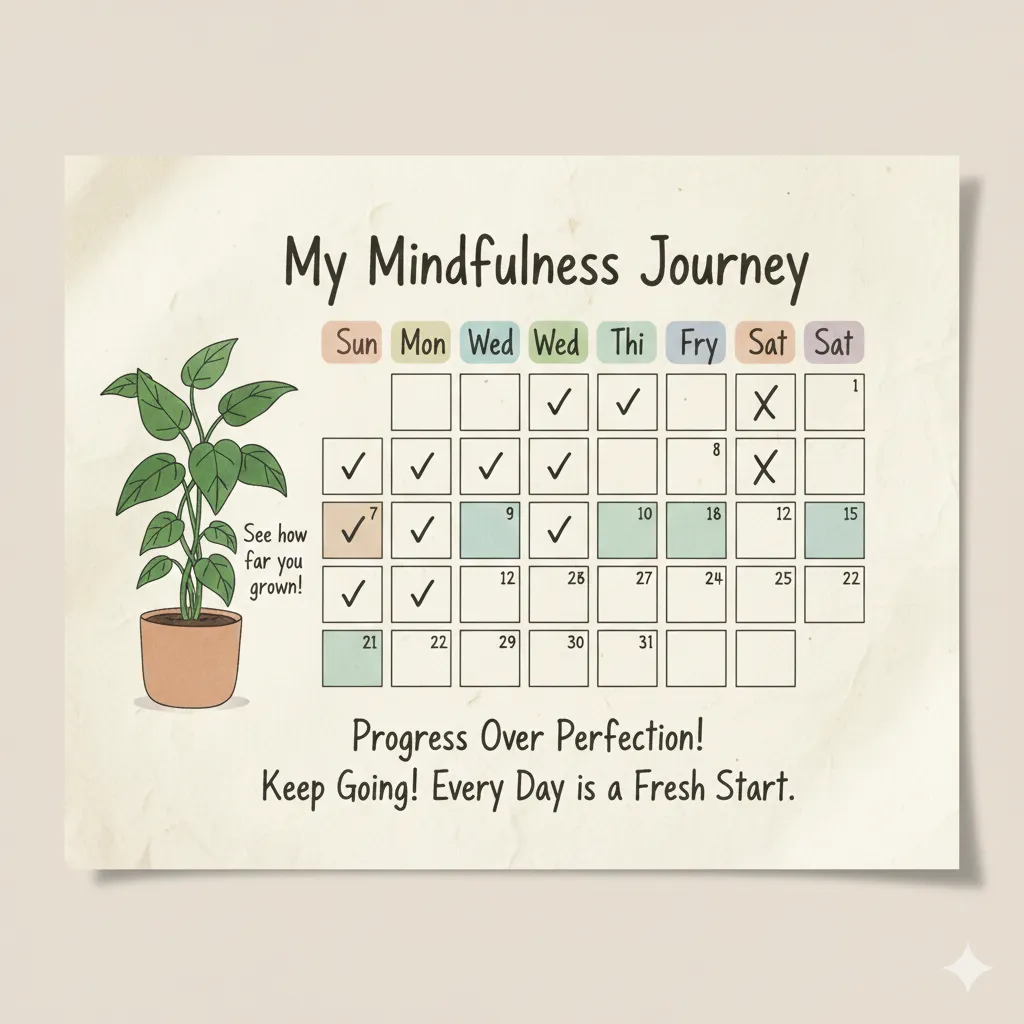
“I started with 5 minutes a day and thought ‘this is nothing.’ Six months later, those 5 minutes have saved me approximately 847 hours of spinning in analysis paralysis.”
What to Expect (The Good, the Weird, and the “Am I Doing This Wrong?”)
Let’s set some realistic expectations, because meditation marketing often oversells and underexplains.
Week 1-2: The Honeymoon You might feel great. Calmer. More focused. Like you’ve discovered the secret to life. This is lovely but temporary. Enjoy it, but don’t expect it to last.
Week 3-4: The Boring Middle Nothing dramatic happens. You sit. Thoughts happen. You notice them. Repeat. This is where most people quit because they think they’re “not doing it right.” But this IS doing it right. The practice is the practice. Keep going.
Week 5-8: The Weird Stuff You might notice subtle shifts:
- Ideas popping up at random times
- Less reactivity to minor annoyances
- More space between stimulus and response
- Occasional moments of genuine creative insight
- Or… nothing obvious at all, which is also fine
Month 3+: The Integration The practice becomes less of a “thing you do” and more of a quality you bring to your day. You’re naturally more aware, more spacious, more creatively flexible. You stop caring whether meditation “works” because you’re just doing it.
Common experiences:
- Restlessness: Totally normal. Note it: “Restlessness.” Keep sitting.
- Sleepiness: Also normal. Sit up straighter, open your eyes slightly.
- Boredom: The most common one. Boredom is just your mind’s protest at not being entertained. It passes.
- Emotional stuff coming up: Happens sometimes. If it’s intense, consider working with a teacher or therapist. If it’s mild, just note it and let it process.
- “I’m not creative yet, is this broken?” Creativity isn’t a vending machine. You’re building capacity, not forcing output.
The Science You Can Actually Use
Let’s ground this in research you can cite at dinner parties (or justify to your skeptical engineer friends).
Colzato et al. (2012) published their findings in Frontiers in Psychology, showing that Open Monitoring meditation specifically enhanced divergent thinking—the kind of thinking that generates multiple solutions and novel connections. This wasn’t just about feeling relaxed; participants showed measurable improvement on creativity tasks.
Lippelt et al. (2014), also in Frontiers in Psychology, demonstrated that OM meditation improved cognitive flexibility and control. Think of it as upgrading your brain’s operating system to handle more diverse inputs and switch between processing modes more efficiently.
The mechanism seems to work like this:
- OM meditation reduces cognitive rigidity—the tendency to get stuck in one way of thinking
- It enhances meta-awareness, giving you perspective on your thought patterns
- It increases attentional breadth, allowing you to hold multiple possibilities simultaneously
- It quiets the default mode network’s tendency toward self-referential thinking (“what does this mean about me?”) while maintaining its creative connectivity
This creates optimal conditions for creative flow: you’re alert but not effortful, open but not scattered, engaged but not attached to outcomes.
For a complete breakdown of the research behind meditation and cognitive enhancement, see The Science of Meditation: What Actually Works.
Why This Works When Other “Creativity Hacks” Don’t
You’ve probably tried the other stuff:
- Taking walks (helpful but not sufficient)
- Brainstorming sessions (often devolve into idea-killing)
- Reading about creativity (ironic, isn’t it?)
- Trying to “think outside the box” (impossible when you don’t realize you’re in a box)
These aren’t bad. They’re just surface-level.
OM meditation works because it addresses the root issue: your relationship with your own thinking. Most creativity problems aren’t about generating ideas—your brain generates thousands of thoughts per day, many of them potentially useful. The problem is that you’re immediately filtering, judging, and discarding most of them before they have a chance to develop.
OM meditation trains you to:
- Notice thoughts without immediately evaluating them
- Hold multiple possibilities without collapsing into certainty
- Recognize when you’re in a creative state versus a critical state
- Switch between modes intentionally rather than reactively
It’s not a hack. It’s infrastructure. You’re building the cognitive flexibility and meta-awareness that makes every other creative practice more effective.
“Other creativity advice: ‘Just think differently!’ OM meditation: ‘Here’s how to actually notice how you’re thinking so you can work with your brain instead of fighting it.'”
Your Starter Kit: What to Do Right Now
If you’re still reading, you’re probably at least mildly convinced (or very bored, in which case, congrats on the OM practice of reading without immediate gratification).
Here’s what to do next:
Today:
- Set a timer for 5 minutes
- Sit somewhere comfortable
- Close your eyes
- Note whatever arises: “Thinking.” “Hearing.” “Feeling.”
- When the timer rings, you’re done. That’s it.
This Week:
- Do the above three times
- Don’t worry about whether you’re “good at it”
- Notice what shows up—both during practice and in your regular creative work
This Month:
- Move through the three phases (noting → cloud-watching → spacious awareness) at your own pace
- Track your practice somewhere visible
- Notice any shifts in your creative process, even subtle ones
Long-term:
- Build to 15-20 minutes daily if you can
- Connect with the MindfulEngineer.ai community for support
- Consider working with a teacher if you want to deepen your practice
The Uncomfortable Truth About Creativity (And What OM Meditation Teaches You)
Here’s what nobody wants to hear: you can’t force creativity. You can only create conditions where it’s more likely to emerge.
OM meditation teaches you this in the most direct way possible. You sit down expecting insights. Nothing. You sit down distracted and annoyed. Suddenly, clarity. You think you’re “bad at this.” Then you notice you’re thinking that, and in the noticing, something loosens.
Creativity doesn’t arrive because you demand it. It emerges when you create enough spaciousness that it has room to breathe. When you stop gripping so tight that your ideas suffocate in your palm.
The research backs this up, but honestly, you don’t need research. Try the practice. Notice what happens. Maybe it unlocks something. Maybe it just makes you slightly less reactive when your creative ideas get shot down in meetings. Both are valuable.
Your brain is already creative. You don’t need to make it something it isn’t. You just need to get out of your own way long enough to let it do what it does best: make weird, unexpected, occasionally brilliant connections between things that shouldn’t go together but somehow do.
OM meditation is how you practice getting out of the way.
“Turns out, the creative breakthrough I was looking for wasn’t at the end of my overthinking tunnel. It was in the spaciousness I found when I finally stopped digging.”
Ready to Start?
Your creative flow isn’t hiding. It’s waiting for you to create the conditions where it can emerge. OM meditation is one of the most reliable ways to build those conditions, backed by neuroscience and centuries of contemplative practice.
Start with 5 minutes. Let it be messy. Let it be boring. Let it be exactly what it is.
Your next creative breakthrough might just be waiting on the other side of watching your thoughts drift by like clouds.
For more resources, guided practices, and a community of practitioners navigating the intersection of mindfulness and creative work, visit MindfulEngineer.ai.
References:
Colzato, L. S., Ozturk, A., & Hommel, B. (2012). Meditate to create: the impact of focused-attention and open-monitoring training on convergent and divergent thinking. Frontiers in Psychology, 3, 116.
Lippelt, D. P., Hommel, B., & Colzato, L. S. (2014). Focused attention, open monitoring and loving kindness meditation: effects on attention, conflict monitoring, and creativity–A review. Frontiers in Psychology, 5, 1083.