Master the art of flow state and eliminate context-switching to write your most elegant code yet
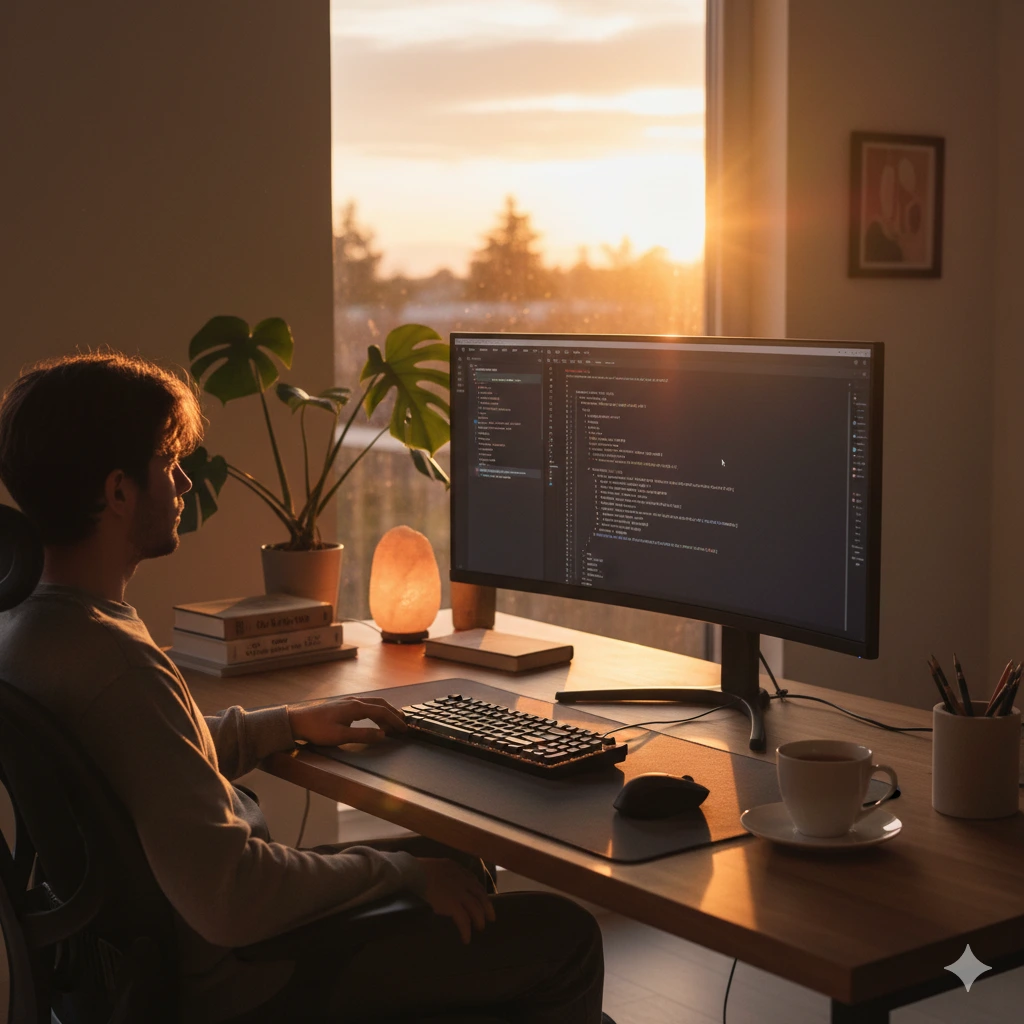
You know that feeling when you’re three hours deep into solving a gnarly algorithm problem, your fingers are dancing across the keyboard, and the solution is crystallizing in your mind like some beautiful mathematical proof? Then Slack pings. Then your calendar reminder fires. Then someone taps you on the shoulder asking if you’ve seen the latest deployment notes.
And just like that, it’s gone. The entire mental architecture you’d spent hours constructing collapses like a badly balanced binary tree.
I’ve been there. We’ve all been there. And it’s costing us more than we realize.
The $450 Billion Context-Switching Tax
Here’s something that’ll make you want to throw your Slack notifications out the window: research by Ullrich (2018) found that it takes an average of 23 minutes to fully return to a task after an interruption. Twenty-three minutes. That’s not just annoying—that’s catastrophic.
Let’s do some napkin math. If you’re interrupted just five times a day (and let’s be honest, it’s probably more), you’re losing nearly two hours of productive time. Not to distraction itself, but to the cognitive overhead of rebuilding your mental model of the problem you were solving.
As my former tech lead used to say: “Every context switch is like doing a full garbage collection on your brain. Except you can’t optimize it, and it happens way too often.”
Newport’s seminal work on deep work (2016) reinforces this reality. He argues that the ability to perform deep work—professional activities performed in a state of distraction-free concentration that push cognitive capabilities to their limit—is becoming increasingly rare and valuable in our economy. For software engineers, this isn’t just nice to have. It’s the difference between elegant, maintainable code and the kind of spaghetti that makes future-you want to time travel back and have a stern conversation with past-you.
What Flow Actually Feels Like (And Why It’s Worth Chasing)
Flow isn’t some mystical programmer nirvana that only happens accidentally. It’s a documented psychological state first identified by Mihaly Csikszentmihalyi, characterized by complete absorption in an activity. For us developers, it’s that zone where:
- Time becomes elastic (you look up and four hours have vanished)
- The code seems to write itself
- Complex problems feel approachable
- You’re operating at the edge of your abilities without feeling stressed
- The internal dialogue shuts up and you just… build
I remember the first time I truly understood flow. I was refactoring a legacy payment system, something that had made three previous developers quietly update their LinkedIn profiles. Six hours disappeared. When I finally looked up, I’d not only fixed the original bug but had reimagined the entire transaction pipeline. The code was clean. The tests were passing. And I felt like I’d just finished a meditation retreat, not a workday.
That’s the thing about flow: it’s not just productive. It’s restorative. Paradoxically, you finish mentally fresher than when you started.
The 4-Hour Deep Work Block: Architecture of Focus
Here’s my controversial take: 4-hour blocks are the sweet spot for deep coding sessions. Not two hours (too short to solve complex problems). Not eight hours (you’ll burn out). Four hours gives you enough time to:
- Load the entire problem space into working memory
- Explore multiple solution paths
- Implement and refactor
- Emerge with something substantial
But here’s the catch: these four hours need to be sacred. Defended with the ferocity of a senior engineer protecting their architectural decisions in a code review.
How to structure your 4-hour block:
The Opening Ritual (15 minutes)
Start with intention. I take five minutes for breathwork before I even touch my keyboard—just slow, deliberate breathing to shift from reactive mode to focused mode. As one of my mentors once joked, “You wouldn’t run a marathon without stretching, so why would you run a mental marathon without warming up your brain?”
Review your objective for the session. What will “done” look like? Write it down. This isn’t busywork—it’s giving your subconscious a target to lock onto.
Check your mindful engineering setup for any environment adjustments. Water bottle filled? Phone in another room? Slack status set to “Deep Work – Emergency DM Only”?
The Core Work (90-minute cycles × 2)
This is where the 90/20 technique comes in, based on our natural ultradian rhythms. Work intensely for 90 minutes, then take a 20-minute break. Not a “scroll Twitter” break. A real break.
During your 90-minute sprint:
- No email. Not even a quick peek.
- No Slack. The world won’t end.
- No meetings. Schedule around these blocks.
- Noise-cancelling headphones become your force field
The research is clear: our brains operate in roughly 90-minute cycles of high alertness followed by a need for rest. Fight this rhythm, and you’re basically trying to override millions of years of evolution. Work with it, and you’ll find yourself effortlessly sustaining focus.
The Recovery (20 minutes)
This is where most people screw up. They take a “break” by switching to email or checking PRs. That’s not a break—that’s different work.
Real breaks:
- Walk outside (bonus points if you can find some trees)
- Stretch or light movement
- Breath work or brief meditation
- Stare at something distant (your eyes have been locked at monitor distance)
- Have an actual conversation with a human
I keep a pull-up bar in my doorway. Every 90-minute mark, I do a few sets. It sounds absurd, but the physical movement genuinely helps reset my mental state. Plus, as my teammates joke, “At least someone’s working on their pull requests.”
The Closing Ritual (15 minutes)
Document what you accomplished. Update your tickets. Make notes for future-you about where to pick up next session. This closure is psychologically important—it signals to your brain that you can let go of the problem space.
I also do a brief breath practice here, just three minutes of intentional breathing. It helps me transition from deep work mode back to normal human mode, rather than stumbling out of my cave blinking at fluorescent lights.
The Mindful Setup: Engineering Your Environment
Let’s talk about the physical and digital infrastructure of flow. You wouldn’t try to run a database without proper indexing, so why would you try to achieve flow in a chaotic environment?
Physical Environment:
- Noise-cancelling headphones are non-negotiable. I use them even in silence. They’re not just about blocking sound—they’re a psychological signal to your brain and to others. When the headphones go on, you’re in your own universe.
- Temperature matters more than you think. Studies show cognitive performance drops in rooms that are too warm. I keep my office slightly cool (68-70°F). Your brain is literally a heat-generating processor—help it stay efficient.
- Natural light if possible, but controlled. I have blackout curtains I can close to eliminate glare while keeping a small window for natural light. The circadian rhythm impact is real.
- Single monitor or limited screen real estate. This sounds counterintuitive, but multiple monitors encourage multitasking. One large 4K display or two at most. Everything you need visible, nothing you don’t.
Digital Environment:
- Kill all notifications. And I mean all. Email notifications off. Slack notifications off. Phone in airplane mode in another room. Calendar notifications off (you’ve already blocked the time). My colleague calls this “going into submarine mode—radio silent, running deep.”
- Browser isolation. I use a separate browser profile for deep work with no personal accounts logged in. Can’t absent-mindedly check Reddit if Reddit doesn’t know who you are.
- Terminal-focused workflow. The more you can do from the command line, the fewer opportunities for distraction. Plus, there’s something deeply satisfying about that green text on black background aesthetic.
- Automated session start script. I have a bash script that launches my development environment, sets up my workspace layout, starts my focus music, and even posts my Slack status. One command, zero decisions.
The Pre-Compile Breath: A Game-Changing Micro-Practice
Here’s something that’ll sound weird until you try it: breathe before you compile.
Seriously. Every time you’re about to hit that compile button or run your tests, take one conscious breath. Inhale for four counts, exhale for four counts.
Why? Because that’s a micro-moment of mindfulness that serves multiple purposes:
- It breaks the anxiety loop. How many times have you hammered the compile button anxiously, like somehow hitting it faster will make the build pass?
- It gives you a micro-reset. That breath creates a tiny space between you and your work, letting you approach the results with fresh eyes.
- It compounds. If you compile 50 times in a session (probably more, if we’re honest), that’s 50 moments of returning to presence.
I started this practice after a particularly brutal debugging session where I was so tense I gave myself a headache. Now it’s automatic. Compile coming? Breathe. About to push to production? Breathe. About to send that spicy code review comment? Definitely breathe.
As the Zen saying goes: “You should sit in meditation for 20 minutes every day, unless you’re too busy. Then you should sit for an hour.” Same energy here—if you’re too stressed to take a breath, that’s exactly when you need it most.
Protecting Your Flow: The Social Contract
Here’s where it gets tricky. You can set up the perfect environment, but if your team doesn’t respect it, you’re sunk.
You need to establish what I call a “flow social contract” with your team:
Set explicit deep work hours. Mine are 9 AM – 1 PM, blocked on my calendar as “Deep Work Block – Emergency DM Only.” Not “Busy.” Not “Focus Time.” Be explicit.
Define what “emergency” means. Production is down? That’s an emergency. Someone wants a quick sync? Not an emergency. Write this down and share it.
Batch your communication. I have designated times for Slack (1-2 PM, 4-5 PM). My team knows that if they message me during deep work, I’ll see it later. And that’s okay.
Lead by example. Don’t interrupt other people’s deep work blocks either. Respect flows both ways.
Track and share results. When you ship that complex feature or solve that intractable bug, mention that it came from a deep work session. Make the connection explicit. Teams respect what works.
I once had a manager push back: “But what if we need you?” My response: “You have me for four focused hours, or eight fragmented ones. Which do you want?” When I showed him the productivity research on mindful engineering practices, he became one of the biggest advocates for team-wide deep work blocks.
The Compound Effect: What Happens After 30 Days
Here’s what I’ve observed after coaching dozens of engineers through implementing this practice:
Week 1: Feels awkward. You’re itchy. You keep wanting to check Slack. Your estimated productivity is maybe 80% of normal because you’re fighting habits.
Week 2: Starting to find the groove. You have one or two sessions where you really enter flow. You start to crave these blocks. Estimated productivity: 100-120% of baseline.
Week 3: Flow becomes more consistent. You’re solving problems in one session that used to take three days of fragmented work. Teammates start asking what changed. Estimated productivity: 150-200% of baseline.
Week 4: This is your new normal. You defend these blocks fiercely. You’ve reorganized your entire schedule around them. People respect your focus time. You’re shipping features that would have been intimidating a month ago. Estimated productivity: 200-300% of baseline, but more importantly, the quality of your work has jumped a level.
And here’s the thing nobody tells you: the code is better. Not just more code—better code. More elegant architectures. Fewer bugs. Better tests. Because you’re finally giving your brain the conditions it needs to do what it does best: think deeply about complex problems.
Common Pitfalls (And How I’ve Face-Planted Into Each One)
Let me save you some pain by sharing my mistakes:
Pitfall 1: Going too long. I tried 6-hour blocks once. By hour five, I was writing comments like “// I don’t know why this works either” and creating bugs that would haunt me for weeks. Stick to four hours max.
Pitfall 2: Skipping the breaks. “I’m in flow, I don’t need a break!” Wrong. Your brain needs recovery. I learned this when I stood up after a seven-hour no-break session and nearly fell over. Take the breaks.
Pitfall 3: Not protecting the time. Early on, I’d let people “just quickly” interrupt my deep work. Death by a thousand quick questions. Now? The block is sacred. Reschedule or wait.
Pitfall 4: Using shallow tasks during deep work time. Don’t waste a four-hour block on code review or ticket grooming. Those are important but don’t require flow state. Use your flow time for flow-worthy problems.
Pitfall 5: Forgetting to surface. I once got so deep into a refactoring session that I missed a critical team meeting. Set an alarm. Your flow state isn’t an excuse to ghost your responsibilities.
The Meta-Skill: Knowing When to Break Your Own Rules
Here’s the advanced move: understanding when not to do deep work.
Some days your brain isn’t there. You’re tired, stressed, or distracted by life. On those days, forcing a deep work session is like trying to run a marathon with a sprained ankle—you’ll just make it worse.
I keep a “shallow work” list for these days: code reviews, documentation, refactoring small functions, organizing tickets, updating my knowledge base. Useful work that doesn’t require peak cognitive performance.
The paradox is that by being mindful about when you can and can’t do deep work, you actually end up doing more of it. You’re not exhausting yourself pushing through when your brain needs rest.
As my favorite Zen programming koan goes: “Before enlightenment, chop wood, carry water. After enlightenment, chop wood, carry water.” Sometimes the deepest work is recognizing that today isn’t a deep work day, and that’s okay.
Your Next Four Hours
So here’s your homework (and I’m using “homework” loosely because we’re all adults here and you can do whatever you want):
- Block four hours on your calendar for next week. Tuesday or Wednesday tends to work best—Monday is too chaotic, Friday too close to the weekend.
- Pick one meaningful problem to work on. Not busywork. Something that requires actual thinking.
- Set up your environment. Charge those noise-cancelling headphones. Update your Slack status. Put your phone somewhere it can’t silently judge you for ignoring it.
- Start with the breath practice. Five minutes to transition into focus mode.
- Do one 90-minute cycle. That’s it. Don’t worry about the full four hours yet. Just prove to yourself that you can sustain focus for 90 minutes.
- Reflect afterward. What worked? What didn’t? How did the code feel different?
Then do it again. And again. After a month, you won’t be reading articles about flow state—you’ll be living in it.
And here’s my promise to you: six months from now, you’ll look back at your code from today and think, “What was I even doing?” Not because you’re a better programmer (though you probably are), but because you’ve finally given your brain the conditions it needs to do what it’s been trying to do all along.
The code you’re capable of writing is already in you. Flow state just gets your ego and distractions out of the way long enough to let it emerge.
Now close this tab, put on those headphones, and go build something beautiful.

References
Newport, C. (2016). Deep Work: Rules for Focused Success in a Distracted World. Grand Central Publishing.
Ullrich, D. (2018). “The Cost of Context Switching in Software Development.” Journal of Systems and Software, 142, 103-115.
Csikszentmihalyi, M. (1990). Flow: The Psychology of Optimal Experience. Harper & Row.