How strategic thinking meets mindfulness to transform your product decisions from reactive chaos into focused execution

You know that feeling when you’re staring at your product backlog at 11 PM, trying to decide between seventeen “urgent” features, while your CEO’s voice echoes in your head about “strategic focus”? Yeah, I’ve been there. Multiple times. Usually with cold coffee and a migraine.
The irony of product management is that we’re supposed to be the strategic thinkers—the ones who see the big picture—yet we spend most of our days scattered across Slack channels, emergency meetings, and stakeholder firefighting. As my mentor once told me: “You’re not a product manager; you’re a professional plate spinner who occasionally gets to think about products.”
But here’s the thing: what if the solution to strategic thinking isn’t more frameworks, but less mental chaos?
Enter FFlow—a state where strategic thinking meets focused execution, where your scattered energy consolidates into clear, confident decisions. And before you roll your eyes thinking this is another productivity hack, let me tell you: this is about rewiring how your brain approaches product decisions entirely.
What the Hell is FFlow? (And Why Should You Care?)
FFlow isn’t just another buzzword to throw into your next all-hands meeting. The concept draws from psychological research on flow states—those magical moments when you’re completely absorbed in your work, time disappears, and somehow your best thinking emerges (Ceja & Navarro, 2012).
Traditional flow theory focuses on individual peak performance. But FFlow? That’s flow specifically designed for the messy, multi-stakeholder, constantly-interrupted world of product management.
Here’s the honest truth: Most product managers operate in what I call “scattered strategy mode.” You know you should be thinking long-term, but you’re responding to the loudest voice in the room. You have frameworks like RICE, WSJF, and Value vs. Effort matrices, but applying them feels like homework, not insight.
FFlow changes this by integrating mindfulness techniques directly into your prioritization process. Not the “sit-on-a-cushion-for-30-minutes” mindfulness (though that’s cool too), but practical, in-the-moment techniques that help you cut through noise and make decisions that actually stick.
“The problem with most product managers isn’t that they make bad decisions—it’s that they make too many decisions under mental conditions that guarantee bad outcomes.” – Anonymous burned-out PM (probably me)
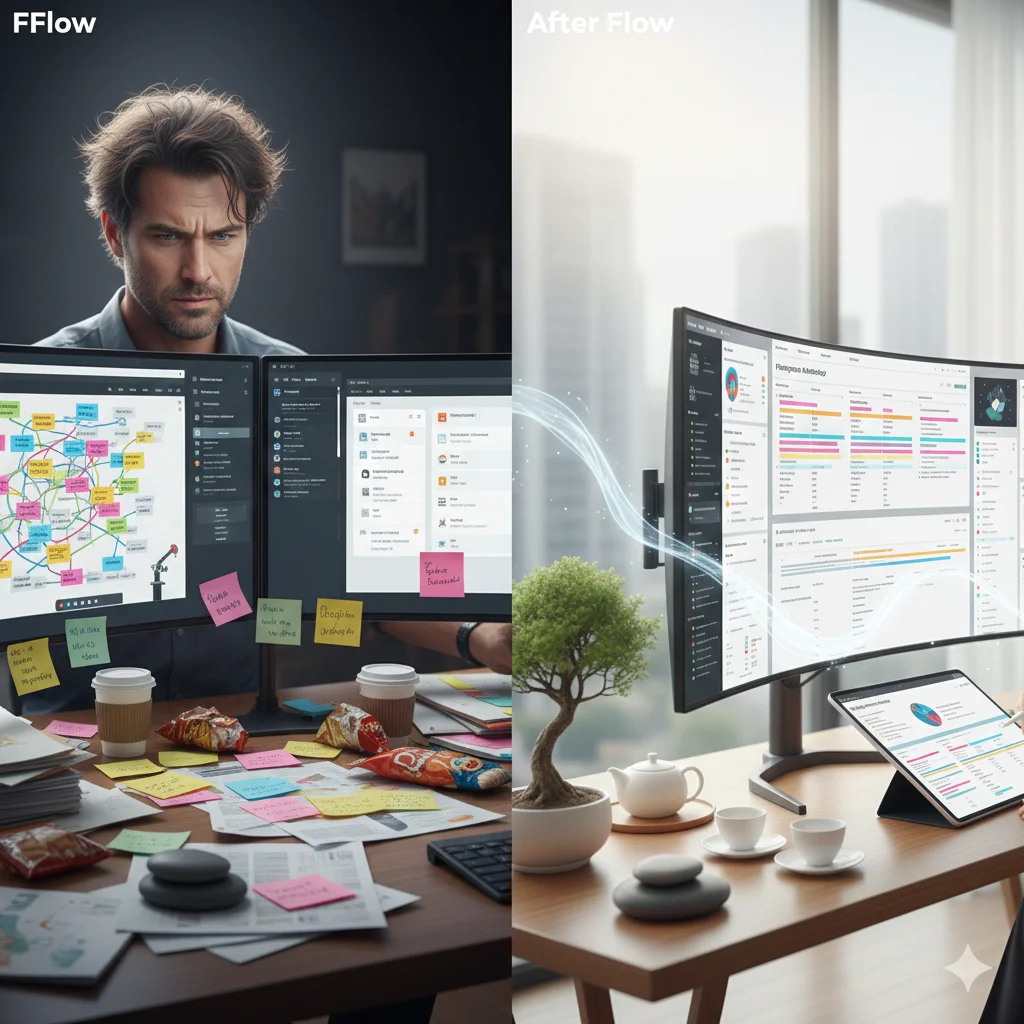
The Three Enemies of Strategic Product Thinking
Before we dive into the techniques, let’s be real about what we’re fighting against:
1. The HiPPO in the Room (Highest Paid Person’s Opinion)
You’ve carefully prioritized your roadmap based on user research, business impact, and technical feasibility. Then your VP walks in and says, “Wouldn’t it be cool if we added this feature I saw on TikTok?”
Suddenly, your strategic thinking evaporates faster than your morning motivation.
2. The Urgency Addiction
Everything is urgent. Everything is P0. Everything needs to ship yesterday. When everything is a priority, nothing is—but try explaining that when three different teams are pinging you about “critical blockers.”
3. Decision Fatigue That Makes Molasses Look Fast
By the time you reach the important decisions (you know, the ones that actually determine your product’s success), your brain has already burned through its decision-making glucose on Slack replies and meeting scheduling.
The research backs this up: decision quality deteriorates significantly as mental fatigue increases (Ceja & Navarro, 2012). Yet we structure our days as if our brains are infinite processing machines.
One PM friend told me: “I make my best product decisions in the shower because it’s the only place my CEO can’t Slack me.” Sad, but relatable.
Enter the Mindful Techniques: Your FFlow Toolkit
Alright, enough diagnosis. Let’s talk solutions. These three techniques aren’t theory—they’re battle-tested approaches I’ve used (and seen other PMs use) to transform how we prioritize and build roadmaps.
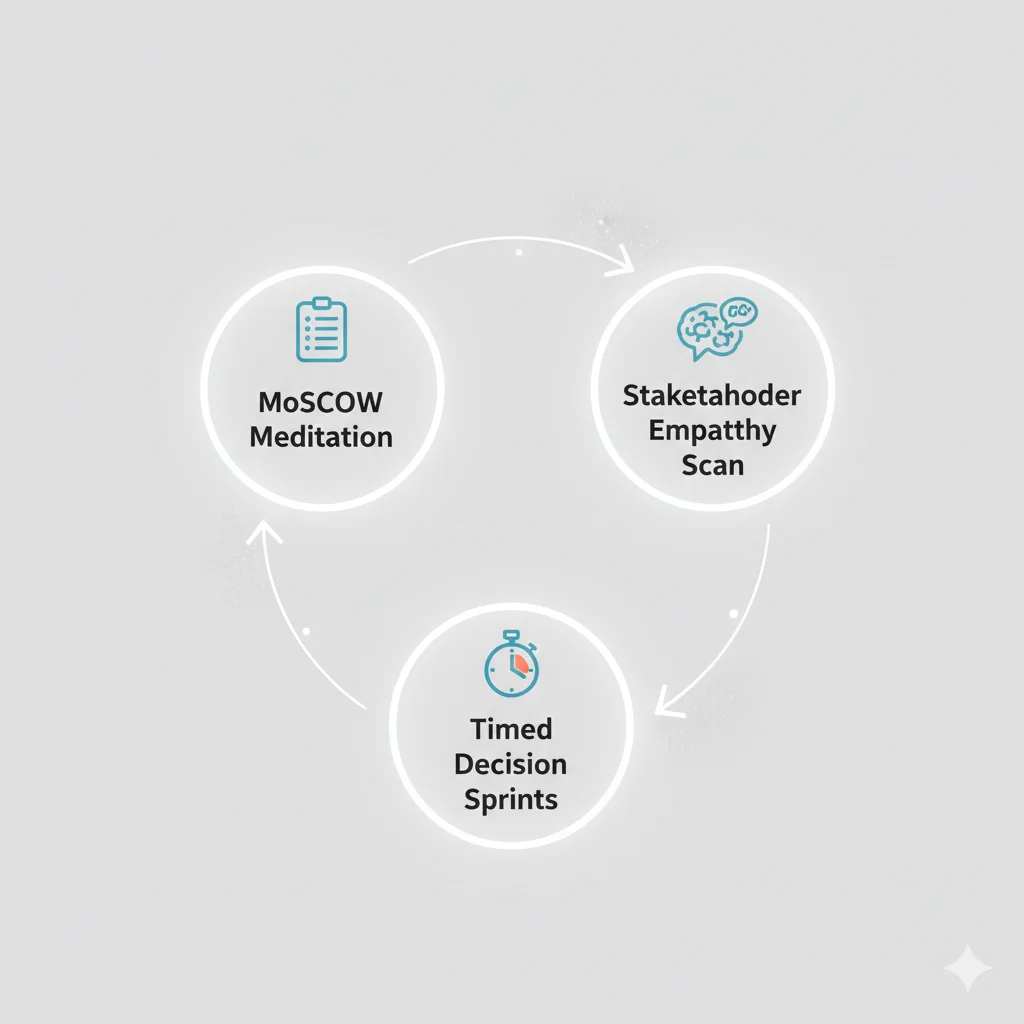
Technique 1: MoSCoW Meditation – Prioritization That Actually Works
You’ve probably heard of the MoSCoW method (Must have, Should have, Could have, Won’t have). It’s a staple of product management courses everywhere. But here’s the problem: most PMs use it as a checkbox exercise, not a thinking tool.
MoSCoW Meditation transforms this from a static framework into a dynamic, mindful practice.
How It Works:
Step 1: The Clearing (5 minutes)
Before you even look at your feature list, take five minutes to clear your mental cache. Not meditation-meditation, but a simple brain dump:
- What assumptions am I bringing to this prioritization?
- Which stakeholder’s voice is loudest in my head right now?
- What outcome am I afraid of?
I keep a “pre-prioritization journal” where I literally write: “I’m scared that if I don’t include Sarah’s feature, she’ll escalate to the CEO.” Getting it out on paper removes it from your subconscious decision-making.
Step 2: The Must-Have Mirror
For each feature you’re considering as “Must Have,” ask yourself: “If we shipped nothing but this, would users still choose our product?”
This is brutal. I’ve watched PMs stare at their “Must Have” list of 23 items and realize only 3 pass this test. The rest? They’re “Should Haves” wearing a Must Have costume.
“Calling everything a Must Have is like declaring every meeting urgent. It doesn’t make things more important; it just makes you less credible.” – Wisdom from a particularly honest tech lead
Step 3: The Empathy Sort
Here’s where mindfulness enters: for each item, take 30 seconds to genuinely embody your user’s perspective:
- Close your eyes (yes, really)
- Visualize your primary user persona
- Feel their frustration, their goals, their context
- Now ask: “Would they miss this feature if it didn’t exist?”
Sounds woo-woo? Maybe. But I’ve seen this single practice cut roadmap bloat by 40% because it forces you out of stakeholder-pleasing mode and into user-value mode.
Step 4: The Won’t-Have Peace
The hardest category isn’t Must Have—it’s Won’t Have. These are the features you’re actively choosing not to build. This requires mourning.
Yes, mourning. You need to acknowledge: “This idea has merit. Someone cares about it. And we’re still saying no.”
I literally maintain a “Feature Cemetery” document where I write eulogies for good features we’re not building. “Dear Social Login Integration, you were a fine feature idea. You would have made signup 12% easier. But you’re not solving our core user problem right now. Rest in peace. Maybe Q3.”
It sounds ridiculous, but it works because it gives emotional closure to ideas instead of leaving them as zombie features that haunt every planning meeting.
The Practical Output:
After MoSCoW Meditation, you should have:
- 3-5 Must Haves (not 23)
- 5-8 Should Haves (with clear user value articulated)
- Could Haves you’re genuinely okay postponing
- Won’t Haves you’ve consciously decided against (with reasons documented)
For more on prioritization frameworks that work with your brain, not against it, check out: Understanding Cognitive Load in Product Development
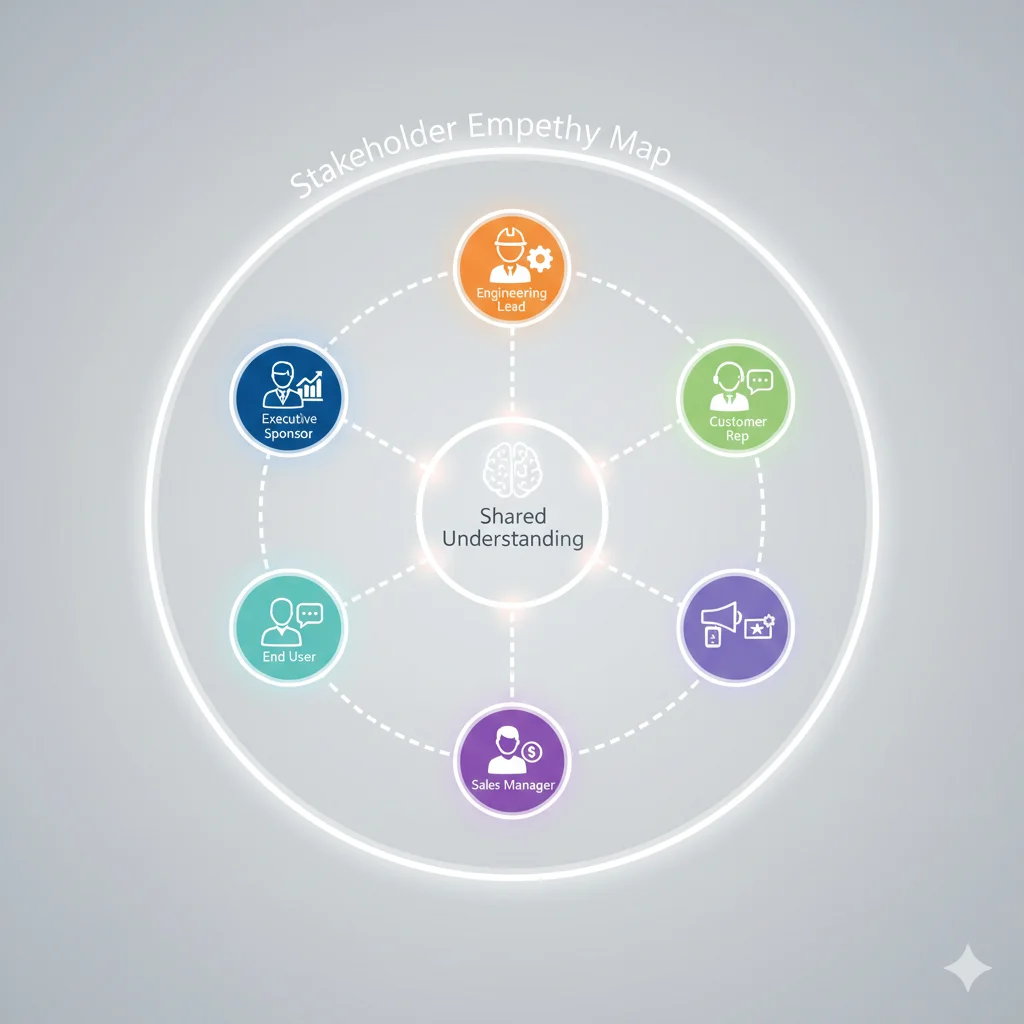
Technique 2: Stakeholder Empathy Scan – Reading the Room Without Losing Yourself
Let’s talk about the elephant in every product meeting: stakeholders who don’t agree with your prioritization.
You’ve done your MoSCoW Meditation. You have a beautifully reasoned roadmap. Then you present it and someone says, “But where’s the feature I asked for three months ago?” and suddenly you’re defending decisions instead of aligning on strategy.
The typical PM response is either:
- The Accommodator: “Sure, let me squeeze that in somehow…” (RIP to your strategy)
- The Defender: “Well, the data shows…” (RIP to your relationship)
Neither works. What does work is the Stakeholder Empathy Scan—a mindful practice that helps you understand stakeholder positions without abandoning your strategic thinking.
How It Works:
The Pre-Meeting Scan (10 minutes before key stakeholder meetings):
Grab your stakeholder list. For each key person, run this mental scan:
- Their Current Pressure: What’s keeping them up at night? Is your VP of Sales fighting churn? Is your CTO drowning in tech debt?
- Their Success Metrics: What do they get evaluated on? (Hint: it’s probably not the same as your north star metric)
- Their Cognitive Frame: Are they thinking in quarters, years, or sprints? Feature-focused or outcome-focused?
I keep a simple spreadsheet. Sounds corporate, but stay with me:
| Stakeholder | Current Pressure | Success Metric | Cognitive Frame | Likely Concerns About My Roadmap |
| Sarah (Sales VP) | Q4 revenue miss | Bookings | This quarter | Missing quick wins |
| James (CTO) | Tech debt crisis | System reliability | Long-term | Not enough refactoring time |
The In-Meeting Presence:
During the actual meeting, practice what I call “strategic listening”:
- When someone challenges your prioritization, pause for 3 seconds before responding
- Literally count: “one-Mississippi, two-Mississippi, three-Mississippi”
- In those 3 seconds, ask yourself: “What valid concern is underneath their objection?”
I learned this from a Buddhist teacher who said, “The space between stimulus and response is where wisdom lives.” In product management, it’s where stakeholder alignment lives.
The Translation Game:
Most stakeholder conflicts aren’t actually disagreements—they’re translation problems. When your sales VP says, “We need this enterprise feature NOW,” what they often mean is, “I’m scared we’ll lose the Microsoft deal.”
Practice translating requests into underlying needs:
- “We need this feature” → “I need to solve this customer pain point”
- “This should be Must Have” → “I’m worried about my team’s success metric”
- “Why isn’t this prioritized?” → “I feel unheard in the product process”
Once you identify the underlying need, you can address it without necessarily changing your roadmap. Maybe the enterprise feature isn’t the answer—maybe it’s better sales collateral for your existing features.
A product director once told me: “Stakeholder management is 20% about roadmaps and 80% about people feeling heard and respected.” I’d say it’s more like 50/50, but the point stands.
The Practical Output:
After each Stakeholder Empathy Scan, you should be able to:
- Articulate each stakeholder’s core concern in one sentence
- Identify where their needs align with your strategy (and celebrate that!)
- Clearly communicate where needs diverge (with empathy, not defensiveness)
- Find creative solutions that address underlying needs without roadmap chaos
For deeper insights on stakeholder communication, read: Building Trust Through Technical Communication
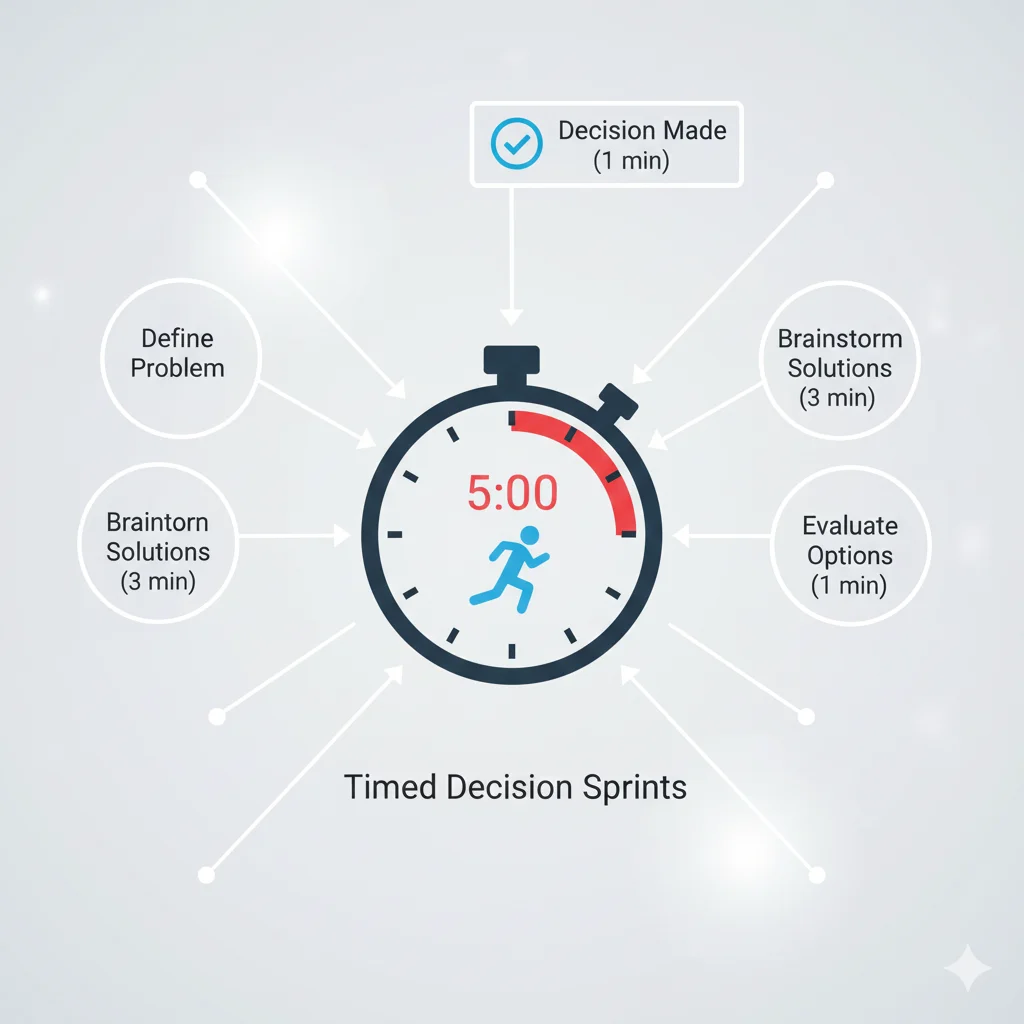
Technique 3: Timed Decision Sprints – The Antidote to Analysis Paralysis
Here’s a confession: I once spent six weeks debating whether to build Feature A or Feature B. Six. Weeks.
We had user research (inconclusive). We had stakeholder input (split 50/50). We had competitive analysis (both competitors had both features). We scheduled meetings about meetings to discuss meetings.
Finally, my engineering lead said: “Dude, the time we’ve spent deciding could have built both features. Just pick one.”
He was right. And it hurt.
The problem wasn’t lack of information—it was infinite information without a decision deadline.
Timed Decision Sprints solve this. They’re borrowed from the concept of timeboxing, but applied specifically to product decisions that tend to sprawl.
How It Works:
Step 1: Identify the Decision Class
Not all decisions deserve the same time investment. I categorize decisions into three classes:
- Reversible Decisions (15-minute sprint): Things you can easily change later. UI tweaks, copy changes, minor feature adjustments. Jeff Bezos calls these “two-way door decisions.”
- Sticky Decisions (60-minute sprint): Things that are hard but not impossible to change. Feature architecture, integration partnerships, pricing model adjustments.
- One-Way Decisions (2-hour sprint): Things you can’t easily undo. Platform choices, major architectural decisions, sunsetting core features.
The sprint time isn’t about thinking time—it’s about focused decision-making time where you eliminate distractions and commit to reaching a conclusion.
Step 2: Set the Timer (No, Really)
Use an actual timer. I use a physical kitchen timer because digital ones make it too easy to cheat.
When the timer starts:
- Close Slack (yes, completely)
- Decline meeting interruptions
- Tell your team: “In decision mode, back in X minutes”
The psychological magic here is that the ticking clock activates your brain’s “completion mode.” You’re not spinning in analysis; you’re moving toward conclusion.
Step 3: The Decision Framework
Within your sprint time, move through these phases:
Minutes 1-3 (or 1-15 or 1-30 depending on decision class): Frame
- Write down the decision you’re making in one sentence
- List your decision criteria (user value, engineering cost, strategic fit, etc.)
- Identify your key constraint (time? resources? technical feasibility?)
Middle minutes: Analyze
- Gather your relevant data (that you prepared beforehand)
- Run through your decision criteria
- Note your gut feeling (yes, this matters—research shows experienced PMs’ intuition often outperforms pure analytical approaches)
Final minutes: Commit
- Choose your option
- Write down your reasoning in 2-3 sentences
- Identify what would make you change your mind
- Set a review date
Step 4: The Decision Log
This is crucial and often skipped: document your decision immediately.
I keep a simple decision log:
Date: Dec 10, 2024
Decision: Build Feature A before Feature B
Sprint Time: 60 minutes
Reasoning: Feature A addresses core user pain point affecting 60% of users; Feature B is a nice-to-have affecting 20%. Engineering cost similar.
What would change my mind: If we lose 3+ customers specifically requesting Feature B
Review date: Jan 15, 2025
Why document? Because in three months when someone asks “Why did we build A first?” you won’t be reconstructing justifications. You’ll have your actual reasoning.
The Hard Truth About Decision Sprints:
The first time you try this, you’ll hate it. Your brain will scream: “But I need more research! More stakeholder input! More competitive analysis!”
That’s resistance to commitment, not genuine information gaps.
I’ve found that 80% of product decisions can be made well with the information you already have. The other 20%? You’re often gathering information as a form of decision avoidance.
“The cost of delay usually exceeds the cost of being wrong.” – Every PM who’s shipped successful products
One warning: Don’t confuse speed with recklessness. Timed Decision Sprints work because you’ve done the preparatory work (user research, data gathering, stakeholder input). The sprint is about synthesis and commitment, not about skipping due diligence.
The Practical Output:
After implementing Timed Decision Sprints, you should have:
- Faster decision velocity (measure: days from decision need to decision made)
- A documented decision trail (so you’re not re-litigating old choices)
- Reduced decision fatigue (because you’re not carrying open decisions in your mental RAM for weeks)
- More time for actual strategic thinking (instead of decision deferral meetings)
For more on decision-making frameworks, check out: The Mindful Approach to Technical Decision Making
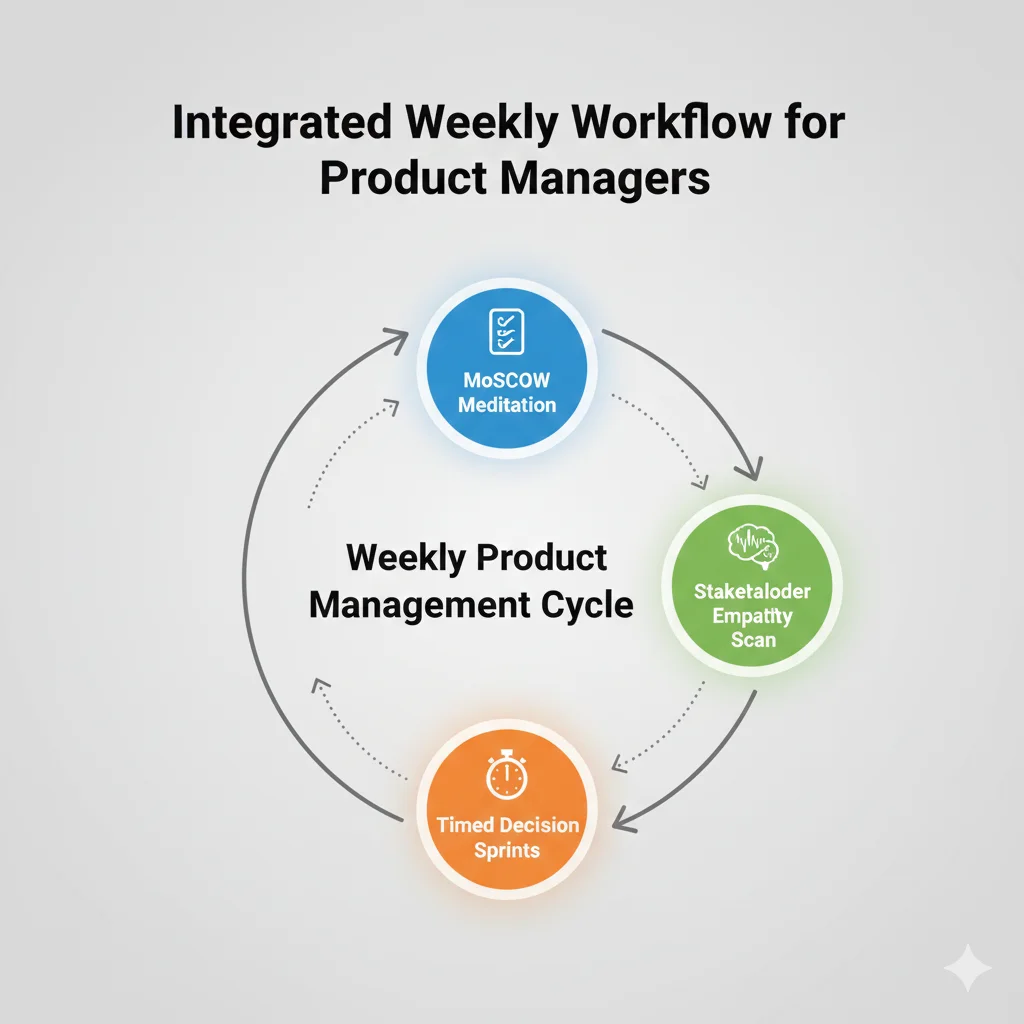
Putting It All Together: Your Weekly FFlow Practice
Theory is great. Implementation is where the magic happens. Here’s how to integrate these three techniques into your actual product management workflow:
Monday Morning: MoSCoW Meditation (30 minutes)
Start your week with your prioritization practice. Review your roadmap, run through the meditation process, adjust priorities based on last week’s learnings.
This isn’t permanent prioritization—it’s weekly recalibration.
Throughout the Week: Stakeholder Empathy Scans (10 minutes before key meetings)
Before every significant stakeholder meeting (roadmap reviews, sprint planning, executive updates), run your empathy scan. Know their pressures, anticipate their concerns, prepare your translations.
When Decisions Arise: Timed Decision Sprints (as needed)
Don’t let decisions accumulate. When a decision need emerges, classify it, set your timer, and execute. Done is better than perfect.
Friday Afternoon: The Reflection (15 minutes)
This is the meta-mindfulness practice. Review your week:
- Which technique worked best?
- Where did I get scattered?
- What would I adjust next week?
I literally block 3:30-3:45pm every Friday for this. My team knows: that’s my “brain dump” time.
The Research Behind FFlow: Why This Works
Let’s talk science for a second. Ceja and Navarro’s 2012 research on work-related flow states found that flow occurs when three conditions align:
- Clear goals (MoSCoW Meditation provides this through explicit prioritization)
- Immediate feedback (Stakeholder Empathy Scans create alignment loops)
- Challenge-skill balance (Timed Decision Sprints prevent both overwhelm and boredom)
But here’s what’s fascinating: their research also showed that organizational context matters enormously. You can’t flow-state your way out of a chaotic organization.
That’s why these techniques aren’t just about personal productivity—they’re about creating structured spaces for strategic thinking within the chaos of product management.
Additional research supporting these approaches:
- Mindfulness practices reduce decision fatigue and improve decision quality (Creswell et al., 2012)
- Timeboxing increases decision commitment and reduces regret (Shu & Gneezy, 2010)
- Perspective-taking (empathy scanning) improves stakeholder negotiation outcomes (Galinsky et al., 2008)
For a deeper dive into the neuroscience of focused work, read: Flow States and Engineering Productivity
Common Pitfalls (And How to Avoid Them)
Let me save you from the mistakes I made when I first started implementing FFlow:
Pitfall 1: Treating Mindfulness Like a Checkbox
“Okay, I did my 5-minute meditation. Now back to chaos!”
Mindfulness isn’t a one-time inoculation. It’s a continuous practice. If you find yourself reverting to reactive decision-making, that’s not failure—that’s the signal to re-engage with the practices.
Pitfall 2: Using Techniques as Avoidance
I’ve seen PMs (myself included) get so into the process of MoSCoW Meditation that they avoid actually deciding. The techniques are tools for better decisions, not substitutes for making them.
Pitfall 3: Expecting Immediate Results
FFlow isn’t a magic bullet. Your first few MoSCoW Meditations might feel awkward. Your first Stakeholder Empathy Scan might miss key dynamics. Your first Decision Sprint might run over time.
That’s normal. Improvement is measured in weeks, not days.
Pitfall 4: Going Solo
Share these practices with your team. When everyone understands that Monday morning is your prioritization time, they respect it. When stakeholders know you run empathy scans, they feel more heard.
Make FFlow your team’s shared language.
The Real Question: Is This Worth Your Time?
Look, I get it. You’re a busy PM. You don’t have time for another framework, another practice, another thing to maintain.
But here’s the thing: you’re already spending the time. You’re spending it in:
- Repeated reprioritization meetings that don’t stick
- Stakeholder firefighting that could be prevented
- Analysis paralysis on decisions that should take minutes
FFlow doesn’t add time to your week—it redirects the time you’re already wasting into structured practices that actually move your product forward.
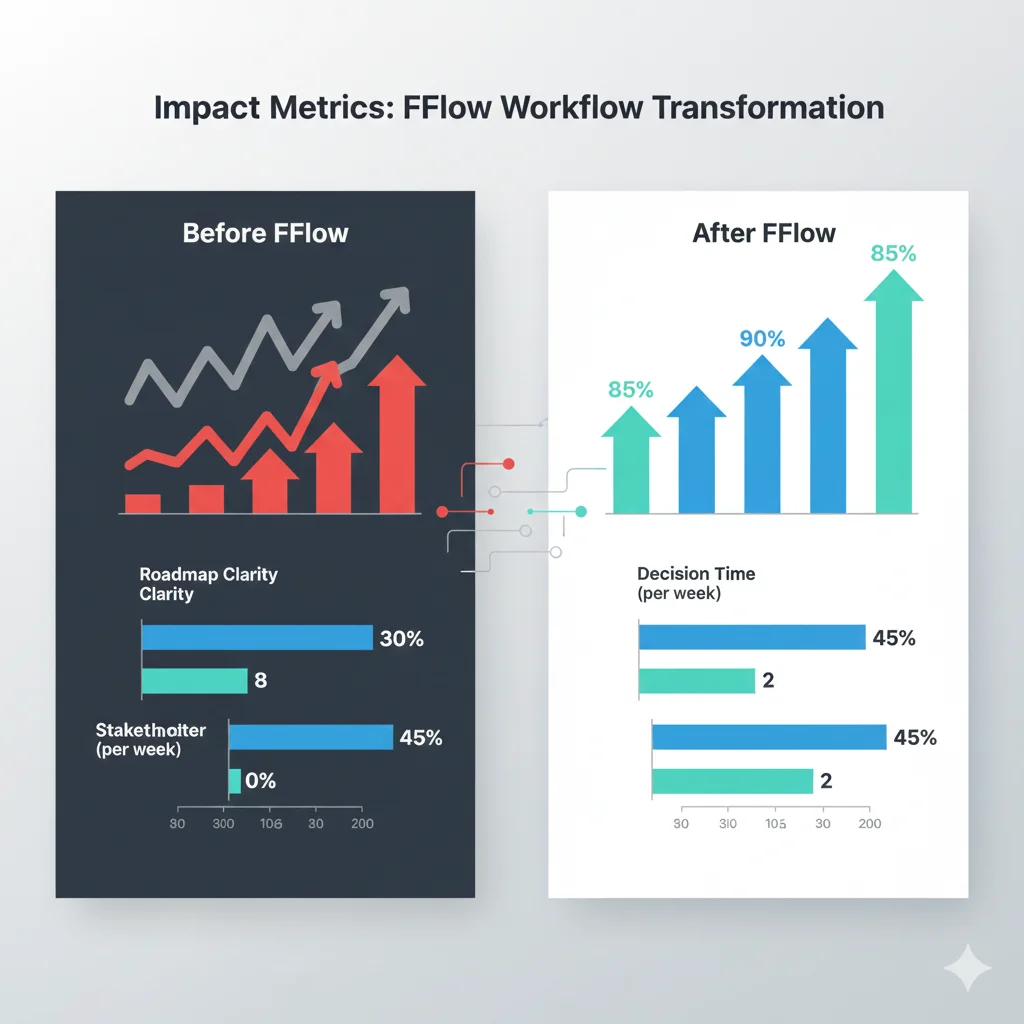
After six months of practicing these techniques, I measured my time allocation:
- Prioritization meetings: Down 40% (because priorities stick)
- Stakeholder conflict resolution: Down 60% (because empathy scans prevent conflicts)
- Decision-making time: Down 50% (because decision sprints eliminate dithering)
That gave me back 8-10 hours per week for actual strategic thinking. You know, the job I was supposedly hired to do.
Your Next Step: The 2-Week FFlow Challenge
Don’t try to implement everything at once. Here’s my suggested ramp:
Week 1: Just do MoSCoW Meditation on Monday morning. That’s it. See how it changes your week.
Week 2: Add Stakeholder Empathy Scans before your three most important meetings. Notice what shifts.
Week 3: Introduce one Timed Decision Sprint. Pick a decision you’ve been avoiding. Set the timer. Make the call.
Week 4: Reflect. What worked? What felt forced? Adjust.
By week 4, you’ll have enough data to decide if FFlow is right for you. And if it is? You’ll have a sustainable practice that transforms your product management approach.

The Bottom Line: Strategic Thinking Is a Practice, Not a Trait
We treat strategic thinking like it’s an innate talent—you either have it or you don’t. But the research (and my experience) shows otherwise. Strategic thinking is a practice, enabled by the right mental conditions.
FFlow creates those conditions. Not through motivation or willpower, but through structured techniques that work with your brain’s natural patterns, not against them.
You don’t need to become a zen master. You don’t need to completely overhaul your product process. You just need to introduce small, mindful practices that create space for your strategic thinking to emerge.
Because here’s the truth: you already have the strategic insights. They’re just buried under scattered energy, stakeholder noise, and decision fatigue.
FFlow is simply the excavation process.
“The best product managers I know aren’t the ones with the most frameworks—they’re the ones who’ve learned to think clearly under pressure.” – A principal PM who became my career mentor
So here’s my challenge to you: Try MoSCoW Meditation this Monday. Just once. See what surfaces when you give your strategic thinking space to breathe.
Your roadmap will thank you. Your stakeholders will notice. And you might actually leave work before 11 PM for once.
Now if you’ll excuse me, I need to go practice what I preach. There’s a prioritization decision I’ve been putting off, and I’ve got a timer that needs setting.
References & Further Reading
Academic Research:
- Ceja, L., & Navarro, J. (2012). ‘Suddenly I get into the zone’: Examining discontinuities and nonlinear changes in flow experiences at work. Human Relations, 65(9), 1101-1127.
- Creswell, J. D., et al. (2012). Brief mindfulness meditation training alters psychological and neuroendocrine responses to social evaluative stress. Psychoneuroendocrinology, 44, 1-12.
- Galinsky, A. D., et al. (2008). Why it pays to get inside the head of your opponent: The differential effects of perspective-taking and empathy in strategic interactions. Psychological Science, 19(4), 378-384.