

You’re lying in bed at 2 AM, mind racing through tomorrow’s sprint planning, but underneath the work thoughts is something deeper—a restless ache you can’t name. Your heart pounds for no reason during lunch breaks. Simple tasks feel impossibly heavy. You’ve optimized your productivity stack, tried meditation apps, even switched teams, but that underlying tension persists. What if the anxiety you’ve been trying to fix isn’t actually anxiety at all?
As engineers and tech professionals, we’re trained to debug systems—but we rarely debug our own emotional code. We analyze stack traces and memory leaks with precision, yet when our inner world throws exceptions, we often misdiagnose the root cause.
Recent neuroscience research reveals something profound: what we experience as persistent anxiety often stems from unprocessed grief. Dr. Mary-Frances O’Connor’s groundbreaking work at the University of Arizona shows that grief activates the same neural pathways as physical pain and attachment seeking, creating a background process that can manifest as chronic anxiety (O’Connor, M.F., Brain and Behavioral Research, 2012).
Grief isn’t just about death—it’s your system’s response to any significant loss or change. That startup dream that pivoted into corporate life. The friendship that faded after you switched cities. The version of yourself before burnout changed everything. These losses run background processes that consume emotional CPU, leaving you anxious and depleted.
Restless Without Reason: When Your Nervous System Holds Memory

You know the feeling: constant low-level tension, like waiting for a build to fail or a server to crash. But there’s no immediate threat—just this persistent sense that something isn’t right. Your nervous system might be processing losses you haven’t fully acknowledged.
Dr. Bessel van der Kolk’s research on trauma and the body reveals that our nervous systems store memories of loss and change, creating what he calls “somatic markers”—physical sensations that signal unresolved emotional processing (van der Kolk, B., The Body Keeps the Score, 2014). These markers can manifest as restlessness, hypervigilance, or that nagging sense that you should be “doing something” without knowing what.
Signs to watch for:
- Feeling on edge during normally peaceful moments
- Difficulty sitting still or focusing, even when rested
- A persistent sense that you’re “forgetting something important”
- Physical tension that doesn’t respond to typical stress relief
Mindful debugging approach:
- Practice the STOP technique: Stop, Take a breath, Observe your body, Proceed with awareness
- Keep a “nervous system log”—note when restlessness peaks and what preceded it
- Try bilateral stimulation: alternate tapping your knees while breathing deeply
Avoiding Certain Triggers: When Your Mind Protects Through Anxiety

Notice how you unconsciously steer clear of that coffee shop where you used to meet your former colleague? Or how certain songs make you reach for the skip button faster than debugging a null pointer exception? Your mind creates anxiety around grief triggers as a protective mechanism.
This phenomenon, called “experiential avoidance,” is documented extensively by Dr. Steven Hayes in his Acceptance and Commitment Therapy research. When we have unprocessed grief, our psychological system flags associated stimuli as threats, generating anxiety to keep us away from potential emotional pain (Hayes, S.C., Journal of Experimental Psychology, 2006).
The irony? This protective anxiety often causes more suffering than facing the grief directly would.
Common avoidance patterns:
- Skipping activities that once brought joy
- Feeling anxious in places connected to past versions of yourself
- Avoiding conversations about certain life changes or transitions
- Productivity guilt when not constantly busy (busy-ness as grief avoidance)
Gentle exposure approach:
- Start small: spend 30 seconds acknowledging what you’re avoiding
- Practice “loving presence”—sit with the discomfort without fixing it
- Ask yourself: “What am I protecting myself from feeling?”
Sleep Feels Unsafe: When Quiet Moments Become Vulnerable

Racing thoughts hit hardest at bedtime, when your defenses are down and your mind’s compiler stops running active processes. Without the day’s distractions, unprocessed grief surfaces as anxiety, making rest feel threatening rather than restorative.
Sleep researcher Dr. Matthew Walker’s work at UC Berkeley shows that grief and anxiety create hyperarousal in the nervous system, particularly affecting REM sleep—the stage crucial for emotional processing. When grief remains unprocessed, the mind treats sleep as unsafe because it’s when difficult emotions are most likely to surface (Walker, M., Why We Sleep, Nature Reviews, 2017).
Bedtime grief-anxiety signs:
- Mind racing specifically about losses or changes when you lie down
- Feeling unsafe or vulnerable during quiet moments
- Intrusive thoughts about “what could have been” scenarios
- Physical restlessness that peaks right before sleep
Creating safe sleep space:
- Practice the 4-7-8 breath technique before bed
- Keep a “worry dump” journal by your bedside
- Use progressive muscle relaxation to release stored tension
- Try loving-kindness meditation focused on parts of yourself you’re grieving
Chronic Overwhelm Persists: When Grief Creates Background Load
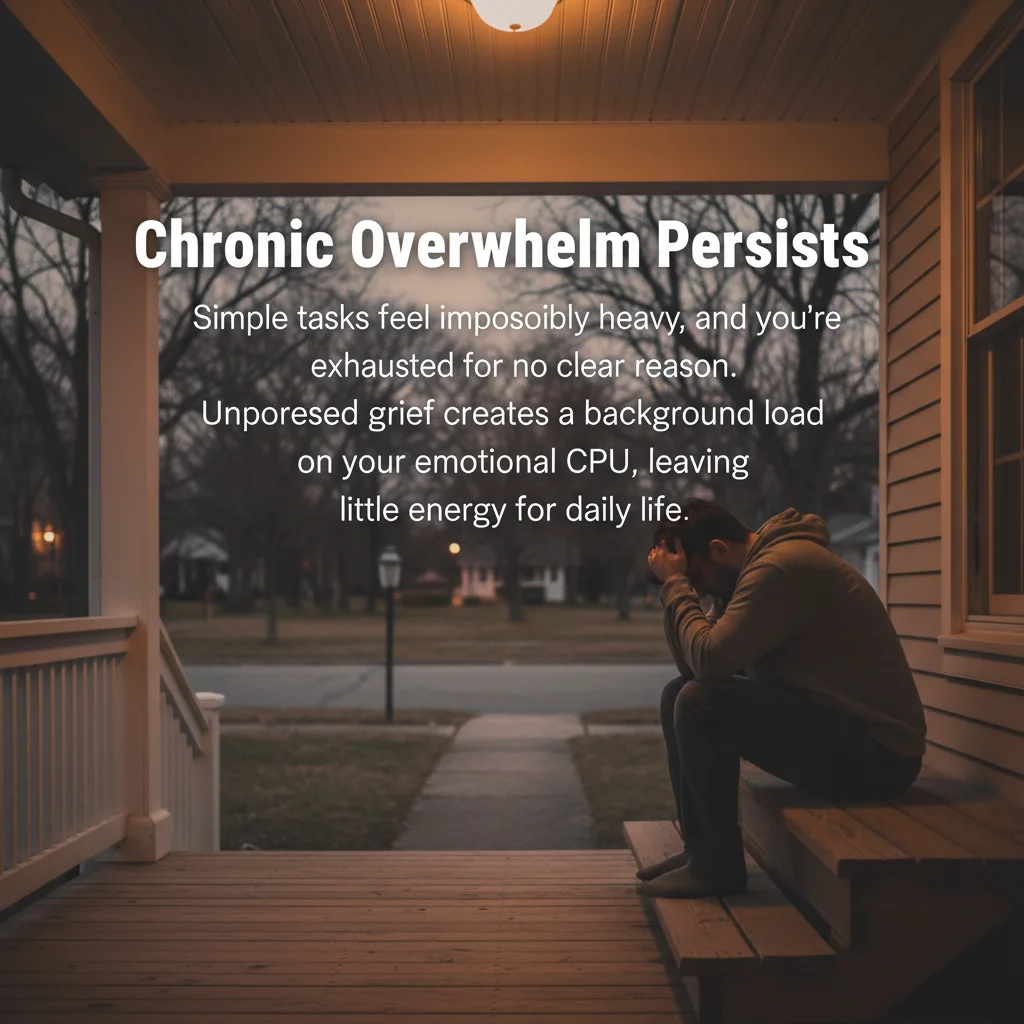
Simple tasks feel impossibly heavy. You’re exhausted for no clear reason. Your energy depletes faster than a poorly optimized algorithm running on legacy hardware. This isn’t laziness—it’s your emotional CPU running background processes for unresolved losses.
Dr. Kristin Neff’s research on self-compassion reveals that unprocessed grief creates what psychologists call “depletion syndrome”—a state where basic tasks require significantly more cognitive and emotional resources because part of your system is constantly processing loss (Neff, K., Journal of Clinical Psychology, 2011).
Think of it like having multiple memory leaks in your emotional architecture. The system still functions, but performance degrades steadily.
Background grief indicators:
- Disproportionate exhaustion after routine tasks
- Feeling overwhelmed by decisions that used to be automatic
- Emotional volatility over minor setbacks
- Difficulty celebrating wins or feeling satisfaction from achievements
Compassionate resource management:
- Practice radical acceptance: “This is hard right now, and that’s okay”
- Set realistic expectations during grief processing periods
- Build in extra recovery time between challenging tasks
- Use time-blocking to protect emotional energy
Debug Your Emotional Code: A Practical Protocol

Ready to debug your emotional code? Start with the most powerful tool in any developer’s kit: pattern recognition. But instead of analyzing log files, you’ll be examining your inner landscape with curiosity and compassion.
The GRIEF Protocol:
G – Gather data: Notice patterns in your anxiety. When does it spike? What situations trigger it? What themes emerge?
R – Recognize losses: Grief isn’t just about death. Consider career transitions, relationship changes, health shifts, lost dreams, or even positive changes that still involved saying goodbye to old versions of yourself.
I – Inquire with compassion: Ask yourself “What am I mourning?” without judgment. The answer might surprise you.
E – Embrace the process: Grief has its own timeline. You can’t force-quit it, but you can give it the processing power it needs.
F – Find support: Just as you wouldn’t debug complex issues in isolation, grief processing benefits from trusted connections.
Guided Practice: The Grief Inventory
Set aside 15 minutes for this practice. Find a quiet space and open a journal or document.
Write these prompts and let your thoughts flow freely:
- “In the past 2-3 years, what significant changes have I experienced?”
- “What versions of myself or my life am I no longer living?”
- “What dreams, relationships, or situations have shifted or ended?”
- “When I think about these changes, what do I feel in my body?”
- “What would it feel like to honor these losses instead of pushing through them?”
Remember: naming your losses isn’t dwelling on the past—it’s freeing up emotional resources for the present.
Compiling a New Response: From Anxiety to Healing

Recognition is the first step toward resolution. When you understand that persistent anxiety might actually be unprocessed grief, everything changes. Instead of fighting your feelings like bugs to be squashed, you can approach them as data to be understood.
Your nervous system isn’t malfunctioning—it’s trying to process significant information. Your avoidance patterns aren’t character flaws—they’re protective mechanisms that once served a purpose. Your restlessness and overwhelm aren’t signs of failure—they’re invitations to honor what you’ve lost so you can fully embrace what remains.
Just as debugging code makes your applications more stable and efficient, processing grief makes your emotional system more resilient and available for joy. The goal isn’t to eliminate all anxiety, but to ensure it’s serving its intended function rather than masking deeper needs.
Start small. Be patient with the process. And remember: even the most elegant code requires regular maintenance and occasional refactoring. Your emotional well-being deserves the same careful attention you give to your craft.