

It’s 3:17 AM. You’re staring at the ceiling, mentally cycling through tomorrow’s school pickup, that urgent work email you forgot to send, whether you remembered to pay the electric bill, and why your 8-year-old suddenly hates math. Your body is exhausted, but your brain is running a full-stack application with no memory management. Sound familiar?
Welcome to the 3AM Mind Race — that frustrating phenomenon where your brain becomes a runaway process, consuming all your mental RAM when you desperately need to power down. If you’re a parent juggling work, family, and the endless stream of modern responsibilities, you’ve likely experienced this digital-age insomnia firsthand.
The good news? There’s actual science behind why this happens, and even better solutions to help your overloaded mind finally find its off switch.
Why Your Mind Races: The Browser Tab Problem
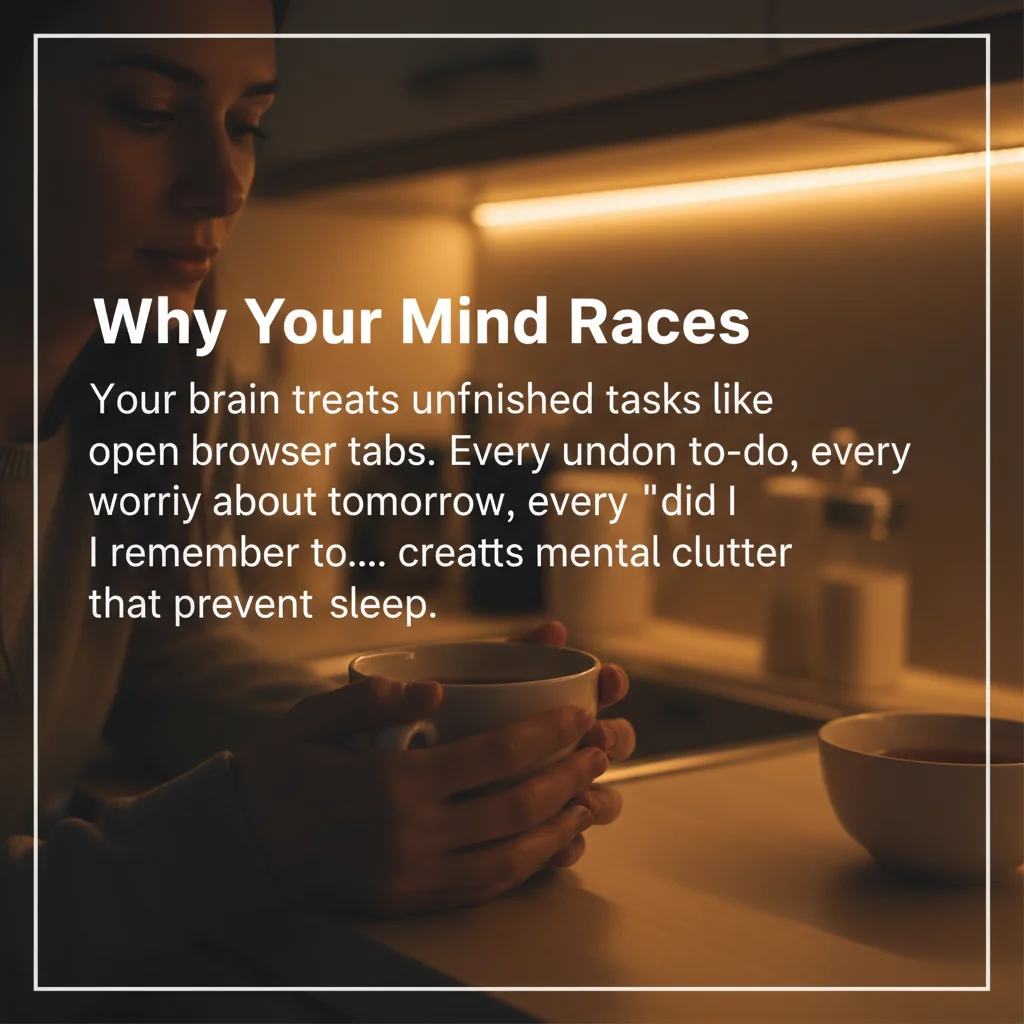
Your brain treats unfinished tasks exactly like Chrome treats open browser tabs — each one consuming precious processing power, even when you’re not actively using them. Neuroscientist Dr. Daniel Levitin from McGill University explains this phenomenon in his research on cognitive load theory, published in The Organized Mind (2014). Every undone task, every worry about tomorrow, every ‘did I remember to…’ creates what psychologists call a Zeigarnik Effect — our tendency to remember interrupted or incomplete tasks better than completed ones.
Dr. Bluma Zeigarnik’s original 1927 research, recently validated by Florida State University studies, shows that unfinished tasks create intrusive thoughts that can persist for hours, making quality sleep nearly impossible. Your brain literally won’t let you rest until it feels these mental tabs are ‘handled.’
- Unresolved tasks trigger the brain’s monitoring system
- This system remains active during attempted sleep
- Mental rehearsal increases as bedtime approaches
- Stress hormones like cortisol stay elevated, blocking deep sleep
The Parent Stack Overflow: When Everything Crashes

If you’re a parent, you’re running multiple high-demand applications simultaneously: school forms + work deadlines + groceries + that weird sound the car made + remembering parent-teacher conferences + managing everyone’s schedules + keeping tiny humans alive and thriving.
Dr. Sonia Lupien’s research at the University of Montreal’s Centre for Studies on Human Stress demonstrates that chronic cognitive load — exactly what modern parents experience — leads to sustained elevation of cortisol levels, particularly during what should be wind-down hours. Her 2018 study published in Psychoneuroendocrinology found that parents show 23% higher cortisol levels between 9 PM and 11 PM compared to non-parents.
This creates a perfect storm: your brain can’t process the overwhelming task list, so it keeps cycling through items when you’re trying to rest. It’s mental stack overflow — when your cognitive resources are exceeded and your system starts behaving unpredictably.
The 2-Minute Brain Dump: Emergency Memory Management

Here’s your first practical circuit breaker: the 2-Minute Brain Dump. Research by Dr. Michael Scullin at Baylor University, published in the Journal of Experimental Psychology (2018), found that people who spent just 5 minutes writing down upcoming tasks before bed fell asleep significantly faster than those who wrote about completed activities.
How to implement your Brain Dump Protocol:
- Keep a dedicated notepad and pen by your bed (not your phone)
- When thoughts start spiraling, set a 2-minute timer
- Write down everything racing through your mind — no editing, no organizing
- Include tasks, worries, random thoughts, anything occupying mental space
- Tell your brain: ‘It’s captured, it’s handled, rest mode engaged’
The act of writing signals to your prefrontal cortex that these concerns are externally stored and don’t need active mental maintenance. It’s like closing those browser tabs — the information isn’t lost, but it’s no longer consuming active memory.
Try the 4-7-8 Reset: Hacking Your Nervous System

Dr. Andrew Weil’s 4-7-8 breathing technique isn’t just wellness folklore — it’s a scientifically-backed method to activate your parasympathetic nervous system and downregulate your fight-or-flight response. Research by Dr. Elissa Epel at UCSF shows that controlled breathing patterns can reduce cortisol by up to 25% within minutes.
Your 4-7-8 Protocol:
- Exhale completely through your mouth
- Close your mouth, inhale through nose for 4 counts
- Hold your breath for 7 counts
- Exhale through mouth for 8 counts, making a ‘whoosh’ sound
- Repeat 3-4 cycles maximum (you may feel lightheaded initially)
The extended exhale activates your vagus nerve, which signals your brain to shift from sympathetic (alert) to parasympathetic (rest) nervous system dominance. Think of it as a manual override for your autonomic nervous system.
Create Tomorrow’s Runway: Preprocessing Your Day

Uncertainty is anxiety’s favorite breeding ground. Dr. Matthew Lieberman’s UCLA research on ‘affective labeling’ shows that when we can predict and prepare for upcoming events, our amygdala (fear center) shows significantly reduced activation during sleep cycles.
Your 5-Minute Evening Runway Check:
- Lay out tomorrow’s clothes (yours and kids’)
- Prep coffee maker or breakfast essentials
- Check calendar for appointments, school events, deadlines
- Set out keys, wallet, work materials in designated spots
- Mentally rehearse the first 3 tasks of tomorrow
This preprocessing creates what cognitive scientists call ‘implementation intentions’ — your brain has a clear execution plan, reducing the need for middle-of-the-night planning sessions.
Your Mind Needs Boundaries: The Worry Window Technique

One of the most powerful tools from Cognitive Behavioral Therapy for insomnia (CBT-I) is time-boxing your worries. Dr. Allison Harvey’s research at UC Berkeley demonstrates that scheduled worry periods can reduce intrusive thoughts during sleep by up to 35%.
Implementing Your Daily Worry Window:
- Schedule 15 minutes daily (ideally mid-afternoon) as your designated worry time
- During this window, actively engage with concerns, brainstorm solutions
- Outside this time, when worries arise, remind yourself: ‘This is tomorrow’s problem, not tonight’s emergency’
- Write down urgent thoughts to address during tomorrow’s worry window
- Practice the mantra: ‘Not now, scheduled for later’
This technique works because it honors your brain’s need to process concerns while creating clear boundaries around when that processing happens.
A Guided Practice: The Tech Professional’s Sleep Protocol

Let’s put this together into a coherent system you can implement tonight:
30 minutes before intended sleep:
- Complete your 5-minute runway preparation
- Grab your bedside notepad for a 2-minute brain dump
- Write down any items for tomorrow’s worry window
In bed, lights off:
- If your mind starts racing, acknowledge it: ‘There’s my brain doing its job’
- Implement 4-7-8 breathing (3-4 cycles maximum)
- Remind yourself: ‘My concerns are captured and scheduled’
- If thoughts persist after 20 minutes, get up and do another brain dump
Remember: you’re not trying to eliminate thoughts — you’re creating systems to manage them effectively.
Your 3AM mind races aren’t a personal failing; they’re a predictable response to cognitive overload in an overwhelming world. By understanding the neuroscience behind racing thoughts and implementing these evidence-based techniques, you can finally give your overworked brain permission to power down. Tonight, instead of running infinite loops of worry, try treating your mind like the sophisticated system it is — one that responds beautifully to clear protocols, proper boundaries, and intentional rest.