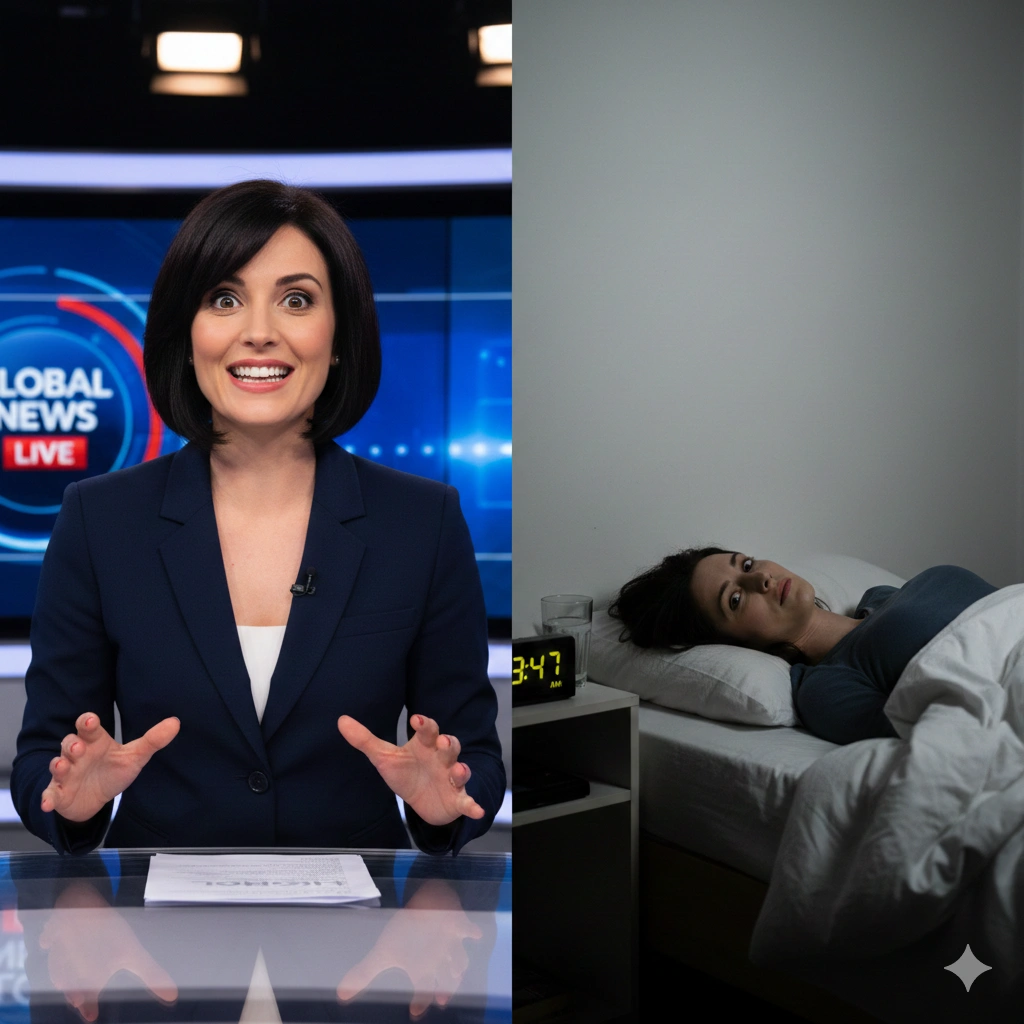
You shouted for two hours straight. Now you can’t sleep for two days.
The red light turns off. The studio goes quiet. Your co-host walks away without a word. You’re still vibrating.
Your heart is pounding at 140 beats per minute. Your hands won’t stop shaking. There’s a metallic taste in your mouth. You just finished hosting a 9 PM debate—two hours of controlled chaos, interrupting guests, cutting off arguments, maintaining composure while three people shouted simultaneously about politics, policy, or whatever crisis dominated today’s news cycle.
You drive home in silence because even music feels too loud. You try to sleep, but your body won’t let you. At 3 AM, you’re still replaying the show in your mind, critiquing every question you asked, every interruption you made, every moment you lost control of the conversation.
Welcome to the hidden epidemic in broadcast journalism: anchor burnout.
Nearly two-thirds of news directors report witnessing increased staff burnout, with the problem particularly acute among on-air talent who face the unique pressure of performing under intense scrutiny while managing high-conflict content night after night.
But here’s what nobody talks about: the adrenaline doesn’t just pump during the show. It stays with you for hours—sometimes days—after the cameras stop rolling.
1. The Cortisol Cascade: When Your Body Forgets How to Shut Down
Or: Why You’re Still Shouting in Your Dreams at 4 AM
At 9 PM, you’re on. Your sympathetic nervous system floods your body with adrenaline and norepinephrine. Your heart rate spikes. Your pupils dilate. Blood flows to your muscles. You’re ready for battle—except the battle is verbal, and there are cameras recording every micro-expression.
Research on media exposure and stress responses shows that the brain activates the stress system upon perception of threat, leading to cortisol secretion. But here’s the catch: when you’re the one delivering or moderating the threatening content—particularly in a heated debate environment—your cortisol levels don’t just spike during the show. They stay elevated for hours afterward.
The hypothalamic-pituitary-adrenal axis activates, releasing cortisol to keep you alert. In a normal stress response, cortisol levels drop once the threat passes. But when you host debate shows night after night, your body stops recognizing when the threat has ended.
The Research Says
A study published in StatPearls examined physiological stress reactions and found that episodic acute stress—characterized by individuals who experience frequent episodes of acute stress—is particularly damaging. This pattern, often seen in professionals with chaotic schedules and constant high-pressure situations, creates a cycle where stress exacerbates health issues and impairs daily functioning. The release of stress hormones leads to increased arterial pressure, heightened mental activity, and mobilization of energy stores. However, when these episodes repeat night after night, the body struggles to return to baseline levels.
Research URL
Mindful Solutions
1. The “Immediate Comedown” Protocol
Within 5 minutes of the show ending, do NOT check social media or review clips. Instead, spend 5 minutes doing vigorous physical activity—jumping jacks, push-ups, walking quickly around the building. This helps metabolize the excess adrenaline.
2. 2-Minute “Legs Up the Greenroom Wall”
Find a quiet space (greenroom, office, even a bathroom stall). Lie on your floor with your legs up against the wall for 2 minutes. This inverted position activates your parasympathetic nervous system—your body’s “brake pedal”—and signals that the threat has passed.
3. The “Cortisol Clock”
Set a timer for exactly 90 minutes after your show ends. Before that timer goes off, avoid all screens, caffeine, and intense conversations. Your cortisol needs time to metabolize. Treat this window as sacred.
2. The Voice That Won’t Come Back: Vocal Cord Trauma as a Burnout Symptom
Or: How Shouting Professionally Destroyed Your Instrument

You’re paid to be heard. But after six months of 9 PM debates, you’ve noticed something alarming: your voice gives out mid-sentence. You’re hoarse by Thursday. You can’t hit certain notes anymore. Sometimes, you sound like you’ve been screaming at a concert—except the only concert was your job.
Debate moderators face a unique vocal challenge: maintaining authority while speaking over others, often for two hours straight, without sounding strained. The result? Chronic voice strain, vocal nodules, and a phenomenon where your natural speaking voice starts to disappear.
The Research Says
According to the RTDNA/Newhouse School Survey, while the research doesn’t specifically track vocal health, newsroom conditions including stress from impending deadlines and large workloads create environments where physical health concerns often go unaddressed. News directors report that staff burnout continues to be a growing problem, with nearly two-thirds agreeing they’ve seen more evidence of burnout than in the past. Physical symptoms, including voice loss, often manifest as early warning signs of deeper burnout issues.
Research URL
Local TV news staffing rises despite burnout challenges
Mindful Solutions
1. The “Silent Hour” Rule
For the first hour after your show, speak as little as possible. Text instead of calling. Nod instead of speaking. Your vocal cords need recovery time just like any other muscle.
2. Humming Meditation
Before bed, spend 3 minutes humming gently. Not singing—humming. The vibration helps release tension in your vocal cords and surrounding muscles. It’s also incredibly calming for your nervous system.
3. Hydration with Intention
Keep room-temperature water at your anchor desk. Cold water constricts your vocal cords. Sip (don’t gulp) every 5 minutes during commercial breaks. Your voice isn’t just in your throat—it’s in how hydrated your entire system is.
3. The Empathy Erosion: When You Stop Feeling Anything About Terrible News
Or: The Day You Realized You Laughed at a Tragedy

You used to cry when reporting on disasters. Now, you barely blink. A plane crash? That’s segment three. A political scandal? You’re thinking about your next question, not the lives affected. Somewhere between your 500th debate and today, you stopped feeling.
This isn’t cruelty. This is survival.
Psychologists call it compassion fatigue or secondary traumatic stress. Journalists call it “professional distance.” But what it actually is: your brain protecting itself from repeated exposure to human suffering by shutting down your emotional response system.
The RTDNA Mental Health Resource Guide acknowledges that newsrooms contain numerous risk factors for burnout, including the stress of deadlines, large workloads, and the need to be ready for breaking news. But for debate anchors, there’s an added layer: you must remain emotionally neutral while facilitating discussions about deeply emotional topics, all while managing interpersonal conflict in real-time.
The Research Says
Research from The Journalist’s Resource examining occupational stress among journalists found that covering trauma generates secondary trauma through a process similar to therapist transference. Journalists may experience indirect, secondary trauma through victims they interview and graphic scenes they witness. Studies showed a small-to-moderate correlation between exposure to traumatic events during work and symptoms of PTSD. For anchors moderating debates about traumatic events rather than reporting from the field, the emotional labor of appearing neutral while discussing tragedy creates its own form of psychological strain.
Research Study
How journalists’ jobs affect their mental health: A research roundup
Mindful Solutions
1. The “One Feeling” Check-In
After every show, identify ONE genuine emotion you felt during the broadcast. Not what you should feel—what you actually felt. Write it down. This practice prevents complete emotional numbness by keeping your feeling-centers engaged.
2. 5-Minute “Debate Debrief” Journaling
Before you leave the studio, write 5 sentences about what happened during the show. Not analysis—just observation. “Guest A seemed angry.” “I felt tense during the immigration segment.” This processing prevents emotional suppression.
3. Permission to Feel—Later
You can’t feel everything during the show, but you can feel it after. Set aside 10 minutes the next morning to actually process one story that affected you. Let yourself feel it fully, then let it go. This prevents emotional buildup.
4. The Social Media Spiral: When the Audience Becomes the Enemy
Or: You Can’t Stop Reading the Comments Even Though They’re Destroying You

The show ends. You promise yourself you won’t check Twitter. You check Twitter.
Within seconds, you’re drowning in criticism. You were “too soft” on one guest, “too aggressive” with another. You’re biased. You’re incompetent. Someone created a 45-second clip of you looking confused (you weren’t confused—you were listening) and it has 50,000 views.
You tell yourself not to respond. You respond.
Now it’s 2 AM and you’re in a Twitter argument with someone whose profile picture is a cartoon frog, trying to defend a question you asked three hours ago that you barely remember asking.
More than two-thirds of TV news directors say staff burnout is worse now than one year ago, with social media harassment emerging as a significant contributor. For on-air personalities, the feedback is instantaneous, public, and often brutal.
The Research Says
A 2024 survey by Mental Health America found that exposure to negative news coverage can trigger the same stress response as experiencing the events firsthand. According to a survey of 266 therapists, 99.6% said watching or reading the news can have a negative impact on mental health. For journalists who are both creating and consuming news while simultaneously being criticized for their coverage, the psychological toll compounds. The 24-hour news cycle combined with social media creates an environment where anchors never escape the news—they live in it constantly.
Research Study
How does negative news coverage impact mental health?
Mindful Solutions
1. The “No-Phone Hour”
From the moment your show ends until one hour later, your phone stays in airplane mode. Not on silent—airplane mode. The world will not end. Your career will not collapse. You need a digital buffer zone.
2. Delegate the Monitoring
If your contract requires social media presence, hire someone or designate a trusted colleague to monitor mentions. They send you only constructive feedback once per week. Everything else gets filtered out. Your mental health is worth the investment.
3. The “Three Compliment Rule”
For every negative comment you read, you must immediately find and read three positive ones. This isn’t toxic positivity—it’s cognitive rebalancing. Your brain’s negativity bias will fixate on criticism; you need to manually override it.
5. The Identity Crisis: When You’re “On” 24/7 and Forget Who You Are Off-Camera
Or: The Moment You Realized You Don’t Have Opinions Anymore, Only Talking Points

Your friend asks what you think about a political issue. You open your mouth and realize—you don’t know. You know what both sides think. You know the talking points. You know the counterarguments. But your own opinion? It’s gone.
You’ve moderated so many debates, inhabited “neutrality” for so many hours, that your authentic self has vanished. You’re not sure if you agree or disagree with anything anymore. You just know how to facilitate disagreement.
Worse, when you’re not at work, you still feel like you’re performing. At dinner with family, you’re moderating the conversation. With your partner, you’re asking interview questions instead of having genuine dialogue. The camera in your head never turns off.
The Research Says
Research on journalist mental health published in USC Social Work’s research highlights a critical issue. Through interviews with freelance journalists, the study uncovered that journalists suffer from work-related mental health challenges including secondary trauma, compassion fatigue, and identity issues. There is stigma in the profession that talking about pain makes you less formidable as a journalist and almost disqualifies you from being a journalist. This creates an environment where anchors suppress their authentic selves to maintain professional credibility, leading to profound identity confusion.
Research Study
Uncovering an overlooked mental health crisis affecting American journalists
Mindful Solutions
1. The “Opinion Journal”
Keep a private journal where you write YOUR opinions—not balanced, not neutral, not fair. Just yours. Write them angry. Write them wrong. Write them honestly. This reconnects you to your authentic voice.
2. “Off-Camera” Identity Rituals
Create activities that have nothing to do with journalism. Join a pottery class. Learn to play guitar. Garden. Something where you’re a complete beginner and nobody knows you’re a news anchor. This rebuilds your non-work identity.
3. The “No Moderating” Rule
At social gatherings, give yourself permission to have opinions without presenting both sides. Practice saying “I think” instead of “Some people say.” It will feel uncomfortable at first—that discomfort is growth.
The Adrenaline Addiction Nobody Talks About
Here’s the darkest secret in broadcast journalism: part of you needs the chaos.
The rush of a 9 PM debate is intoxicating. The adrenaline spike feels like power. The control you exert over conversational chaos is addictive. On some level, you’ve become dependent on the cortisol surge to feel alive.
Episodic acute stress is characteristic of individuals who lead chaotic lifestyles, constantly facing deadlines or conflicts. The cycle of stress exacerbates health issues and impairs functioning, but it also creates a biochemical dependency where normal life feels boring by comparison.
This is why days off feel empty. Why vacation makes you anxious. Why retirement terrifies you.
You’re not burning out—you’re burned in.
The Industry’s Dirty Secret
Almost nine out of ten news directors say they’re trying to do something about burnout, but their solutions often focus on cosmetic fixes: pizza parties, gym memberships, mental health resources that nobody has time to use.
What the industry won’t acknowledge: the problem isn’t that anchors aren’t resilient enough. The problem is that debate-format news creates unsustainable physiological and psychological demands.
You cannot moderately high-conflict conversations for two hours nightly without biological consequences. The human nervous system wasn’t designed for this. The vocal cords weren’t designed for this. The empathy centers of your brain weren’t designed for this.
And yet, the industry continues to reward those who can endure it longest, calling it “professionalism” when it’s actually just survival.
Your 60-to-300 Second Survival Practices
These aren’t luxuries. They’re necessities.
The 2-Minute “Legs Up the Greenroom Wall” (Post-Show Physical Reset)
- Find any private space
- Lie on your back with legs elevated against the wall
- Set a timer for 2 minutes
- Focus only on your breathing
- This inverted position activates your parasympathetic nervous system
- Signals to your body that the threat has passed
The 5-Minute “Debate Debrief” Journaling (Emotional Processing)
- Immediately after your show, before leaving the building
- Write 5-7 sentences answering: What happened? How did I feel? What surprised me?
- Use paper, not digital—the physical act matters
- Don’t analyze or judge—just observe and record
- Prevents emotional suppression and builds self-awareness
The 3-Minute “Voice Recovery” Ritual (Vocal Cord Care)
- Spend first hour after show in relative silence
- At home, do 3 minutes of gentle humming (not singing)
- Drink room-temperature water slowly
- This heals vocal strain and calms your nervous system simultaneously
What Recovery Actually Looks Like
You’re not going to quit. We both know that. This job is part of your identity, even when it’s destroying you.
So recovery looks different for anchors. It’s not about finding work-life balance—it’s about finding work-life integration that doesn’t kill you.
Recovery means accepting that you’ll feel amped up after shows. Instead of fighting it, you create rituals that safely discharge that energy.
Recovery means understanding your voice is an instrument that requires maintenance, not punishment.
Recovery means protecting your emotional capacity by processing instead of suppressing.
Recovery means recognizing that social media is a choice, not an obligation.
Recovery means remembering that neutrality on-camera doesn’t require neutrality in your actual life.
The Question Nobody Wants to Ask
How long can you do this?
Not how long will your contract last. Not how long until you get promoted. How long can your body, mind, and spirit sustain this level of stress?
The average broadcast career lasts 15-20 years. Many anchors burn out much sooner. Some develop chronic health conditions directly linked to stress—hypertension, autoimmune disorders, anxiety disorders, vocal damage that ends their careers.
The industry treats this as acceptable collateral damage. As if losing your voice, your sleep, your emotional range, and your sense of self is just the price of admission.
But what if it doesn’t have to be?
Building a Sustainable Anchor Life
Links to Mindful Engineer Resources:
For deeper exploration of stress management and burnout recovery, visit these resources:
- Job-Hunt Burnout: Staying Human Through Professional Uncertainty – Understanding identity beyond career
- Caregiver Fatigue: Refilling When Empty – Compassion fatigue recovery techniques
- First Responder Burnout: The 3-Minute Reset – Managing repeated adrenaline dumps
- Chronic Illness and Career – Sustainable work practices when your body is stressed
Sustainable Practices
1. Anchor Your Morning, Not Your Evening
You can’t control the chaos of your show, but you can control your morning. Create a sacred morning routine that has nothing to do with news. This builds resilience.
2. Therapy Is Non-Negotiable
Find a therapist who specializes in high-stress professions or PTSD. You’re experiencing repeated exposure to conflict and human suffering. That’s traumatic.
3. Voice Coaching + Vocal Rest
Work with a voice coach monthly. Take vocal rest seriously. Your career depends on your instrument working.
4. Build External Identity
Develop interests, relationships, and activities completely separate from journalism. You need to exist outside this work.
5. Exit Strategy
Yes, even if you love this. Have a plan for what comes next. The knowledge that this isn’t forever makes the present more sustainable.
A Different Kind of Courage
The industry celebrates anchors who work through illness, who never show weakness, who moderate debates flawlessly no matter what’s happening in their personal lives.
But there’s a different kind of courage: admitting that this job is hard. Acknowledging that repeated exposure to conflict affects you. Implementing boundaries that protect your health even when it means disappointing producers.
The courage to say “I need to leave on time tonight” or “I can’t read social media right now” or “I need therapy” or “I need a break.”
That’s not weakness. That’s survival.
The 11:01 PM Choice
At 11:01 PM, when the adrenaline is still pumping and your body is still vibrating and you can’t yet imagine sleeping, you have a choice.
You can scroll Twitter, replaying the show in your mind, letting criticism seep into your consciousness, staying in fight-or-flight mode until your body collapses from exhaustion.
Or you can lie on your floor with your legs up the wall for two minutes. You can journal for five. You can hum for three.
You can choose recovery over rumination.
You can choose to remember that you are not your show, not your social media mentions, not your on-camera persona.
You are a human being who happens to have a very demanding job. And human beings need rest, processing, and compassion—especially from themselves.
Take Your Next Breath
The red light will turn on again tomorrow. The guests will argue. The control room will shout in your ear. The audience will critique every choice you make.
But right now, in this moment, you can breathe.
You can put your legs up the wall.
You can close your journal.
You can turn off your phone.
You can be off-camera, off-message, off-duty.
You can just be.
RESEARCH CITATIONS & REFERENCES
- RTDNA/Newhouse School Survey – Local TV News Staffing & Burnout (2024)
Local TV News Staffing & Burnout (2024) - RTDNA Report – Burnout Getting Worse in Local News (2023)
Burnout Getting Worse in Local News (2023)
- StatPearls – Physiology, Stress Reaction (2024)
Physiology, Stress Reaction (2024) - The Journalist’s Resource – How Journalists’ Jobs Affect Mental Health (2023)
How Journalists’ Jobs Affect Mental Health (2023)
- PMC – Bad News & Women’s Stress Reactivity Study
There Is No News Like Bad News: Women Are More Remembering and Stress Reactive after Reading Real Negative News than Men
- Mental Health America – Negative News Coverage & Mental Health (2024)
Negative News Coverage & Mental Health - USC Social Work – Journalists’ Mental Health Crisis
Uncovering an overlooked mental health crisis affecting American journalists
RTDNA Mental Health Resource Guide