
Stop waiting for the breakdown—track the warning signs with journaling, mood tracking, and weekly reflection rituals
You wouldn’t drive your car without a dashboard. You wouldn’t run a server without monitoring tools. You wouldn’t deploy code without error tracking. Yet somehow, you’re running the most complex system you’ll ever manage—yourself—with zero real-time feedback, no early-warning alerts, and definitely no dashboard to tell you when you’re about to crash.
By the time you recognize burnout, it’s already here. You’re already exhausted, cynical, disconnected, and operating at a fraction of your capacity. The warning signs were there—you just weren’t looking for them. Or more accurately, you didn’t have a system to capture them before they snowballed into crisis.
Recent research from Mayo Clinic reveals something critical: burnout develops gradually, emerging as a prolonged response to chronic job stress. It’s not a sudden collapse—it’s a slow erosion. And like any gradual system failure, it’s predictable if you know what to measure and when to look.
This is where your personal burnout early-warning system comes in. Not a wellness app that guilt-trips you into meditating. Not a self-care checklist that makes you feel worse for not having time to complete it. But a simple, sustainable tracking system that gives you visibility into your mental and emotional state before the crash happens.
Let’s build it together.
Issue #1: The “I’m Fine” Phenomenon (Spoiler: You’re Not Fine)
When Your Default Answer to “How Are You?” Becomes Autopilot Lying

Someone asks how you’re doing. Without thinking, you say “fine” or “good” or “hanging in there.” But if they actually pressed you—if you pressed yourself—you’d realize you can’t remember the last time you felt genuinely rested, energized, or enthusiastic about your work. You’re not fine. You’re running on autopilot, and autopilot doesn’t report system failures until it’s too late.
This reflexive minimization of your own struggles is what researchers call “alexithymia”—difficulty identifying and describing your own emotional states. When you’re constantly in motion, constantly responding to demands, you lose the capacity to accurately assess how you’re actually doing. You become a stranger to yourself.
A study in the Journal of Occupational Health Psychology found that workers who couldn’t accurately identify early stress signals were 3.2 times more likely to experience severe burnout within six months. Your inability to notice isn’t a personality flaw—it’s a warning sign itself.
Research Reference
Sonnentag, S., & Fritz, C. (2015). “Recovery from job stress: The stressor-detachment model as an integrative framework.” Journal of Organizational Behavior, 36(S1), S72-S103. https://onlinelibrary.wiley.com/doi/abs/10.1002/job.1924
Tracking Solutions:
- Daily mood check-in ritual: Before you open your laptop each morning, ask yourself three questions: “How am I feeling right now? What’s my energy level? What’s one thing I need today?” Write down your answers in 10 words or less. Track patterns over weeks.
- Energy accounting: Rate your energy on a 1-10 scale three times daily (morning, midday, evening). When you see three consecutive days below 5, that’s your early warning. Don’t wait for it to reach 2.
- Emotional granularity practice: Instead of “fine,” identify the actual emotion: Tired? Anxious? Overwhelmed? Disconnected? Frustrated? Naming specifics gives you actionable data instead of vague reassurances.
- Weekly honest conversation: Schedule 15 minutes every Sunday evening to review your week with complete honesty. What drained you? What energized you? What patterns are emerging? Document it.
Issue #2: The Sunday Night Dread Loop (When Monday Morning Starts Ruining Your Weekend)
That Special Feeling When 6 PM Sunday Hits Different

It’s Sunday evening. You’re theoretically “relaxing,” but your stomach is tightening. Your mind keeps drifting to your inbox, your upcoming deadlines, that difficult conversation you’ve been avoiding. You’re not present in your Sunday—you’re already living in Monday’s anxiety. And it’s ruining both days.
This phenomenon, which researchers call “anticipatory work stress,” is one of the most reliable early indicators of developing burnout. When work stress begins bleeding into your time off, it’s not because you’re weak—it’s because your nervous system is dysregulated and can’t properly transition between “on” and “off” modes anymore.
Research published in Stress and Health journal found that workers experiencing Sunday night anxiety were 67% more likely to report symptoms of emotional exhaustion within three months. The dread isn’t just uncomfortable—it’s predictive.
Research Reference
Cropley, M., & Zijlstra, F. R. (2011). “Work and rumination.” In J. Langan-Fox & C. L. Cooper (Eds.), Handbook of stress in the occupations (pp. 487-503). Edward Elgar Publishing. https://www.elgaronline.com/view/edcoll/9781849809498/9781849809498.00046.xml
Tracking Solutions:
- Weekend quality metric: Every Sunday night, rate your weekend on a simple scale: Did you truly disconnect? (Yes/Partially/No). Track this for four weeks. Three consecutive “No” responses = red flag.
- Pre-Monday thought download: Sunday evening, set a timer for 5 minutes and write everything that’s bothering you about the upcoming week. Capture it on paper so it’s not looping in your head. Review these concerns—are they recurring every week?
- Transition ritual tracking: Document what you do to transition from work to home each day. If you don’t have a ritual, that’s diagnostic data. Your system needs boundaries that your brain can recognize.
- Recovery quality assessment: Rate how well you recovered over the weekend on a 1-5 scale. If you’re consistently at 2 or below, your system isn’t getting the downtime it needs to prevent burnout.
Issue #3: The Perpetual Tab Overflow (When Your Brain Resembles Your Browser)
47 Open Tasks, Zero Completed Thoughts

You sit down to work on Project A. Within 10 minutes, you’ve context-switched to email, Slack, Project B, a “quick” research rabbit hole, and back to Project A—except now you can’t remember what you were doing. Your attention is fragmented across so many competing demands that you’re completing nothing while appearing busy with everything.
This cognitive overload isn’t just annoying—it’s an early burnout indicator. When your working memory is consistently maxed out, your prefrontal cortex (responsible for focus, decision-making, and emotional regulation) starts to fail. You become reactive instead of responsive, scattered instead of strategic.
Mayo Clinic’s research emphasizes that a heavy workload without adequate time or support to accomplish expected output is a primary driver of burnout. If you’re tracking your tasks and finding that your “to-do” list never shrinks—only grows—that’s your dashboard blinking red.
Research Reference
Mark, G., Iqbal, S. T., Czerwinski, M., Johns, P., & Sano, A. (2016). “Email duration, batching and self-interruption: Patterns of email use on productivity and stress.” Proceedings of the 2016 CHI Conference on Human Factors in Computing Systems, 1717-1728.
https://dl.acm.org/doi/10.1145/2858036.2858262
Tracking Solutions:
- Task completion ratio: Track how many tasks you start versus complete each day for two weeks. If your ratio falls below 30% completion, you’re overcommitted and heading toward burnout.
- Context-switch counter: Use a simple tally system—every time you switch tasks before completing what you started, make a mark. Count at day’s end. More than 15 switches daily indicates fragmented attention and mounting cognitive load.
- Priority drift documentation: Write down your top three priorities each morning. At day’s end, check what you actually worked on. If there’s consistent misalignment, external demands are overriding your agency—a key burnout factor.
- Cognitive load score: Rate your mental fatigue at the end of each workday (1-10 scale). When you see scores of 8+ for three consecutive days, your system is overloaded. Time to reduce input before it crashes.
Issue #4: The Empathy Erosion (When You Stop Caring and It Scares You)
That Moment You Realize You’ve Become the Cynical Person You Used to Avoid

You used to care deeply about your work, your colleagues, your projects. Now? Someone shares a problem and your first thought is irritation, not compassion. A teammate needs help and instead of offering support, you feel resentment. You’re becoming cynical, detached, emotionally numb—and somewhere deep down, you recognize this isn’t who you want to be.
This emotional blunting is called “depersonalization” in burnout literature, and it’s one of the three core dimensions of burnout alongside emotional exhaustion and reduced personal accomplishment. It’s your psyche’s defense mechanism—if you stop caring, you can’t get hurt. But it also means you’ve already crossed a critical threshold.
Research from Mayo Clinic’s Program on Physician Well-Being found that depersonalization predicts job turnover, decreased quality of work, and increased errors. When you stop caring, your performance suffers—and so does everyone around you.
Research Reference: Maslach, C., & Leiter, M. P. (2016). “Understanding the burnout experience: Recent research and its implications for psychiatry.” World Psychiatry, 15(2), 103-111. [https://www.ncbi.nlm.nih.gov/pmc/articles/PMC4911781/]
Tracking Solutions:
- Compassion check-in: Once weekly, reflect on a recent interaction where someone needed help. How did you respond? With patience or irritation? With empathy or detachment? Track the pattern over time.
- Connection quality audit: Count meaningful conversations (deeper than surface small talk) each week. If the number is consistently declining, your relational capacity is depleting—a core burnout signal.
- Cynicism journal: When you notice cynical thoughts (“Nothing ever changes,” “Why bother,” “Nobody cares”), write them down. If these thoughts are increasing in frequency, that’s trending data showing emotional exhaustion.
- Values alignment check: Monthly, review whether your work still connects to your core values. If the disconnect is widening, track that gap. Misalignment between values and daily reality accelerates burnout.
Issue #5: The Performance Paradox (Working Harder, Accomplishing Less)
When Your Output Graphs Look Like a Sad Trombone
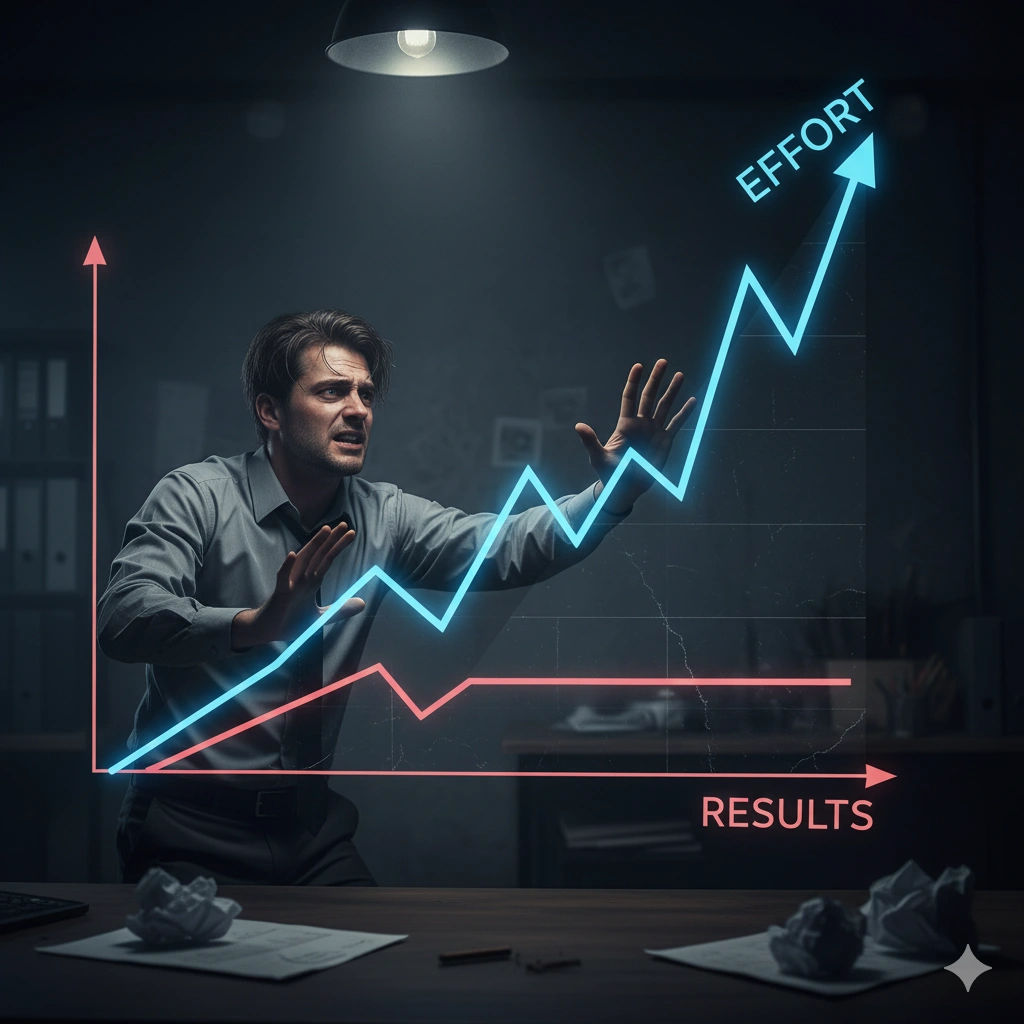
You’re working more hours than ever. You’re responding to emails at midnight. You’re sacrificing sleep, exercise, relationships—everything—to keep up. Yet somehow, you’re accomplishing less. Your quality is declining. Simple tasks take twice as long. You’re trapped in a paradox: the harder you push, the less effective you become.
This isn’t laziness or incompetence—it’s biology. When your stress response stays chronically activated, your cognitive functions degrade. Your creativity shuts down. Your problem-solving ability diminishes. You’re running a marathon at sprint pace, and your system is breaking down from the sustained overload.
Mayo Clinic research demonstrates that burnout can lead to lower productivity, decreased quality of care, and increased errors. The performance decline isn’t a cause of burnout—it’s a symptom. And it’s measurable if you’re paying attention.
Research Reference
Dyrbye, L. N., Shanafelt, T. D., Sinsky, C. A., et al. (2017). “Burnout among health care professionals: A call to explore and address this underrecognized threat to safe, high-quality care.” NAM Perspectives, Discussion Paper, National Academy of Medicine.
https://nam.edu/burnout-among-health-care-professionals-a-call-to-explore-and-address-this-underrecognized-threat-to-safe-high-quality-care/
Tracking Solutions:
- Output versus input ratio: Track hours worked versus tangible outputs completed each week. Graph it. If you see hours increasing while outputs decrease or stagnate, you’re in the performance paradox.
- Quality self-assessment: Rate the quality of your work each week (1-10). If quality is declining despite increased effort, that’s your system telling you it needs recovery, not more pushing.
- Rework tracking: Document how often you have to redo work due to errors or missed details. Increasing rework despite more careful effort signals cognitive fatigue—a precursor to burnout.
- Decision fatigue log: Note how long it takes you to make decisions. When simple decisions start taking significantly longer, your executive function is depleted. Track this trend over weeks.
Quick Mindfulness Practices: Your Weekly Dashboard and Daily Log
These aren’t optional extras—they’re your monitoring infrastructure:
Practice 1: Weekly 10-Minute Dashboard Review
Every Sunday evening (or your preferred day), sit down with your tracking data from the week. Review:
- Your daily mood scores: What’s the trend?
- Your energy levels: Are they declining?
- Your task completion ratio: Are you finishing what you start?
- Your connection quality: Are you isolating?
- Your Sunday night dread rating: Is it intensifying?
Look for patterns, not perfection. If three or more metrics are trending negative, that’s your early warning. Don’t wait for all five to hit red. Adjust now: say no to something, delegate a task, schedule a day off, ask for help. Treat your metrics like you’d treat server alerts—seriously, and immediately.
Why this works: You’re creating feedback loops that would otherwise be invisible. Most people don’t realize they’re burning out until they’re actively burning. This practice gives you leading indicators instead of lagging ones.
Practice 2: Daily 1-Minute Mood Log
At the same time each day (suggest: end of workday), open a simple document or app and record:
- Today’s date
- Mood (one word)
- Energy level (1-10)
- One notable event (positive or negative)
That’s it. Four data points, 60 seconds maximum. Do this for 30 days minimum. After a month, you’ll have 30 data points showing patterns you couldn’t see day-to-day. You’ll notice: “I’m consistently exhausted on Fridays,” or “My mood crashes every time I have back-to-back meetings,” or “I haven’t logged ‘energized’ in three weeks.”
Why this works: Consistency beats intensity. You’re not trying to journal extensively—you’re collecting data. Over time, this data becomes your personal burnout signature, showing you exactly what drains you and what sustains you.
The Bigger Picture: From Reactive to Proactive Well-Being
Here’s what most people get wrong about burnout prevention: they wait until they’re drowning, then frantically search for a life raft. By then, they’re already in crisis mode—exhausted, overwhelmed, barely functional. Recovery takes months instead of days.
But burnout doesn’t appear overnight. Mayo Clinic research consistently shows it’s a gradual, measurable process. The exhaustion creeps in. The cynicism grows slowly. The sense of ineffectiveness builds over time. Each phase has observable markers—if you’re looking for them.
Your early-warning system isn’t about adding more to your plate. It’s about creating visibility into what’s already happening. It’s the difference between driving blind and driving with a functioning dashboard. Same road, same destination—but one approach lets you see the warning lights before the engine fails.
Dr. Tait Shanafelt and Dr. Stephen Swensen, pioneers in burnout research at Mayo Clinic, emphasize that burnout must be reframed from an individual problem to an organizational opportunity. But while organizations should create better systems, you can’t wait for them to fix everything. Your personal monitoring system gives you agency—data to advocate for yourself, evidence to support boundary-setting, and early detection to intervene before crisis.
Implementation: Your 30-Day Monitoring Protocol
Don’t try to track everything perfectly starting tomorrow. Build gradually:
Week 1: Start the daily 1-minute mood log only. Just mood, energy, and one event. Get the habit established.
Week 2: Add the Sunday night dread rating. Notice if Monday is ruining your weekend.
Week 3: Begin tracking task completion ratio. How many things are you finishing versus starting?
Week 4: Implement the full weekly dashboard review. Look at your data. What patterns emerge?
By day 30, you’ll have a functioning early-warning system. You’ll know your baseline, recognize your patterns, and see deviations from normal. That’s when the system becomes truly valuable—because you’ll catch the warning signs weeks or months before burnout would have fully manifested.
Building Alerts Into Your System
Data without action is just documentation. Your tracking system needs triggers—specific thresholds that demand response:
Yellow Alert Triggers (Investigate and adjust):
- Energy scores below 5 for three consecutive days
- Task completion ratio below 40% for one week
- Sunday night dread rated 7+ for two weeks
- Cynicism journal entries increasing in frequency
Red Alert Triggers (Immediate intervention required):
- Energy scores below 3 for five consecutive days
- Zero meaningful connections in one week
- Work quality self-rated below 4 for three consecutive weeks
- Inability to identify any positive emotions for seven days
When yellow alerts trigger, make minor adjustments: delegate one task, cancel one meeting, take one afternoon off. When red alerts trigger, you need significant intervention: talk to your manager, take several days off, seek professional support, make structural changes to your workload.
These aren’t suggestions—they’re system requirements for sustainable operation.
Conclusion: The Dashboard You Can’t Afford Not To Have
You track your finances. You track your health metrics. You track your work projects. But do you track the one thing that makes all of those possible—your mental and emotional capacity?
Burnout isn’t a mystery. It’s not random bad luck or personal weakness. It’s a predictable systems failure that occurs when demand chronically exceeds capacity without adequate recovery. And like any system failure, it announces itself through warning signs—if you’re monitoring for them.
Your early-warning system doesn’t prevent all stress. It doesn’t eliminate difficult work or erase challenging situations. But it gives you something invaluable: visibility. You see the decline before it becomes crisis. You catch the erosion before it becomes collapse. You notice the warning lights while you still have options.
Most people realize they’re burnt out only after they’ve already crashed—when they’re calling in sick, having panic attacks, or fantasizing about quitting everything. By then, recovery is measured in months, sometimes years. Your monitoring system compresses that timeline dramatically. You catch issues at yellow alert, not red emergency.
Start today. Pick one metric. Log one data point. Build from there. Your future self—the one who didn’t burn out because you saw it coming and changed course—will thank you for the simple discipline of paying attention.
Because here’s the truth: you’re already collecting this data. You already know when you’re exhausted, when work is meaningless, when you’re cynical and detached. You’re just not writing it down, tracking it, or acting on it. You’re flying blind with a functional dashboard sitting right in front of you, unused.
Turn it on. Start monitoring. Respect the warning lights.
Your system is talking to you. It’s time to listen.
Research Papers Referenced
- Mayo Clinic Proceedings (2024). “Changes in Burnout and Satisfaction With Work-Life Integration in Physicians and the General US Working Population Between 2011 and 2023.” [https://www.mayoclinicproceedings.org/article/S0025-6196(24)00668-2/fulltext]
- Mayo Clinic (2024). “Job burnout: How to spot it and take action.” [https://www.mayoclinic.org/healthy-lifestyle/adult-health/in-depth/burnout/art-20046642]
- Mayo Clinic Press (2024). “Breaking down burnout in the workplace.” [https://mcpress.mayoclinic.org/mental-health/breaking-down-burnout-in-the-workplace/]
- Swensen, S., & Shanafelt, T. (2020). Mayo Clinic Strategies to Reduce Burnout: 12 Actions to Create the Ideal Workplace. Oxford University Press.
- Sonnentag, S., & Fritz, C. (2015). Recovery from job stress: The stressor-detachment model as an integrative framework. Journal of Organizational Behavior, 36(S1), S72-S103.
- Cropley, M., & Zijlstra, F. R. (2011). Work and rumination. In Handbook of stress in the occupations (pp. 487-503). Edward Elgar Publishing.
- Mark, G., Iqbal, S. T., Czerwinski, M., Johns, P., & Sano, A. (2016). Email duration, batching and self-interruption: Patterns of email use on productivity and stress. Proceedings of the 2016 CHI Conference on Human Factors in Computing Systems, 1717-1728.
- Maslach, C., & Leiter, M. P. (2016). Understanding the burnout experience: Recent research and its implications for psychiatry. World Psychiatry, 15(2), 103-111.
Dyrbye, L. N., Shanafelt, T. D., Sinsky, C. A., et al. (2017). Burnout among health care professionals: A call to explore and address this underrecognized threat to safe, high-quality care. NAM Perspectives, National Academy of Medicine.