
When one mark decides NLSIU vs Tier-3 college—navigating the brutal reality of CLAT with your mental health intact
You scored 99 marks. That’s higher than 97% of the 70,000+ aspirants who took CLAT this year. You’re brilliant, hardworking, dedicated. But here’s the crushing reality: NLSIU Bangalore’s cutoff was 100. NALSAR Hyderabad? Also 100. You’re one mark away from your dream. One mark—probably one question you second-guessed, one passage you misread, one logical reasoning trap you fell into.
And now? You’re looking at colleges you’ve never heard of. Your parents are asking what went wrong. Your coaching institute has moved on to celebrate the toppers. Your friends are posting admission confirmations to top NLUs while you’re refreshing the counseling portal, hoping for a miracle in the fifth round that never comes.
This is the brutal mathematics of CLAT: The exam has an acceptance rate as low as 3 percent, making it one of the toughest entrance examinations in India. Over 70,000 aspirants compete for fewer than 3,000 seats across 25 NLUs. The margin between success and devastation isn’t talent or effort—it’s often a single mark, one question, one moment of doubt that derails years of preparation.
The Consortium of National Law Universities has made efforts to address mental health concerns. In 2024, they launched a mental health initiative offering webinars and counseling services specifically for CLAT aspirants, recognizing that exam preparation creates overwhelming stress. But this support comes during preparation—what about after results, when you’re processing the grief of falling short despite doing everything right?
Research on law student mental health reveals alarming statistics: 96% of law students experience significant stress, compared to 70% of medical students and 43% of graduate students. For aspirants, the stress begins even before admission—during the months of preparation where your entire future feels compressed into 120 questions and 120 minutes.
Let’s talk about surviving this pressure—before, during, and especially after the exam—when the results either validate or devastate years of your effort.
Issue #1: The Rank Roulette Nightmare (When 100 Marks Gets You Everywhere or Nowhere)
That Moment You Realize the System Isn’t Merit-Based—It’s Luck-Based
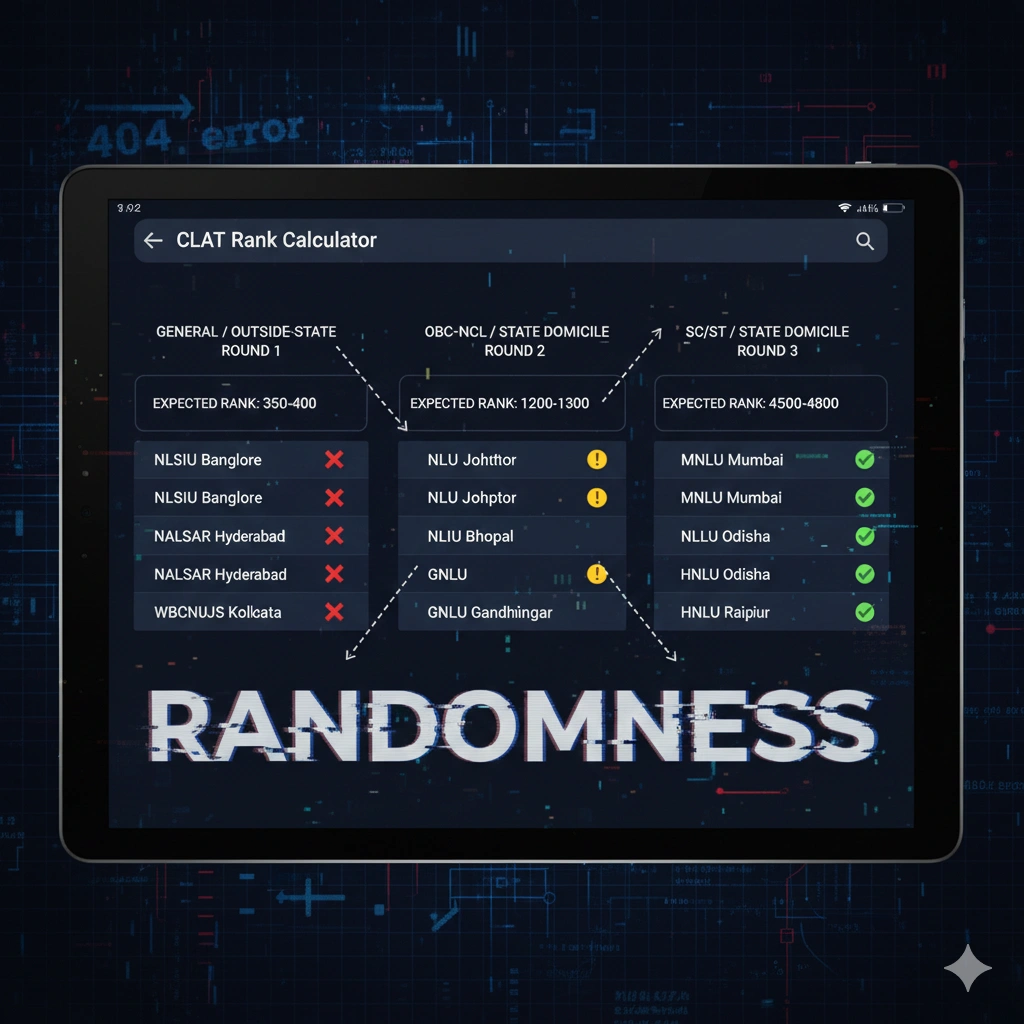
You scored 95 marks. Depending on your category, domicile status, and which counseling round you’re in, this score could mean NLUJ Jodhpur or a Tier-3 NLU you’re embarrassed to mention. Your friend scored 93 but got NLIU Delhi through domicile quota while you, with higher marks but no domicile advantage, are scrambling for seats in the fifth round.
The system isn’t transparent—it’s a lottery disguised as meritocracy. NLSIU Bengaluru requires an opening rank around 100–112 (expected cutoff: 108+ marks) for general category, while NALSAR Hyderabad expects ranks around 150–159 (expected cutoff: 100–104 marks). But these numbers shift based on factors you can’t control: how many people scored above you, reservation policies, domicile rules, and seat acceptance patterns.
You can’t strategize for randomness. You can only prepare excellently and hope the roulette wheel stops on your number.
Research on admission stress highlights how competitive entrance exams create psychological distress, particularly when outcomes feel disproportionate to effort invested. The uncertainty amplifies anxiety—you don’t just fear failure, you fear that your success won’t be recognized.
Research Reference
“Mental Health in India: 12 Proven Solutions to Overcome Challenges in Educational Institutions.” DesiDastak (2024).
https://desidastak.com/mental-health-in-india-12-proven-solutions/
Mindful Solutions:
- Multiple scenario planning: Before results, create mental models for different outcomes—NLSIU, top-5 NLU, mid-tier NLU, private college. Research each option seriously. When you’ve mentally explored all paths, individual results feel less catastrophic.
- Decouple effort from outcome: You can control preparation quality. You cannot control cutoff fluctuations, category competition, or how many toppers choose commerce seats. Separate your worth from variables you don’t influence.
- Community reality check: Join CLAT aspirant forums not to compare, but to understand the systemic randomness everyone faces. When you see dozens of brilliant students with similar struggles, you realize the system’s flaws, not your inadequacy.
- Post-result processing time: Give yourself 48 hours after results to feel everything—disappointment, anger, grief. Don’t make decisions, don’t force positivity. Just feel. Then, after processing, make strategic choices about next steps.
Issue #2: The Coaching Institute Pressure Cooker (When Your Teacher Knows Your Mock Scores Better Than Your Name)
Living Inside a Percentile Factory Where Humanity Gets Outsourced

Your coaching institute knows exactly three things about you: your registration number, your mock test percentile, and whether you’re likely to become a testimonial. If you’re consistently scoring 95+, you get attention—extra tips, personal guidance, maybe even a photo opportunity. If you’re hovering around 80-85, struggling with logical reasoning, you’re invisible. You’re just tuition fees, not a success story in the making.
The coaching culture creates artificial hierarchies. Top scorers in mocks get lauded publicly. Average scorers get generic advice. Struggling students get ignored or worse—made to feel they’re wasting everyone’s time. This creates internalized shame: “If I was smart enough, I’d be scoring better. If I was worthy, the teachers would notice me.”
The CLAT consortium recognized this pressure, reducing questions from 200 to 120-150 to decrease mental stress on aspirants. But the coaching industrial complex hasn’t adjusted its pressure—only its marketing.
Research on academic stress in India shows that institutional pressure—through constant evaluation, public ranking, and conditional validation—significantly damages student mental health, creating anxiety that persists even post-admission.
Research Reference
“NLUs must stop ‘show business’; prioritise students’ mental health: Dr Pallab Das.” Bar & Bench (2024). https://www.barandbench.com/interviews/nlus-must-stop-show-business-prioritise-students-mental-health-dr-pallab-das
Mindful Solutions:
- Create external validation sources: Your worth isn’t determined by coaching institute hierarchy. Find mentors outside the system—lawyers, NLU students, family members—who see you as a whole person, not a percentile.
- Mock tests as data, not identity: Each mock reveals preparation gaps—that’s their purpose. A 78 percentile isn’t a statement about your intelligence; it’s feedback showing you need stronger current affairs or faster reading comprehension. Treat it like code debugging, not character judgment.
- Selective engagement: You don’t need every doubt-solving session, every extra class, every motivational webinar. Choose what genuinely helps your preparation. Protect your mental energy from the coaching center’s FOMO creation machine.
- Alternative learning communities: Study groups with 3-4 peers focused on collaborative learning—not competition—can replace the toxic coaching environment. You’ll learn more and stress less.
Issue #3: The Current Affairs Anxiety Loop (When the World Won’t Stop Happening Long Enough for You to Study It)
Trying to Memorize the News While the News Keeps Changing

You’ve made flashcards for the last six months of current affairs. You know every Supreme Court judgment, every government scheme, every international treaty. Then, the week before CLAT, there’s a major political development, a landmark judgment, and three policy announcements. Your preparation suddenly feels outdated. Do you revise what you know, or scramble to learn what just happened?
Current affairs isn’t a finite syllabus—it’s an infinite loop. Unlike Quantitative Techniques (where formulas stay consistent) or Legal Reasoning (where principles remain stable), current affairs punishes you for not being omniscient about the world’s happenings right up until exam day.
This creates chronic anxiety. You can never feel “done” with current affairs preparation. There’s always one more article to read, one more development to know. The goalpost keeps moving, and you’re exhausted from chasing it.
Research on law students reveals that 48% report chronic stress or anxiety during their academic journey, with 35% citing fear of failure as the primary source of stress. For CLAT aspirants, this fear manifests uniquely: failure isn’t just about not knowing enough—it’s about the world changing faster than you can learn it.
Research Reference “Mental Health in India: 12 Proven Solutions to Overcome Challenges in Educational Institutions.” DesiDastak (2024).
https://desidastak.com/mental-health-in-india-12-proven-solutions/
Mindful Solutions:
- Six-month window strategy: Focus deeply on the most recent six months before CLAT. Questions rarely go beyond this timeframe. Older current affairs get less weightage—allocate your energy accordingly.
- Themes over events: Instead of memorizing every detail of every news item, identify themes—judicial overreach, climate policy, international relations shifts. Questions test understanding of patterns, not rote memorization of dates.
- Daily 30-minute cap: Set a strict limit on current affairs study each day. More time doesn’t equal better retention—it equals overwhelm. Thirty focused minutes of quality sources (newspapers’ editorials, legal blogs) beats three hours of doomscrolling news apps.
- Pre-exam freeze: Five days before CLAT, stop consuming new current affairs. Revise what you know. Last-minute cramming of breaking news creates panic, not preparation. Trust your existing knowledge base.
Issue #4: The Legal Reasoning Impostor Syndrome (When Every Answer Feels Right Until It’s Wrong)
That Special Hell of Choosing Between Two Equally Logical Options

You read the legal principle. You read the facts. You eliminate two obviously wrong options. Now you’re left with two answers that both seem correct. One relies on a literal interpretation; the other applies equitable principles. You choose one. You’re wrong. The explanation says you should have chosen the other. You review the question. You still think your answer was defensible.
Legal reasoning in CLAT isn’t about knowing the law—it’s about guessing which interpretation the question-setter preferred. Unlike math (where 2+2 always equals 4), legal reasoning has defensible ambiguity. Your thought process can be logically sound, yet your answer can be marked incorrect because you didn’t think like the examiner.
This creates deep self-doubt. You start questioning not just your answers, but your ability to think legally. “If I can’t get these right, maybe I’m not meant for law.” But here’s the truth: Many law students struggled with exactly these reasoning patterns, which is why the exam format itself has undergone multiple revisions to address fairness concerns.
Legal education research shows that the Socratic method and ambiguous reasoning exercises initially destabilize students who excelled through rote learning. This isn’t cognitive deficiency—it’s adjustment to a fundamentally different thinking paradigm.
Research Reference
“Law Student Mental Health Statistics You Need to Know.” Clio Blog (2025).
https://www.clio.com/blog/law-student-mental-health-statistics/
Mindful Solutions:
- Percentage-based self-assessment: In legal reasoning, 70% accuracy is excellent. You’re not supposed to get everything right—the questions are designed with defensible ambiguity. If you’re hitting 70-75%, you’re on track. Stop chasing perfection in an imperfect question format.
- Pattern recognition over principle memorization: After solving 50-100 legal reasoning questions, you’ll notice examiner preferences—they favor literal interpretation in certain contexts, equitable reasoning in others. Learn the pattern, not just the principles.
- Explanation analysis: When you get legal reasoning wrong, don’t just read the correct answer—study the explanation thoroughly. Often, the examiner reveals their thinking framework. Understanding their logic helps you align future answers.
- Confidence threshold: If you’re genuinely torn between two options and can’t decide, pick one and move on within 90 seconds. Extended deliberation rarely improves accuracy—it just drains time and confidence.
Issue #5: The Post-Result Identity Crisis (When CLAT Becomes Your Entire Personality)
Realizing You Don’t Know Who You Are Without This Exam

For the past year (or two, or three), CLAT has been your entire identity. Your friends know you as “the person preparing for law school.” Your family’s conversations revolve around your preparation. You’ve deferred other plans—relationships, hobbies, travel, jobs—because “first CLAT, then everything else.”
Then results come. Whether you get your target college or not, there’s a void. If you got in, you’re suddenly directionless—”Now what? I prepared for this moment, but I never thought about what comes after.” If you didn’t get in, you’re shattered—”I sacrificed everything for this, and now I have nothing. Not the college, not the alternative plans I postponed, not the person I was before preparation consumed me.”
This identity crisis is particularly acute for repeat aspirants. Each attempt deepens your entanglement with CLAT until the exam stops being something you’re taking and becomes who you are. When people ask “How are you?”, you don’t know how to answer without referencing percentile, preparation, or exam dates.
Research shows depression rates among law students increase from 8-9% pre-law school to 40% after three years, but for aspirants, depression can begin even before admission—during the identity erosion phase where everything beyond CLAT feels irrelevant.
Research Reference
“Law Student Mental Health Statistics You Need to Know.” Clio Blog (2025).
https://www.clio.com/blog/law-student-mental-health-statistics/
Mindful Solutions:
- Three-dimensional identity map: Write down five things about yourself unrelated to CLAT—personality traits, values, relationships, hobbies you abandoned, dreams unrelated to law. Read this list weekly. You existed before CLAT; you’ll exist after it.
- Parallel life maintenance: Even during intense preparation, maintain one non-negotiable activity that connects you to your pre-CLAT self—weekly calls with friends, monthly book club, Sunday morning runs. This isn’t “distraction”—it’s identity preservation.
- Scenario planning beyond results: Visualize your life post-CLAT in all scenarios: got target NLU, got mid-tier NLU, didn’t get desired college, taking another attempt. Create concrete plans for each. When you’ve imagined all paths, no single outcome feels like existential catastrophe.
- Gratitude practice for non-CLAT wins: Daily, identify one good thing unrelated to preparation—a conversation that made you laugh, a sunset you noticed, a meal you enjoyed. This rewires your brain to find meaning beyond exam outcomes.
Quick Mindfulness Practices: Your CLAT Survival Toolkit
When pressure peaks and panic threatens to overwhelm preparation:
Practice 1: The 2-Minute “Logical Reasoning Ground”
You’re stuck on a logical reasoning question. You’ve reread it three times. Frustration is building. Your inner critic is screaming: “This should be easy. Why can’t you figure this out?”
Stop. Close your eyes. Place both feet firmly on the ground. For 2 minutes, practice this:
Breathe in for 4 counts. As you inhale, mentally say: “I am capable of understanding this.” Hold for 2 counts. Feel the pause. Exhale for 6 counts. As you exhale, mentally say: “I release the need to force the answer.” Repeat for 2 minutes (approximately 8 cycles).
After this practice, return to the question. Often, the answer becomes clear when you stop forcing comprehension. Your subconscious processed it during the breathing space.
Why it works: Cognitive forcing creates mental blocks. When you’re frustrated, your prefrontal cortex (responsible for problem-solving) becomes less effective. The breathing practice reduces cortisol, allowing clearer thinking to emerge organically.
Practice 2: The 3-Minute “Rank Release Ritual”
Results are out. You scored lower than expected. Or you got your target rank but feel empty instead of elated. Or you’re one mark away from your dream college and drowning in “what ifs.”
Before making any decisions, before posting anything, before talking to anyone, take 3 minutes alone:
Minute 1: Acknowledge: Say aloud or write down exactly what you’re feeling. “I feel devastated.” “I feel disappointed despite my high rank.” “I feel angry at the system.” Don’t censor. Just name it.
Minute 2: Validate: Say to yourself: “These feelings are real and reasonable. My reaction is human. I’m allowed to feel this way.” Give yourself permission to be sad, angry, or confused—even if others think you “should” feel differently.
Minute 3: Ground: Place one hand on your heart, one on your belly. Breathe normally. Mentally repeat: “This result is one data point in my life. It does not define my entire future. I am more than this number.”
After 3 minutes, you’re ready to engage with others, make decisions, and plan next steps from a grounded place instead of reactive overwhelm.
Why it works: Immediate reactions to results are often dysregulated—either catastrophizing or numbing. This ritual creates space between stimulus (results) and response (your actions), allowing your nervous system to regulate before you make significant decisions.
The Bigger Picture: CLAT Is One Door, Not the Only Path
Here’s what coaching institutes won’t tell you: countless successful lawyers never attended top-3 NLUs. Successful legal careers are built by graduates of NLUJ, RMLNLU, GNLU, and even private law colleges whose names don’t carry NLSIU’s prestige. The college matters less than what you do once you’re there.
Yes, NLSIU opens certain doors more easily—placement opportunities, alumni networks, brand recognition. But those doors aren’t permanently closed to others. Mid-tier NLU graduates intern at top law firms. Private college students crack judicial services. State university law students build thriving litigation practices.
In CLAT 2023, students with a score of 75+ could secure seats in one of the 22 NLUs. A 75 percentile score isn’t failure—it’s accessing legal education at institutions with qualified faculty, decent infrastructure, and valid degrees. What you make of those five years matters infinitely more than whether your college is ranked #3 or #13.
The obsession with top-tier NLUs creates a false binary: NLSIU or bust, NALSAR or failure. But legal education isn’t hierarchical destiny—it’s foundational preparation. Your career trajectory depends on your work ethic, internships, networking, specialization choices, and professional skills developed over years, not just the college name on your degree.
Implementation: Building Sustainable Exam Preparation
Small shifts prevent complete burnout:
Daily: One hour of non-CLAT life. Talk to family about non-exam topics. Watch something unrelated to current affairs. Take a walk without revising mental notes.
Weekly: One complete study-free evening. No guilt. Your brain needs consolidation time to transform short-term memory into long-term retention. Rest isn’t laziness—it’s neuroscience.
Monthly: One honest mental health check. Are you sleeping? Eating properly? Experiencing any joy? If three consecutive months show decline, adjust your preparation strategy—intensity without sustainability leads to collapse right before the exam.
Post-exam: Regardless of results, take 72 hours before making major decisions. Let the emotional intensity settle. Then, with clarity, evaluate your options and choose your next step.
Conclusion: Your Worth Isn’t Measured in Marks Out of 120
Ten years from now, you won’t remember your exact CLAT rank. You’ll barely remember the exam itself. But you will remember how you treated yourself during this challenging period—whether you showed yourself compassion or cruelty, whether you maintained perspective or spiraled into self-destruction, whether you preserved your identity or lost yourself entirely in percentile obsession.
CLAT is designed to be difficult. With an acceptance rate as low as 3 percent, most aspirants—intelligent, hardworking, deserving aspirants—won’t get their first-choice college. That’s statistical reality, not personal failure.
You’re attempting something genuinely challenging. The pressure you feel is real, the competition is intense, and the stakes feel impossibly high. Give yourself credit for showing up, for persisting, for not abandoning your goal despite how difficult the journey is.
But also remember: you are not your CLAT score. You’re not defined by whether you clear NLSIU’s cutoff or settle for a mid-tier NLU. You’re a whole person with talents, values, relationships, and a future that extends far beyond 120 questions answered in 120 minutes.
Prepare strategically. Give your honest best. But protect your mental health with the same discipline you protect your study schedule. Because ultimately, succeeding in law school—at any NLU—requires not just academic knowledge but emotional resilience, self-awareness, and the ability to handle pressure without self-destruction.
Those qualities aren’t tested by CLAT. They’re tested by how you navigate the preparation and results. Master those, and you’ll succeed in law school and beyond—regardless of which college admits you.
Your rank might not be perfect. Your college might not be your first choice. But your wellbeing, your character, and your capacity for self-compassion—those are non-negotiable.
Guard them fiercely. You’ll need them long after CLAT becomes a distant memory.
Research Papers Referenced
- Consortium of National Law Universities (2024). “Mental Health Initiative for CLAT Aspirants.” Lawctopus. [https://lawctopus.com/clatalogue/clat-ug/consortium-of-nlus-launches-mental-health-initiative-for-clat-aspirants/]
- Das, P. (2024). “NLUs must stop ‘show business’; prioritise students’ mental health.” Bar & Bench Interview. [https://www.barandbench.com/interviews/nlus-must-stop-show-business-prioritise-students-mental-health-dr-pallab-das]
- “Mental Health in India: 12 Proven Solutions to Overcome Challenges in Educational Institutions.” DesiDastak (2024). [https://desidastak.com/mental-health-in-india-12-proven-solutions/]
- “Law Student Mental Health Statistics You Need to Know.” Clio Blog (2025). [https://www.clio.com/blog/law-student-mental-health-statistics/]
- Verma, G., et al. (2022). “Improving mental health on college campuses: Perspectives of Indian college students.” Journal of American College Health, 70(3), 731-738. [https://pubmed.ncbi.nlm.nih.gov/35227409/]
- Skead, N., & Rogers, S. (2014). “Stress, Anxiety and Depression in Law Students: How Student Behaviors Affect Student Well-being.” Deakin Law Review.
- “The Full Weight of Law School: Stress on Law Students is Different.” Lawyers Concerned for Lawyers, Massachusetts (2025). [https://www.lclma.org/2019/01/18/the-full-weight-of-law-school-stress-on-law-students-is-different/]
IMS India (2024). “What is a Good Score in CLAT 2026? Top NLUs and Cutoff Marks.” [https://www.imsindia.com/blog/clat/good-score-in-clat/]