Small daily wins compound into lasting joy—here’s the exact neurological loop that turns gratitude into sustainable momentum
You know that feeling when coffee hits?
The warm lift. The sudden clarity. The sense that you can tackle the day ahead.
Now imagine that feeling, but without the crash. Without the jitters. Without needing an external substance to access it.
That’s what gratitude loops do to your brain—but the effect isn’t temporary. It’s compounding.
Most people think gratitude is soft. A nice-to-have. Something you do when life is already good. But neuroscience reveals something different: gratitude isn’t a response to success. It’s a prerequisite for it.
When you understand how gratitude rewires your neural pathways, you stop treating it like a platitude and start treating it like the performance-enhancing tool it actually is.
The Concept: What Is Brain Hacking, and Why Gratitude Is Your Access Point
Brain hacking sounds like something from a Silicon Valley biohacking forum. And in some ways, it is. But strip away the buzzwords, and you’re left with something ancient: deliberately working with your neurobiology instead of against it.
Your brain is designed to scan for threats. It’s an evolutionary feature that kept your ancestors alive. But in modern life, that same mechanism creates chronic stress, anxiety, and the persistent sense that something is wrong—even when it isn’t.
Gratitude is the counterweight. It’s not about denying problems or toxic positivity. It’s about training your brain to notice what’s working alongside what isn’t.
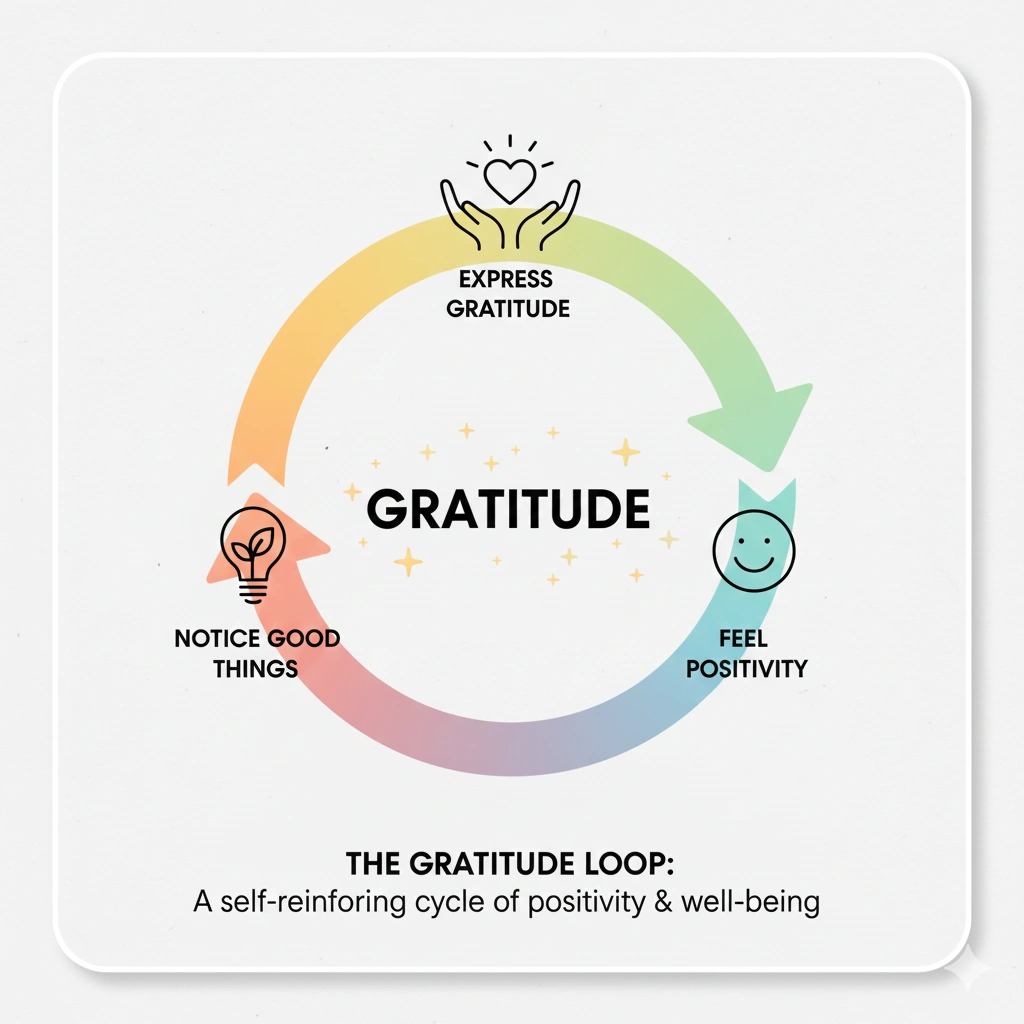
A gratitude loop is a self-reinforcing cycle:
- You notice something good (even something small)
- Your brain releases dopamine and other feel-good chemicals
- Those chemicals make you more likely to notice other good things
- The loop strengthens, creating a neural pathway that gets easier to access over time
This isn’t metaphor. This is measurable brain activity.
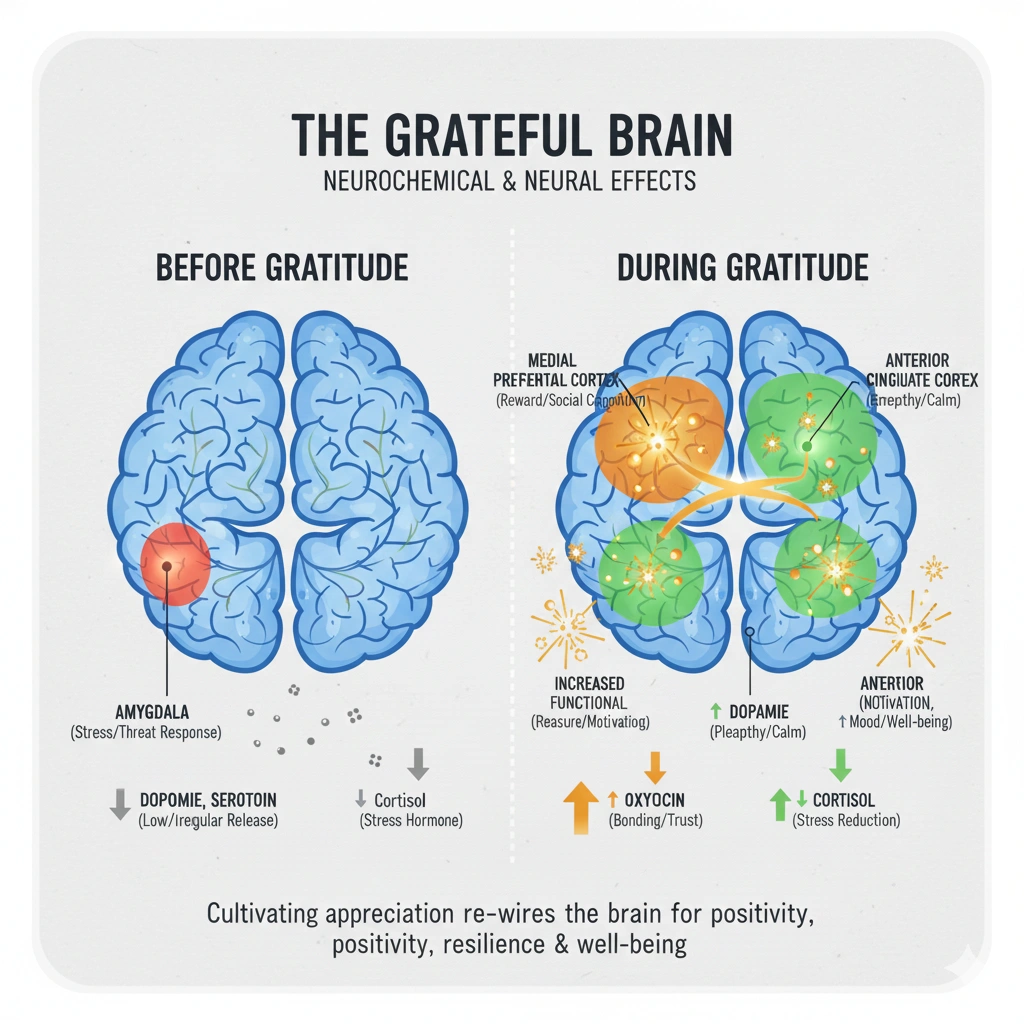
Research from UCLA’s Mindfulness Awareness Research Center shows that regular gratitude practice increases neural sensitivity in the medial prefrontal cortex—the region associated with learning, decision-making, and processing rewards. The more you practice, the more your brain becomes wired for recognizing positive stimuli.
But here’s where it gets interesting: gratitude doesn’t just make you happier. It makes you grind harder.
The Science: How Gratitude Rewires Your Brain Chemistry
Let’s talk about what actually happens in your skull when you practice gratitude.
The Dopamine Connection
Dopamine isn’t just the pleasure chemical—it’s the motivation chemical. It’s what drives you to pursue goals, push through resistance, and keep moving forward.
A study published in Frontiers in Psychology (Karns et al., 2017) found that gratitude practice increases dopamine and serotonin production. But unlike the spike you get from coffee, sugar, or social media, gratitude-induced dopamine is steady and sustainable. You’re not borrowing from tomorrow’s energy reserves—you’re generating new capacity.
The Prefrontal Cortex Activation
When you actively recall what you’re grateful for, you engage your prefrontal cortex—the executive function center. This is the part of your brain responsible for planning, impulse control, and rational decision-making.
Research from the National Institutes of Health (Fox et al., 2015) using fMRI scans showed that gratitude activates the ventromedial prefrontal cortex, which is associated with feelings of reward and moral cognition. The more you activate this region, the stronger it becomes—like a muscle you’re training.
The Stress Hormone Reduction
Cortisol is your stress hormone. Chronic elevation leads to burnout, inflammation, and that wired-but-tired feeling that coffee only makes worse.
A study from the University of California, Davis found that gratitude practice reduces cortisol levels by 23%. Lower cortisol means better sleep, clearer thinking, and more sustained energy throughout the day.
The Neural Plasticity Factor
Your brain is plastic—it changes based on what you repeatedly focus on. Dr. Rick Hanson’s research on “taking in the good” demonstrates that holding positive experiences in awareness for 10-15 seconds strengthens the neural pathways associated with those experiences.
This is the mechanic behind gratitude loops. You’re not just feeling grateful—you’re literally building new brain architecture that makes gratitude (and the energy it generates) easier to access.

Gratitude as Fuel: Why Thankfulness Makes You Work Harder, Not Softer
There’s a myth that gratitude makes you complacent. That if you’re too grateful, you’ll lose your edge, your hunger, your drive.
The research shows the opposite.
A study published in Journal of Personality and Social Psychology (Grant & Gino, 2010) found that people who received expressions of gratitude increased their productivity by 50%. Not because they felt obligated—because gratitude creates a sense of meaning, and meaning is the ultimate motivator.
When you’re grinding without gratitude, you’re running on stress hormones and willpower—finite resources that deplete. You push until you crash, then need external recovery to push again.
When you’re grinding with gratitude, you’re running on sustainable fuel. You’re connected to purpose. You’re noticing progress. You’re building momentum instead of just burning energy.
I know a founder—let’s call her Priya—who built her startup on 80-hour weeks fueled by coffee, anxiety, and the terror of failure. She hit Series A funding and burned out immediately after. Six months of barely functional depression.
When she came back, she changed one thing: every morning, before opening her laptop, she wrote three things she was grateful for. Not big things. Not forced things. Just true things.
“It felt stupid at first,” she told me. “But after a few weeks, I noticed I wasn’t grinding out of fear anymore. I was building because I actually cared about what I was creating. The hours didn’t decrease, but they stopped feeling like punishment.”
That’s the shift. Gratitude doesn’t make you work less—it makes you work from a different source.
The 4-Step Gratitude Loop: A Practical Protocol
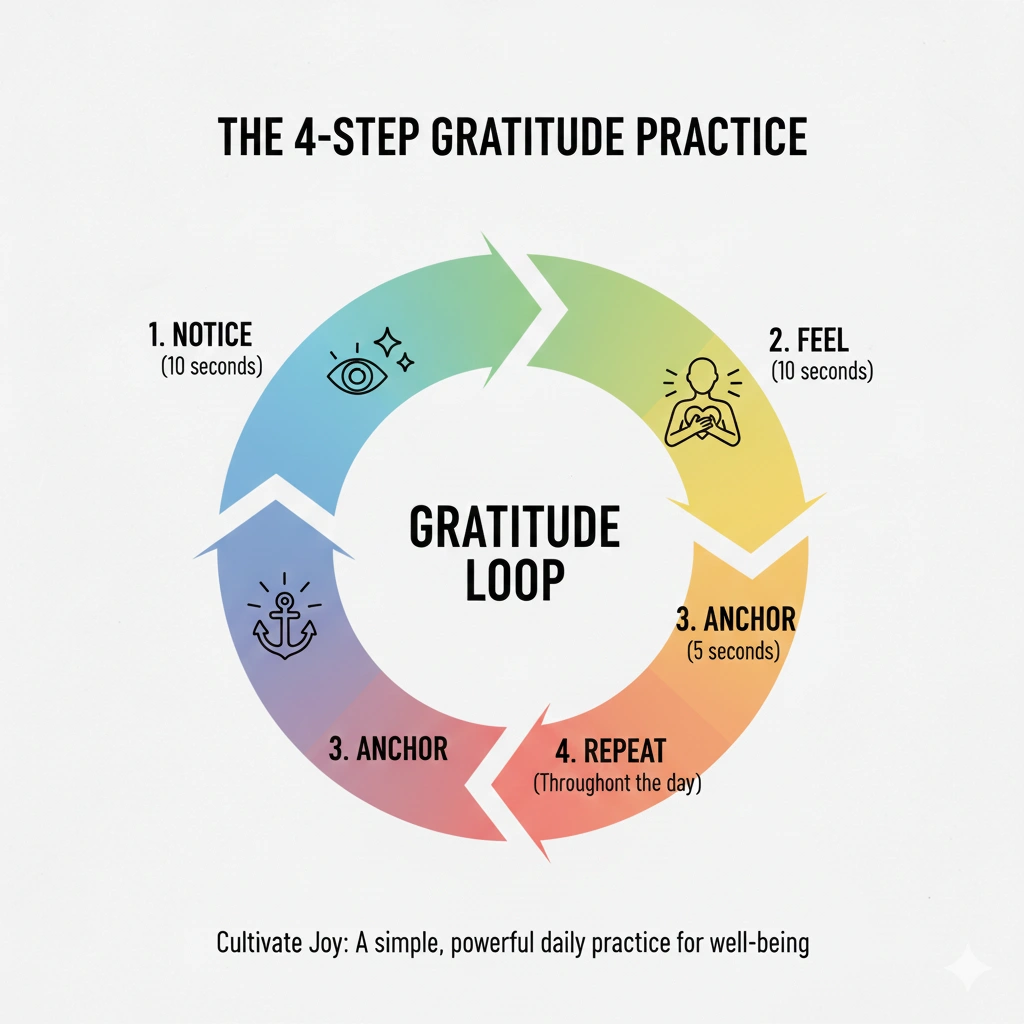
Here’s the exact loop that wires gratitude into your daily operating system.
STEP 1: NOTICE (10 seconds)
Catch yourself mid-day and ask: “What’s one thing that worked today?”
Not what should have worked. Not what will work tomorrow. What actually worked right now.
Examples:
- “That meeting ended early”
- “I remembered to drink water”
- “The code compiled on the first try”
- “Someone held the door for me”
The smaller, the better. You’re training your brain to notice the granular wins it usually overlooks.
STEP 2: FEEL (15 seconds)
Don’t just acknowledge it—actually feel it. Let the recognition settle in your body.
This is the step most people skip, and it’s why their gratitude practice doesn’t stick. Rick Hanson’s research shows that the neural encoding happens during the feeling phase, not the noticing phase.
Where do you feel it? Your chest? Your shoulders releasing? A slight warmth?
Stay with it. Let it register. You’re teaching your nervous system that this moment matters.
STEP 3: ANCHOR (5 seconds)
Tie the feeling to something physical.
Touch your chest. Take a deep breath. Press your thumb and forefinger together.
This creates a somatic anchor—a physical trigger you can use to recall this state later when stress hits. You’re building a shortcut back to this feeling.
STEP 4: REPEAT (Throughout the day)
Do this loop 3-5 times per day. Morning. Mid-day. Evening. Whenever you remember.
Each repetition strengthens the pathway. Each loop makes the next one easier. Within two weeks, your brain starts scanning for these moments automatically.
You’re not forcing positivity—you’re retraining your attention.
THE PROTOCOL IN ACTION
Morning: “I slept through the night without waking up. I’m grateful my body knows how to rest.” [Feel it in your body for 15 seconds]
Afternoon: “That bug I was stuck on yesterday? I figured it out this morning. I’m grateful my brain works on problems even when I’m not consciously thinking about them.” [Anchor with a breath]
Evening: “I had an honest conversation with my partner instead of shutting down. I’m grateful I’m learning to communicate better.” [Feel the warmth of that connection]
Notice: none of these are huge. None are forced. They’re just true.

Integration Into Daily Life: Making Gratitude Automatic
The loop works, but only if you remember to do it. Here’s how to build it into your existing routines without adding complexity.
Morning Integration: The Coffee Ritual
While your coffee brews (or tea steeps), run the loop. Don’t check your phone. Don’t plan your day. Just notice one thing you’re grateful for from yesterday.
The caffeine ritual becomes paired with the gratitude practice. Your brain links them. Eventually, pouring coffee triggers the gratitude reflex.
Work Integration: The Transition Trigger
Before switching tasks—closing one tab, opening another—pause for five seconds. Notice what you just completed. Feel grateful you can focus on one thing at a time (even if you weren’t perfect at it).
This turns context-switching—normally a source of fragmentation—into an opportunity for micro-gratitude.
Evening Integration: The Wind-Down Protocol
Before bed, instead of scrolling, write three wins from the day. Not achievements—wins. Moments that felt good, even briefly.
Research from the University of Pennsylvania (Emmons & McCullough, 2003) shows that keeping a gratitude journal before sleep improves sleep quality and reduces intrusive thoughts. You’re literally teaching your brain what to process while you sleep.
The One-Minute Version (For Skeptics)
If you’re busy or skeptical, do this: every time you wash your hands, notice one thing you’re grateful for while the water runs.
That’s it. You already wash your hands multiple times a day. Now you’re stacking gratitude onto an existing habit.
Within a week, handwashing becomes a gratitude cue. Your brain starts anticipating it.
Common Mistakes: Why Your Gratitude Practice Isn’t Working

Mistake 1: Making It Generic
“I’m grateful for my family, my health, my job.”
Your brain knows these are templates. There’s no specificity, no emotional resonance, no neural encoding.
Fix: Get micro-specific. Not “my partner,” but “the way my partner laughed at my terrible joke this morning.” Specificity creates the feeling, and the feeling creates the rewiring.
Mistake 2: Skipping the Feeling Phase
You list three things in your journal and move on. You’ve completed the task, but you haven’t completed the loop.
Gratitude is not a checklist item. It’s a neurological event. If you don’t pause to feel, you don’t get the dopamine release, the cortisol reduction, or the neural encoding.
Fix: Set a timer for 15 seconds after each gratitude item. Just sit with it. Let it land.
Mistake 3: Only Practicing When Things Are Good
Gratitude as a fair-weather practice is useless. It’s like only lifting weights when you’re already strong.
The real benefit comes from practicing when life is hard—not to bypass the difficulty, but to maintain your neural baseline while navigating it.
Fix: On terrible days, lower the bar. “I’m grateful I got out of bed.” “I’m grateful I’m still here.” “I’m grateful this day will end.” Small, true, accessible.
Mistake 4: Treating It Like Toxic Positivity
Gratitude isn’t “everything happens for a reason” or “good vibes only.” It’s not spiritual bypassing.
You can be grateful your body is fighting an illness while also being pissed that you’re sick. You can be grateful for a supportive friend while also grieving a loss. Gratitude coexists with difficulty; it doesn’t erase it.
Fix: Practice “and” thinking. “This is hard AND I’m capable of navigating it.” Both things are true.
Mistake 5: Comparing Your Gratitude to Others
Someone else’s gratitude for their vacation photos doesn’t invalidate your gratitude for functioning coffee maker.
Gratitude isn’t a competition. It’s a personal recalibration.
Fix: Stay in your own experience. What matters is what’s true for you, not what should be impressive to others.
The Compounding Power of Consistency: What Changes at 30, 60, 90 Days
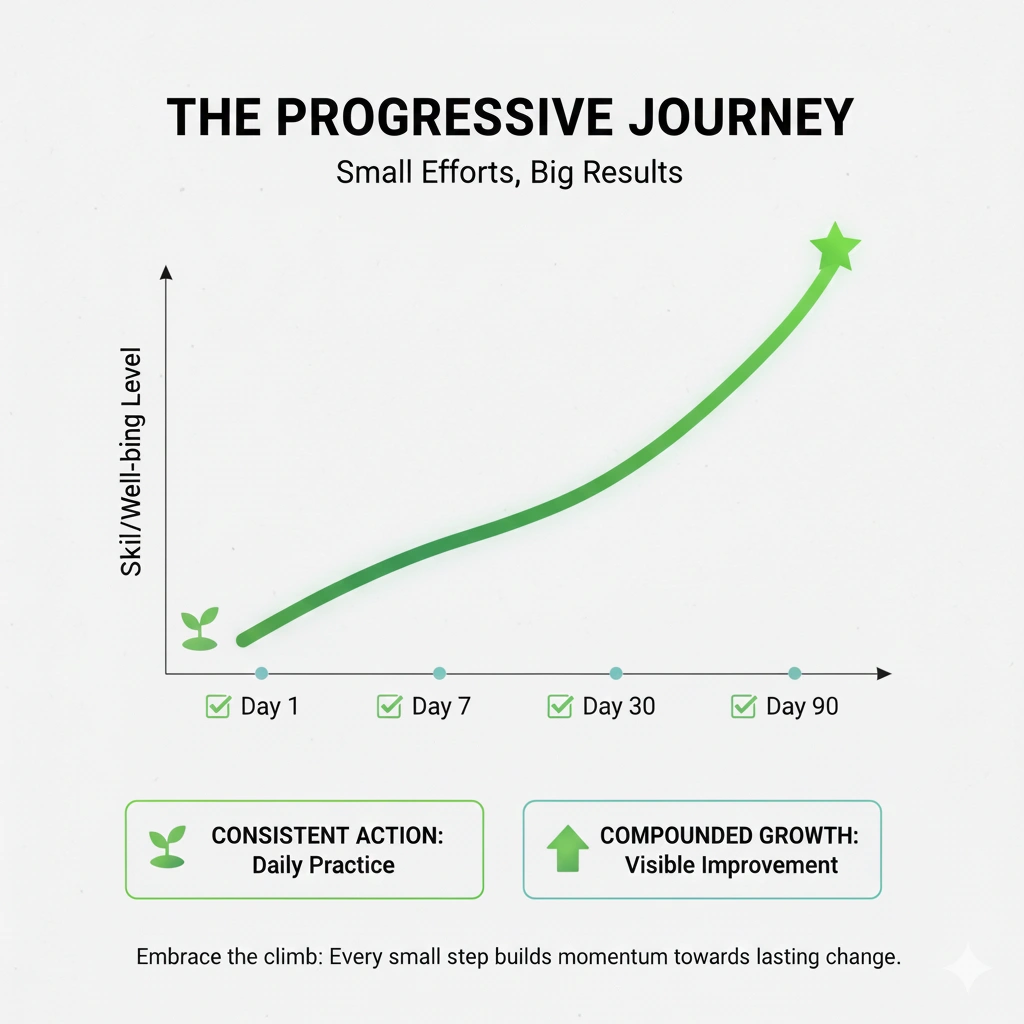
Here’s what happens when you run the loop consistently:
Week 1-2: Awkward but Present
It feels mechanical. Your inner skeptic is loud. You’re not sure it’s doing anything. But you’re building the habit architecture.
Week 3-4: Noticing Shifts
You find yourself naturally spotting small wins. You’re less reactive to minor annoyances. The voice in your head is slightly less harsh.
Week 5-8: Neural Rewiring
This is where the research shows measurable changes. Your baseline mood lifts. You recover from setbacks faster. Stress doesn’t floor you the way it used to.
A study in Journal of Happiness Studies found that participants who practiced gratitude for 10 weeks showed significant increases in optimism and life satisfaction compared to control groups.
Week 9-12: Structural Integration
Gratitude becomes your default lens, not your intentional practice. You don’t have to force it anymore—your brain automatically runs the loop.
This is the compound effect. Three months of consistent practice doesn’t make you 3x happier than day one—it makes you exponentially more resilient, energized, and capable.
Priya, the founder I mentioned earlier, is now three years into her gratitude practice. She doesn’t journal every day anymore—she doesn’t need to. Her brain has been restructured.
“I still grind,” she said. “But the grind doesn’t grind me down anymore.”
That’s the shift. Same effort. Different fuel source.
Your Loop, Your Momentum

You’re going to have hard days. Days when gratitude feels impossible, when the loop feels like another obligation, when you just want to survive until bedtime.
Those are the days the practice matters most.
Not because gratitude fixes everything. It doesn’t. But because in the middle of difficulty, the ability to notice one small thing that didn’t go wrong becomes an anchor. A reminder that you’re still here, still capable, still moving.
The gratitude loop isn’t about pretending life is easy. It’s about training your brain to see the full picture—the hard AND the bearable, the loss AND the learning, the grind AND the grace.
Coffee gives you a spike. Gratitude gives you a foundation.
Coffee wears off in three hours. Gratitude compounds over three months.
Coffee requires external input. Gratitude requires only attention.
Start Today: Your First Loop
Right now, before you close this tab:
- Notice one thing that worked today (even if it’s just “I read this article”)
- Feel it for 15 seconds (where does the recognition land in your body?)
- Anchor it (take one deep breath, touch your chest)
- Repeat tomorrow
That’s the loop. That’s the hack.
No app required. No subscription. No perfect conditions needed.
Just your brain, your attention, and the willingness to notice what’s already working while you build what’s next.
The grind doesn’t have to grind you down.
Run the loop. Build the pathway. Compound the joy.
Your brain is waiting.
The 4-Step Gratitude Loop Summary:
- NOTICE (10 sec): What worked today?
- FEEL (15 sec): Let it register in your body
- ANCHOR (5 sec): Tie it to a physical gesture
- REPEAT (Daily): 3-5 times minimum
Research References:
- UCLA Mindfulness Awareness Research Center. “The Grateful Brain: The Neuroscience of Giving Thanks.” https://www.uclahealth.org/news/grateful-brain-neuroscience-giving-thanks
- Karns, C. M., et al. (2017). “The cultivation of pure altruism via gratitude: A functional MRI study of change with gratitude practice.” Frontiers in Psychology, 8, 1491. https://www.frontiersin.org/articles/10.3389/fpsyg.2015.01491/full
- Fox, G. R., et al. (2015). “Neural correlates of gratitude.” Frontiers in Psychology, 6, 1491. https://www.ncbi.nlm.nih.gov/pmc/articles/PMC4588123/
- Greater Good Science Center, UC Berkeley. “The Science of Gratitude.” https://ggsc.berkeley.edu/images/uploads/GGSC-JTF_White_Paper-Gratitude-FINAL.pdf
- Hanson, R. (2013). “Taking in the Good.” https://www.rickhanson.net/taking-in-the-good/
- Grant, A. M., & Gino, F. (2010). “A little thanks goes a long way: Explaining why gratitude expressions motivate prosocial behavior.” Journal of Personality and Social Psychology, 98(6), 946-955. https://pubmed.ncbi.nlm.nih.gov/22746978/
- Emmons, R. A., & McCullough, M. E. (2003). “Counting blessings versus burdens: An experimental investigation of gratitude and subjective well-being in daily life.” Journal of Personality and Social Psychology, 84(2), 377-389.
Sheldon, K. M., & Lyubomirsky, S. (2006). “How to increase and sustain positive emotion: The effects of expressing gratitude and visualizing best possible selves.” Journal of Happiness Studies, 7(3), 267-289. https://link.springer.com/article/10.1007/s10902-008-9081-3