How neuroscience proves meditation is the secret shortcut to effortless peak performance—and why your competition might already be doing it

You know that feeling when you’re so absorbed in what you’re doing that three hours pass like three minutes? When your fingers dance across the keyboard, your code compiles perfectly on the first try, or your presentation flows so naturally that you forget you’re even presenting?
That’s flow state. And here’s the kicker: while most people think it’s some mystical gift reserved for Olympic athletes and virtuoso musicians, neuroscience has revealed something remarkable—your brain already knows how to get there. You just need the right key.
That key? Ten minutes of meditation.
As my meditation teacher once said: “Trying to find flow without training your mind is like expecting to run a marathon after spending years exclusively on your couch—technically possible, but why make it harder than it needs to be?”
The Neuroscience Love Affair Between Meditation and Flow
Let’s talk about what’s actually happening in your brain when you hit that sweet spot of effortless performance.
Mihály Csíkszentmihályi, the psychologist who literally wrote the book on flow (appropriately titled “Flow”), spent decades studying this phenomenon. He discovered that flow states are characterized by a specific pattern: reduced self-consciousness, distorted time perception, and a merging of action and awareness (Csíkszentmihályi, 1990). Basically, your inner critic takes a coffee break while your skills take the wheel.
But here’s where it gets interesting.
In 2008, a groundbreaking study published in the Proceedings of the National Academy of Sciences by Lutz and colleagues revealed something extraordinary. They found that experienced meditators showed enhanced attention and reduced mind-wandering—the exact cognitive profile needed for flow states (Lutz et al., 2008). The researchers observed decreased activation in the brain’s default mode network (DMN) during meditation, the same neural network that quiets down during flow.
Think of your DMN as that annoying coworker who won’t stop talking about themselves. When it’s running wild, you’re stuck in loops of self-referential thinking: “Am I good enough? What will people think? Did I leave the stove on?” When it settles down—whether through meditation or flow—suddenly you have mental bandwidth for what actually matters.

The bridge between mindfulness and flow isn’t metaphorical—it’s measurable, physical, and sitting right between your ears.
A neuroscientist friend jokes: “The DMN is like a chatty Uber driver. Sometimes you just need them to focus on the road and let you enjoy the ride.”
Why Your Pre-Task Body Scan Is Your Secret Weapon
Here’s a technique that sounds almost too simple to work: before tackling your most important task of the day, spend 2-3 minutes doing a body scan.
Start at the crown of your head. Notice any tension. Move down through your face, jaw (you’re probably clenching it right now—relax), neck, shoulders, and systematically through your entire body. No need to change anything. Just notice.
This isn’t woo-woo. It’s tactical neural preparation.
The body scan accomplishes something crucial: it anchors your attention in direct sensory experience rather than conceptual thinking. You’re training the same attentional muscles you’ll need when you’re three hours deep into that coding project or complex analysis. You’re essentially doing a soundcheck before the concert.
Research on interoception (awareness of internal body states) shows that heightened body awareness correlates with improved emotional regulation and attention control—both essential for maintaining flow states. When you know where tension lives in your body, you can catch yourself before stress derails your performance.
For engineers and developers: Think of the body scan as garbage collection for your neural RAM. You’re clearing out background processes before running your main program.
(Related reading: How to Build a Morning Routine That Actually Sticks)
One developer told me: “I thought body scans were like checking my car’s tire pressure—boring but probably important. Turns out they’re more like clearing your cache before launching a new app. Everything just runs smoother.”

The 10-Minute Focused Attention Protocol
Now, let’s get into the main event: Focused Attention (FA) meditation. This is the workhorse practice that neuroscientists have studied most extensively, and it’s devastatingly effective.
Here’s your protocol:
Minutes 1-2: Settle In
- Find a comfortable seated position (yes, a chair is fine—you’re not auditioning for a yoga magazine)
- Set a timer for 10 minutes
- Close your eyes or soften your gaze downward
- Take three deep breaths
Minutes 3-9: The Practice
- Bring your attention to the sensation of breathing at your nostrils or belly
- When your mind wanders (and it will—that’s literally the whole point), notice where it went
- Gently bring attention back to the breath
- Repeat this about 4,000 times
Minute 10: Transition
- Take a moment to notice how you feel
- Open your eyes slowly
- Carry that quality of attention into your next task
Here’s the secret nobody tells you: the magic isn’t in maintaining perfect focus. It’s in the moment you notice you’ve drifted and choose to come back. That’s the rep. That’s the bicep curl for your attention.
The neuroscience here is elegant. Each time you catch your mind wandering and redirect it, you’re strengthening the anterior cingulate cortex (ACC) and dorsolateral prefrontal cortex (DLPFC)—your brain’s attention control centers. You’re literally building the neural infrastructure for sustained focus.
A 2011 study in Psychiatry Research: Neuroimaging found that just eight weeks of mindfulness meditation led to measurable changes in brain regions associated with attention, emotion regulation, and self-awareness. Your brain is more plastic than you think.

(For more on building meditation habits: The Engineer’s Guide to Starting Meditation Without the Woo-Woo)
A friend once asked me: “If meditation is so simple, why is it so hard?” I told him: “For the same reason pushups are simple but hard. Simple doesn’t mean easy. It means you can’t hide behind complexity when you don’t want to do the work.”
The Performance Stack: How to Combine These Practices
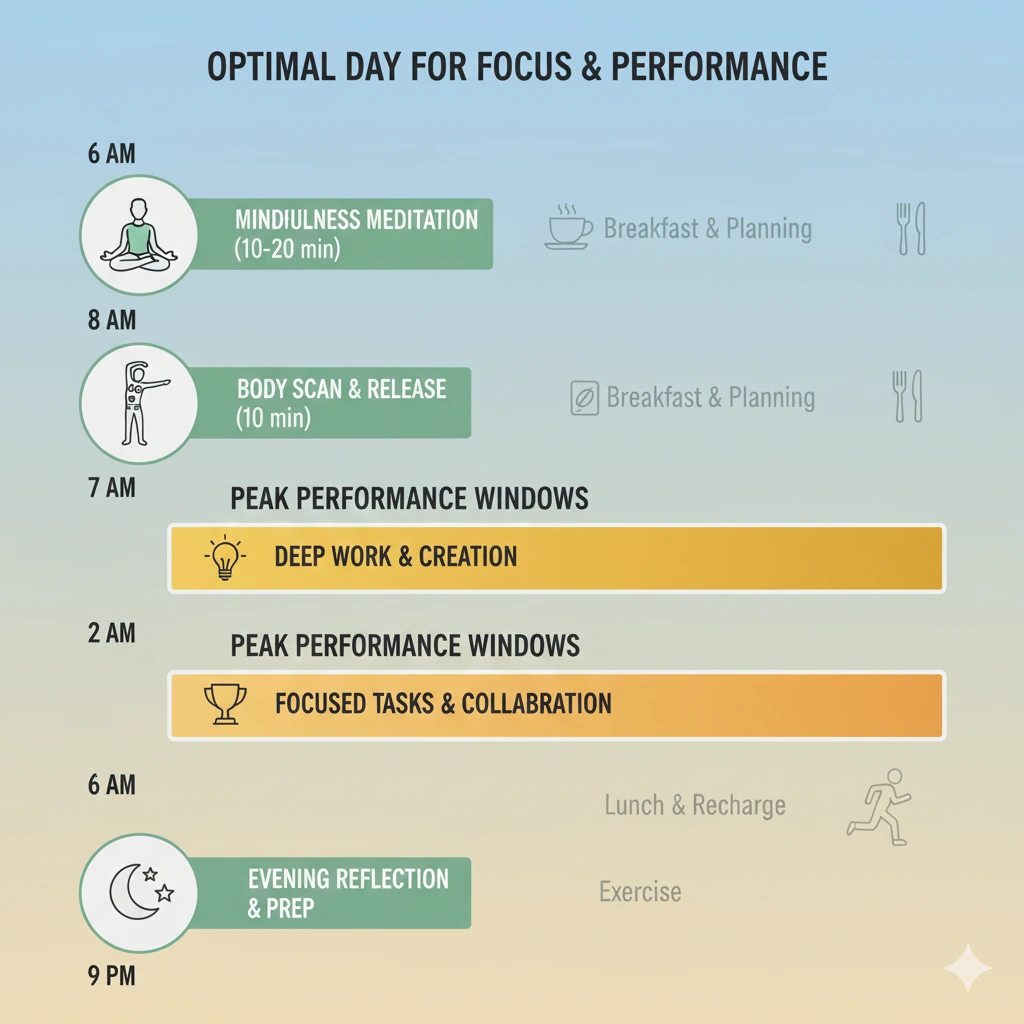
Here’s how to sequence these techniques for maximum impact:
Morning (or before your deep work block):
- 2-3 minute body scan (clear the cache)
- 10-minute FA meditation (build attention capacity)
- 1-2 minute transition (carry the quality forward)
- Jump into your most challenging task
The timing matters. You want the residual effects of meditation—that calm, focused awareness—to be fresh when you engage with demanding work. Think of it as priming your neural engine.
Research suggests that the benefits of a single meditation session can last 1-3 hours, which conveniently maps onto most people’s deep work blocks. You’re not meditating to feel peaceful (though that’s a nice side effect). You’re meditating to build a platform for peak performance.
Mid-day reset:
- Another 5-10 minute session after lunch can prevent the afternoon slump
- Brief body scan before important meetings or presentations
The compounding effect:
- Week 1: You’ll notice it’s hard and your mind won’t shut up (this is normal)
- Week 2-3: Small improvements in how quickly you can settle into focus
- Week 4-8: Noticeable changes in your ability to sustain attention
- Month 3+: Flow states become more accessible and sustainable
(Dive deeper: The Science of Timing: When to Do Deep Work)
One CEO I know describes it perfectly: “Meditation isn’t about adding more to your day. It’s about subtracting the mental friction that makes everything take three times longer than it should.”
What Actually Happens in Your Brain During Flow (And Why Meditation Gets You There Faster)
Let’s get nerdy for a moment because understanding the mechanism makes the practice more compelling.
During flow states, researchers have observed several key neurological changes:
1. Transient Hypofrontality Your prefrontal cortex—the part that overthinks everything—temporarily downregulates. This is why time distortion happens and why you lose self-consciousness. The critic falls silent.
2. Neural Efficiency Your brain actually uses less energy during flow, not more. It’s like the difference between a novice driver gripping the wheel with white knuckles versus an experienced driver who makes it look effortless.
3. Neurochemical Cocktail Flow triggers a release of norepinephrine (focus), dopamine (motivation and reward), endorphins (pain blocking), anandamide (lateral thinking), and serotonin (satisfaction after). It’s your brain’s natural performance-enhancing drug.
4. Synchronized Brain Waves EEG studies show increased alpha and theta wave activity—the same brainwave patterns associated with meditation.
Here’s the connection: meditation trains your brain to more easily transition into these states. Regular meditators show:
- Greater baseline control over attention (less effort to focus)
- Faster transitions into flow-conducive brainwave states
- Reduced activity in the DMN (less self-referential thinking)
- Enhanced interoceptive awareness (better at detecting when flow is emerging)
In essence, meditation is flow training. You’re practicing the mental state in a controlled setting so you can access it on demand when it matters.

(Related: Understanding Your Brain’s Operating System)
A neuroscientist colleague put it this way: “Asking why meditation helps with flow is like asking why stretching helps with athletic performance. They’re not the same thing, but one makes the other way more accessible.”
The Common Pitfalls (And How to Avoid Them)
Let’s address why most people fail at this:
Pitfall #1: Waiting to “Get Good” at Meditation Before Expecting Results You don’t need to be a meditation master to see benefits. Studies show measurable attention improvements after just 4-5 days of practice. Stop postponing your start date until conditions are perfect.
Pitfall #2: Meditating Like You’re Trying to Win The goal isn’t to achieve some blissed-out state. It’s to train attention. If your mind wanders 100 times in 10 minutes, and you bring it back 100 times, that’s 100 successful reps. You’re winning.
Pitfall #3: Inconsistent Practice Ten minutes daily beats 70 minutes on Sunday. Your brain needs regular training, not binge sessions. Think of it like brushing your teeth—consistency matters more than duration.
Pitfall #4: Expecting Flow on Demand Meditation increases the probability of flow, but it’s not a magic button. You still need appropriate challenge level, clear goals, and immediate feedback in your task. Meditation just makes your brain more flow-ready when conditions align.
Pitfall #5: Doing It Alone While meditation is a solo practice, learning with others or using guided sessions (at least initially) dramatically improves adherence. Your brain’s social circuits can work for you here.
(Troubleshooting guide: Why Your Meditation Practice Isn’t Working)
As the saying goes in meditation circles: “The best meditation practice is the one you actually do. The second best is all the other ones.”
Your 30-Day Challenge (Because Reading Alone Changes Nothing)
Here’s your practical action plan:
Week 1: Foundation
- Days 1-7: Just 5 minutes of FA meditation daily
- Goal: Show up, even if it feels pointless
- Track: Mark each day you complete it
Week 2: Body Awareness
- Days 8-14: Add 2-minute body scan before meditation
- Total time: 7 minutes
- Notice: Any changes in how quickly you settle into focus
Week 3: Full Protocol
- Days 15-21: 2-min body scan + 10-min FA meditation
- Total time: 12 minutes
- Experiment: Do this before your most challenging work
Week 4: Integration
- Days 22-30: Continue full protocol
- Add: Note when you notice flow-like states during work
- Observe: Correlation between practice and performance
Track these metrics:
- How many days you practiced
- Time until you notice wandering mind (gets faster)
- Duration of uninterrupted focus during work (increases)
- Subjective sense of effort during challenging tasks (decreases)

(Get the companion resources: 30-Day Meditation Challenge Tracker)
One practitioner told me: “I used to think meditation was like yoga—something I’d get to when I had time. Now I realize it’s more like coffee—something I need before I have time for anything else.”
The Bottom Line: Your Competitive Advantage Is Neural
Look, here’s the uncomfortable truth: while you’re reading articles about productivity hacks and downloading the latest focus app, your competitors might be doing something simpler and more effective. They’re training their brains.
The research is clear. The mechanism is understood. The practice is straightforward. What’s missing is your commitment to 10 minutes a day.
Meditation isn’t a luxury practice for monks in mountains. It’s tactical neural training for anyone who wants to perform at their best when it matters most. The bridge between mindfulness and flow isn’t just scientifically validated—it’s practically actionable.
Csíkszentmihályi spent a lifetime studying flow. Neuroscientists have mapped the brain states. The technique is proven. The only question is: will you do it?

Ten minutes. One practice. Your brain’s full potential.
The timer is set. Your move.
References
Csíkszentmihályi, M. (1990). Flow: The Psychology of Optimal Experience. Harper & Row.
Lutz, A., Slagter, H. A., Dunne, J. D., & Davidson, R. J. (2008). Attention regulation and monitoring in meditation. Trends in Cognitive Sciences, 12(4), 163-169.
Lutz, A., Slagter, H. A., Rawlings, N. B., Francis, A. D., Greischar, L. L., & Davidson, R. J. (2009). Mental training enhances attentional stability: Neural and behavioral evidence. Journal of Neuroscience, 29(42), 13418-13427.
Hölzel, B. K., Carmody, J., Vangel, M., Congleton, C., Yerramsetti, S. M., Gard, T., & Lazar, S. W. (2011). Mindfulness practice leads to increases in regional brain gray matter density. Psychiatry Research: Neuroimaging, 191(1), 36-43.
Kotler, S., & Wheal, J. (2017). Stealing Fire: How Silicon Valley, the Navy SEALs, and Maverick Scientists Are Revolutionizing the Way We Live and Work. Dey Street Books.
Tang, Y. Y., Hölzel, B. K., & Posner, M. I. (2015). The neuroscience of mindfulness meditation. Nature Reviews Neuroscience, 16(4), 213-225.