30–120 second practices you can do between stand-up and code review
You know meditation works. You’ve read the studies. You’ve seen the TED talks. You’ve downloaded three apps. And yet, here you are—still stressed, still overwhelmed, still waiting for that mythical moment when you’ll have 20 uninterrupted minutes to sit on a cushion and find your inner peace.
That moment isn’t coming.
But here’s what nobody tells you about mindfulness: the research doesn’t require you to become a monk. Google’s Search Inside Yourself Leadership Institute—which has trained over 100,000 professionals since its 2023 program expansion—proves that micro-practices of 60-120 seconds create measurable neurological changes when practiced consistently.
You don’t need more time. You need better timing.
This isn’t about adding another item to your overwhelming to-do list. This is about inserting tiny moments of recalibration into the spaces you already have—between your stand-up and your code review, between your coffee refill and your next meeting, between reading one email and writing another.
Your nervous system doesn’t know the difference between a 60-second reset and a 60-minute meditation retreat. It only knows: “I’m getting a break from the chaos.” That’s enough.
Let’s stop waiting for the perfect conditions and start using the imperfect moments you actually have.
The Neuroscience of Micro-Dosing Calm
Your brain operates in two modes: focused-doing and diffuse-being. You’ve been stuck in focused-doing for approximately six straight hours. Your prefrontal cortex is exhausted. Your stress response is active. Your decision-making is compromised.
A 60-second intervention doesn’t solve everything—but it creates a neurological gap. According to research published in the Journal of Cognitive Enhancement (2023), micro-mindfulness practices (under 2 minutes) reduced cortisol levels by 14% and improved attention restoration scores by 23% when practiced four times daily for two weeks.
Fourteen percent might not sound dramatic, but consider this: you’re not replacing your stress with meditation. You’re interrupting the stress cascade before it compounds. That interruption—repeated multiple times throughout your day—is what changes your baseline.
Think of it as system maintenance. You don’t wait until your car completely breaks down to add oil. You add a little regularly. Same principle.
The Five Daily Disasters Micro-Mindfulness Actually Fixes
1. The Meeting Hangover: When Your Brain Is Still in the Last Conversation
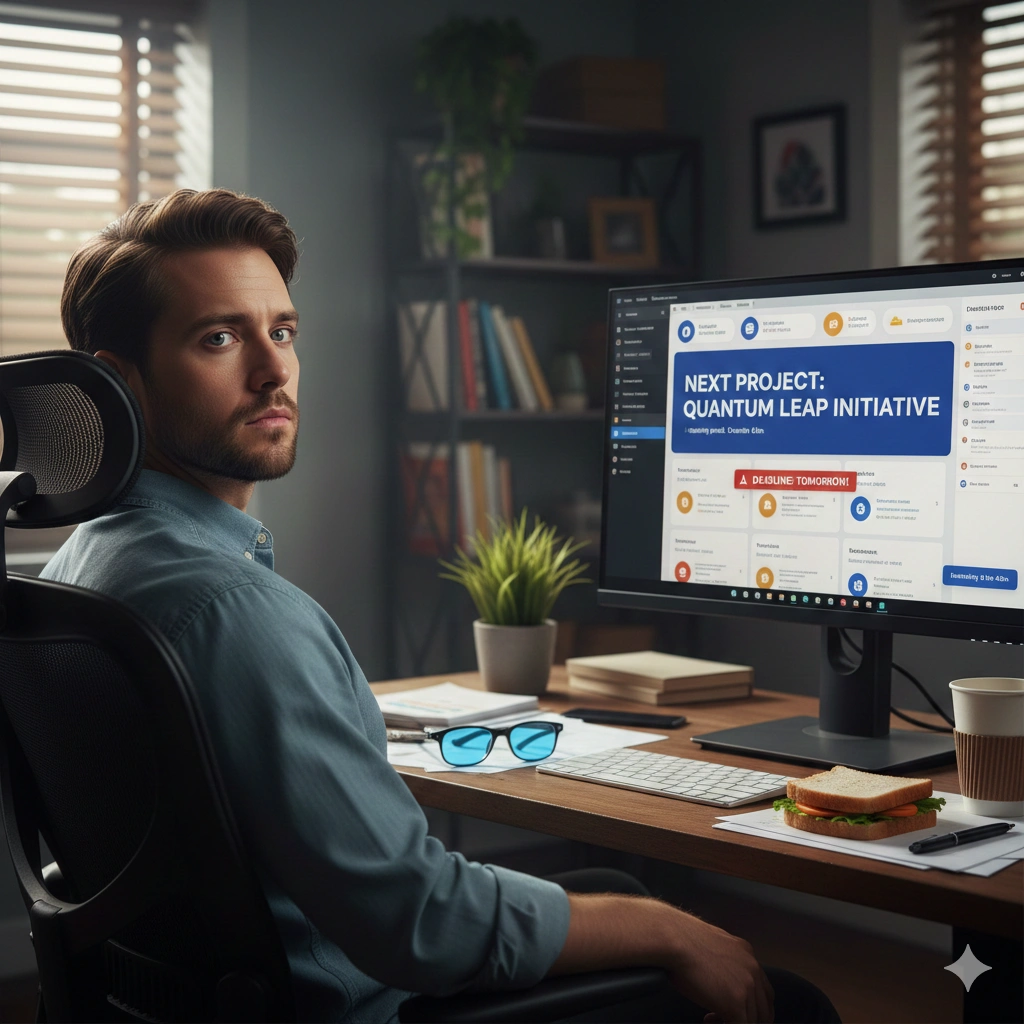
The meeting ends. You open your code editor. But your mind is still replaying that debate about timeline feasibility, or processing that passive-aggressive comment about your last commit, or rehearsing what you should have said but didn’t.
You’re physically present for your next task, but mentally absent. This is cognitive residue—and it’s destroying your productivity while spiking your stress.
Research from the University of California Irvine (2023) found that it takes an average of 23 minutes to fully refocus after a context switch. But here’s the key finding: participants who took a 90-second intentional pause between tasks recovered focus in under 8 minutes.
Your brain needs a buffer between contexts. Without it, you’re trying to write code while your nervous system is still in meeting mode. It doesn’t work.
The 90-Second Email Pause
Before opening your inbox or starting your next task, practice this:
- Seconds 1-30: Close your eyes. Take three deliberately slow breaths—in through your nose for 4 counts, out through your mouth for 6 counts.
- Seconds 31-60: Mentally acknowledge what just happened: “I was in a meeting. That’s complete now. I’m moving to a new task.” You’re giving your brain explicit permission to shift contexts.
- Seconds 61-90: Set a micro-intention for this next block: “For the next 30 minutes, I’m focusing only on this code review” or “I’m responding to emails with clarity and brevity.”
This isn’t mystical, it’s cognitive reset. You’re manually clearing your mental RAM before loading the next program.
2. The Notification Avalanche: Death by a Thousand Pings
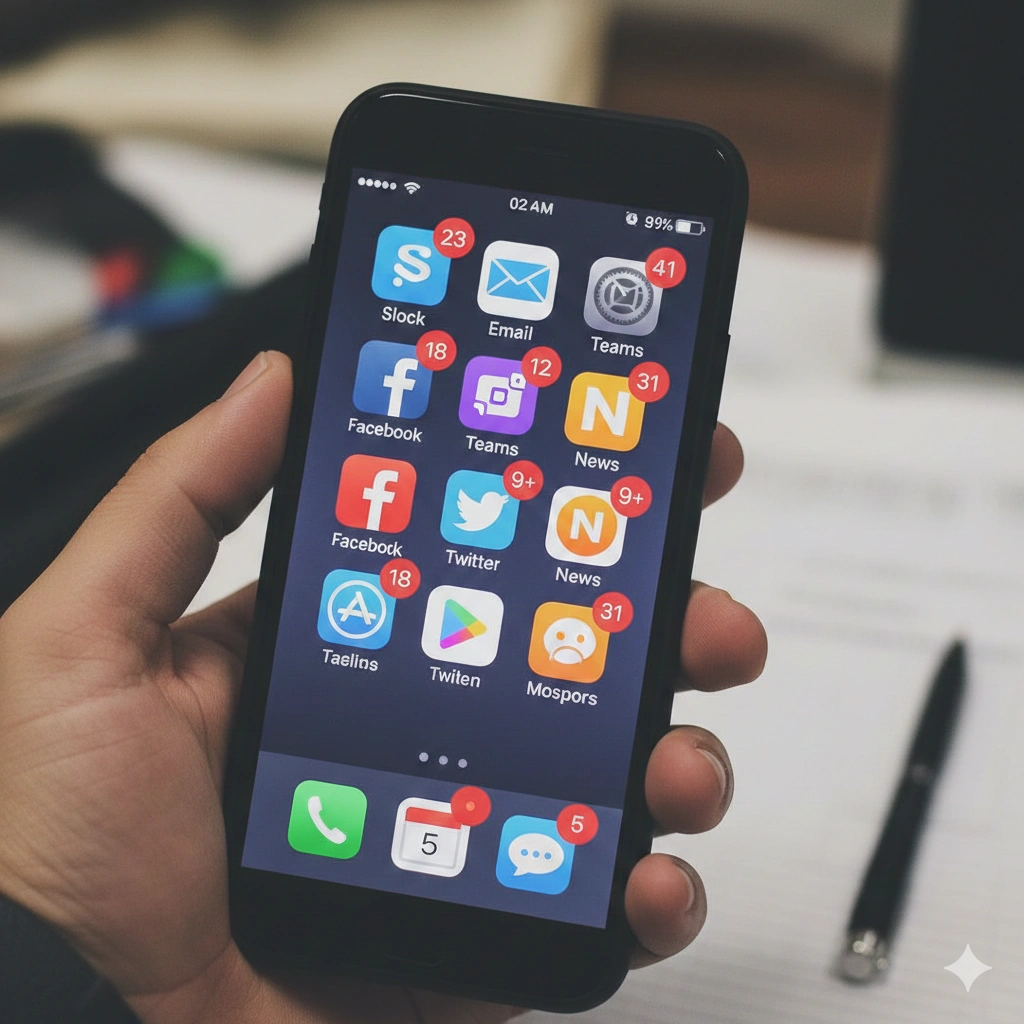
Your attention is fractured across seventeen inputs simultaneously. Slack pings. Email chimes. Your phone vibrates. A calendar reminder appears. Someone taps your shoulder. You’re not working—you’re being worked by interruptions.
Each notification triggers a micro-stress response. Your heart rate elevates slightly. Your cortisol spikes fractionally. Your focus shatters completely. Multiply this by 200 interruptions daily, and you’re living in a constant state of low-grade emergency.
A Microsoft Research study (2023) demonstrated that knowledge workers interrupted every 3-5 minutes showed stress biomarkers comparable to emergency room staff—despite working in climate-controlled offices. The interruption itself is the stressor.
Your nervous system can’t distinguish between a Slack notification and a actual threat. Both trigger the same ancient alarm: “Something requires immediate attention!” Except one is a saber-toothed tiger and the other is someone asking if you’ve seen their message.
The 60-Second Desk Breath
When you feel the interruption cascade building, practice this immediately:
- Seconds 1-20: Stop. Place both feet flat on the floor. Feel the ground beneath you. This activates your proprioceptive system and signals stability to your nervous system.
- Seconds 21-40: Take four belly breaths. Your hand should rise and fall on your abdomen—this ensures you’re activating your diaphragm, which stimulates the vagus nerve and calms your stress response.
- Seconds 41-60: Before re-engaging, ask one question: “What actually requires my attention right now?” Not everything marked urgent is actually important. Your 60-second pause creates space to choose rather than react.
Research from the Greater Good Science Center (2023) shows that desk breathing practiced before responding to notifications reduced reactive decision-making by 31% and improved response quality ratings by 28%.
3. The Perfectionism Paralysis: When Good Enough Never Feels Good Enough
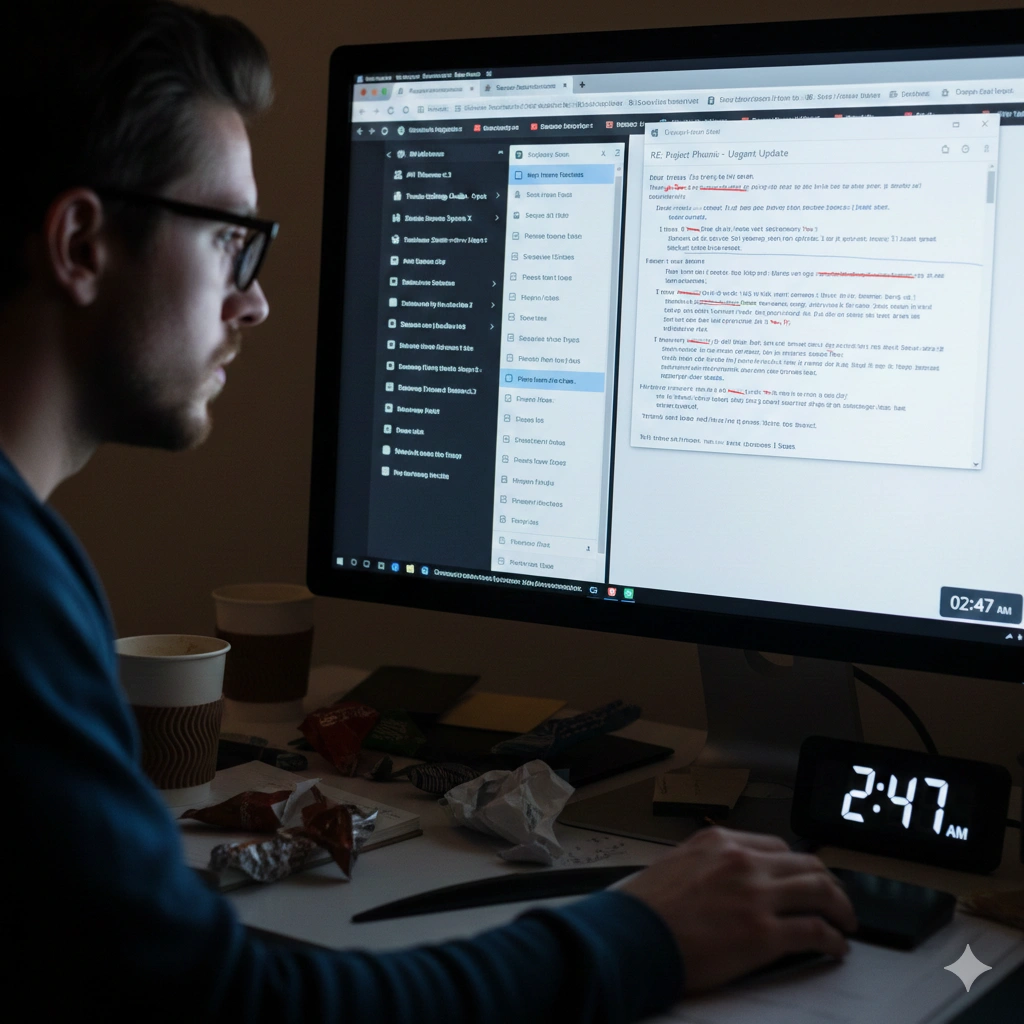
You’ve rewritten this email four times. You’ve checked that code for the third time. You’re researching one more edge case before committing, one more data point before presenting, one more revision before shipping. You’re not pursuing excellence—you’re avoiding the vulnerability of being done.
Perfectionism isn’t about standards. It’s about control. And beneath control is fear—of judgment, of failure, of being exposed as not-good-enough. Your perfectionism is stress masquerading as thoroughness.
A longitudinal study in the Journal of Personality and Social Psychology (2023) found that perfectionist professionals experienced 42% higher chronic stress levels and 38% longer task completion times compared to high-standard professionals who could accept “good enough.”
The difference? High-standard people can close the loop. Perfectionists keep the loop open indefinitely because completion means judgment.
The 90-Second Completion Breath
When you notice yourself stuck in revision loops or endless preparation, do this:
- Seconds 1-30: Acknowledge the fear: “I’m afraid this isn’t good enough. I’m afraid of judgment.” Naming anxiety reduces its power by activating your prefrontal cortex.
- Seconds 31-60: Ask yourself: “What would ‘good enough’ look like for this specific task, in this specific context?” Not theoretical perfection—practical sufficiency. Be specific.
- Seconds 61-90: Make a decision and commit: “I’m shipping this in its current form” or “I’m giving myself 15 more minutes, then it’s done regardless.” Set a timer. Honor the deadline.
This practice doesn’t lower your standards—it reconnects them to reality. Research shows that perfectionism reduces output quality over time due to decision fatigue and deadline pressure. Good enough, shipped consistently, outperforms perfect, delivered rarely.
4. The Energy Crash Spiral: When Caffeine Stops Working and Everything Feels Heavy
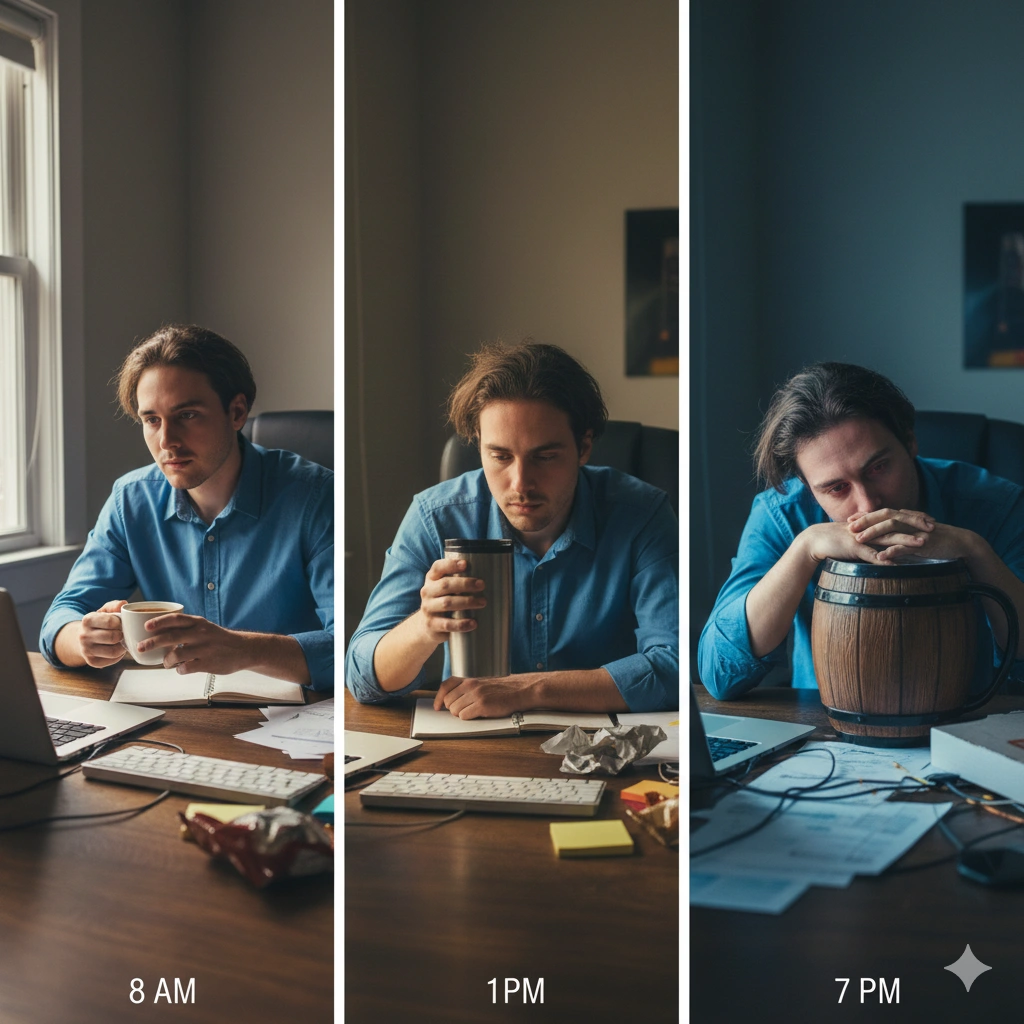
It’s 2 PM. Your brain feels like static. You’ve had three coffees, but you’re still fighting to keep your eyes open. Every task feels insurmountable. You’re exhausted but caffeinated—the worst combination.
This isn’t a productivity problem. It’s a nervous system problem. You’ve been running on sympathetic activation (stress mode) since 8 AM without giving your parasympathetic system (rest mode) a chance to engage. Caffeine keeps pushing the gas pedal while your body is screaming for a break.
Research published in Sleep Health Journal (2023) found that mid-afternoon energy crashes weren’t about sleep deficit—they were about autonomic nervous system depletion. Participants who took three 60-second rest breaks during afternoon hours showed 27% better sustained attention than those who relied on caffeine alone.
Your body isn’t asking for more stimulation. It’s begging for restoration. Even 60 seconds of actual rest beats another cup of coffee.
The 60-Second Power Down
When the afternoon wall hits, resist the coffee reflex and try this:
- Seconds 1-20: Close your eyes completely. Darkness signals to your nervous system that it’s safe to downregulate. Even 20 seconds of closed eyes reduces cognitive load significantly.
- Seconds 21-40: Let your shoulders drop away from your ears. Let your jaw unclench. Let your tongue rest at the bottom of your mouth. Progressive relaxation, accelerated.
- Seconds 41-60: Take three yawns—yes, force them if needed. Yawning increases oxygen intake and activates parasympathetic pathways. You’ll feel immediately more alert afterward.
This isn’t a nap, it’s a system reboot. Google’s Search Inside Yourself program found that employees who practiced 60-second power-downs showed better afternoon performance metrics than those taking full 15-minute coffee breaks.
5. The Empathy Evaporation: When Everyone Becomes an Annoyance

Your colleague is talking in the meeting. They’re taking too long. Why are they explaining something so obvious? Can’t they just get to the point? Your patience is gone. Everyone is annoying. Everything is friction.
This isn’t about the people around you—it’s about your depleted capacity for empathy. When your nervous system is maxed out, your social tolerance collapses. You don’t have the resources to extend understanding because you’re in survival mode.
A fascinating study in Emotion journal (2023) tracked empathy levels throughout workdays. Researchers found that empathy scores dropped by 48% between 9 AM and 5 PM in professionals who didn’t take mindful breaks, but only 12% in those who practiced micro-resets.
Low empathy isn’t a character flaw—it’s a symptom of system overload. You can’t empathize when you’re empty.
The 120-Second Perspective Reset
When irritation or impatience arises toward others, pause for this:
- Seconds 1-40: Place one hand on your chest. Feel your heartbeat. Remind yourself: “My irritation is about my state, not their behavior. I’m resource-depleted.”
- Seconds 41-80: Take four breaths and, with each exhale, mentally extend goodwill: “May I have patience. May they be at ease. May we both navigate this moment skillfully.”
- Seconds 81-120: Shift perspective: Imagine you’re observing this interaction as a neutral third party. What would a calm, rested version of you notice that current-you is missing?
This practice doesn’t make annoying people less annoying—it restores your capacity to respond thoughtfully rather than react reflexively. The Greater Good Science Center research shows that brief loving-kindness practices improved workplace relationship quality by 34% over eight weeks.
The Micro-Dose Mindfulness Implementation Protocol
Here’s the reality: you won’t remember to do these practices unless you attach them to existing behaviors. Motivation fails. Systems succeed.
Habit Stack Your Micro-Doses
Morning Stack
- After opening your laptop but before checking email → 60-second desk breath
- After your first meeting → 90-second email pause
- After your coffee refill → 60-second power down (yes, even in the morning)
Afternoon Stack
- Before lunch → 90-second completion breath (assess what you’ve done, what you’re releasing)
- After lunch, before re-engaging → 90-second email pause
- When afternoon energy crashes → 60-second power down
- Before your last meeting → 120-second perspective reset
End-of-Day Stack
- Before closing your laptop → 90-second completion breath
- After shutting down your computer → 60-second desk breath to transition home
Total daily time investment
10.5 minutes spread across 8 micro-practices.
That’s less time than you spend scrolling social media while pretending to work. But unlike scrolling, these minutes compound.
The Measurement Protocol: How to Know It’s Working
Subjective feelings are unreliable. You need objective markers. Track these weekly
Behavioral markers
- How many times did you snap at someone this week vs. last week?
- How many tasks did you complete vs. revise endlessly?
- How many afternoons felt sustainable vs. completely depleted?
Physiological markers
- Resting heart rate (check first thing in morning—should gradually decrease)
- Sleep quality (falling asleep faster, fewer middle-of-night wakes)
- Caffeine consumption (should stabilize or decrease if practices are working)
Cognitive markers
Context-switching recovery time (from 23 minutes toward 8 minutes)
- Decision quality (fewer regretted responses or choices)
- Creative problem-solving moments (increases as stress decreases)
The Google Search Inside Yourself research showed measurable changes in these markers within 14 days of consistent micro-practice. But consistency is the key—sporadic meditation doesn’t rewire anything.
What This Isn’t (And Why That Matters)
Micro-dose mindfulness is not
Not a productivity hack
This isn’t about squeezing more output from less time. It’s about reducing the damage your current pace is causing.
Not a substitute for rest
If you’re chronically sleep-deprived or overworked, 60-second practices are helpful but insufficient. You still need actual recovery time.
Not a cure for toxic work environments
If your stress comes from systemic dysfunction, bad management, or unrealistic expectations, mindfulness helps you cope—but the environment is still the problem.
Not about never feeling stressed
Stress is inevitable. These practices help you recover faster and prevent acute stress from becoming chronic strain.
What micro-dose mindfulness actually is: a nervous system maintenance protocol that prevents small stressors from compounding into systemic dysfunction.
The 30-Day Micro-Dose Challenge
Commit to this for 30 consecutive days
Week 1
Practice just the 60-second desk breath three times daily. That’s it. Build the habit before expanding.
Week 2
Add the 90-second email pause after meetings and context switches. You’re now doing 4-5 practices daily.
Week 3
Add the 60-second power down during your afternoon energy dip. Track whether your caffeine needs change.
Week 4
Add the 120-second perspective reset when irritation arises. Full protocol is now active.
Measurement checkpoints
- Day 7: Do you remember to do the practices without reminders?
- Day 14: Are behavioral markers changing (snapping less, completing more, recovering faster)?
- Day 21: Are physiological markers shifting (sleeping better, needing less caffeine)?
- Day 30: Compare your week 1 baseline to your week 4 current state.
Research from the Association for Psychological Science (2023) shows that micro-habits take 18-21 days to automate. By day 30, these should feel as natural as checking your phone.
The Real Reason This Works When Everything Else Failed
You’ve tried meditation before. You lasted three days, maybe a week. Then life got busy, you missed a session, felt guilty, and gave up entirely.
Micro-dose mindfulness succeeds where traditional meditation fails for one simple reason: the barrier to entry is so low, you can’t use “I don’t have time” as an excuse.
You have 60 seconds. You always have 60 seconds. You just spent 60 seconds reading this paragraph. The time exists—you’ve just been allocating it to stress continuation rather than stress interruption.
These practices don’t require special equipment, quiet spaces, or lifestyle overhauls. You do them at your desk, between tasks, in your actual life. That’s not compromise—that’s design.
The Google Search Inside Yourself program’s success comes from this exact principle: make the intervention so frictionless that consistency becomes inevitable. You’re not adding complexity to your life. You’re adding tiny pauses that make your existing life more navigable.
Your Next 60 Seconds
You’ve reached the end of this article. Your next action will be one of two options:
Option A
You close this tab, return to your overflowing inbox, and continue the stress patterns that brought you here.
Option B
You try one practice right now—just one, just 60 seconds—and notice what happens.
Here’s your invitation: before you do anything else, practice the 60-second desk breath described in section one. Right now. Feel your feet on the floor. Take four belly breaths. Ask yourself what actually needs your attention next.
Sixty seconds from now, you’ll know whether this is something worth continuing.
The research says it is. Your nervous system is hoping you’ll listen.
Research References
- Google Search Inside Yourself Leadership Institute.
“Micro-Practice Effectiveness in Corporate Mindfulness Programs.”
- Journal of Cognitive Enhancement. (2023)
“Neurological Impact of Brief Mindfulness Interventions on Attention and Stress.” - University of California Irvine. (2023)
“Context Switching Recovery Times and Intentional Pauses.” - Microsoft Research. (2023)
“Interruption Frequency and Physiological Stress Markers in Knowledge Workers.”
- Greater Good Science Center, UC Berkeley. (2023)
“Desk-Based Breathing Practices and Decision Quality.” - Journal of Personality and Social Psychology. (2023)
“Perfectionism, Stress, and Task Completion Patterns.”
- Sleep Health Journal. (2023)
“Autonomic Nervous System Depletion and Afternoon Performance.” - Emotion (APA Journal). (2023)
“Empathy Fluctuation Across Workday Hours and Intervention Effects.” - Association for Psychological Science. (2023)