
What sounds like self-help pseudoscience is actually neuroscience—a simple daily ritual that rewires how you speak to yourself

You wouldn’t talk to a stranger the way you talk to yourself.
Stand in front of a mirror right now and say out loud: “I’m proud of you.” Go ahead. I’ll wait.
Couldn’t do it, could you? Or if you did, something inside you recoiled. Your face flushed. You looked away. Maybe you laughed it off as ridiculous.
That discomfort? That’s the distance between how you treat yourself and how you treat literally anyone else in your life.
Mirror work sounds absurd. I know. It sounds like something from a 1980s self-help seminar where people wear crystals and talk about manifesting abundance. But here’s the thing about practices that sound woo: sometimes they work anyway.
And this one? It’s backed by neuroscience, tested in clinical settings, and quietly transforming people who rolled their eyes at it first.
Including me.
What Is Mirror Work? (And Why Your Skepticism Is Valid)
Mirror work is deceptively simple: you stand in front of a mirror, look yourself in the eyes, and speak affirmations out loud.
That’s it. Sixty seconds. Direct eye contact with yourself. Words of kindness directed inward.
Your skepticism makes sense. We live in a culture that mistakes self-compassion for self-indulgence, that confuses humility with self-deprecation. Somewhere along the way, you learned that being hard on yourself was the same as being responsible.
It isn’t.

A software developer I know—let’s call him Marcus—came to me burned out, anxious, and convinced he was failing at everything. When I suggested mirror work, he literally laughed.
“I’m a rational person,” he said. “I deal in logic and evidence. You want me to talk to myself in a mirror like some kind of Stuart Smalley sketch?”
Fair point. But I asked him one question: “How do you talk to yourself when you make a mistake?”
He paused. “Like… honestly?”
“Honestly.”
“I tell myself I’m an idiot. That I should have known better. That everyone can see I’m a fraud.”
“Would you talk to a junior developer on your team that way?”
“God, no. I’d be fired.”
“Then why is it acceptable to talk to yourself that way?”
He had no answer. Neither do most people.
The Neuroscience: Why Talking to Your Reflection Rewires Your Brain
Here’s what happens when you look in a mirror and speak to yourself:
Your brain can’t fully distinguish between receiving kindness from others and offering kindness to yourself. When you make eye contact with your reflection and speak compassionately, you activate the same neural pathways that light up when someone you trust offers you support.
Research from the University of Arizona (Kross et al., 2014) found that self-directed speech—especially when combined with visual feedback like a mirror—creates psychological distance from negative emotions. It allows you to observe your experience rather than drown in it.
But the real magic happens deeper in your neural architecture.
A study published in Social Cognitive and Affective Neuroscience (Longe et al., 2010) using fMRI scans showed that self-criticism activates the lateral prefrontal cortex and dorsal anterior cingulate—areas associated with error processing and behavioral inhibition. Your brain treats self-criticism like a threat.
Self-compassion, however, activates completely different regions: the left temporal pole and insula, areas associated with empathy, emotional regulation, and positive self-regard. When you speak kindly to yourself, your nervous system literally shifts from threat mode to safety mode.
Mirror work amplifies this effect because of something called “gaze perception.” Eye contact—even with yourself—triggers oxytocin release, the same bonding hormone that fires when you connect with loved ones. You’re essentially befriending yourself at a neurochemical level.
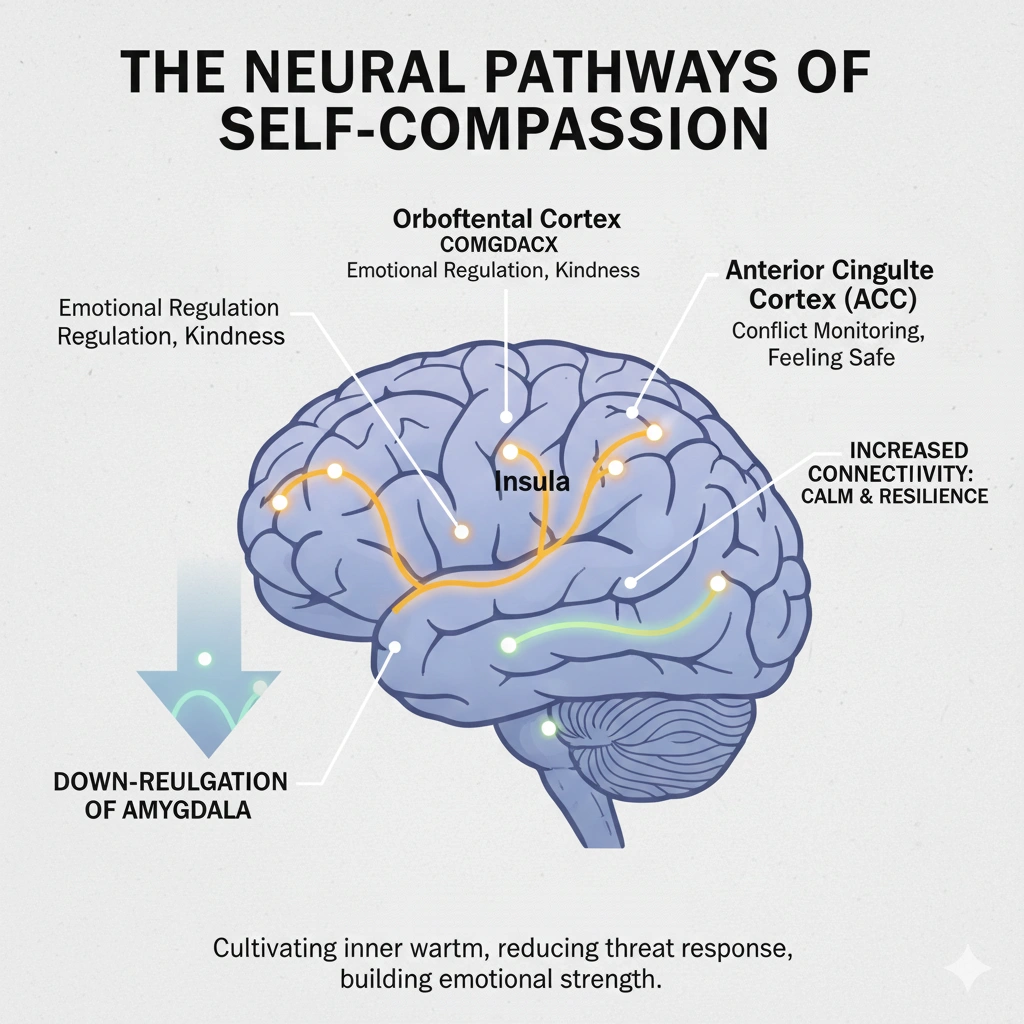
Dr. Kristin Neff’s research at the University of Texas has demonstrated that self-compassion practices reduce anxiety and depression while increasing emotional resilience and life satisfaction. Her studies show that self-compassion is a stronger predictor of mental well-being than self-esteem.
The difference? Self-esteem depends on external validation and performance. Self-compassion doesn’t. It’s unconditional regard for yourself, independent of achievement or approval.
Mirror work is one of the fastest ways to build that unconditional regard.
The Power of Mirror Work: What Changes When You Look Yourself in the Eye

Marcus started his mirror practice skeptically. Sixty seconds every morning after brushing his teeth. Just one phrase: “I’m doing my best, and that’s enough.”
The first week, he felt ridiculous. The second week, he felt resistant—his inner critic had a field day with the practice itself. “This is stupid. You’re wasting time. Real professionals don’t need affirmations.”
By week three, something shifted.
“I was debugging some code that wasn’t working,” he told me. “Normally, I’d spiral into this internal monologue about how I’m terrible at my job. But this time… I just heard my voice from that morning: ‘I’m doing my best.’ And something softened. I took a break, came back fresh, and found the bug in ten minutes.”
This is what mirror work does. It doesn’t make you delusional or inflate your ego. It creates a compassionate inner voice that can coexist with—and eventually quiet—the harsh critic.
What Mirror Work Actually Addresses
The inner critic isn’t your enemy. It’s a protection mechanism that developed when you were young, trying to keep you safe from rejection, failure, or harm. But it’s outdated software running on old assumptions.
Mirror work doesn’t delete the critic. It updates the algorithm.
When you consistently meet your own gaze with kindness, you:
- Interrupt automatic negative self-talk: The visual and verbal combination creates pattern disruption
- Build distress tolerance: You learn to sit with discomfort without fleeing or fighting
- Repair attachment wounds: Many people never received consistent mirroring and validation as children; you’re giving yourself what you needed then
- Strengthen self-trust: Regular check-ins with yourself build an internal foundation of safety
Research in the Journal of Clinical Psychology (Albertson et al., 2015) found that even brief self-compassion interventions significantly reduce body dissatisfaction and improve self-worth. The mirror component specifically addresses self-perception distortions.
How to Integrate Mirror Work Into Daily Life: A Practical Protocol

You don’t need a special mirror or a meditation cushion. You need sixty seconds and a willingness to feel awkward.
THE BASIC PRACTICE
When: First thing in the morning or last thing at night—bookend your day with kindness
Where: Bathroom mirror works perfectly; you’re already there
How long: Start with 60 seconds; build to 2-3 minutes as it becomes natural
The Steps:
- Stand or sit in front of the mirror – Position yourself so you can comfortably see your eyes
- Make eye contact with yourself – Not a glance; actual sustained contact. This is the hardest part.
- Take three deep breaths – Let your nervous system settle
- Speak your affirmation out loud – Not in your head. Out loud. This is crucial.
- Notice what comes up – Resistance, laughter, tears, skepticism—all normal. Don’t judge it.
- Repeat 2-3 times – Let the words sink in, even if they feel foreign
- Close with one breath – Seal the practice
CHOOSING YOUR AFFIRMATIONS
Start with what feels true or almost-true. If “I’m amazing” makes you want to throw up, don’t use it.
Try these instead:
- “I’m doing my best right now”
- “I’m learning as I go”
- “I deserve kindness—from myself too”
- “I’m allowed to make mistakes”
- “I’m enough, even on hard days”
- “I’m worthy of my own compassion”
Notice none of these are grandiose or performance-based. They’re foundational truths about your inherent worth.
VARIATIONS FOR DIFFERENT NEEDS
For perfectionism: “I don’t have to be flawless to be valuable”
For burnout: “Rest is productive too”
For imposter syndrome: “I belong here, even when I doubt myself”
For relationship struggles: “I’m worthy of love, including my own”
For general overwhelm: “I’m here, and that’s enough for today”
MAKING IT STICK
- Anchor to existing habits: Do it right after brushing your teeth
- Set a phone reminder: Not for the practice, but for the first week to build the habit
- Keep it stupid simple: One phrase, sixty seconds, no elaboration needed
- Track without pressure: Mark it on a calendar, but don’t weaponize tracking
Common Pitfalls: Why Your Practice Might Not Work Yet

Pitfall 1: You’re Performing Instead of Feeling
Mirror work isn’t about convincing yourself of something you don’t believe. It’s about creating space for a kinder perspective.
If your affirmation is “I’m successful and powerful” but you feel like garbage, your brain flags it as false and rejects it. Start where you are. “I’m struggling today, and that’s okay” is infinitely more powerful than forced positivity.
Pitfall 2: You Skip It When You Need It Most
The days you least want to do mirror work are precisely the days it matters most. Your inner critic is loudest when you’re stressed, tired, or vulnerable.
That’s not a coincidence—that’s when you need compassion most. Pushing through the resistance IS the practice.
Pitfall 3: You Expect Instant Transformation
This isn’t a magic spell. Your inner critic has been training for years, maybe decades. Sixty seconds a day won’t immediately silence it.
What it will do: plant seeds. Create tiny moments of questioning. Build a competing neural pathway. Over time, the compassionate voice gets stronger.
Pitfall 4: You Make It Complicated
You don’t need candlelight, specific times, perfect phrasing, or Instagram-worthy aesthetics. You need your face and sixty seconds of honesty.
Complexity is often resistance in disguise. Keep it bare bones.
Pitfall 5: You Think It’s Narcissistic
Self-compassion isn’t self-absorption. Research shows that self-compassionate people are actually MORE empathetic and caring toward others, not less.
When you stop wasting energy on self-criticism, you have more to give. The voice that says “this is selfish” is your inner critic’s last defense.
The Compounding Power of Consistency
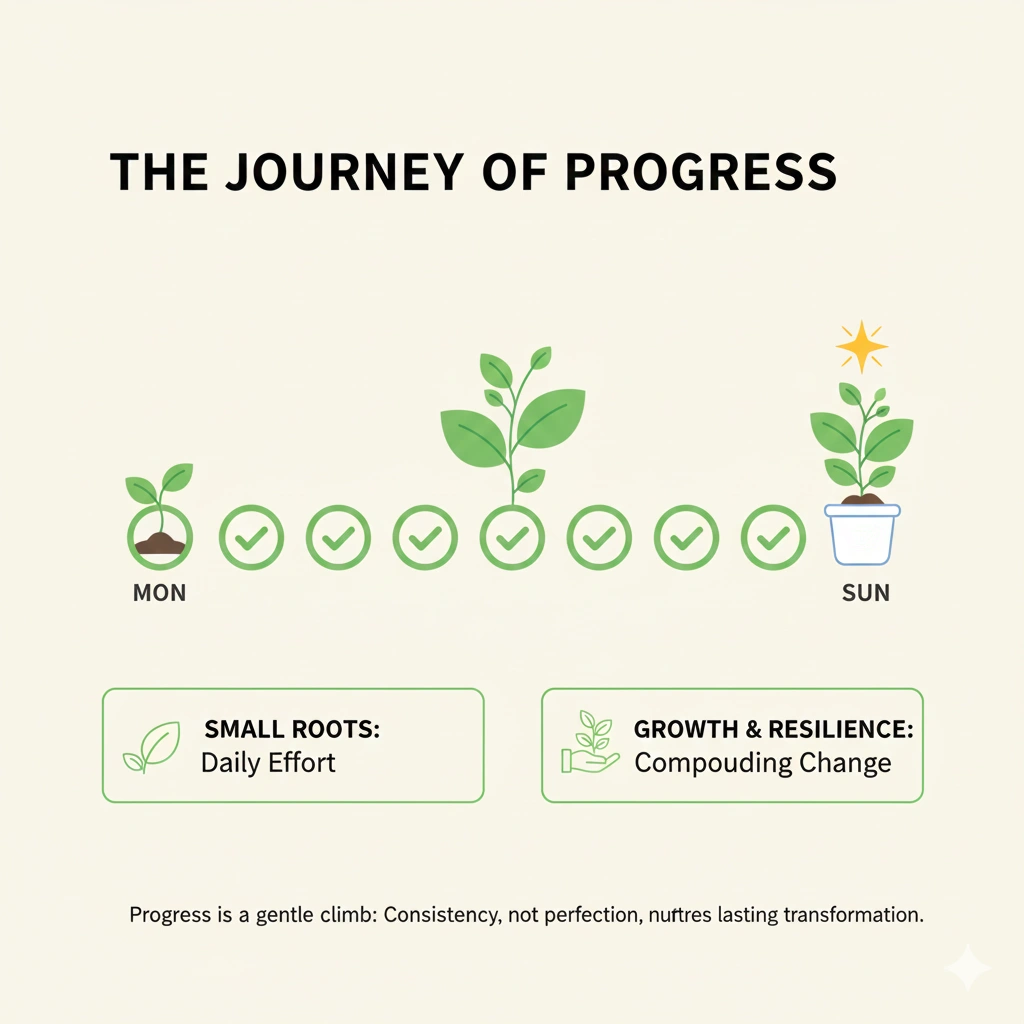
Here’s what nobody tells you about mirror work: the first month is uncomfortable. The second month is boring. The third month is when things get interesting.
Marcus is now eighteen months into his practice. He doesn’t think about it anymore—it’s just what he does before coffee.
“Last week I got passed over for a promotion,” he told me. “A year ago, I would have spent three days in a shame spiral, convinced I was a failure. But instead, I stood in front of the mirror that night and said, ‘This hurts, and I’m still worthy.’ And I believed it. Not because I’m delusional, but because I’ve said it enough times that my brain now has evidence it’s true.”
That’s the compounding effect. Each time you show up, you’re making a deposit into your self-regard account. Small, consistent deposits become an unshakeable foundation.
A meta-analysis in Clinical Psychology Review (MacBeth & Gumley, 2012) examining 20 studies found that self-compassion practices significantly reduce depression, anxiety, and stress while improving quality of life. The effect sizes were comparable to traditional cognitive behavioral therapy.
Sixty seconds a day. That’s the ask.
Your Reflection, Your Relationship

You’re going to spend your entire life with yourself. You’ll be there for every triumph and every failure, every moment of joy and every encounter with pain.
The question isn’t whether you’ll have an internal dialogue. You will. The question is: what will that dialogue sound like?
Will it be the voice of a harsh taskmaster, cataloging your deficiencies? Or will it be the voice of a wise friend, holding you through difficulty while calling you toward growth?
Mirror work is how you shift the voice.
It’s not positive thinking. It’s not denial. It’s not pretending problems don’t exist.
It’s facing yourself—literally—and choosing kindness over cruelty. It’s building a relationship with the one person you can never escape: you.
The skepticism you feel? That’s your inner critic, sensing a threat to its dominance. Of course it wants you to dismiss this as woo. It’s been running the show for years.
But you don’t have to listen.
Start Tomorrow Morning

Before your first cup of coffee. Before you check your phone. Before you open your laptop and dive into the day’s demands.
Stand in front of the mirror.
Look yourself in the eyes.
Take a breath.
And say: “I’m here. I’m trying. That’s enough.”
Just once. Just to see what happens.
You might feel foolish. You might want to laugh. You might feel nothing at all.
That’s fine. You’re not performing. You’re planting a seed.
Come back tomorrow. Same mirror. Same phrase. One more deposit into a new way of being with yourself.
The inner critic built its fortress over years. You’re not storming it in a day.
But you are starting the quiet work of building a different foundation—one where you’re not your own worst enemy, but your own steady companion.
Sixty seconds. That’s all.
The mirror is waiting.
Your First Week Protocol:
Day 1-3: Just make eye contact. Don’t even say anything if it feels too vulnerable. Breathe and look.
Day 4-5: Add one phrase: “I’m here.”
Day 6-7: Expand: “I’m here, and I’m doing my best.”
Week 2 onward: Choose your affirmation and stick with it for at least 30 days before changing.
Research References:
- Kross, E., et al. (2014). “Self-talk as a regulatory mechanism: How you do it matters.” Journal of Personality and Social Psychology, 106(2), 304-324. University of Arizona Research
- Longe, O., et al. (2010). “Having a word with yourself: Neural correlates of self-criticism and self-reassurance.” Social Cognitive and Affective Neuroscience, 8(7), 741-749. https://academic.oup.com/scan/article/8/7/741/1664058
- Neff, K. D. (2003-present). Self-Compassion Research. University of Texas at Austin. https://self-compassion.org/the-research/
- Albertson, E. R., Neff, K. D., & Dill-Shackleford, K. E. (2015). “Self-compassion and body dissatisfaction in women: A randomized controlled trial of a brief meditation intervention.” Mindfulness, 6(3), 444-454. https://onlinelibrary.wiley.com/doi/abs/10.1002/jclp.22761
MacBeth, A., & Gumley, A. (2012). “Exploring compassion: A meta-analysis of the association between self-compassion and psychopathology.” Clinical Psychology Review, 32(6), 545-552. https://www.sciencedirect.com/science/article/abs/pii/S0272735812000827