
Staying Present When Patients Yell and Preceptors Judge
The patient in Room 212 is yelling at you because you’re a student. Your clinical preceptor is watching your every move with arms crossed, waiting for you to make a mistake. You haven’t slept more than four hours in three days. You’ve got an exam tomorrow on pathophysiology that you haven’t studied for. And somewhere in the chaos, you’re supposed to remember that Mrs. Johnson in Room 214 needs her medications in exactly seven minutes while documenting everything perfectly in the electronic health record system you just learned yesterday.
Welcome to nursing clinical rotations, where you’re expected to perform like an experienced nurse while being treated like you know nothing—all while your mental health crumbles under pressure that research shows is destroying an entire generation of future healthcare providers.
According to a 2023 systematic review published in Nurse Education in Practice, burnout prevalence among nursing students is 19%, with emotional exhaustion affecting a staggering 41%. But here’s the devastating part: research shows that burnout doesn’t begin when you become a nurse—it begins during nursing school, and for many, it never goes away.
Studies reveal that 73.5% of nursing students report emotional exhaustion, 70.56% experience depersonalization, and 76% have low personal accomplishment. These aren’t just statistics—they’re warning signs that the system preparing our future nurses is fundamentally broken.
The Five Daily Battles No One Warns You About
1. “The Perpetual Student Paradox” – When You’re Responsible But Not Trusted

Here’s the impossible situation: you’re responsible for patient care, documentation, medication administration, and treatment decisions—but you’re simultaneously treated as incompetent, watched constantly, and questioned on every move. You’re expected to know everything while being reminded you know nothing.
The research confirms this psychological trap. Studies on nursing student stress show that lack of experience and ability in providing care creates significant anxiety, combined with fear of making critical mistakes. Research reveals that the highest stressor students experience is “not knowing how to discuss patients’ illness with teachers or medical and nursing personnel,” followed by “lack of experience and ability in providing nursing care and making judgments.”
What makes this worse? The preceptor relationship. Research shows that clinical instructors and preceptors play a critical role in either alleviating or exacerbating student stress. When preceptors are unavailable, dismissive, or openly critical, student stress skyrockets. Studies confirm that stress from teachers and nursing staff is one of the highest reported sources of anxiety during clinical rotations.
The judgment is constant and exhausting. Research on clinical learning environments shows that students experience stress related to being observed and evaluated continuously. Every interaction with a patient, every medication administration, every documentation entry—all performed under scrutinizing eyes looking for errors. The psychological weight of this constant evaluation creates hypervigilance that’s mentally and emotionally draining.
Mindful Solutions
- The 3-Minute “Chart Pause” Practice: Before documenting in the electronic health record or completing any paperwork, take three minutes away from the computer. Find a quiet corner (supply room, break room, bathroom). Close your eyes. Take five slow breaths. Mentally review what you need to document without judgment—just facts. This brief pause reduces documentation anxiety and prevents the “everything I do is wrong” spiral. You’re creating space between the experience and the record, reducing perfectionism pressure.
- Preceptor Relationship Reframing: Remember that harsh preceptors are often stressed nurses dealing with their own burnout. Their criticism rarely reflects your actual competence—it reflects their exhaustion. This cognitive reframe doesn’t excuse poor treatment, but it prevents internalization.
- Daily Competence Log: Each clinical day, write down three specific things you did competently—even small things like patient communication, successful vital signs, or noticing a subtle change. Evidence-based self-validation counteracts constant external criticism.
- Permission to Ask Questions: Reframe “I don’t know” from weakness to professionalism. Saying “I want to double-check this to ensure patient safety” is not incompetence—it’s responsible practice. The best nurses admit uncertainty.
2. “The Sleep Deprivation Death Spiral” – When Rest Becomes a Luxury You Can’t Afford

You’re working 12-hour clinical shifts. Studying for high-stakes exams. Completing care plans that take hours. Writing papers. Attending lectures. And somewhere in there, you’re supposed to sleep—except you can’t, because the workload is literally impossible to complete with adequate rest.
The research on nursing student sleep deprivation is alarming. Studies show that nursing students experience significant sleep disturbances, chronic fatigue, and daytime sleepiness that impairs clinical judgment and increases medical errors. Research confirms that exhausted students are at higher risk for mistakes that can harm patients—creating additional anxiety that further prevents sleep.
What’s particularly devastating? Research reveals that nursing students’ stress levels are significantly higher than students in other healthcare professions and general college populations. The combination of high academic demands, intense clinical requirements, witnessing patient suffering and death, and fear of making fatal mistakes creates a perfect storm that disrupts sleep patterns.
The consequences extend beyond tiredness. Studies show that chronic sleep deprivation in nursing students leads to depression, anxiety, impaired memory and learning, decreased immune function, and increased risk of burnout before graduation. You’re being systematically exhausted during the years you’re supposed to be learning—creating a foundation of burnout that carries into professional practice.
Mindful Solutions
- Strategic “Micro-Sleep” Protection: You cannot add hours to the day, but you can protect critical sleep windows. Identify your minimum viable sleep requirement (usually 6 hours) and protect it fiercely. This might mean skipping optional study groups or accepting a slightly lower grade on one assignment. Survival trumps perfection.
- Power Nap Discipline: Research shows that 20-minute power naps improve cognitive function and reduce fatigue. During clinical days, if you have a break, use 20 minutes for sleep rather than scrolling your phone. Set an alarm and rest.
- Sleep Hygiene Basics: Even with limited time, maintain consistent sleep and wake times when possible. Your circadian rhythm needs predictability. Blackout curtains, white noise, and no screens 30 minutes before bed—these basics matter when every minute of sleep counts.
- Acceptance Over Perfection: You cannot do everything perfectly on four hours of sleep. Accept that during this season, you’re in survival mode. C’s get degrees. Your health matters more than perfect grades.
3. “The Emotional Trauma Dump” – Processing Death, Suffering, and Grief With Zero Support

Your patient coded during your shift. You watched them die. You performed CPR on a child. You held a sobbing family member’s hand. You cleaned the body afterward. And tomorrow, you’ve got a biochemistry exam and no one asks if you’re okay.
The research on nursing students’ exposure to trauma is sobering. Studies show that nursing students witness patient death, suffering, and trauma without adequate psychological preparation or processing support. Research confirms that clinical experiences involving patient mortality create significant emotional distress, particularly for students who lack coping mechanisms or debriefing opportunities.
What makes this worse? The culture of emotional suppression. Research shows that nursing education often implicitly teaches students to suppress authentic emotional responses and maintain professional composure—a form of emotional labor that’s psychologically damaging. Students learn quickly that expressing distress is seen as weakness rather than humanity.
The consequences are severe. Studies reveal that nursing students exposed to traumatic clinical experiences without support are at significantly higher risk for developing depression, anxiety, PTSD symptoms, compassion fatigue, and burnout. Research shows that 52.3% of nursing students experience anxiety, 38.3% experience depression, and 34.4% experience high stress—rates dramatically higher than non-nursing students.
Mindful Solutions
- The 90-Second “Patient Metta” Practice: After difficult patient interactions—especially traumatic experiences—find a private space immediately (bathroom, empty room, stairwell). Close your eyes. Place one hand over your heart. Take three deep breaths. Silently offer compassion to the patient: “May you be free from suffering. May you be at peace.” Then offer compassion to yourself: “May I be free from suffering. May I process this with kindness.” This brief loving-kindness meditation prevents emotional suppression and acknowledges the weight of what you witnessed.
- Post-Trauma Journaling: After traumatic clinical experiences, spend five minutes writing about what happened and how you feel. Don’t sensor, don’t judge—just write. Research shows expressive writing about traumatic experiences significantly reduces PTSD symptoms and emotional distress.
- Peer Processing Groups: Create informal debriefing circles with trusted classmates. After particularly difficult clinical days, meet for 30 minutes to share experiences and validate each other’s emotions. You’re not weak for struggling—you’re human.
- Professional Counseling Access: If your school offers mental health services, use them. Many nursing students avoid counseling because they think they “should be tough enough”—but processing trauma is professional self-care, not weakness.
4. “The Imposter Syndrome Infection” – When Everyone’s a ‘Natural’ Except You
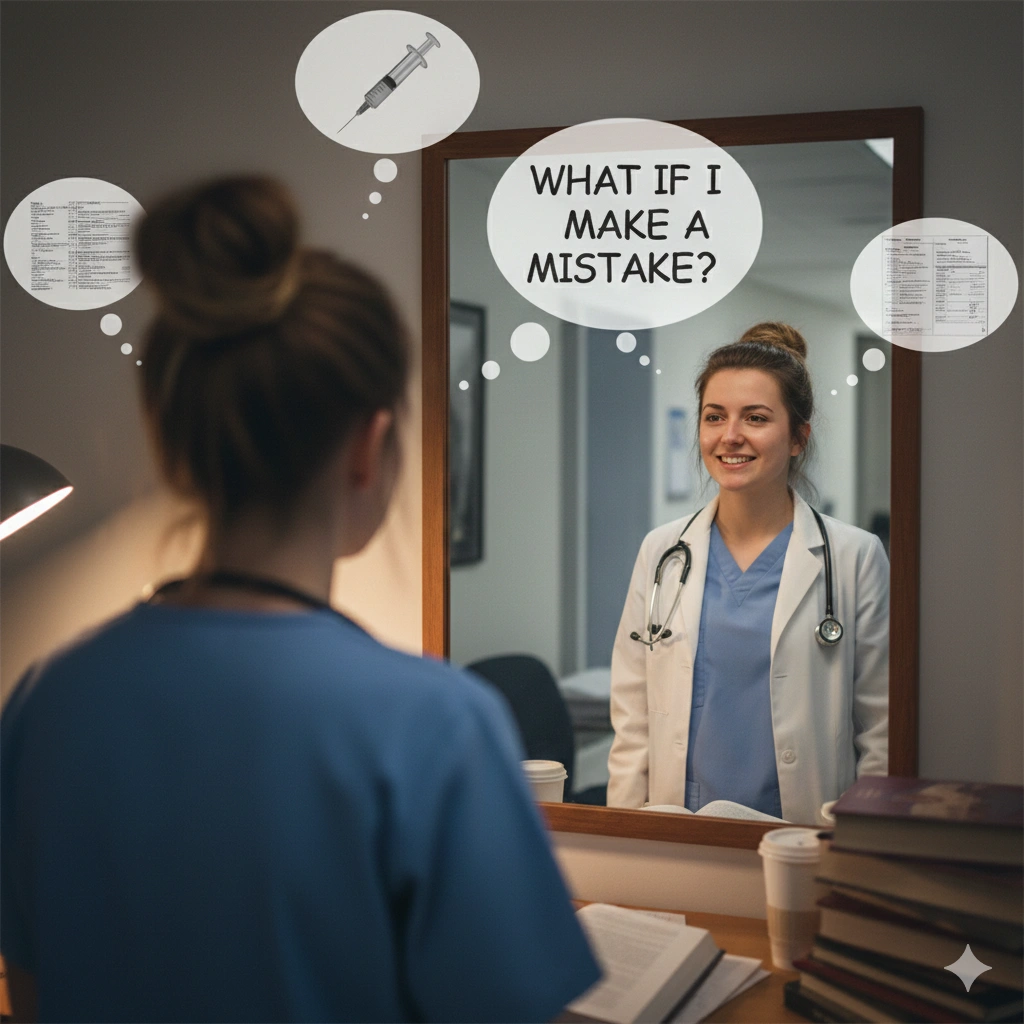
Your classmate seems to know everything. The preceptor compliments another student’s assessment skills. You see other students confidently starting IVs while you’re still struggling. And somewhere in the comparison, you conclude: everyone else is a natural nurse, and you’re faking your way through.
The research on imposter syndrome in nursing students is extensive. Studies show that nursing students frequently experience feelings of being fraudulent, believing they’re not truly competent despite evidence to the contrary. Research confirms that imposter syndrome is associated with increased anxiety, depression, decreased self-efficacy, and consideration of leaving nursing school.
What fuels this? The perfectionism culture in nursing education. Research shows that nursing programs often emphasize error avoidance to such an extreme that students internalize the belief that any mistake means they’re unfit for the profession. Studies reveal that fear of making mistakes is one of the highest stressors reported by nursing students, creating a psychological environment where imposter syndrome thrives.
The comparison trap is real. Research shows that nursing students who compare themselves to peers experience significantly higher stress and lower self-esteem. Social media compounds this—seeing others’ highlight reels while living your own behind-the-scenes struggles creates distorted perceptions of everyone else’s competence versus your own.
Mindful Solutions
- Evidence-Based Self-Assessment: Keep a “competence portfolio.” Document every skill you successfully perform, every positive patient interaction, every preceptor compliment (even small ones). When imposter syndrome strikes, review this evidence. Your feelings say you’re incompetent; your evidence proves otherwise.
- Normalize the Learning Curve: Research shows that feeling incompetent is part of the normal learning process. Remind yourself: “I’m supposed to be learning. This discomfort means I’m growing.” Reframe struggle as proof of learning, not evidence of inadequacy.
- Comparison Awareness: When you notice yourself comparing to others, pause. Silently acknowledge: “I’m comparing my behind-the-scenes to their highlight reel. This isn’t accurate.” Then redirect attention to your own progress from week one to now.
- Seek Specific Feedback: Instead of asking “How am I doing?” (which invites vague responses your anxious brain interprets negatively), ask “What’s one specific thing I’m doing well, and one specific thing I can improve?” Concrete feedback counteracts vague impostor feelings.
5. “The Financial Fear Factor” – Paying to Work While Drowning in Debt

You’re paying thousands of dollars in tuition to work unpaid clinical hours. You can’t maintain a full-time job because clinical rotations are unpredictable and demanding. Student loans are accumulating. And meanwhile, you’re performing actual nursing work that trained nurses get paid for—except you’re doing it for free while paying for the privilege.
The financial stress of nursing school is well-documented but rarely addressed. Research shows that nursing students experience significant financial anxiety, particularly those from low-income backgrounds. Studies confirm that unpaid clinical hours—often 500-700 hours required for graduation—create financial hardship that compounds academic stress.
What makes this particularly challenging? Research reveals that many nursing students must work part-time jobs alongside school and clinicals to survive financially, leading to severe sleep deprivation, reduced study time, and increased burnout risk. Studies show that nursing students working more than 20 hours per week have significantly higher stress levels and lower academic performance.
The debt burden is crushing. Research shows that nursing students graduate with an average debt of $40,000-$60,000, creating financial pressure that influences career decisions and contributes to early career burnout. Studies confirm that financial stress is a significant predictor of consideration of leaving nursing before graduation.
Mindful Solutions
- Financial Reality Planning: Work with a financial counselor to create a realistic budget and understand loan repayment options. Knowing the numbers reduces anxiety about unknown financial futures.
- Community Resources: Investigate nursing student scholarships, emergency financial aid, and loan forgiveness programs for future work in underserved areas. Many students don’t pursue available resources because they don’t know they exist.
- Part-Time Work Boundaries: If you must work during school, set firm boundaries. Protect sleep and study time. It’s better to graduate with slightly more debt than to fail out from exhaustion.
- Long-Term Perspective: Remind yourself that this financial stress is temporary. Nursing salaries, while not matching the difficulty of the work, do provide stability. You’re investing in future financial security even though it’s painful now.
Your Clinical Survival Mindfulness Kit
Practice 1: The 3-Minute “Chart Pause” for Documentation Anxiety
This practice creates space between clinical experience and documentation, reducing perfectionism paralysis.
How to practice
- After completing patient care and before opening the electronic health record to document, step away from the computer
- Find a quiet space—supply closet, bathroom, empty patient room, break room
- Set a mental timer for three minutes
- Close your eyes and take five slow, deep breaths—inhale for 4 counts, exhale for 6 counts
- Mentally review what happened during the patient interaction without judgment—just facts: what you assessed, what you did, what the patient’s response was
- Remind yourself: “Documentation records what happened. It doesn’t judge my performance. I’m recording facts.”
- Open your eyes, return to the computer, and document with reduced anxiety
Why it works
Research on nursing student documentation anxiety shows that fear of judgment through charting creates perfectionism paralysis. This practice separates the act of caregiving from the act of recording, reducing the emotional charge around documentation. Studies confirm that brief mindfulness pauses before high-stress tasks improve performance and reduce anxiety.
Practice 2: The 90-Second “Patient Metta” for Emotional Processing
After difficult or traumatic patient interactions, this loving-kindness practice prevents emotional suppression.
How to practice
- Immediately after a difficult patient experience (coding, death, suffering, trauma), find privacy before continuing your shift
- Close your eyes and place one hand over your heart center
- Take three slow, deep breaths
- Silently offer compassion to the patient with each breath:
- “May you be free from suffering”
- “May you be safe”
- “May you be at peace”
- Then offer compassion to yourself:
- “May I be free from suffering”
- “May I process this with kindness”
- “May I carry this gently”
- Take one final deep breath and open your eyes
Why it works
Research on compassion fatigue in nursing students shows that witnessing trauma without processing creates emotional accumulation leading to burnout. This practice acknowledges the weight of what you experienced while preventing suppression. Studies on loving-kindness meditation confirm that brief compassion practices significantly reduce secondary trauma and emotional exhaustion.
When Mindfulness Isn’t Enough: Recognizing Crisis
Let’s be absolutely clear: breathing exercises help, but they don’t fix systemic problems. If you’re experiencing any of these, professional intervention is essential:
- Thoughts of self-harm or suicide
- Complete inability to function (can’t attend class or clinicals due to mental health)
- Panic attacks that prevent you from providing patient care
- Substance dependence to cope with nursing school stress
- Persistent depression lasting more than two weeks with no improvement
- Dissociation or detachment from reality
- Eating disorder behaviors triggered or worsened by nursing school stress
According to research from the National League for Nursing (NLN), burnout affects 19% of nursing students, with 41% experiencing emotional exhaustion. These aren’t personal failures—they’re predictable responses to an unsustainable system.
Resources
- Campus Counseling Services (most schools offer free mental health support for students)
- National Suicide Prevention Lifeline: 988
- Crisis Text Line: Text HOME to 741741
- Substance Abuse and Mental Health Services Helpline: 1-800-662-4357
- Consider taking a leave of absence if needed—your mental health matters more than graduation timelines
The Truth About Nursing Education
You need to hear this: Research shows that 73.5% of nursing students experience emotional exhaustion, 70.56% experience depersonalization, and 76% have low personal accomplishment. These aren’t isolated cases—this is a systemic crisis.
- Studies reveal that nursing students face stress levels higher than students in other healthcare professions and general college populations. The combination of academic demands, unpaid clinical hours, exposure to trauma, financial pressure, and perfectionism culture creates conditions scientifically proven to cause burnout.
- And here’s what nobody tells you: Research shows that burnout in nursing school predicts burnout in professional practice. Students who graduate burned out become nurses who leave the profession within two years. One-third of newly licensed registered nurses leave within the first year, and one-fifth leave within the second year—largely due to burnout that began in nursing school.
The system is broken. Not you.
Moving Forward: You’re Not Alone
You’re one of thousands of nursing students experiencing this right now. Research confirms you’re facing documented, measured, severe occupational stress—during your education, before you’re even employed.
Start with one practice this week. The 3-minute Chart Pause. The 90-second Patient Metta. Simply acknowledging that what you’re experiencing is real, valid, and not your fault.
You’re not “just” a nursing student. You’re managing life-and-death responsibilities, processing trauma, learning complex medical knowledge, performing unpaid labor, and doing it all while being constantly evaluated and often criticized.
That’s extraordinary.
The next time someone says “nursing school is hard,” let yourself feel the full weight of that understatement. Yes, it’s hard. It’s scientifically, measurably, devastatingly hard—and the fact that you’re still showing up proves your strength.
Take care of yourself. You’re worth it.
And the patients who will someday receive your care? They’re counting on you to survive this with your humanity intact.
You can do this. Not by being perfect—but by being human.
Research References
- Gómez-Urquiza, J. L., et al. (2023). Prevalence and levels of burnout in nursing students: A systematic review with meta-analysis. Nurse Education in Practice, 72, 103753. https://www.sciencedirect.com/science/article/pii/S1471595323002159
- PMC – Evolution and Treatment of Academic Burnout in Nursing Students: A Systematic Review (2023): https://pmc.ncbi.nlm.nih.gov/articles/PMC10137671/
- PMC – Academic Burnout in Nursing Students: An Explanatory Sequential Design (2023): https://pmc.ncbi.nlm.nih.gov/articles/PMC9834498/
- Journal of Nursing Education – Academic Burnout and Stress in Prelicensure Nursing Students (2025): https://journals.healio.com/doi/full/10.3928/01484834-20250530-02
- Frontiers in Public Health – Factors Related to Burnout in Nursing Students (2023): https://www.frontiersin.org/journals/public-health/articles/10.3389/fpubh.2023.1142576/full
- PMC – Nursing Students’ Academic Burnout: Prevalence and Association with Self-Efficacy (2024): https://pmc.ncbi.nlm.nih.gov/articles/PMC12131394/
- Journal of Nursing Education and Practice – From Nursing Students to NLRN: Longitudinal Study on Burnout (2025): https://jnepweb.org/journal/jnep/archives/article/71/
- Medicine Journal – Stress Levels of Nursing Students: Systematic Review (2022): https://journals.lww.com/md-journal/fulltext/2022/09090/stress_levels_of_nursing_students__a_systematic.53.aspx
- PMC – Sources of Stress and Coping Strategies Among Undergraduate Nursing Students (2022): https://pmc.ncbi.nlm.nih.gov/articles/PMC9379378/
- PMC – The Visualization of Stress in Clinical Training: Study of Nursing Students’ Perceptions: https://ncbi.nlm.nih.gov/pmc/articles/PMC7729641/
- American Nurse Journal – Effective Clinical Learning for Nursing Students (2024): https://www.myamericannurse.com/effective-clinical-learning-for-nursing-students/
- ScienceDirect – Nursing Students’ Perceived Stress and Clinical Learning Experience (2022): https://www.sciencedirect.com/science/article/abs/pii/S1471595322001718