Remembering 25 Orders While Being Yelled At in Three Languages
Table 12 wants their steak cooked to an impossible “medium-rare-plus.” Table 7 is waving frantically because their water glass dropped below half-full. The kitchen is backed up twenty minutes. Your section just got double-seated—again. And the woman at Table 4 is screaming at you in French, English, and what sounds like Italian about how her gluten-free, dairy-free, taste-free meal isn’t meeting her expectations.
Welcome to fine dining service, where you’re expected to be a sommelier, therapist, punching bag, memory champion, and performing artist—all while earning $2.13 an hour plus the hope that someone tips you fairly.
According to research published in PLOS ONE, the mental health statistics for restaurant waiters are devastating: depression affects 38.3% of servers, anxiety impacts 52.3%, and stress afflicts 34.4%. But here’s what makes it even worse—a study from Southern Medical University found that waiters and waitresses have a 22% higher risk of stroke on average than those in low-stress jobs, jumping to 33% for women. That’s higher than the stroke risk for neurosurgeons.
Yes, you read that correctly. Research shows that serving food is more physiologically damaging than brain surgery because while a neurosurgeon may be mentally drained, they feel valued. You? You just got yelled at for forgetting extra sauce, then tipped nothing on a $300 check because the kitchen was slow.
The Five Daily Battles Nobody Tips You For
1. “The Memory Hunger Games” – When Your Brain Becomes a Walking Order Pad
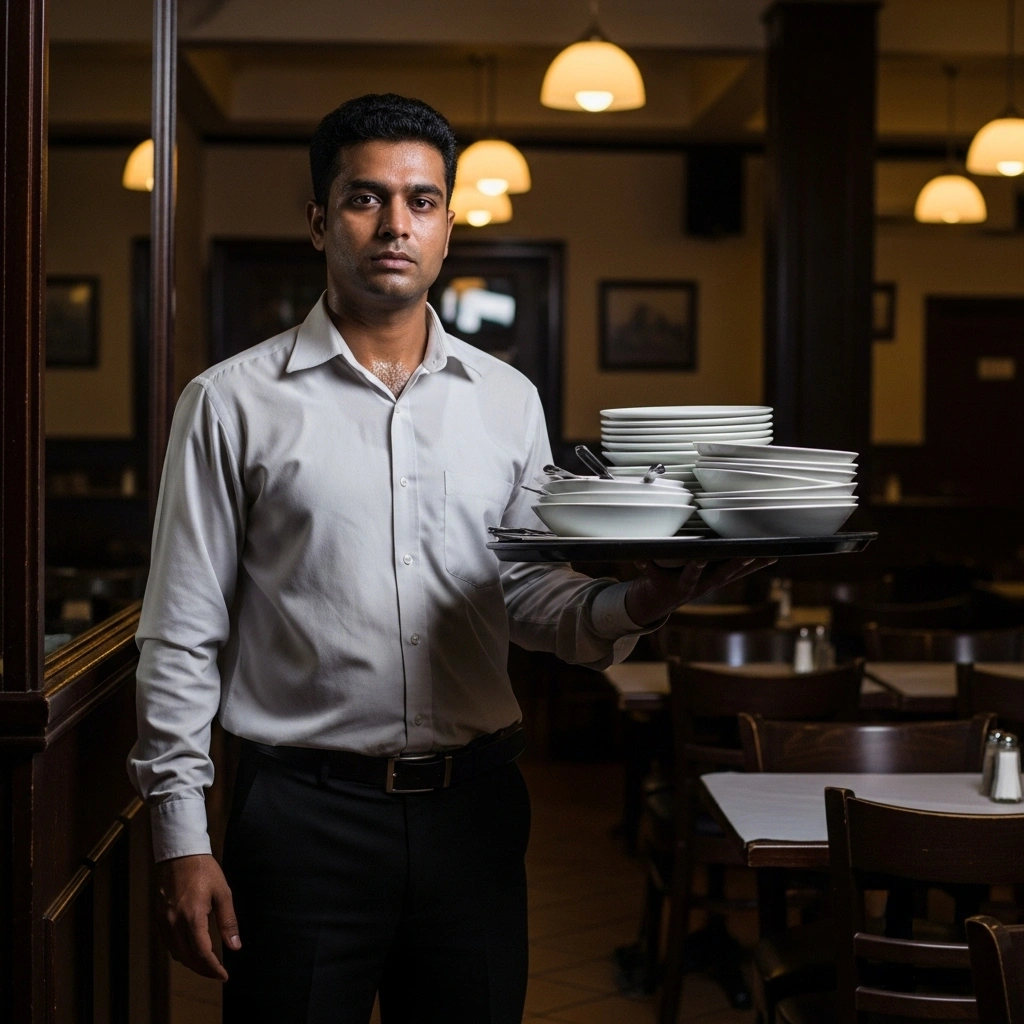
You’re not just taking orders. You’re memorizing a novel’s worth of information per shift: Table 3 is allergic to shellfish but the husband secretly eats it when his wife isn’t looking. Table 7’s daughter has celiac disease—actual celiac, not trendy gluten-avoidance. Table 12 wants their wine served at exactly 55 degrees. Table 9 asked you twelve minutes ago for more bread and you’ve forgotten twice because you’re simultaneously handling six other tables.
The research on server memory is fascinating and terrifying. A study on Buenos Aires waiters found that servers successfully memorize complex orders by creating mental schemas that link customers with their physical positions at tables and their drink orders. But here’s the catch—when customers switch seats, accuracy plummets. Your memory strategy depends on spatial positioning, and when that’s disrupted, your mental filing system collapses.
The cognitive load is immense. Research on fine dining servers shows they must memorize extensive wine lists, detailed menu descriptions including sourcing and preparation methods, multiple service styles, food pairings, and table settings—all while executing flawless, real-time service. One memory lapse—forgetting one dietary restriction or one allergy—could be life-threatening for a guest and career-ending for you.
The constant mental multitasking creates chronic stress. Studies show that servers must maintain situational awareness across multiple tables, prioritize tasks constantly, manage competing urgent demands, and remember dozens of specific details while physically moving at high speed. Your brain is running multiple complex programs simultaneously—and there’s no pause button.
Mindful Solutions
- The 60-Second “Order Ground” Practice: After taking a complex order, before entering it into the system, pause for 60 seconds. Close your eyes briefly if possible. Take three deep breaths. Visualize each person at the table and their order as a clear image in your mind. This brief consolidation pause helps transfer information from working memory to short-term memory more reliably.
- Spatial Memory Anchoring: When taking orders, consciously link each person’s order to their physical position. Touch the table lightly at their spot while repeating their order internally. This somatic anchoring reinforces memory.
- Permission to Write Things Down: If your restaurant allows, advocate for the right to use discreet note-taking. Explain that accuracy serves the restaurant’s reputation better than error-prone memorization. Many high-end restaurants now accept this.
- Post-Shift Brain Recovery: After shifts, give your brain 20 minutes of complete rest. No screens, no conversations, no stimulation. Let your overworked cognitive system decompress.
2. “The Emotional Punching Bag Protocol” – Smiling Through Verbal Assault

Let’s be direct: you’re verbally abused. Daily. And you must smile, nod, and say “Of course, my pleasure” while absorbing treatment that would get someone arrested in any other context.
The research on customer abuse toward servers is chilling. Studies on emotional labor show that servers experience some of the highest rates of workplace verbal abuse across all professions. You’re expected to perform constant emotional labor—displaying required positive emotions while suppressing authentic negative reactions—regardless of how customers treat you.
The psychological toll is severe. Research reveals that emotional labor creates emotional dissonance—the stress of maintaining a false emotional performance that contradicts genuine feelings. This chronic dissonance leads to emotional exhaustion, depersonalization, depression, and burnout. Studies show that jobs requiring high emotional labor with low control (exactly describing server work) create maximum psychological damage.
What makes it worse? Research on restaurant work stress confirms that servers have no control over who they serve, what expectations customers bring, whether customers will be reasonable or abusive, or the quality/timing of food from the kitchen. You’re held responsible for the entire dining experience while controlling almost none of its variables.
The power dynamic is brutal. Research shows that customers know servers financially depend on tips, creating an exploitative dynamic where you must tolerate abuse to survive economically. Studies document that servers absorb racist comments, sexual harassment, personal insults, and rage—all while maintaining professional composure because speaking up costs you money.
Mindful Solutions
- The 2-Minute “Tip Gratitude” Reset: This isn’t about being grateful for bad tips—it’s about protecting your mental health from accumulating toxicity. After particularly abusive interactions, find a private space (walk-in cooler, bathroom, outside) for two minutes. Close your eyes. Place one hand on your heart. Take six deep breaths. With each exhale, visualize releasing the customer’s toxicity like smoke dissipating. Silently affirm: “Their abuse says nothing about my worth. I am professional. I am competent. I am worthy of respect.”
- Emotional Compartmentalization: Visualize a locker in your mind. After toxic interactions, mentally place that customer’s words and energy in the locker and close it. This isn’t suppression—it’s conscious containment preventing emotional contagion.
- Collective Processing: Find one coworker you trust. Create a 5-minute end-of-shift ritual where you each share the worst interaction you experienced. Simply being heard and validated prevents toxic internalization.
- Advocate for Abuse Policies: Push management to create clear protocols allowing you to refuse service to abusive customers. Show them research proving that protecting staff improves retention and performance. Some restaurants now have “We support our staff” policies—yours should too.
3. “The Wage Theft Tightrope” – When Working Harder Means Earning Less\
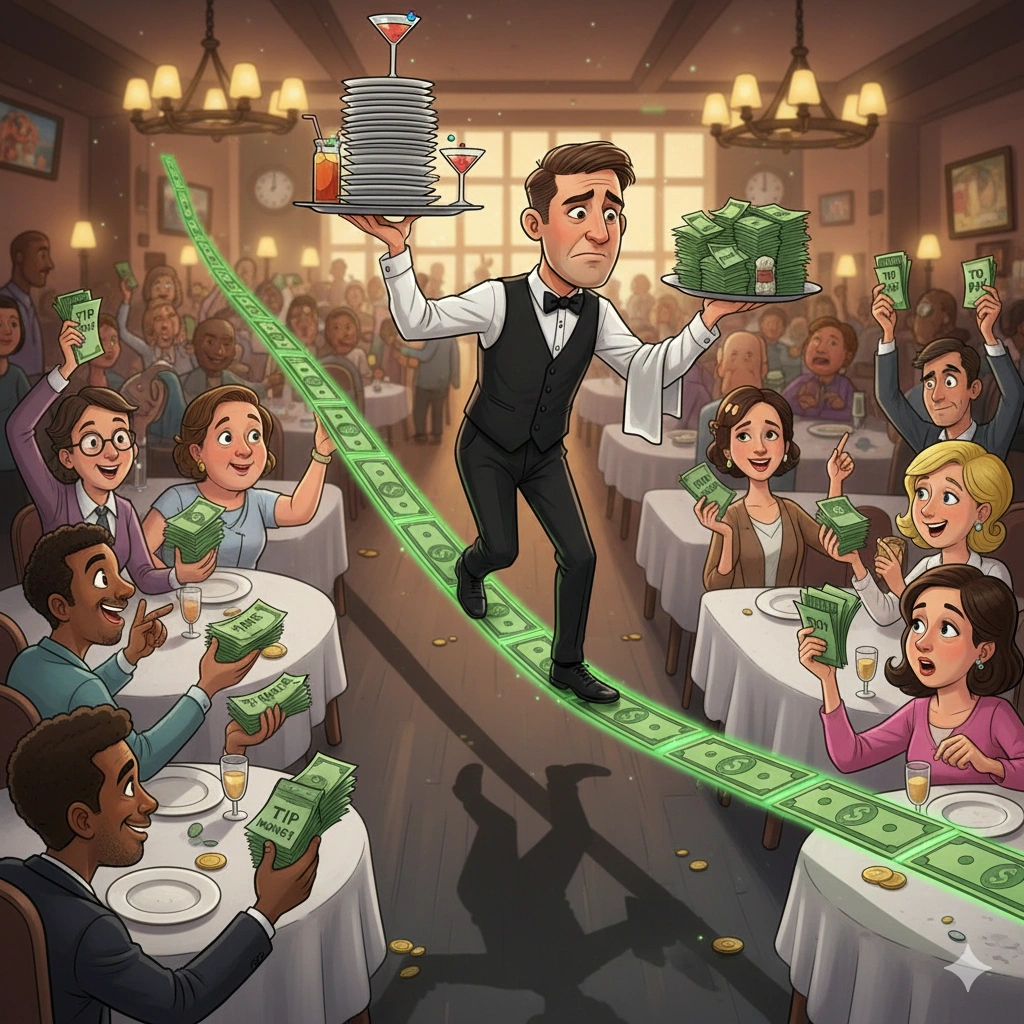
Here’s the brutal economics of server work: In most states, you earn $2.13-$5 per hour. Your actual income depends entirely on the generosity of strangers who have zero obligation to treat you fairly. Bad service? No tip. Great service? Maybe no tip. Kitchen was slow? Your fault, no tip. Customer is cheap? No tip. Customer “doesn’t believe in tipping”? No tip.
The financial insecurity is documented in research. Studies show that fine dining servers earn an average of $51,000-$58,000 annually, but this is wildly inconsistent based on seasonality, economy, customer demographics, and pure luck. Research confirms that servers experience significant financial stress due to unpredictable income, inability to budget reliably, no benefits or sick pay, and constant economic anxiety.
The tip system creates psychological torture. Research on emotional labor and tipping shows that servers must perform excessive positivity and deference because their survival depends on customer satisfaction—even when customers are objectively wrong or abusive. Studies document that minorities, women, and servers perceived as “unattractive” consistently receive lower tips for identical service quality. Your income is determined partially by factors completely outside your control: your race, gender, appearance, and customers’ biases.
The “busy trap” is real. Research confirms that being extremely busy doesn’t guarantee better earnings. If the kitchen is slow or you get triple-seated, service quality drops, tips decrease, but your physical and mental exhaustion increases. You can work harder and earn less—a devastating economic reality.
Mindful Solutions
- Financial Reality Documentation: Keep detailed records of your actual hourly earnings (including tips). Calculate your real average wage. This evidence helps when negotiating for better positions or deciding when to leave.
- Tip Perspective Reframe: When you receive a bad tip, pause. Breathe. Remind yourself: “This reflects their values, not my worth. I did my job well.” Don’t allow one bad tip to color your entire shift or self-perception.
- Gratitude for Good Tips: When you do receive a generous tip, pause for 30 seconds. Acknowledge it consciously: “Someone valued my work. This is evidence that I’m good at what I do.” Let positive evidence in as consciously as you try to keep negative evidence out.
- Exit Strategy Planning: The most mindful thing you might do is plan your transition out of serving if the financial instability is destroying your mental health. There’s no shame in acknowledging that the system is broken.
4. “The Physical Destruction Marathon” – When Your Body Becomes Your Enemy
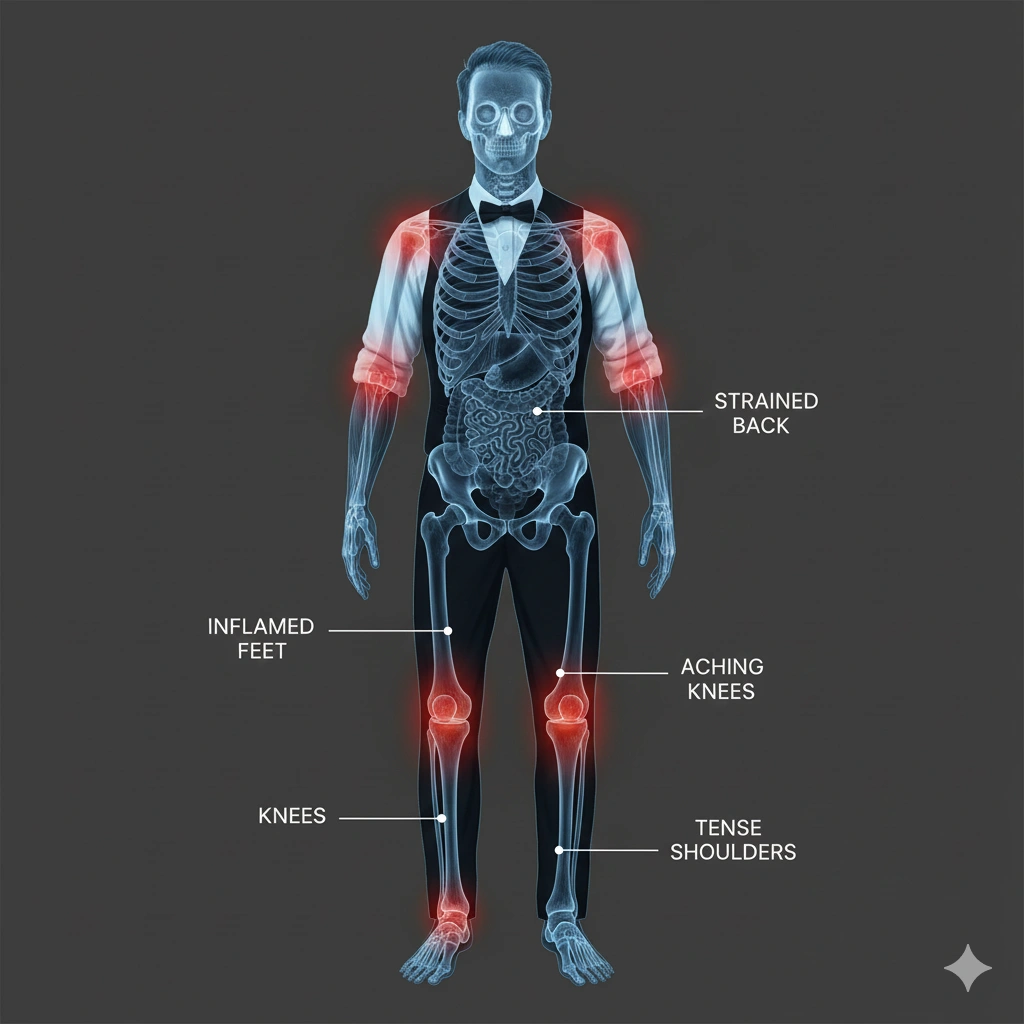
You walk 10-15 miles per shift. You’re on your feet for 8-12 hours straight. You’re carrying heavy trays at awkward angles. You’re bending, reaching, twisting, lifting—thousands of repetitive movements daily. And at the end of the night, your feet are swollen, your back is screaming, and you can barely walk to your car.
The physical toll of server work is well-documented. Research on fine dining servers confirms that the job leads to chronic back pain, foot fatigue, repetitive stress injuries, varicose veins from prolonged standing, and cardiovascular strain. Studies show that standing for extended periods without adequate breaks reduces circulation, increases joint stress, and causes musculoskeletal disorders.
The research on night-shift restaurant workers (many fine dining establishments work late hours) reveals additional health damage: disrupted sleep patterns even on days off, increased risk of metabolic syndrome and diabetes, cardiovascular disease risk elevation, weakened immune system, and chronic fatigue. Studies confirm that restaurant workers working irregular late hours experience sleep deprivation that accumulates over time, creating chronic health problems.
The physical environment compounds the damage. Research shows that restaurant kitchens are extremely hot, dining rooms require constant fast-paced movement, carrying heavy trays creates ergonomic strain, and the combination of physical demands with mental stress accelerates body breakdown. Your job is physically demanding as construction work, but without the recognition or compensation that physically demanding jobs typically receive.
Mindful Solutions
- Micro-Recovery Movements: Every 90 minutes, take 2 minutes to do gentle stretches. Roll your ankles. Flex your feet. Gently rotate your neck. These tiny interventions prevent injury accumulation.
- Compression and Support: Invest in quality compression socks and supportive shoes designed for standing professions. This isn’t optional—it’s occupational health protection.
- Post-Shift Body Care Ritual: After work, spend 10 minutes on deliberate body recovery. Ice your feet if swollen. Gentle stretching. Even brief attention signals to your body that you care about its wellbeing, reducing stress-related inflammation.
- Advocate for Break Compliance: Research shows that servers often work through legally required breaks. Demand your breaks. Your body needs recovery time to prevent long-term damage.
5. “The Social Extinction Event” – When Everyone You Love Is Free Except You
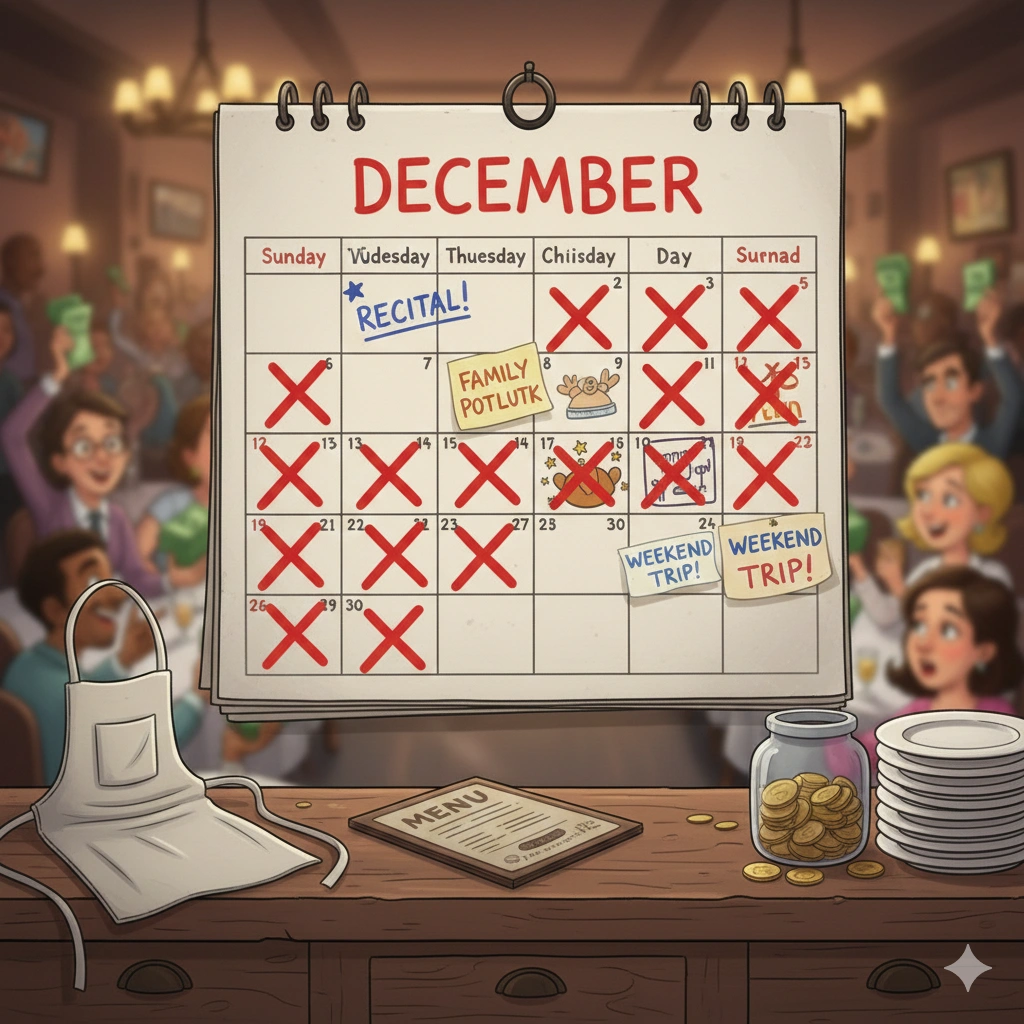
It’s Thanksgiving. Your family is gathering for dinner at 6 PM. You’re working a double shift at the restaurant. It’s Saturday night. Your friends are going out. You’re at work. It’s your partner’s birthday. You requested off two months ago, but you got scheduled anyway because “we’re short-staffed.”
The social isolation of restaurant work is documented in research. Studies show that shift work, particularly evening and night shifts, dramatically reduces social contacts, participation in family events, ability to maintain friendships, and romantic relationship quality. Research confirms higher rates of marital problems, social isolation, and loneliness among workers with nonstandard schedules.
The scheduling powerlessness compounds the isolation. Research on restaurant worker conditions shows that servers often have schedules changed last-minute, get forced to work holidays and weekends, have requests for time off denied regularly, and face retaliation for requesting schedule changes. You’re working when the rest of the world is celebrating, socializing, and connecting—creating a profound sense of exclusion.
The psychological impact is severe. Studies on social isolation and mental health show increased rates of depression, anxiety, feelings of loneliness, and reduced life satisfaction among workers with antisocial schedules. Research confirms that restaurant workers experience higher substance abuse rates, partially attributed to using alcohol or drugs to cope with isolation and inability to socialize normally.
The “waitmares” phenomenon is real. Research documents that restaurant workers commonly experience nightmares about work—specifically about being “in the weeds” (overwhelmed)—years after leaving the industry. Studies show these stress dreams indicate trauma from chronic occupational stress, and they persist because the stress was so intense it created lasting neural patterns.
Mindful Solutions
- Quality Over Quantity: When you do have time off, be radically present. Put away your phone. Engage fully. 30 minutes of genuine connection beats three hours of distracted half-presence.
- Restaurant Worker Community: Build friendships with other servers who share your schedule. Create post-shift rituals—late-night food, group chats, weekend morning meetups when everyone’s finally off.
- Boundaries Where Possible: If you have any negotiating power, protect one non-negotiable day off. Frame it as preventing burnout rather than being “difficult.” Research shows that even one guaranteed off day reduces burnout significantly.
- Reframe the Schedule: Instead of mourning what you’re missing, acknowledge what your schedule provides—weekday freedom for appointments, quiet mornings, avoiding rush-hour traffic. It’s not better, but it’s different.
Your Shift-Survival Mindfulness Kit
Practice 1: The 60-Second “Order Ground” for Memory Overload
When you’re drowning in orders and special requests, this practice creates a memory consolidation pause.
How to practice
- After taking a particularly complex order (dietary restrictions, modifications, special requests), don’t immediately rush to input it
- Step to a quiet corner—even just five feet away from the table
- Close your eyes for 3-5 seconds (or soften your gaze downward if closing eyes isn’t possible)
- Take three slow, deep breaths
- Visualize each person at the table and their order as a clear mental image, linking person to position to order
- Open your eyes and input the order with confidence
Why it works
Research on memory consolidation shows that brief pauses after encoding new information significantly improve retention. Studies on waiter memory confirm that servers use spatial-position schemas to remember orders—this practice reinforces that neural pattern. The three deep breaths also activate your parasympathetic nervous system, reducing stress hormones that interfere with memory formation.
Practice 2: The 2-Minute “Tip Gratitude” for Emotional Recovery
After abusive customer interactions or disappointing tips, this practice prevents toxic accumulation and protects self-worth.
How to practice
- Find a private space immediately after a difficult interaction—bathroom, walk-in cooler, back alley, your car
- Set a mental timer for two minutes (checking your watch/phone is fine)
- Close your eyes and place one hand over your heart center
- Take six slow, deep breaths—inhale for 4 counts, exhale for 6 counts
- With each exhale, visualize releasing the customer’s negativity like dark smoke leaving your body
- Silently affirm: “Their words are not truth. Their behavior reflects them, not me. I am professional, competent, and worthy of respect.”
- End by acknowledging one thing you did well that shift—even something small
Why it works
Studies on emotional labor show that servers who don’t process emotional abuse accumulate psychological damage that leads to depression, anxiety, and burnout. This practice creates conscious emotional release and cognitive reframing. Research on self-affirmation confirms that consciously countering negative messages with truthful positive statements protects self-esteem and prevents internalization of abuse.
When Mindfulness Isn’t Enough: Recognizing Crisis
Let’s be clear: breathing exercises help, but they don’t fix systemic exploitation. If you’re experiencing any of these, professional help isn’t optional—it’s essential:
- Substance dependence: Increasing reliance on alcohol or drugs to cope with shifts or decompress after work
- Persistent depression: Hopelessness, lack of joy, constant fatigue that doesn’t resolve with rest
- Anxiety or panic attacks before, during, or after shifts
- Physical symptoms that won’t heal: chronic pain, digestive issues, insomnia persisting beyond single shifts
- Thoughts of self-harm or suicide
- Complete emotional numbness or inability to care about anything
According to research from PLOS ONE, depression affects 38.3% of waiters, anxiety impacts 52.3%, and stress afflicts 34.4%—these are occupational hazards, not personal failures.
Resources
- Employee Assistance Programs (if offered)
- National Suicide Prevention Lifeline: 988
- Crisis Text Line: Text HOME to 741741
- Substance Abuse and Mental Health Services Helpline: 1-800-662-4357
The Truth About Your Work
You need to hear this: research from Southern Medical University ranks food service among the most stressful occupations globally—more physiologically damaging than neurosurgery. You face a 22-33% higher stroke risk than low-stress professions. Depression rates are 38.3%, anxiety 52.3%.
This isn’t because you’re weak. It’s because the job is legitimately, measurably destructive.
You’re expected to
- Perform Olympic-level multitasking while smiling
- Absorb verbal abuse as though it’s part of the job description
- Memorize encyclopedic information while moving at high speed
- Maintain perfect emotional performance regardless of your authentic state
- Earn poverty wages while being blamed for systemic problems
- Sacrifice your physical health, social life, and mental wellbeing
And you’re doing all of this so strangers can have a pleasant evening.
Your work has dignity. Creating positive experiences, facilitating celebration and connection, performing hospitality—these matter. But the system that exploits your labor while destroying your health is broken.
Moving Forward: You Deserve Better
Start with one practice this week. The 60-second Order Ground. The 2-minute Tip Gratitude. Simply acknowledging that what you’re experiencing is real and documented.
You’re not “just” a waiter. You’re a memory athlete, crisis manager, emotional labor performer, physical endurance specialist, and hospitality professional—all while making it look effortless.
That’s extraordinary.
The next time someone dismisses your profession or tips poorly, let yourself feel the truth: your work is hard, your skills are real, and you deserve respect.
Take care of yourself. You’re worth it.
Research References
- PLOS ONE – Prevalence and Predictors of Work-Related Depression, Anxiety, and Stress Among Waiters: https://journals.plos.org/plosone/article?id=10.1371/journal.pone.0249597
- PMC/NCBI – Work-Related Mental Health Among Waiters in Upscale Restaurants: https://www.ncbi.nlm.nih.gov/pmc/articles/PMC8049486/
- VICE – Scientists Say It’s More Stressful to Be a Waiter Than a Neurosurgeon: https://www.vice.com/en/article/scientists-say-its-more-stressful-to-be-a-waiter-than-a-neurosurgeon/
- NeuroLaunch – Psychological Effects of Waiting Tables: https://neurolaunch.com/psychological-effects-of-waiting-tables/
- ResearchGate – If Memory Serves: The Effect of Restaurant Servers’ Memorization and Muddling of Orders: https://www.researchgate.net/publication/338299584_If_memory_serves_The_effect_of_restaurant_servers%27_memorization_and_muddling_of_orders
- OysterLink – Pros and Cons of Being a Fine Dining Server: https://oysterlink.com/spotlight/pros-and-cons-of-being-fine-dining-server/
- Restaurant HQ – 10 Tips for Managing Restaurant Employee Burnout: https://www.therestauranthq.com/operations/restaurant-employee-burnout/
- Toast POS – What is a Fine Dining Server?: https://pos.toasttab.com/blog/glossary/what-is-a-fine-dining-server
- The Outline – Working in the Restaurant Industry Will Haunt Your Dreams (Waitmares Research): https://theoutline.com/post/8512/restaurant-jobs-nightmares-in-the-weeds