
Five minutes of silence after your killer punchline. Here’s what actually helps.
You’re mid-set. You’ve been building to this moment—the setup was perfect, the timing flawless. You deliver your killer punchline with the confidence of someone who’s tested this joke a hundred times.
Silence.
Not the good kind of silence before laughter erupts. The bad kind. The kind where you can hear someone cough in the back row. Where phones start glowing. Where the bartender’s ice scooping becomes the loudest sound in the room.
Five seconds feels like five years. You keep talking, trying to recover, but your voice sounds different now—smaller, desperate. You can feel the sweat forming. Your brain is screaming contradictory instructions: “Move on!” “Try to save it!” “Leave the stage immediately!”
Welcome to bombing, the experience every comedian faces and most never fully recover from. Research published in Personality and Individual Differences reveals that compared to the general population, professional stand-up comedians report significantly higher levels of anxiety and depression, with studies showing comedians screened positive for alcohol and substance use problems at elevated rates.
This isn’t another article romanticizing the “struggling artist” or telling you to “just keep going.” This is about how you survive when your art requires you to be vulnerable in front of strangers who have permission to reject you—loudly, publicly, and immediately.
The Five Demons Every Comedian Battles
1. “The Bomb That Keeps Exploding: When One Bad Set Infects Everything”
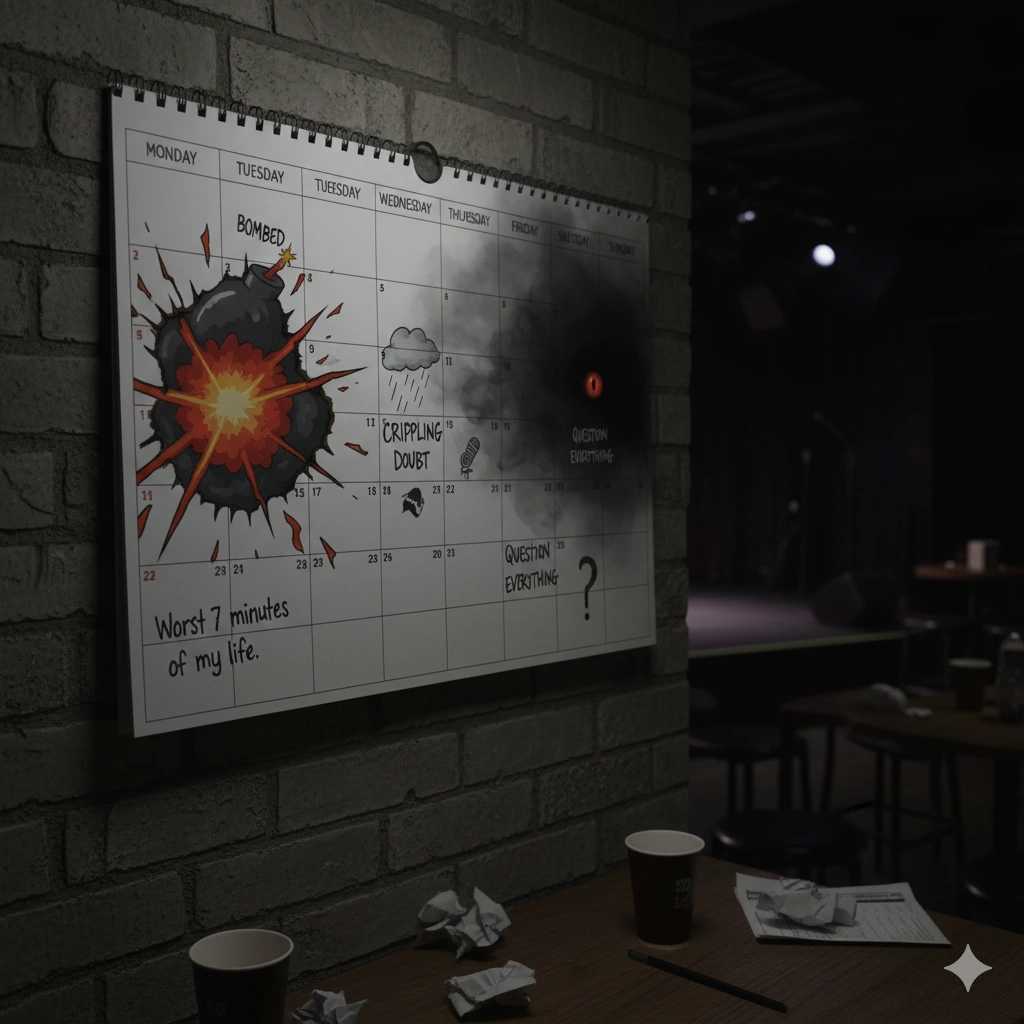
Picture this: You bomb on Tuesday night. Wednesday, you replay every excruciating moment. Thursday, you’re too anxious to write. Friday, you have another gig but can’t remember any of your material because your brain is still stuck on Tuesday. Saturday, you bomb again because you’re performing from a place of fear. Sunday, you consider quitting comedy forever.
One bad set becomes a psychological infection that spreads through your entire comedy life.
Studies reveal that stage fright affects comedians universally, from newcomers to seasoned professionals, with the fear of bombing identified as one of the biggest sources of performance anxiety. Research shows that comedians’ brains perceive audiences as judging entities, triggering fight-or-flight responses including increased heart rate, shaky hands, and dry mouth.
The sad clown paradox—documented since psychological experiments in the 1980s—identifies that comedians often use humor as coping mechanisms to hide trauma, yet constantly require admiration and acknowledgement to function, experiencing cyclothymic temperament swinging between depressive and manic states.
One bombing experience doesn’t just hurt in the moment—it creates anticipatory anxiety that sabotages future performances. You stop taking creative risks. You cling to safe material. You perform defensively rather than authentically. The bomb wins even when you’re not bombing.
What Actually Works
The 2-Minute “Bomb Embrace” Practice (Literally Bow to Silence)
This sounds absurd. That’s the point. After a bombing set—not days later, right after—you need a ritual that interrupts the shame spiral before it begins.
Here’s how
Step 1: Find Private Space (30 seconds)
- Bathroom, green room, outside venue
- Anywhere you can be alone briefly
Step 2: Physical Bow (30 seconds)
- Literally bow—full theatrical bow
- Say aloud: “I bombed. I acknowledge this truth.”
- Feel the ridiculousness of bowing to failure
Step 3: Gratitude Paradox (60 seconds)
- “Thank you for showing me I can survive bombing”
- “Thank you for reminding me I’m brave enough to try”
- “Thank you for this data about what doesn’t work”
This practice does three things: It acknowledges reality (denial makes it worse), it adds absurdist humor to strip away shame’s power, and it reframes bombing as information rather than identity.
Comedian Zach Galifianakis admitted that for every great show, he endured about seven hundred terrible ones, and that bombing hasn’t become easier but keeping at it despite outcomes gives more confidence.
Immediate Post-Bomb Protocol
DON’T
- Replay the set obsessively for hours
- Apologize to everyone you see
- Check social media for confirmation of your failure
- Make major career decisions
- Drink alone to “process”
DO
Write three sentences about what you learned
- Text one comedian friend: “I bombed. It sucked. I’m okay.”
- Move your body (walk, anything to shift physiology)
- Schedule your next performance immediately
- Sleep—your brain needs reset time
Research Reference
Research on stage anxiety in comedians reveals that nerves and anxiety affect comedians’ performances by causing memory lapses, timing problems, and physical stiffness, with many developing coping strategies including meditation, breathing exercises, and physical activity to manage pre-show stress. Source: https://comedylens.com/why-comedians-bomb/
2. “The Validation Addiction: When You Need Strangers to Tell You You’re Okay”
You check your social media obsessively after every set. Likes equal validation. Comments equal worth. Silence equals failure. Someone posts a video of their standing ovation. You posted nothing because your set was mediocre. The comparison spiral begins.
You’re 35 years old and your emotional regulation depends on whether drunk people in a basement laughed at your jokes. This is not sustainable.
Research demonstrates that comedians scored significantly higher on measures of Malignant Self-Regard, suggesting traits of vulnerable narcissism including hypersensitivity to criticism and strong desire for approval—characteristics that can be both personal vulnerabilities and professional mechanisms to enhance comedic performance.
One study participant described the pattern: “Even if just one out of ten customers is rude, it affects us.” The need for universal approval creates impossible standards where anything less than unanimous laughter feels like devastating rejection.
Comedians often struggle with the “troubled stand-up stereotype,” and while research shows mixed results on whether they have higher rates of psychological dysfunction than the general population, the entertainment industry culture clearly affects mental health outcomes, with comedians more likely to report seeking psychiatric treatment during their careers.

What Actually Works
Post-Show 3-Minute “Heckler Forgiveness” Practice
This practice isn’t about actually forgiving hecklers (though that’s a bonus). It’s about releasing the psychological grip that audience members—whether actively hostile or passively indifferent—have on your self-worth.
After every show, before checking your phone:
Minute 1: Audience Acknowledgment
- Close your eyes
- Picture the audience (the whole audience, not just the one person who hated you)
- Say: “They came to laugh. Some did. Some didn’t. Both are okay.”
Minute 2: Self-Compassion
- Hand on heart
- “I did something brave tonight”
- “My worth isn’t determined by their response”
- “I am enough, regardless”
Minute 3: Release
- Breathe out slowly
- Visualize their judgment leaving your body like smoke
- “Their opinions are theirs to keep, not mine to carry”
This practice recognizes that you’re hardwired to care about social acceptance (it kept our ancestors alive), while creating conscious distance between performing and self-worth.
Break the Validation Cycle
The Phone-Free Hour: After every performance, phone stays off for one full hour. No checking:
- Social media reactions
- Text responses
- Video views
- Comments
One hour lets the neurochemical spike settle before you feed it with external validation-seeking.
Diversify Worth Metrics
Create non-comedy sources of self-worth:
- Relationships (not audience members)
- Skills unrelated to performing
- Acts of service/kindness
- Physical accomplishments
- Creative work no one sees
When comedy is your only source of worth, every bomb becomes existential. When it’s one of many sources, bombs hurt but don’t destroy you.
Research Reference
Studies examining comedians’ personality characteristics found they scored higher on vulnerable narcissism markers, with heightened sensitivity to criticism and desire for approval, though some differences became non-significant when accounting for geographic factors like living in entertainment industry hubs. Source: https://www.psypost.org/stand-up-comedians-display-heightened-anxiety-substance-use-problems-and-malignant-self-regard/
3. “The Income Roulette: When Your Art Can’t Pay Your Rent”
You work open mics for free. You accept $50 gigs that require three hours of travel. You headline for $200 and feel grateful. Meanwhile, your college roommate just bought a house.
You’re 32 and living with roommates. You have a day job you hate that drains creative energy. You cancel social plans because you “need to be fresh for the show.” The show pays nothing. Your friends stop inviting you.
You calculate: If you do four shows a week at $75 each, that’s $1,200 monthly—except most shows pay nothing, and the ones that pay sometimes don’t actually pay.
Research on comedians revealed they spend months or years working unpaid open mics, traveling for minimal compensation, and facing constant financial precarity while pursuing an art form with no guaranteed career trajectory or retirement benefits.
The financial stress compounds mental health issues. Studies show that 27% of comedians reported having received psychiatric care at higher rates than the general population, with substance use often linked to coping with industry pressures including financial instability.
You tell yourself it’s about the art, not the money. But you also need to eat. And pay rent. And maybe see a therapist about why you keep choosing financial instability to make strangers laugh.

What Actually Works
Financial Reality Check (Monthly)
Most comedians avoid looking at their actual finances. Avoidance increases anxiety. Clarity creates agency.
First week of each month, fill out:
- Comedy income this month: $___
- Comedy expenses (travel, recordings, etc.): $___
- Net comedy income: $___
- Day job/other income: $___
- Total expenses: $___
- Difference: $___
This isn’t about judgment. It’s about data. You can’t make strategic decisions without knowing where you actually stand.
The Tiered Income Strategy
Tier 1: Survival (Non-Negotiable) Day job, freelance work, whatever pays bills. No shame here. Most comedians have day jobs for years. Some forever. That’s reality.
Tier 2: Comedy Revenue Pursue paid gigs strategically:
- Know your minimum (what’s the lowest you’ll work for?)
- Negotiate (even $25 more is $25 more)
- Diversify: performing, writing, teaching, producing
Tier 3: Investment Unpaid showcases, competitions, networking shows—these have value but can’t be your entire calendar. Limit to 30% of gigs maximum.
Set Financial Boundaries
You can say:
- “I can’t do unpaid shows anymore”
- “My minimum is $X for travel gigs”
- “I need payment upfront”
Venues that respect you will understand. Venues that don’t probably weren’t paying fairly anyway.
Alternative Revenue Streams
Many successful comedians supplement with:
- Teaching comedy classes
- Corporate training (humor in workplace)
- Writing (comedy or otherwise)
- Content creation with sponsorships
- Comedy consulting
Your day job doesn’t make you less of a comedian. It makes you someone who can afford to eat while pursuing comedy.
Research Reference
Analysis of the comedy industry economics reveals that most comedians work multiple unpaid or low-paid performances before establishing financial viability, with many maintaining supplementary income sources throughout their careers to manage industry financial instability. Source: https://en.wikipedia.org/wiki/Sad_clown_paradox
4. “The Heckler’s Veto: When One Voice Silences Your Art”
You’re mid-joke. Someone yells: “You suck!” Or “Get off stage!” Or something worse—personal, cruel, designed to destroy.
The room goes silent. Everyone’s watching. How you respond defines the next sixty seconds of your life. Except you can’t think because your amygdala just hijacked your prefrontal cortex and you’re in pure survival mode.
You either: (A) Try to destroy them verbally, risk looking mean (B) Ignore them, risk looking weak (C) Engage playfully, risk encouraging more (D) Freeze, guarantee the set is over
There’s no perfect answer. And this moment will replay in your mind for weeks.
Studies show that comedians often score high in introvertive anhedonia and impulsive non-conformity—personality traits making them simultaneously drawn to performing while being deeply affected by negative interactions.
The heckler doesn’t just interrupt your set. They interrupt your psychology. One hostile voice activates your threat response so powerfully that the ninety-nine people who were laughing become invisible. Evolution wired you to focus on threats over rewards. The heckler exploits that wiring.
Worse: Sometimes the heckler is internal. It’s your own voice saying “This isn’t working” or “They hate this” or “You’re bombing” before anyone’s even responded.

What Actually Works
The Heckler Forgiveness Practice (Post-Show, 3 Minutes)
This practice isn’t about excusing bad behavior. It’s about not carrying someone else’s toxicity into your next performance.
Step 1: Name the Wound (60 seconds)
- Acknowledge what happened: “Someone was cruel tonight”
- Acknowledge how it felt: “It hurt. I felt humiliated.”
- Write it down if needed (externalizes it from your mind)
Step 2: Separate Act from Identity (60 seconds)
- “They heckled my joke, not my worth”
- “Their cruelty reveals their pain, not my inadequacy”
- “I cannot control their behavior; I can control my response”
Step 3: Compassionate Release (60 seconds)
- For them: “May they find peace so they don’t need to hurt others”
- For you: “May I release this moment and perform freely tomorrow”
- Physical release: Shake out your body, literally shake off the experience
This isn’t about being “nice” to hecklers. It’s about not letting them rent space in your head indefinitely.
Practical Heckler Management
During the Show
- Brief acknowledge: “I hear you” or “Noted,” then immediately back to material
- House rules reference: “Staff will handle this” (signal to venue)
- Playful redirect: “Hold that thought, I’ll take questions after” (only if you have the energy)
- Never engage in extended battle—you lose either way
After the Show
- Talk to venue: Persistent heckling should result in removal
- Debrief with comedian friends: They’ve been there
- Don’t replay it obsessively: Your brain will catastrophize
- Remember: Most audience members side with you, not heckler
Build Psychological Armor
Not armor that makes you cold or defensive, but armor that lets you stay present:
- Meditation practice (builds emotional regulation)
- Comedy community (reminds you you’re not alone)
- Therapy (seriously, most great comedians have therapists)
- Material about hecklers (transmute the pain into art)
Research Reference
Psychological research on comedians reveals they often face adversity from young ages, developing humor as coping mechanism while remaining sensitive to criticism and negative interactions, with these traits persisting into professional performing careers. Source: https://www.mqmentalhealth.org/no-fooling-around-humour-and-mental-health/
5. “The Loneliness Echo Chamber: When Comedy Isolates Instead of Connects”
You perform three nights a week. You’re surrounded by people—comedians, audiences, venue staff. Yet you’re profoundly lonely.
You watch other comedians networking effortlessly. You see comedy “families” forming—people who hang out, collaborate, support each other. You’re not in those circles. Maybe you’re too weird. Too introverted. Too something.
After shows, everyone goes to the bar. You want to connect but don’t know how. Or you go and feel invisible. Or you’re too tired from performing to socialize and go home alone.
Your non-comedy friends don’t understand why you “need” to do this. They stopped asking about shows because you’re always either high from killing or devastated from bombing, and they can’t relate to either extreme.
Research documents that comedians often came from distant, disjointed family settings and use humor to obtain intimacy while simultaneously feeling like alienated outsiders, creating patterns of seeking connection while feeling fundamentally alone.
One comedian described the mental state while performing: “There are times when I’m going ‘ha ha, yeah, yeah’, and inside I’m going ‘I want to die.'” The public performance of joy alongside private suffering creates profound disconnection between how you’re perceived and how you feel.
Comedy promised community. Instead, you’re surrounded by people yet completely alone.
What Actually Works
Build Actual Comedy Community (Not Just Stage Acquaintances)
The Three-Person Rule: Identify three comedians you genuinely like as humans (not just as performers). Reach out:
- “Want to grab coffee and talk about material?”
- “Can I get feedback on this new bit?”
- “Tough show tonight. Want to debrief?”
Real friendships form through vulnerability, not just proximity. Share struggles, not just successes.
Collaborative Comedy
- Co-write projects
- Produce shows together
- Create group podcasts/videos
- Start a writer’s group
Working together creates bonds deeper than just watching each other’s sets.
Maintain Non-Comedy Connections
Your non-comedy friends are important. They see you as more than your profession. Schedule regular time with them that has nothing to do with performing.
If they ask about comedy, give real answers—not just “it’s going great!” or “it’s terrible!” but actual nuanced updates. Educate them about the reality so they can support you meaningfully.
Address the Deeper Loneliness
If you’re lonely despite being around people constantly, the issue might be:
- Difficulty with genuine vulnerability
- Fear of being known beyond your stage persona
- Unresolved attachment wounds from childhood
- Depression creating disconnection
These require support beyond comedy community. Consider:
- Therapy (specialized in performers if possible)
- Support groups for artists/performers
- Reconnecting with old friends
- Building life outside comedy
Your art shouldn’t be the only thing connecting you to humanity.
The Weekly Check-In
Every Sunday, ask yourself:
- Did I have one genuine conversation with someone this week?
- Did I connect with someone beyond surface level?
- Do I feel seen as a person, not just as a comedian?
If answers are consistently “no,” something needs to change. Loneliness isn’t weakness—it’s data that you need more authentic connection.
Research Reference
Studies on comedian psychology reveal that while comedy can serve as medium for forming relationships and gaining acceptance, many comedians struggle with intimacy, coming from backgrounds characterized by family distance and using humor as both connection tool and protective barrier against deeper vulnerability. Source: https://fherehab.com/learning/comedians-depressed-mental-illness/
The Uncomfortable Truth About Stand-Up Comedy
Here’s what they don’t tell you at your first open mic: Stand-up comedy is one of the most psychologically demanding art forms humans have created. You stand alone, in front of strangers, making yourself deliberately vulnerable, and your success is measured by immediate, audible response—or devastating silence.
Most art forms allow editing. Comedy is live. Most performances have ensemble support. Comedy is solo. Most careers have predictable advancement. Comedy has none.
Research reveals that comedians demonstrate significantly higher rates of depression and anxiety compared to general populations, while simultaneously showing enhanced cognitive flexibility and creativity—the same neural pathways generating innovative humor connections also create intense introspection characteristic of depression.
The “sad clown paradox” isn’t just cultural stereotype. It’s documented phenomenon: Using humor as coping mechanism for underlying trauma while requiring constant external validation creates psychological vulnerability.
Some survive this and thrive. Others don’t. The difference isn’t talent—it’s developing psychological tools to manage the unique pressures of this bizarre profession.
But here’s the other truth: Comedy can be healing. For you and your audience.
When you share authentic stories about struggle, you give others permission to feel less alone. When you find humor in darkness, you offer others a different way to see their pain. When you bomb and show up again tomorrow, you model resilience.
The suffering isn’t required for the art, despite what the industry romanticizes. But if you’re suffering anyway, you might as well transform it into something useful.
Your Daily Survival Toolkit
Pre-Show (15 minutes)
- Physical warm-up (voice, body, anything to ground)
- Review material (but don’t obsess)
- Breathing exercises (box breathing: 4 in, 4 hold, 4 out, 4 hold)
- Remind yourself: “My worth exists regardless of response”
Post-Show (Immediate)
- If you killed: Savor it fully, text someone, enjoy the high
- If you bombed: 2-minute Bomb Embrace practice
- Either way: Phone off for one hour minimum
- Either way: 3-minute Heckler Forgiveness practice
Weekly Non-Negotiables
- One genuine conversation with another comedian
- One social connection outside comedy
- One complete day off performing
- Review finances honestly
- Schedule something purely for joy
Monthly Check-Ins
Am I enjoying this anymore? (Be brutally honest)
- Is my mental health stable? (Red flags: substance dependence, suicidal thoughts, complete isolation)
- Do I have support systems? (Therapy, friends, community)
- Is my financial situation sustainable? (Can’t do comedy if you’re homeless)
When Everything Becomes Too Much
If you’re reading this section, you’re probably in crisis. The bombing won’t stop. The money isn’t there. The loneliness is crushing. You’re wondering if comedy is worth it. Or if you are.
Listen carefully: Your worth exists independent of whether strangers laugh at your jokes. Always.
Mental health resources for comedians and performers:
Global
- International Association for Suicide Prevention: https://www.iasp.info/resources/Crisis_Centres/
US
- 988 Suicide & Crisis Lifeline: Call/text 988 (24/7)
- The Laughter Foundation: Healthcare specifically for comedians – https://thelaughterfoundation.org
UK
- Samaritans: 116 123 (24/7)
Australia
- Lifeline: 13 11 14 (24/7)
India
- KIRAN Helpline: 1800-599-0019 (24/7)
Immediate Steps When Crisis Hits
- Step away from comedy. Take a real break. Not “I’ll do fewer shows.” A complete break. Comedy will still exist in a month.
- Call someone who cares about you as a person, not as a comedian. Tell them you’re struggling.
- Assess: Is this temporary burnout or deeper crisis? Both require help, but different kinds.
- Consider: Do you want to do comedy, or do you feel trapped by sunk cost fallacy? “I’ve invested so much” is not a reason to destroy yourself.
- Remember: Quitting comedy doesn’t mean you failed. Sometimes the bravest thing is walking away from something that’s killing you.
Remember
- Audiences will forget your sets
- Your family won’t forget losing you
- Bad shows are temporary
- Permanent decisions based on temporary pain last forever
- You matter beyond the stage
A Letter to You, From Someone Who Gets It
You’re reading this at 2 AM after a show, aren’t you? Replaying every moment that didn’t land. Calculating how many more years until you “make it.” Wondering if you have what it takes.
I want you to know: You’re not broken. Comedy is hard. Impossibly hard. Harder than people who’ve never done it can comprehend.
You’re attempting something most humans would never risk: standing alone, making yourself vulnerable, and inviting judgment. Every time you step on stage, you’re brave. Even when you bomb. Especially when you bomb and show up again.
Your bombing doesn’t define you. Your financial struggle doesn’t define you. Your loneliness doesn’t define you. Your battles with depression or anxiety don’t define you.
What defines you is: You’re still here. Still trying. Still believing that laughter matters enough to fight for.
Research shows comedians face extraordinary mental health challenges. But research also shows that comedians who build support networks, practice self-compassion, maintain boundaries, and seek help when needed not only survive—they create art that changes lives.
You deserve
- Audiences who appreciate your courage
- Financial stability that doesn’t require suffering
- Community that sees you beyond your stage persona
- Mental health that doesn’t require constant management
- A career that energizes rather than destroys you
Until the industry changes—and it must change—take care of yourself with the same dedication you bring to your craft.
Final Reminders: You’re Going to Be Okay
Daily Anchors
- 2-minute Bomb Embrace after rough sets
- 3-minute Heckler Forgiveness after shows
- One hour phone-free post-performance
- One genuine human connection
- One moment of self-compassion
Weekly Non-Negotiables
- One day completely off performing
- One financial reality check
- One conversation outside comedy world
- One creative act purely for joy
- Review: Am I still enjoying this?
Monthly Reality Checks
- Mental health: Am I okay?
- Financial health: Is this sustainable?
- Social health: Do I feel connected?
- Career trajectory: Is this working?
- Permission to reassess: Can I change direction?
Remember
Every great comedian has bombed spectacularly
- Your worth exists independent of laughs
- Financial struggle doesn’t mean artistic failure
- Loneliness is fixable with intentional connection
- Asking for help is strength, not weakness
If today feels impossible, just make it to tomorrow. Then do it again. That’s all you need.
One joke. One breath. One show at a time.
You’re going to be okay.
Research References Cited
- Personality and Individual Differences (2024): Personality and psychopathology in stand-up comedians
- URL: https://www.sciencedirect.com/science/article/abs/pii/S0191886924000904
- PsyPost (2024): Stand-up comedians display heightened anxiety, substance use problems, and malignant self-regard
- URL: https://www.psypost.org/stand-up-comedians-display-heightened-anxiety-substance-use-problems-and-malignant-self-regard/
- Psychology Today (2025): The Hidden Connection Between Comedy and Depression
- URL: https://www.psychologytoday.com/us/blog/parenting-from-a-neuroscience-perspective/202506/the-hidden-connection-between-comedy-and
- FHE Health (2025): The Comedian’s Struggle: Mental Illness in the Spotlight
- URL: https://fherehab.com/learning/comedians-depressed-mental-illness
- Wikipedia: Sad clown paradox
- URL: https://en.wikipedia.org/wiki/Sad_clown_paradox
- MQ Mental Health (2023): No Fooling Around: Humour and Mental Health
- URL: https://www.mqmentalhealth.org/no-fooling-around-humour-and-mental-health/
- Frontiers in Psychology (2023): Beyond laughter: systematic review on comedy interventions for mental health
- URL: https://www.frontiersin.org/journals/psychology/articles/10.3389/fpsyg.2023.1161703/full
- PMC (2023): Beyond laughter: systematic review comedy interventions mental health
- URL: https://pmc.ncbi.nlm.nih.gov/articles/PMC10442070/
- Comedy Lens (2024): Cracking the Code of Stand-Up Comedy: The Truth About Bombing
- URL: https://comedylens.com/why-comedians-bomb/
- MasterClass: Steve Martin Teaches Comedy – Nerves, Hecklers, and Bombing
- URL: https://www.masterclass.com/classes/steve-martin-teaches-comedy/chapters/nerves-hecklers-and-bombing
- StudioBinder (2023): Overcoming Stage Fright with Jenny Slate & Other Acclaimed Comedians
- URL: https://www.studiobinder.com/blog/overcoming-stage-fright/
- Medium (2024): Why Even the Most Seasoned Comedians Get Pre-Show Nerves
- URL: https://medium.com/@dyanbermeo_40758/why-even-the-most-seasoned-comedians-get-pre-show-nerves-and-how-they-cope-528a11add81b
- CreativeStandUp (2013): Stage Fright – How To Overcome Stage Fright As a Comedian
- URL: https://creativestandup.com/stage-fright-in-stand-up-comedy/
- Pitch Lab (2024): How to Manage Your Stage Fright like a Stand-Up Comic
- URL: https://www.pitchlab.io/pitch-lab-blog/2022/8/12/how-to-manage-your-stage-fright-like-a-stand-up-comic
- Comedy Writer (2025): Handling Nerves and Stage Fright in Standup Comedy
- URL: https://comedywriter.info/handling-nerves-and-stage-fright/
- Comedy Lens (2024): Laugh in the Face of Fear: How to Overcome Stage Fright
- URL: https://comedylens.com/overcoming-stage-fright-for-stand-up-comedians/
- GOLD Comedy (2021): How to bounce back after bombing: learn from comedians
- URL: https://goldcomedy.com/resources/comedians-bounce-back-bombing/
- The Laughter Foundation: Health Care for Comedians
- URL: https://thelaughterfoundation.org/projects/health-care-for-comedians
- Columbus State University: The Courage to Perform: Stand-Up Comedy and Personal Well-being
- URL: https://csuepress.columbusstate.edu/cgi/viewcontent.cgi?article=1531&context=theses_dissertations
- PubMed (2013): Humour-related interventions for people with mental illness: randomized controlled pilot study
- URL: https://pubmed.ncbi.nlm.nih.gov/24337476/