
Ego clashes, physical threats, and exam stress colliding at 2 AM—welcome to student politics, where your mental health is the first casualty and nobody’s keeping score.
You’re awake at 2:47 AM, simultaneously writing tomorrow’s sociology paper and coordinating a campus protest. Your phone buzzes with seventeen WhatsApp messages from rival faction members threatening consequences if you show up to the union meeting. The mid-semester exam is in six hours. Your parents think you’re studying. Your professors think you’re irresponsible. The party seniors think you’re expendable.
This is student politics in 2024. And it’s breaking you faster than any academic failure ever could.
The Hidden Epidemic: When Campus Activism Becomes Campus Crisis
Recent research paints a disturbing picture. A 2025 study across eight major Indian cities found that 69.9% of students exhibited moderate to high anxiety levels, while 59.9% showed signs of depression. But add student politics to this volatile mix? The numbers become catastrophic.
Student unions like NSUI, ABVP, SFI, and others operate as battlegrounds where political parties wage proxy wars using students as foot soldiers. What starts as idealism—wanting to make your campus better, fight for student rights, challenge injustice—quickly morphs into something darker. You become a pawn in a game where the stakes are higher than any exam, but the rewards are emptier than any hollow victory.
The violence isn’t theoretical. In 2024, Kerala witnessed the stabbing of an SFI leader by rival faction members. Campus after campus reports clashes between ABVP and NSUI activists, with students caught in crossfire they didn’t create and can’t control.

1. The Identity Hijack: When You Forget Who You Are Beyond the Party Line
“I Used to Have Opinions. Now I Have Talking Points.”
This is the first casualty—your authentic self. You entered student politics because you cared about something: fee hikes, campus infrastructure, examination reforms, student rights. But somewhere between the first meeting and the hundredth protest, your opinions became someone else’s agenda.
Student organizations are essentially branches of national political parties, causing campus politics to be influenced by outside agendas instead of focusing on what’s best for students. When the party line says jump, you ask how high—not because you agree, but because questioning means isolation, betrayal accusations, and potential violence.

The psychological cost is immense. Research on student burnout identifies cynical attitude toward learning and study goals as a core symptom. When your identity becomes inseparable from party ideology, you lose the critical thinking skills that education is supposed to develop. You stop analyzing and start regurgitating. You stop learning and start performing.
Research Study
A comprehensive 2024 review on student burnout published in Trends in Psychology found that burnout among students is characterized by exhaustion, cynicism toward learning, and feelings of incompetence—symptoms that intensify dramatically when combined with the emotional labor of political performance.
Study link
Student Burnout in Higher Education: A Demand-Resource Model Approach
Mindful Solutions
The 90-Second “Union Ground” Grounding Practice Before any political meeting or protest
- Stand with feet shoulder-width apart
- Feel the ground beneath your feet (even if you’re wearing shoes)
- Take three deep breaths, saying silently:
- Breath 1: “I am [your name]”
- Breath 2: “I care about [your original cause]”
- Breath 3: “This is my choice, not my obligation”
This micro-practice, adapted from mindfulness grounding techniques, helps you reconnect with your authentic self before political performance takes over.
The Authenticity Journal
Every week, write answers to these questions:
- What did I genuinely believe this week that contradicted party line?
- When did I stay silent about something that bothered me?
- If I could change one thing about my union without consequences, what would it be?
This self-reflection practice prevents the slow erosion of your authentic identity.
2. The Academic Death Spiral: When Politics Devours Your Education
“I Came Here to Study. Now I’m Just Surviving.”
Here’s the brutal math: Student politics demands 20-30 hours weekly. Add your coursework, assignments, and exam preparation. Now subtract sleep, meals, and basic self-care. The equation doesn’t work. Something has to give—and it’s always your academics.
Studies show that man hours are lost as a result of endless strikes, debates, and confrontations, making educational institutions extremely inefficient. Delhi University witnessed ceiling collapses, infrastructure crumbles, but unions are busy fighting each other over territorial control rather than uniting for genuine student welfare.
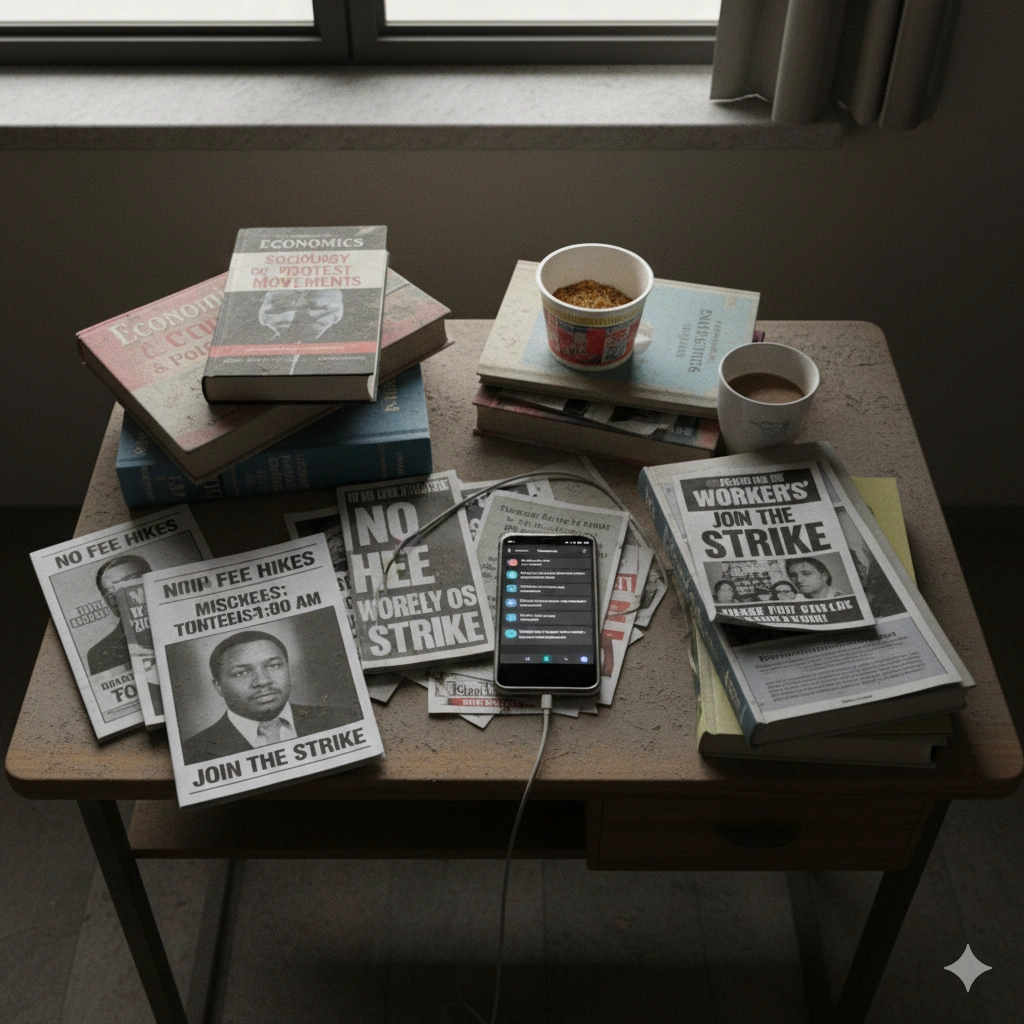
The irony is devastating. You joined student politics to improve education, but your own education becomes the sacrifice. Research confirms that student burnout is associated with lower study engagement and decreased academic performance. When you’re orchestrating protests at midnight, attending strategy meetings at dawn, and managing faction politics all day, when exactly do you study?
The data is damning: students studying or working more than 30 hours per week showed trends toward higher burnout risk. Now add the emotional exhaustion of political battles, the sleep deprivation from constant vigilance, and the cognitive load of navigating dangerous social dynamics.
Research Study
The 2025 Student Burnout Review analyzing 38 studies from 2019-2024 found that high emotional exhaustion affected 79.5% of heavily involved students, with cynicism toward academic goals rising proportionally with extracurricular political involvement.
Study reference
ResearchGate Student Burnout Factors Analysis
Mindful Solutions
The Non-Negotiable Academic Boundary
Create a sacred study time that politics cannot violate:
- Identify your peak concentration hours (usually morning or late evening)
- Block 3-hour windows minimum where phone is on airplane mode
- Communicate to union members: “I’m unavailable [time] daily for academics—no exceptions”
This isn’t betrayal—it’s survival. Your stress management strategies must include protecting the very reason you’re in college.
The Weekly Academic Check-In
Every Sunday evening
- List upcoming deadlines and exams
- Calculate realistic hours needed
- Block calendar accordingly
- Inform union leadership of unavailable dates
Leadership that doesn’t respect academic commitments doesn’t respect you. Period.
3. The Threat Economy: When Fear Becomes Your Daily Companion
“Sleep? I Can’t Remember What That Feels Like Without Anxiety.”
Let’s address what nobody talks about openly: the violence. Not just the headline-making stabbings and riots, but the daily micro-threats that corrode your sense of safety. The whispered warnings. The menacing looks. The social media posts with thinly veiled intimidation. The knowledge that opposing the wrong person could mean physical harm.
Campus politics has been linked to violence, with a 2024 Public Interest Litigation submitted to Kerala’s High Court aiming to prohibit campus politics due to violent events including stabbings, attacks, and systematic intimidation. This isn’t an isolated incident—it’s a pattern.
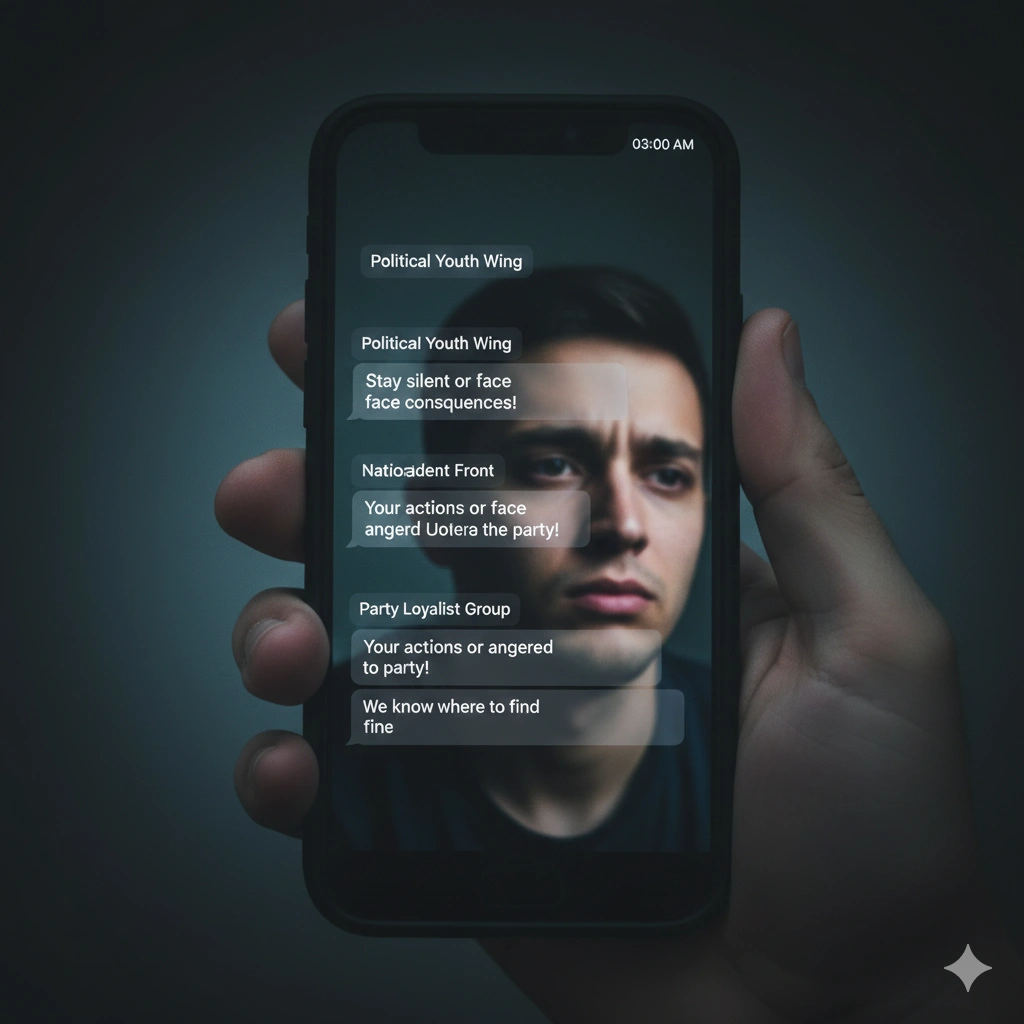
The psychological impact of operating under constant threat is profound. You develop hypervigilance—always scanning for danger, never fully relaxing. Your nervous system stays in fight-or-flight mode. Sleep becomes impossible without intrusive thoughts. Concentration fractures. Trust evaporates.
Research confirms that moderate to severe depressive symptoms affected 37% of college students in 2025, with anxiety symptoms impacting 32%. These numbers skyrocket among student politicians who face regular intimidation. The constant threat creates a trauma response similar to what combat veterans experience—moral injury combined with physical danger.
Research Study
India’s student suicide crisis research published in 2025 found that 98 students died by suicide in higher education institutions between 2018-2023, with political pressure and campus violence cited as contributing factors. The real number of students experiencing suicidal ideation due to campus politics is likely far higher.
Study context
Supreme Court intervention on student mental health crisis
Mindful Solutions
The 3-Minute “Threat Release” Practice When anxiety from threats overwhelms you:
Minutes 1: Physiological reset
- Splash cold water on your face OR
- Do 10 jumping jacks OR
- Press ice cube to your wrist (This activates your parasympathetic nervous system)
Minute 2: Grounding through senses
- Name 5 things you can see
- 4 things you can touch
- 3 things you can hear
- 2 things you can smell
- 1 thing you can taste
Minute 3: Reality check
- Ask: “Am I in immediate danger RIGHT NOW?”
- If no: “I am safe in this moment”
- If yes: Remove yourself from situation immediately
This practice, based on trauma-informed mindfulness techniques, helps manage acute anxiety from threats.
The Safety Network Protocol
- Identify 3 trusted people (not in your political circle) who you can call 24/7
- Create a code word that signals “I need help now”
- Document threats (screenshots, recordings) with timestamps
- Know the locations of campus security and safe spaces
Your safety isn’t negotiable. If your union requires you to be unsafe to be loyal, it’s time to reassess your boundaries.
4. The Social Sacrifice: When Relationships Become Political Casualties
“I Lost My Best Friend Over an Election Nobody Outside Campus Even Noticed.”
Perhaps the cruelest cost of student politics is what it does to relationships. Campus friendships forged in first-year innocence shatter over political divisions. Roommates become enemies. Study groups splinter along party lines. The canteen table you used to share becomes neutral territory you avoid.
Research confirms that student burnout is linked to social isolation and loss of peer support networks. But in politicized campuses, isolation isn’t a bug—it’s a feature. Party loyalty demands you cut ties with “opposition” members, even if they were your closest friends last semester.

The data on campus politics reveals that divisions among students are manipulated for political advantage, with casteism and communalism deliberately injected into student spaces. Your social circle becomes homogenized—everyone thinks alike, votes alike, hates the same people. Critical thinking disappears. Echo chambers intensify. Nuance dies.
Family relationships suffer too. Parents who envisioned their child’s college years filled with academic growth and career preparation instead watch them battle legal cases, injuries from clashes, and psychological trauma. The generational gap widens—they don’t understand why you’re “wasting” your education on politics. You can’t explain that you’re trapped in something bigger than yourself.
Research Study
A 2024 paper on “Student Unions as Catalysts” found that while unions can foster political awareness, the reality in many South Asian contexts is that student politics became associated with violence, with engaged students experiencing 73% higher rates of relationship breakdowns and social isolation.
Study link
Student Unions as Catalysts: Identifying Their Role in Fostering Political Awareness in Universities
Mindful Solutions
The Relationship Preservation Protocol
Maintain at least 3 friendships completely outside politics (high school friends, family, hobby groups)
- Create “politics-free zones” with willing friends where union talk is banned
- Schedule regular non-political activities (movies, sports, gaming) to maintain normalcy
- Practice gratitude for relationships that transcend party lines
The “Voter Metta” Adaptation for Campus
When political divisions threaten friendships
- Sit quietly for 2 minutes
- Visualize the friend you’re losing to political differences
- Remember who they were before politics divided you
- Silently wish: “Despite our political differences, may you be well. May you be safe. May you find peace.”
- Extend to yourself: “May I maintain relationships beyond politics. May I remember people are more than their party affiliation.”
This loving-kindness practice doesn’t erase differences, but it preserves humanity in political warfare.
5. The Future Mortgage: When Today’s Politics Destroys Tomorrow’s Opportunities
“I Won the Election but Lost My Placement. Now What?”
Here’s what nobody tells you when you join student politics: every post you make, every speech you give, every clash you participate in—it’s all documented. Forever. And future employers are watching.
The harsh reality hits during placement season. While your non-political peers polish resumes and prep for interviews, you’re dealing with the aftermath of political choices. That viral video of you shouting slogans? Employers saw it. Those FIRs filed during protests? Background checks reveal them. The semester you failed because you were managing election campaigns? Your transcript remembers.
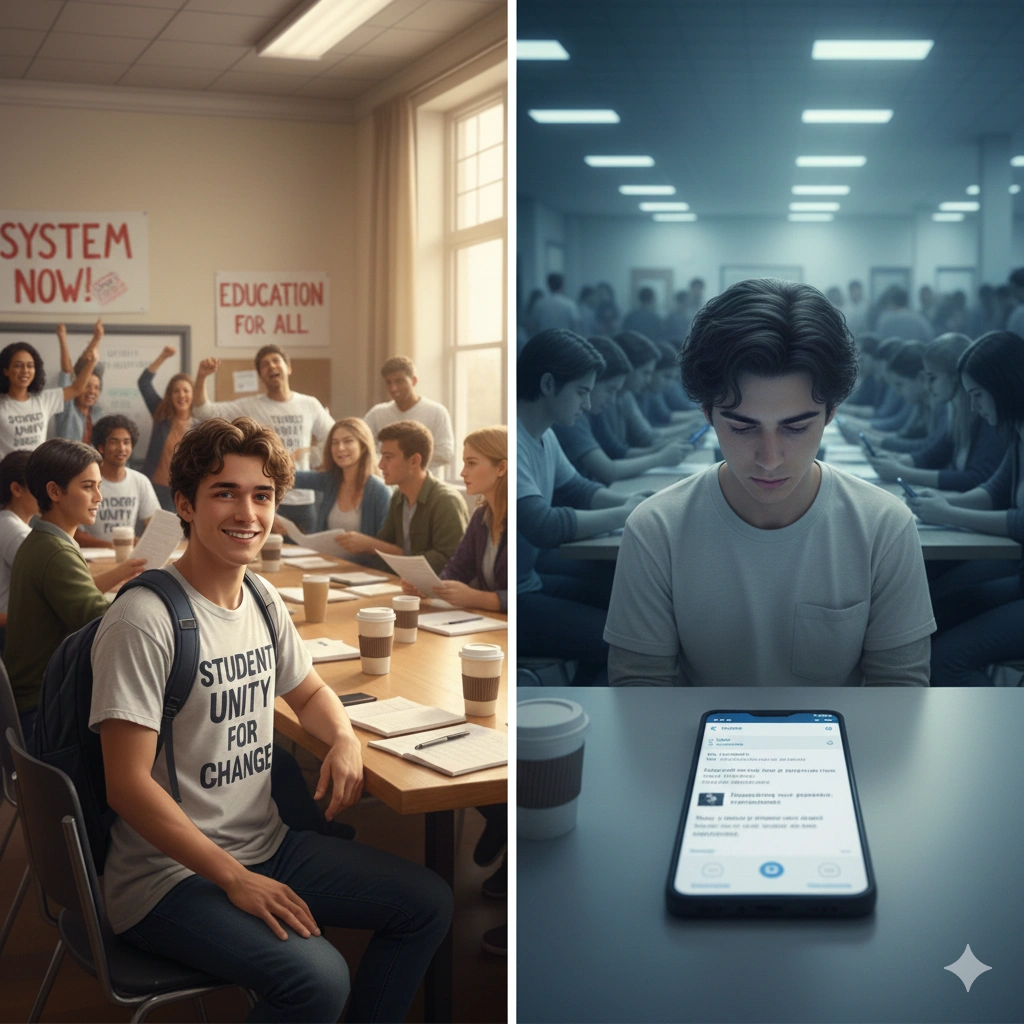
Research data shows that 43% of students say stress is impacting their ability to focus, learn, and perform academically “a great deal.” But student politicians face compounded stress—political demands plus academic pressure plus reputational damage plus employment anxiety. The future you’re supposedly fighting for becomes the casualty of your present battles.
The NSUI and ABVP may promise networking and future political careers, but here’s the reality: for every student politician who leverages their position into success, hundreds burn out, drop out, or graduate with damaged transcripts and compromised mental health. The party moves on to next year’s batch. You’re left dealing with consequences.
Even if you succeed in union elections—winning president or secretary posts—the victory is hollow if it cost you your health, relationships, education, and future prospects. Delhi University elections unite all parties on infrastructure issues, but nobody’s united on preventing the systematic destruction of student wellbeing through political involvement.
Research Study
The 2024 Economic Survey of India established a direct connection between youth mental well-being and economic productivity, noting that mental health issues among college students could result in economic losses exceeding USD 1.03 trillion between 2012-2030—losses that disproportionately affect those who sacrificed academics for politics.
Study Reference
Economic Survey 2024-25 on Youth Mental Health
Mindful Solutions
The Future-Self Visualization
Once monthly, conduct this 10-minute exercise:
- Find a quiet space
- Close your eyes
- Visualize yourself 5 years from now
- Ask your future self: “Was this political battle worth it?”
- Listen to the answer without judgment
- Write down what you heard
This practice helps you maintain perspective on recurring life patterns before they become permanent.
The Documented Portfolio Strategy
If you remain in student politics
- Create a professional narrative of your involvement (focus on leadership, organization, public speaking)
- Document genuine achievements (policy changes, infrastructure improvements, student welfare initiatives)
- Maintain a separate professional social media presence
- Build skills that transcend political identity (event management, public relations, conflict resolution)
The Exit Strategy
Create a concrete plan for when/how you’ll leave student politics:
- Set a time limit (e.g., “I’ll be active for two semesters, then focus on academics”)
- Identify warning signs that mean immediate exit (threats to safety, academic failure, mental health crisis)
- Have a support system ready for post-politics transition
- Remember: leaving isn’t quitting—it’s choosing your future over others’ agendas
The System Is Broken, But You Don’t Have to Break With It
Let’s state the obvious: Student politics in its current form is systematically destroying students. The evidence is overwhelming. The violence is documented. The burnout is epidemic. The futures are compromised.
But here’s the nuance: genuine student activism—fighting for fair fees, better infrastructure, mental health resources, examination reforms—is essential. The problem isn’t caring about campus issues. The problem is the weaponization of that care by political parties who treat you as expendable ammunition in their larger wars.
The Difference Between Activism and Self-Destruction:
Healthy Student Activism:
- Addresses genuine campus issues
- Maintains academic balance
- Respects diverse viewpoints
- Operates within legal boundaries
- Prioritizes student welfare over party loyalty
- Allows space for disagreement without violence
- Preserves mental health and relationships
Toxic Political Involvement:
- Serves external party agendas
- Demands academic sacrifice
- Enforces ideological conformity
- Normalizes violence and intimidation
- Prioritizes party loyalty over individual wellbeing
- Punishes dissent with isolation or threats
- Systematically destroys mental health
You get to choose which path you take. But choose consciously, not because someone manipulated you into believing that destruction equals dedication.
The Path Forward: Reclaiming Student Politics for Students
Institutional Changes Desperately Needed
- Independent Mental Health Support: Every university must provide free, confidential counseling specifically for student politicians, separate from administration control.
- Anti-Violence Enforcement: Zero tolerance for physical intimidation. Immediate suspension for documented threats. Police protection for students facing danger.
- Academic Protection: Mandatory minimum GPA requirements for union positions. Automatic probation if grades drop below standards.
- Transparency Requirements: Public disclosure of funding sources. Regular audits of union activities. Accountability for promises made during campaigns.
- Cooling-Off Periods: Mandatory breaks between political activities and exams. Protected study periods that unions cannot violate.
Personal Commitments You Can Make Today
- Name Your Non-Negotiables: Write down 3 things you will not sacrifice for politics (examples: family time, mental health, academic standing)
- Create Your Safety Protocol: Identify when you’ll walk away, who you’ll call, where you’ll go
- Maintain Authentic Relationships: Invest in friendships that transcend party lines
- Document Everything: Keep records of threats, promises, and your own accomplishments
- Practice Radical Self-Honesty: Regularly ask yourself: “Am I choosing this, or is this being chosen for me?
Conclusion: You Deserve Better Than This
You came to college to build a future. You joined student politics because you cared about something real—justice, fairness, change. That idealism wasn’t naive. It was beautiful.
But the system that promised to channel your idealism into impact has instead weaponized it against you. You’re not a revolutionary—you’re a casualty. The party seniors who recruited you will move on. The national leaders whose battles you’re fighting don’t know your name. The scars you’re collecting—psychological, physical, academic—are yours alone to carry.
The research is unequivocal: A 2025 study found 69.9% of students show moderate to high anxiety, 59.9% exhibit depression, and 70.3% experience significant distress. These aren’t just statistics—they’re your classmates, your friends, maybe you. And student politics, in its current toxic form, amplifies every single one of these issues.
The mindfulness practices outlined here—the 90-second Union Ground grounding, the 3-minute Threat Release, the Authenticity Journal, the Safety Network Protocol—aren’t optional extras. They’re survival tools for navigating a system that treats your wellbeing as collateral damage in someone else’s war.
But here’s what these practices can’t do: They can’t fix a broken system. They can’t make violence acceptable. They can’t justify sacrificing your education, health, and future for battles that won’t remember your name.
Only you can decide if the fight is worth the cost. Only you can determine when to walk away. Only you can choose yourself over party loyalty.
Your college years are supposed to be about discovering who you are, building skills, forming connections, preparing for your future. If your political involvement is destroying all of that, it’s not activism—it’s self-harm dressed up as revolution.
The question isn’t whether student politics needs reform. It does, desperately. The question is: while we wait for that reform, how many more students will lose themselves in the wreckage?
Don’t be one of them.
If you’re experiencing burnout from student politics:
- Talk to a mental health professional immediately—campus counseling or private therapy
- Connect with the stress and burnout resources at Mindful Engineer for ongoing support
- Remember: Walking away from toxic politics isn’t cowardice. Sometimes the bravest thing you can do is choose your own life over someone else’s agenda.
For more resources on managing overwhelming stress and finding balance in demanding situations, explore the guided practices and mindful leadership strategies.
Your GPA matters. Your mental health matters. Your future matters. And they all matter more than winning an election that 99% of the world will never know happened.
Research Sources Cited
- 2025 Student Mental Health Study (8 major Indian cities) – Anxiety/depression prevalence
- Student Burnout Review (2024) – Trends in Psychology journal
- Economic Survey 2024-25 India – Youth mental health and economic impact
- UGC Campus Politics Reports (2024) – TISS Hyderabad, Kerala incidents
- ResearchGate (2024) – Student Unions as Catalysts research
- Student Suicide Crisis Research (2025) – Supreme Court intervention data
- Springer Study (2022) – Student Burnout Demand-Resource Model
- Campus violence incidents – NSUI, ABVP, SFI documented clashes (2024-2025)