Super Human Focus: A Journey Through Ajana Chakra and Awareness
The sacred Ajna Chakra, a key to super human mind
The Wandering Mind
Your mind moves constantly.
Like a butterfly, it lands nowhere for long.
This is natural. This is human.
But within you lies the capacity for stillness. For focus. For presence that does not waver.
The path is simple. Ancient. Proven.
Begin Small: The First Five Minutes
You cannot climb a mountain in one step.
You cannot focus for hours if you cannot focus for five minutes.
So we begin here. Five minutes.
Choose one object. A candle flame. Your breath. A word.
Stay with it for five minutes.
When you wander — and you will wander — return gently.
This return is not failure. This return is the practice itself.
“I tried to meditate for five minutes. My mind visited 47 different countries, planned 3 meals, and wrote half a novel. But I returned. And returned again.”

The Progressive Path
Week One to Two: Five Minutes Daily
Same practice. Same gentleness.
Do not increase the time. Deepen the quality.
Notice when you drift. Return without judgment.
Week Three to Four: Ten Minutes
Your capacity grows naturally.
Like a plant reaching toward light, your focus strengthens through consistent practice.
Ten minutes feels longer. This is normal.
Stay.
Week Five to Eight: Twenty-Five Minutes
Now you are ready for sustained practice.
This is the foundation of true concentration.
The mind that can stay present for twenty-five minutes can accomplish profound work.
Ajna Chakra: The Third Eye of Clarity
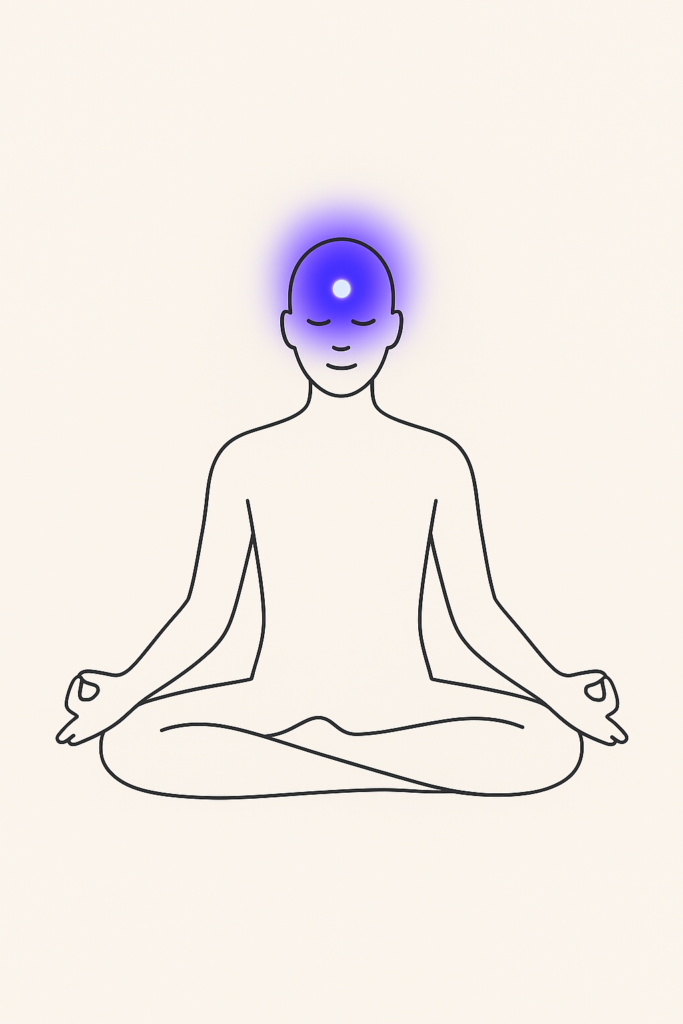
Between your eyebrows rests a point of power.
The sixth chakra. Ajna. The command center of consciousness.
Location: Between the eyebrows, slightly above Color: Indigo, deep purple Element: Light Governs: Intuition, wisdom, concentration, mental clarity
When Ajna is open and flowing:
- Thoughts are clear
- Decisions come easily
- Focus is natural
- The mind is calm like still water
When Ajna is blocked:
- Confusion reigns
- Concentration scatters
- The mind churns endlessly
- Clarity feels impossible
Opening Ajna: Three Sacred Sounds
Sound is vibration. Vibration is energy. Energy awakens dormant centers.
1. OM (AUM) — The Universal Vibration
Sit comfortably. Spine naturally straight. Take a full breath.
Chant: OOOOOOMMMMMM
Let the sound resonate at your third eye. Feel the vibration between your eyebrows.
Repeat: 11 times, 21 times, or 108 times. Practice daily for ten minutes.
2. SHAM (SHUM) — The Seed Sound of Ajna
This is Ajna’s bija mantra. Its own unique vibration.
Pronounced like “shum” (rhymes with “hum”).
Chant continuously for 5–10 minutes. Let the sound fill your head with clarity.
Notice the stillness that follows.
3. OM NAMAH SHIVAYA — The Five-Syllable Mantra
“I bow to the inner Self.”
This powerful mantra clears all chakras, with special resonance at Ajna.
Chant in sets of nine. Or continuously for 20 minutes.
Let the rhythm carry you into stillness.
“I chanted OM for 20 minutes. My cat joined in. Now we’re both enlightened. Or confused. Hard to tell.”
Kriyas: Purification Practices for Mental Clarity
Kriyas are cleansing actions. They remove what clouds the mind. They prepare the system for focus.

Nadi Shodhana: Alternate Nostril Breathing
This kriya balances the left and right brain hemispheres. It calms the nervous system. It sharpens focus dramatically.
The Practice:
Sit comfortably. Right hand raised to face.

Close right nostril with right thumb. Inhale slowly through left nostril (count to 4).

Close left nostril with ring finger. Open right nostril. Exhale through right (count to 4).

Inhale through right (count to 4). Close right, open left. Exhale through left (count to 4).

This is one complete round.
Duration:
- Beginners: 5 rounds
- Intermediate: 10 rounds
- Advanced: 20 rounds
Practice daily before meditation or focused work.
The mind becomes clear. Balanced. Ready.
Kapalabhati: Skull-Shining Breath
This kriya energizes. It clears mental fog. It awakens the third eye.
The Practice:
Sit with spine straight. Take a natural breath in.
Exhale sharply through nose, pulling navel toward spine. The inhale happens passively.
Continue rapid, forceful exhales. Let inhales happen naturally.
Start with 30 breaths. Rest. Observe the clarity.
Progression:
- Week 1: 30 breaths, once daily
- Week 2: 50 breaths, once daily
- Week 3: 100 breaths, once daily
Note: Skip during menstruation, pregnancy, or if you have high blood pressure.
The mind after Kapalabhati is like a polished mirror.
Clear. Bright. Focused.


Trataka: Steady Gazing
Trataka is both kriya and meditation.
It strengthens the eyes. It steadies the mind. It opens Ajna directly.
The Practice:
Place a candle at eye level, arm’s length away. Sit comfortably in dim light.
Gaze at the flame without blinking. Do not strain. Relax your eyes.
When tears come (they will), close your eyes. Visualize the flame at your third eye. Hold the inner image as long as possible.
Duration:
- Beginners: 1–2 minutes gazing
- Intermediate: 3–5 minutes gazing
- Advanced: 10 minutes gazing
Practice 3–4 times weekly.
The ability to focus on external objects strengthens. The ability to hold internal focus deepens.
Bhramari: Bee Breath
The humming bee breath calms mental turbulence immediately.
The Practice:
Sit comfortably. Close your eyes. Place your index fingers gently on your ears, closing them.
Inhale deeply through nose.
Exhale making a humming sound: “Mmmmmmmm” Let the sound resonate in your head. Feel the vibration at your third eye.
The sound should be like a bee’s hum — steady, smooth, continuous.
Repeat 5–10 times.
The mind settles. Anxiety dissolves. Focus emerges.
Use before important work requiring deep concentration.
Jala Neti: Nasal Cleansing
When the nasal passages are clear, the mind is clear.
This ancient kriya is simple but powerful.
The Practice:
Use a neti pot filled with lukewarm saline water. Tilt head sideways over a sink.
Pour water into upper nostril. Water flows through and out the lower nostril.
Breathe through mouth throughout.
Repeat on other side.
Frequency: 2–3 times weekly, or daily during allergy season.
Clear nostrils = clear breath = clear mind = clear focus.
Agnisara Kriya: Fire Essence
This kriya awakens inner fire. It energizes the entire system. It brings vitality to mental practice.
The Practice:
Stand with feet shoulder-width apart. Hands on thighs, slightly bent forward.
Exhale completely, emptying lungs.
Without inhaling, pull abdomen in and out rapidly. Like a bellows pumping.
Continue 10–20 pumps. Then inhale slowly and stand.
Progression:
- Week 1: 10 pumps, 3 rounds
- Week 2: 20 pumps, 3 rounds
- Week 3: 30 pumps, 3 rounds
Avoid during: Pregnancy, menstruation, hernia, ulcers.
After this practice, sitting for focus feels natural. Effortless. The body is awake. The mind is ready.

A Complete Daily Practice
Morning Preparation (20 minutes):
5 minutes: Jala Neti (as needed) 3 minutes: Agnisara Kriya (3 rounds) 5 minutes: Kapalabhati (50–100 breaths) 5 minutes: Nadi Shodhana (10 rounds) 2 minutes: Bhramari (5 times)
Your system is now prepared. Clear. Balanced. Ready.
Focus Session:
5 minutes: Trataka with candle 10 minutes: Chant OM or SHAM, focusing at third eye 25 minutes: Your chosen work or study 5 minutes: Rest in awareness
Evening Practice (10 minutes):
5 minutes: Nadi Shodhana (calms the mind) 5 minutes: Silent meditation at Ajna chakra
Understanding the Path
These practices are not separate techniques.
They are one system. One path to clarity.
Kriyas purify the body and nervous system. Chanting awakens the energy centers. Meditation stabilizes the awakened awareness. Focus becomes natural.
Like preparing soil before planting seeds.
First cleanse (kriyas). Then activate (chanting). Then rest in what emerges (meditation).
“I did all the kriyas. Now I’m so focused I haven’t blinked in three hours. Send help. Or eye drops.”
A Simple Reflection
Answer these questions. Notice what you remember.
- What is the starting focus duration?
- Where is Ajna chakra located?
- What is the seed sound for Ajna?
- Which kriya balances left and right brain?
- What does Kapalabhati mean?
- How long should beginners gaze during Trataka?
- What is the purpose of kriyas?
- How many breaths in beginning Kapalabhati practice?
Answers:
1. Five minutes
2. Between the eyebrows
3. SHAM (SHUM)
4. Nadi Shodhana
5. Skull-shining breath
6. 1–2 minutes
7. Purification and preparation
8. 30 breaths
Correct answers show presence during reading. Incorrect answers show opportunity for practice.
Both are perfect.
The Way Is Simple
- Choose one kriya. Practice it for one week. Notice what shifts.
- Then add Ajna meditation. Five minutes daily.
- Then extend to ten minutes. To twenty-five minutes.
- The progression happens naturally.
- Like water wearing stone. Like the sun dissolving fog.
- Consistent, gentle practice creates profound change.
Begin Today
Light a candle. Sit before it. Gaze for two minutes.
This is enough. This is the beginning.
Your focused mind has always been there. These practices simply remove what covers it.
Return to them daily. With patience. With gentleness.
The clarity you seek is already within you.