“It’s 11:47 PM. You’re still at your desk, refactoring code that already works perfectly. Your partner texted three hours ago asking if you’re coming to bed. Your coffee has gone cold twice. But you can’t stop—because if you do, the voice in your head whispers that you’re not good enough, not working hard enough, not worthy of the success you’ve built. Sound familiar?”
Welcome to invisible burnout—the silent epidemic destroying high achievers from the inside out. Unlike the dramatic collapse we see in movies, this burnout doesn’t announce itself with sirens. It’s the slow memory leak that crashes your system when you least expect it.
Research from Stanford’s Workplace Mental Health Initiative reveals that 76% of high-performing professionals experience chronic stress symptoms, yet only 23% recognize it as burnout. Why? Because we’ve been conditioned to mistake self-destruction for dedication.
Let’s debug the patterns that are corrupting your mental code—and install the counter-algorithms that will save your career and sanity.
The Perfectionism Prison: When ‘Good Enough’ Throws Fatal Errors
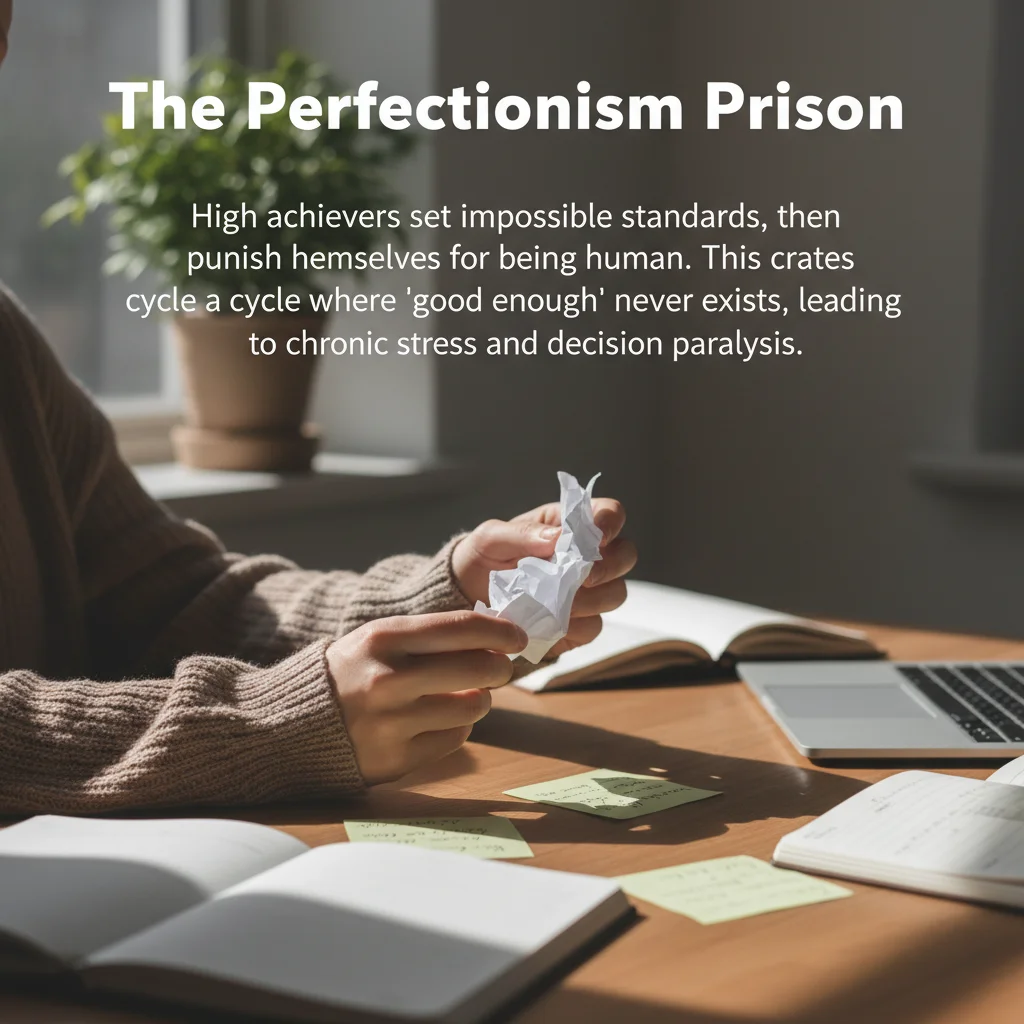
High achievers don’t just aim high—they aim for impossible. Every deliverable becomes a masterpiece. Every email needs three drafts. Every presentation must be flawless. This isn’t dedication; it’s a cognitive bug that’s eating your CPU cycles alive.
Dr. Brené Brown’s research on perfectionism, published in the Journal of Counseling Psychology, reveals a devastating truth: perfectionism actually decreases performance and increases anxiety by 34%. When ‘good enough’ doesn’t exist in your vocabulary, your brain operates in a constant state of threat detection.
Here’s what’s happening in your neural network: the anterior cingulate cortex, responsible for error detection, becomes hypervigilant. Every minor flaw triggers the same stress response as a genuine crisis. Your amygdala can’t distinguish between a typo in an email and a tiger in the room.
The perfectionism symptoms you’re ignoring:
- Spending 3 hours on tasks that should take 30 minutes
- Avoiding projects where you might not excel immediately
- Feeling physically ill when receiving constructive feedback
- Rewriting or redoing work that others consider excellent
The Boundary Black Hole: How Success Becomes Self-Sabotage

Success is intoxicating. Each achievement triggers a dopamine hit that makes your brain crave the next win. Before you know it, you’re addicted to being indispensable. Every ‘yes’ to work becomes a ‘no’ to recovery, relationships, and the very foundations that made you successful in the first place.
MIT’s Sloan School of Management conducted a five-year study tracking high achievers’ work patterns. The results were sobering: professionals who consistently worked beyond optimal capacity showed a 47% decrease in creative problem-solving and a 52% increase in critical decision errors within 18 months.
Your brain isn’t designed for constant performance mode. The default mode network—active during rest—is where breakthrough insights happen. When you eliminate downtime, you’re not just risking burnout; you’re actively sabotaging your competitive edge.
The boundary collapse warning signs:
- Checking emails during meals, conversations, or ‘time off’
- Feeling guilty or anxious when not actively working
- Canceling personal commitments for work repeatedly
- Believing that others can’t do your job as well as you can
The Identity Trap: When Your Self-Worth Runs on Achievement.exe

Perhaps the most dangerous pattern is when your identity becomes inextricably linked to your output. You stop being a person who happens to work in tech and become a walking resume. Rest feels like regression. Vacation feels like vulnerability. Taking a sick day feels like fraud.
Dr. Tim Kasser’s research at Knox College, published in Psychological Science, demonstrates that people whose self-worth depends on external achievements show higher rates of anxiety, depression, and relationship dysfunction. When your identity runs on achievement.exe, any system downtime feels like existential failure.
This isn’t just philosophical—it’s neurological. When work becomes identity, your brain processes career setbacks as threats to survival. A delayed project triggers the same neural pathways as physical danger.
Signs you’re trapped in achievement-based identity:
- Introducing yourself primarily through job titles or achievements
- Feeling lost or anxious during unstructured time
- Difficulty connecting with others outside work contexts
- Measuring self-worth through productivity metrics
Counter-Code 1: Strategic Recovery Protocols
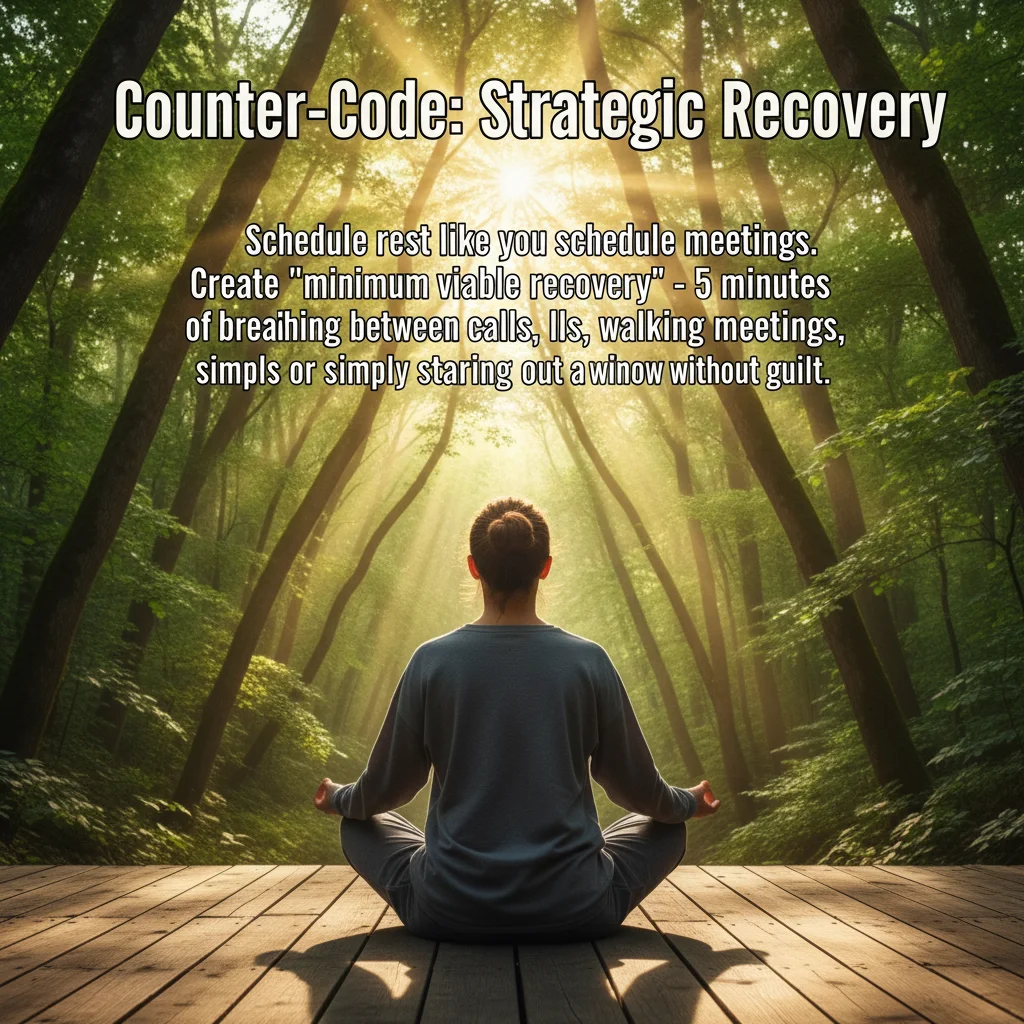
The solution isn’t to abandon ambition—it’s to engineer sustainable systems. Strategic recovery isn’t luxury; it’s preventive maintenance for your most critical asset: your mind.
UCLA’s Mindful Awareness Research Center found that professionals who practiced structured micro-recovery showed 31% better decision-making accuracy and 28% lower cortisol levels than those who pushed through without breaks.
Implement these recovery protocols immediately:
- The 5-Minute Reset: Between meetings, take five conscious breaths while staring out a window or at a plant
- Walking Algorithms: Take calls while walking. Your bilateral movement activates creative neural pathways
- Scheduled Shutdown: Set a hard stop time for work—and treat it as seriously as your most important meeting
- Weekend Firewall: Create one work-free day per week. Non-negotiable.
Guided Practice: The Emergency Recovery Sequence
When you feel overwhelmed, run this immediate protocol:
- Stop what you’re doing and place both feet on the ground
- Take three deep breaths, making your exhale longer than your inhale
- Name five things you can see, four you can hear, three you can touch
- Ask: ‘What’s the minimum viable version of what I’m trying to accomplish?’
- Do only that. Save perfectionism for tasks that truly matter.
Counter-Code 2: Progress Over Perfection Algorithms
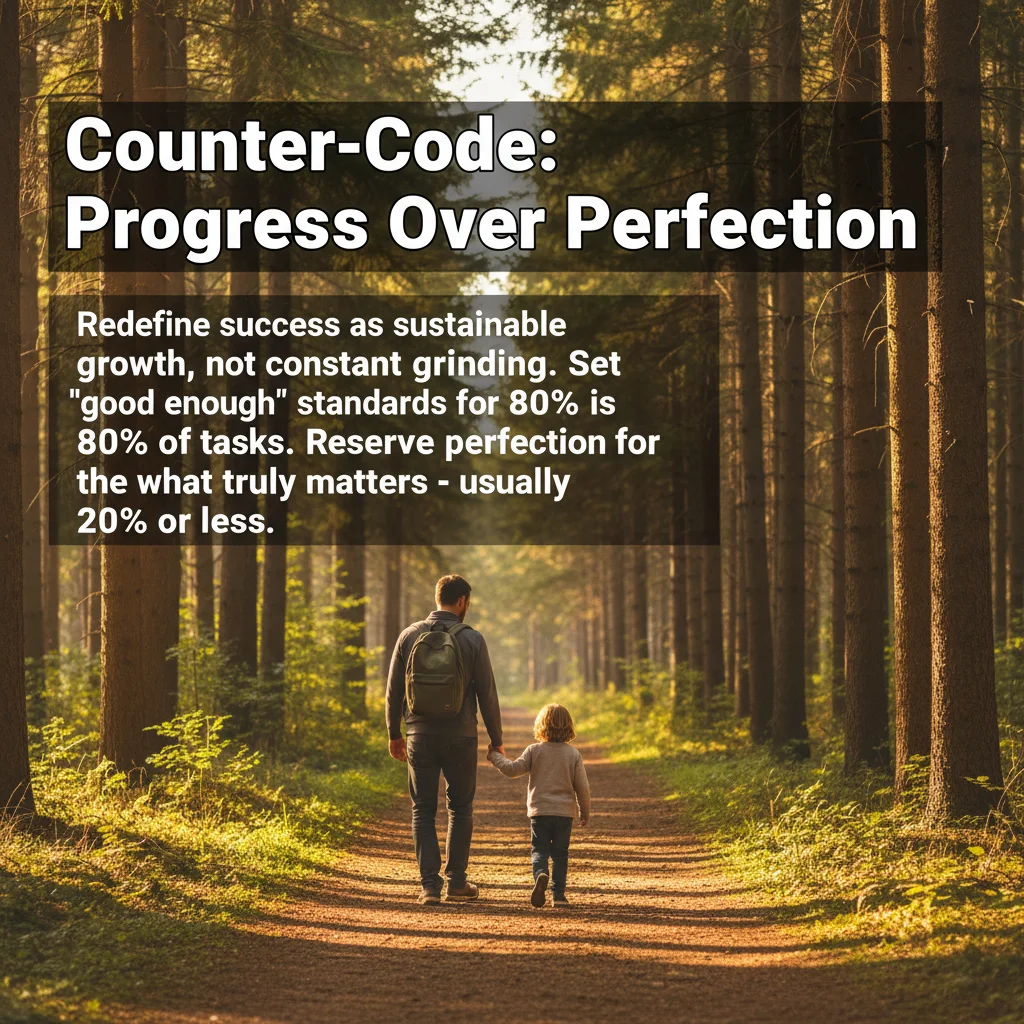
Perfectionism is a bug masquerading as a feature. The cure isn’t lowering standards—it’s applying the right standards to the right tasks. Most work requires ‘good enough.’ Reserve perfection for the 20% that truly impacts your goals.
Research from the Harvard Business Review’s study of 16,000 professionals revealed that those who distinguished between ‘excellence work’ and ‘sufficiency work’ were 38% more productive and reported 45% higher job satisfaction.
Install these new operating parameters:
- The 80/20 Rule: Identify which 20% of your tasks deserve perfectionism. Everything else gets ‘good enough.’
- Time Boxing: Set strict time limits for tasks. When time’s up, ship it.
- Draft Culture: Embrace ‘version 1.0’ thinking. You can always iterate.
- Progress Metrics: Track completion, not perfection. Celebrate shipped work over flawless work.
Counter-Code 3: Identity Beyond Achievement

The final firewall against burnout is cultivating an identity that exists independent of your professional success. You are not your resume. Your worth isn’t determined by your output. This isn’t motivational speaking—it’s psychological survival.
Stanford psychologist Carol Dweck’s research on identity resilience shows that people with diverse self-concepts recover from setbacks 60% faster than those with singular professional identities.
Build your multi-dimensional identity:
- The Non-Title Introduction: Practice introducing yourself without mentioning your job for one month
- Analog Hobbies: Pursue activities completely unrelated to work—gardening, cooking, music, sports
- Relationship Investment: Schedule time with friends and family like you schedule important meetings
- Learning for Joy: Study something purely for curiosity, not career advancement
Your career is a vehicle for your life, not the destination. When you remember this fundamental truth, work becomes sustainable, relationships deepen, and paradoxically, your professional performance often improves.
The invisible burnout epidemic isn’t just destroying careers—it’s stealing lives. But now you have the counter-code. You know the patterns that lead to self-destruction, and more importantly, you have the algorithms that lead to sustainable success.
Your future self is counting on the choices you make today. Choose recovery over grinding. Choose progress over perfection. Choose the full spectrum of who you are over the narrow identity of what you do.
The best code isn’t the most complex—it’s the most sustainable. The same is true for the best life.