
“It’s been six months since I retired, but I still wake up at 5 AM feeling anxious about a project that doesn’t exist. I check emails that no longer matter. I reach for my phone, expecting urgent notifications that never come. It’s like my brain is running a program that won’t shut down.”
If this sounds familiar, you’re experiencing what neuroscientists call “cognitive persistence” — your brain’s stubborn refusal to stop running old behavioral loops, even when they’re no longer needed.
After decades of conditioning your mind to operate in high-performance mode, retirement doesn’t come with an automatic “off” switch. Your neural pathways are deeply grooved with patterns of urgency, achievement, and external validation. But here’s the good news: your brain’s neuroplasticity means you can literally rewire these patterns at any age.
The Achievement Loop: When Your Brain Won’t Stop Searching
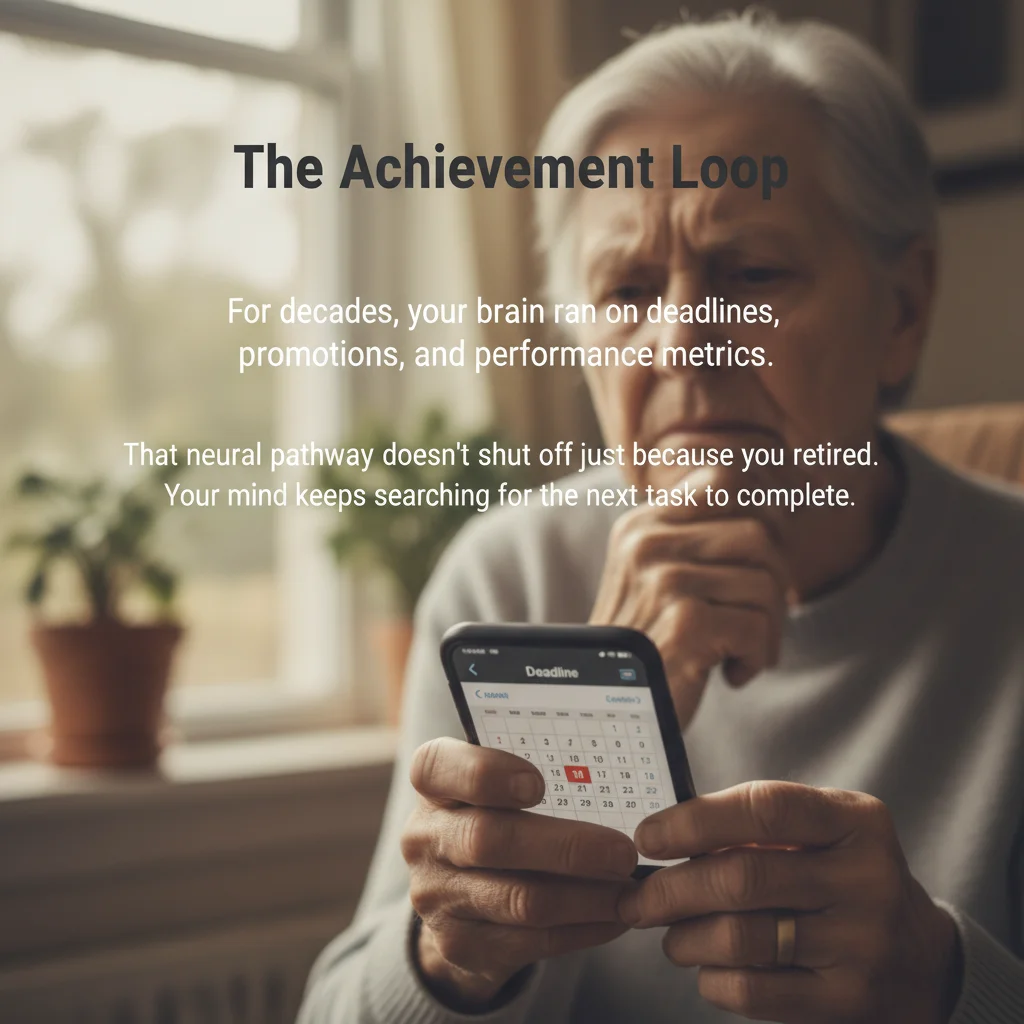
For years, your brain operated on what researchers call the “dopamine-driven achievement cycle.” Every completed task, every deadline met, every performance review triggered a release of dopamine — your brain’s reward chemical. This created powerful neural highways that automatically scan for the next goal, the next problem to solve.
Dr. Teresa Amabile’s research at Harvard Business School, published in the Harvard Business Review, found that the “progress principle” — our brain’s reward system for forward momentum — becomes so deeply embedded that it continues firing even without external triggers (https://hbr.org/2011/05/the-power-of-small-wins).
Your retirement brain keeps running this code because:
- Neural pathway strength: Repeated behaviors create myelin sheaths around neurons, making these patterns fire automatically
- Dopamine withdrawal: Without regular achievement hits, your brain craves the familiar reward cycle
- Threat detection: Your amygdala interprets the absence of goals as potential danger
Identity Without Title: The Operating System Crisis

When you remove your professional identity — “Senior Engineer,” “Department Head,” “Project Manager” — your brain experiences what psychologists call “role exit stress.” It’s like uninstalling your operating system without having a replacement ready.
Research by Dr. Helen Ebaugh at the University of Houston reveals that professional identity becomes so intertwined with our sense of self that losing it triggers the same neural patterns as grief (Sociological Quarterly, 1988). Your prefrontal cortex, which manages self-concept, literally struggles to compute who you are without these external markers.
Signs your brain is stuck in identity limbo:
- Introducing yourself with your former title months after retiring
- Feeling invisible or irrelevant in social situations
- Constantly referencing past professional achievements
- Anxiety when people ask “What do you do?”
Rewire Your Purpose: From External to Internal Validation

The key to installing your new mental operating system lies in shifting from external validation to internal awareness. Instead of asking “What do I need to accomplish today?” — the question that drove your working years — try asking “How can I be fully present today?”
Neuroscientist Dr. Judson Brewer’s research at Brown University shows that mindfulness practices literally change brain structure, strengthening the posterior cingulate cortex (associated with self-awareness) while calming the default mode network that creates mental chatter (Proceedings of the National Academy of Sciences, 2011).
Daily Purpose Reset Practice:
- Each morning, before checking any devices, sit quietly for 2 minutes
- Ask yourself: “What would it feel like to be fully here today?”
- Notice physical sensations — your breath, the temperature, sounds around you
- Set an intention based on presence, not productivity: “Today I’ll listen deeply” or “Today I’ll notice beauty”
Create New Rhythms: Building Structure Without Stress
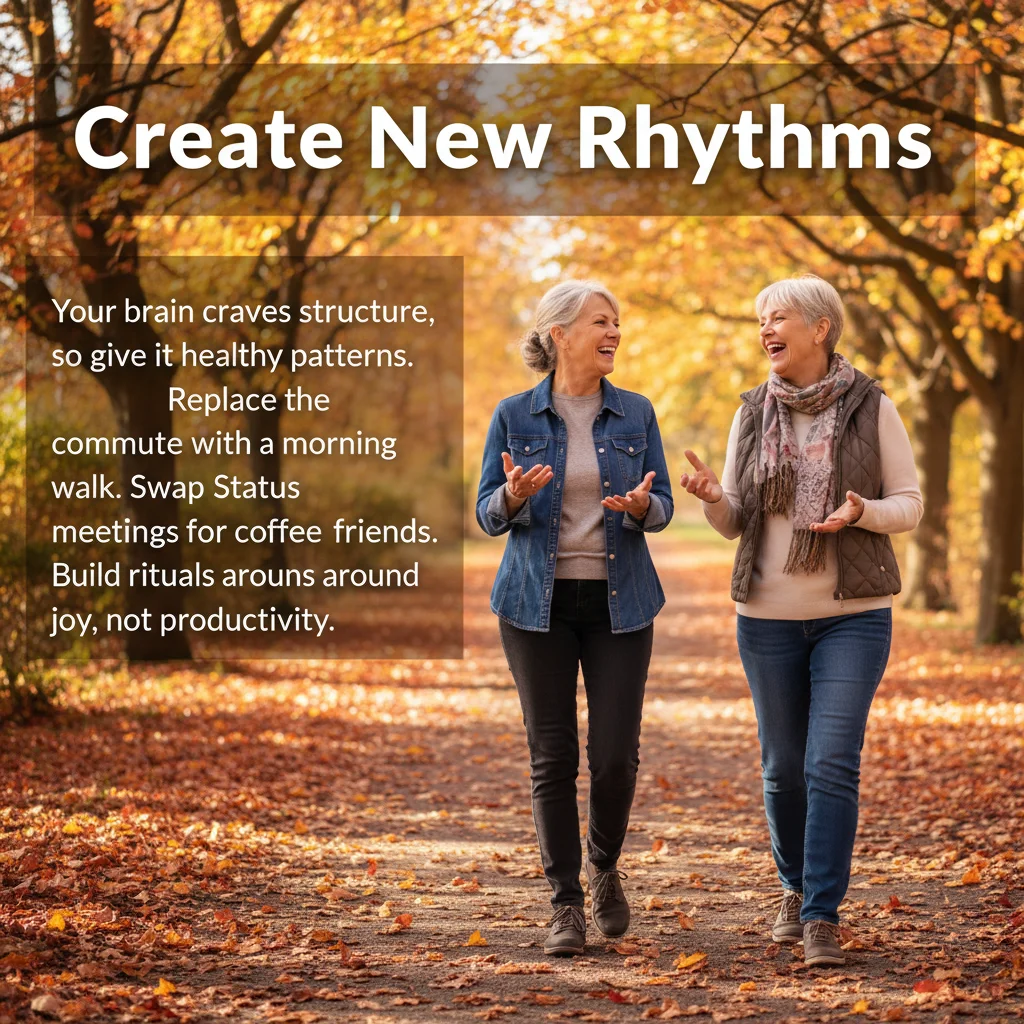
Your brain craves structure — it’s how we evolved to feel safe and oriented. The problem isn’t that you had routines during your career; it’s that those routines were built around external demands rather than internal wisdom.
Dr. Russell Foster’s research at Oxford University on circadian rhythms shows that consistent daily patterns actually reduce cortisol (stress hormone) production and improve cognitive function (Nature Reviews Neuroscience, 2020). The key is creating rhythms that nourish rather than deplete you.
Healthy Rhythm Swaps:
- Replace: Rushed morning coffee while checking emails → With: Slow morning coffee while watching sunrise
- Replace: Status meetings → With: Weekly coffee dates with friends
- Replace: Working lunch at your desk → With: Mindful meals without distractions
- Replace: Evening work catch-up → With: Evening gratitude practice
Practice Present Awareness: Your New Debug Mode

When you catch your mind racing toward imaginary deadlines or searching for non-existent tasks, think of it as entering “debug mode” — a chance to identify and fix the old code that’s still running in the background.
Dr. Sara Lazar’s neuroimaging research at Massachusetts General Hospital found that just eight weeks of mindfulness practice increased cortical thickness in areas associated with attention and sensory processing while reducing activity in the amygdala, your brain’s alarm system (Psychiatry Research: Neuroimaging, 2005).
The 3-Breath Reset Protocol:
- Catch: Notice when your mind starts the old achievement-seeking loop
- Pause: Stop whatever you’re doing and take three conscious breaths
- Ground: Feel your feet on the floor, notice the temperature of the air
- Redirect: Ask “What does this moment need?” instead of “What should I be doing?”
This simple practice interrupts the old neural pathway and begins carving new grooves toward mindful presence.
Your retirement isn’t a system failure — it’s an upgrade opportunity. After decades of running high-performance code optimized for external demands, you now get to install a new operating system designed for inner fulfillment, genuine connection, and present-moment awareness. The transition takes time, but your brain’s remarkable plasticity means that new, more peaceful patterns are not just possible — they’re inevitable with consistent practice.