
Learn why the quiet truth spoken in closed doors matters more than official announcements, and how mindful leaders are quietly dismantling gossip cultures while building unprecedented loyalty.
Introduction: When Gossip Shapes the Workplace Narrative
You’re in a meeting. The decision has been made. The strategy is clear. But you already know what’s really going to happen—because you heard about it from someone who heard it from someone in HR three days ago.
Welcome to gossip politics.
This isn’t just office chatter. This is the shadow decision-making system running parallel to your organization’s official structure. While your CEO presents the vision, the actual power flows through conversations in bathroom stalls, lunch tables, and Slack DMs marked “please don’t share this.”
The statistics are unsettling: according to research from the Workplace Bullying Institute, 88% of employees report regular workplace gossip. More striking—gossip is the primary source of information for 52% of employees, outpacing official company communications.
Your organization doesn’t have one information system. It has two. The formal one, which pretends to be official. And the informal one, which actually determines reality.
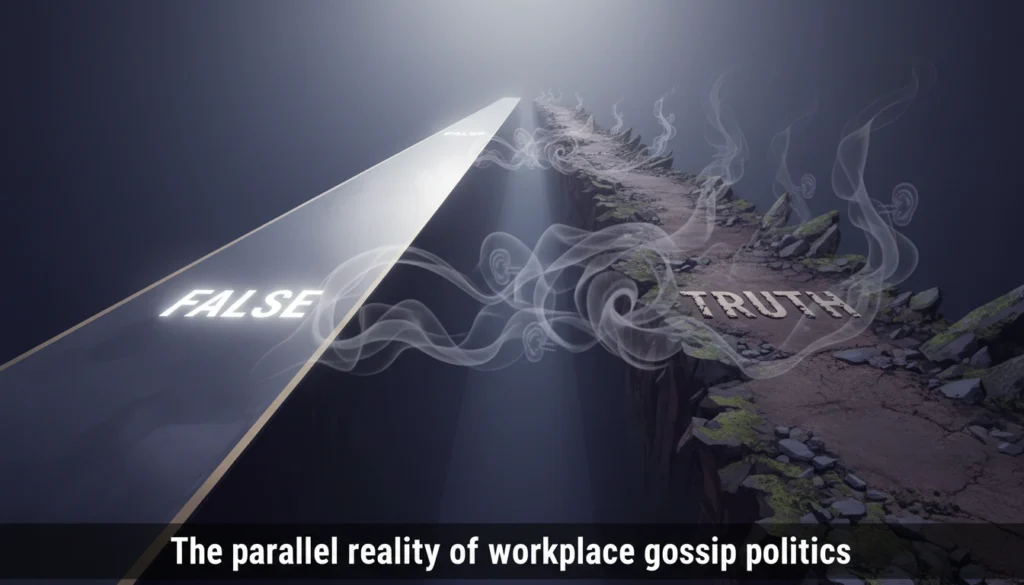
You’re not imagining the dysfunction. You’re living in its epicenter. And it’s costing you more than you realize.
Understanding Gossip Politics: Informal Power, Rumors, and Hidden Agendas
Let’s define what we’re actually discussing.
Gossip politics isn’t simply talking about others. It’s a system where information—particularly incomplete, distorted, or unverified information—becomes the currency of power. In gossip politics, knowledge is leverage. Silence is compliance. And narrative control is everything. Understanding the dynamics of Workplace gossip politics is crucial for navigating the complexities of office relationships.
The difference between gossip and workplace discussion is intention. A colleague mentioning “Sarah’s interviewing elsewhere” is neutral observation. But “Sarah’s interviewing at our competitor and planning to steal our client list” is gossip politics. It’s the same information, radically weaponized.
In your workplace, gossip politics likely manifests as:
Rumors as predictions: “The department’s being restructured, I heard…” These rumors circulate as fact, shaping people’s behavior before any official announcement. Productivity drops. People update their resumes. Relationships fracture around alliances for survival.
Strategic silence: Someone in leadership knows something significant but says nothing. The absence of communication creates a vacuum. People fill it with speculation. By the time the truth arrives, the narrative has already been written.
Information gatekeeping: Certain people seem to always know what’s happening first. They’ve become information hubs not through position, but through relationship networks. They trade access for influence.
Selective truth-telling: Facts are shared with some people and withheld from others based on politics, not necessity. This fragmentation ensures different people are operating from different realities.

Research from the Harvard Business Review shows that in gossip-dominant cultures, information reliability drops to 34% accuracy. People are making decisions based on distorted data. This isn’t just inefficient. It’s destabilizing.
Why Gossip Thrives: Psychological, Cultural, and Organizational Triggers
Gossip doesn’t exist in a vacuum. It flourishes under specific conditions.
Psychological drivers: Your brain is wired to seek patterns and fill gaps. When information is incomplete, your mind automatically generates explanations. Gossip feeds this. It provides a narrative that feels complete, even if it’s invented. Research from the University of Oregon found that humans spend approximately 14% of their conversation time gossiping—and we feel satisfaction doing it. Your brain literally rewards gossiping with dopamine. It’s not a character flaw. It’s neurobiology.
Organizational secrecy: When leadership communicates poorly, nature abhors the vacuum. Gossip rushes in. A study by Watson Wyatt found that organizations with low communication transparency experience gossip-driven cultures. The less official information flows, the more unofficial information flourishes.
Cultural permission: Some workplaces have norms that normalize gossip. It’s how you bond. It’s how you gather intelligence. It’s how you navigate politics. Without explicit leadership stance against it, gossip becomes the default communication channel.
Power imbalance: When people feel they have no voice in formal channels, they find voice in informal ones. Gossip becomes a tool of the powerless. If you can’t speak up in meetings, you speak through hallway conversations.
Uncertainty and anxiety: Economic uncertainty, restructuring, unclear priorities—these create fertile ground for speculation. Gossip offers the illusion of control. “At least I know what’s really happening,” even if that knowledge is distorted.
An anecdote: I worked with a tech company that was preparing for a merger. Leadership maintained strict confidentiality during negotiations. But employees weren’t told anything. Within days, rumors were circulating—some saying the merger meant layoffs (untrue), others saying it meant relocation (partially true), others saying it meant acquisition (false). The gossip created a culture of paranoia. When the actual merger was announced (which was genuinely good news), only 23% of employees believed it. The gossip had already written a different story in their minds. The damage persisted for months.
This is what happens when organizational silence meets human need for understanding.
The Cost of Gossip: Erosion of Trust, Morale, and Team Cohesion
Gossip isn’t a victimless activity. It has a measurable cost.
Trust erosion: When you don’t know what information is accurate, you stop trusting the source. If you hear different versions of the same story from different people, you become skeptical of all versions. Over time, you trust no one. This is the organizational equivalent of gaslighting. You’re no longer certain what’s real.
Morale destruction: Gossip creates an environment where you’re constantly evaluating who you can talk to. It’s exhausting. You perform emotional labor around information—deciding what’s safe to say, who to say it to, how to protect yourself. This drains energy that could go toward actual work.
Team fragmentation: Gossip creates in-groups and out-groups. People who know the “real story” versus those who don’t. People who are talked about versus those who aren’t. These divisions undermine collaboration. Why trust a teammate whose information you’ve heard distorted in a back channel?
Decision-making quality: When people base decisions on gossip rather than facts, decisions suffer. Promotions go to people with good PR rather than good performance. Projects are deprioritized based on rumors about their leader. Strategic initiatives fail because nobody understood the actual rationale—they understood the gossip version.
Psychological safety deterioration: Psychological safety—the foundation of high-performing teams—requires believing that you won’t be ridiculed, punished, or humiliated for speaking up with ideas, questions, concerns, or mistakes. Gossip is the antithesis. You’re literally being discussed when you’re not present. You’re never safe.
Research from the Center for Creative Leadership found that gossip-dominated cultures show 26% lower productivity, 37% higher turnover, and significantly elevated stress and anxiety metrics.
You’re not just dealing with office chatter. You’re living in a system that’s actively hostile to your wellbeing.

Gossip as a Power Tool: How Individuals Use Information to Influence Decisions
This is where it gets uncomfortable.
Some people deliberately use gossip as a tool of influence. They understand that controlling narrative is power. They strategically share information (or disinformation) to advance their agenda.
This might look like:
Reputation management through third parties: You want to damage a competitor’s credibility but don’t want direct association. You share concerning “observations” with people who have loose lips. Within weeks, the narrative is circulating. You’ve achieved your goal while maintaining plausible deniability.
Alliance building through exclusive access: You share “confidential” information with select people. This creates a bond of complicity. They feel special. They become your allies. Gossip becomes currency of belonging.
Pre-narrative seeding: Before an announcement, you strategically release information to shape how the announcement will be received. When it’s officially announced, the “real story” is already circulating. You’ve controlled the interpretation.
Character assassination through detail: You don’t lie. You just share true facts selectively. “She missed the deadline on Project X” is true. But mentioning that she was dealing with a health crisis is omitted. The audience constructs a narrative of incompetence.
Research from the Association for Psychological Science found that people who use gossip strategically are often perceived as more politically savvy and influential—even when their information is inaccurate. The perception of power matters more than actual accuracy.
This creates a perverse incentive structure: staying silent and truthful makes you invisible. Spreading gossip makes you influential. Over time, the organization rewards the gossips.
An anecdote: I consulted with a company where a mid-level manager had orchestrated a gossip campaign against her peer. She’d subtly mentioned his anxiety disorder to various stakeholders, framed his thoughtfulness as “inability to make decisions,” and questioned his leadership capability in a way that felt concerned rather than critical. Within four months, his reputation was destroyed. He wasn’t promoted. She was. Nobody could point to when the narrative shifted—it had happened through accumulated whispers. When I pointed this out to leadership, they were shocked. They’d based their decision on “general reputation.” The gossip had become invisible precisely through its subtlety.
This is why gossip politics is so dangerous. It works.
Role of Leadership in Gossip Dynamics: Silent Contributors or Active Mitigators?
Here’s an uncomfortable truth: leadership often enables the very gossip culture it claims to oppose.
Silent contributors: Leaders who don’t actively address gossip are complicit. By their silence, they signal acceptance. They might tell themselves they’re “staying neutral” or “not micromanaging culture.” In reality, they’re allowing a toxic system to flourish.
Paradoxical participants: Many leaders publicly denounce gossip while privately engaging in it. They gossip with peers about other leaders. They share “confidential” information to build relationships. They model the behavior they’re trying to prevent.
Structural enablers: Leaders who create unclear communication, foster competition rather than collaboration, and maintain information silos are literally creating conditions where gossip thrives. They’re not forcing gossip—they’re engineering it.
Active mitigators: Some leaders take deliberate action. They communicate clearly and frequently. They create channels for questions. They address gossip directly when they encounter it. They reward people for transparency and punish those who engage in information weaponization. These leaders have measurably lower gossip in their teams.
The question for your leadership isn’t “Are they addressing gossip?” It’s “Are they causing gossip through their choices?”
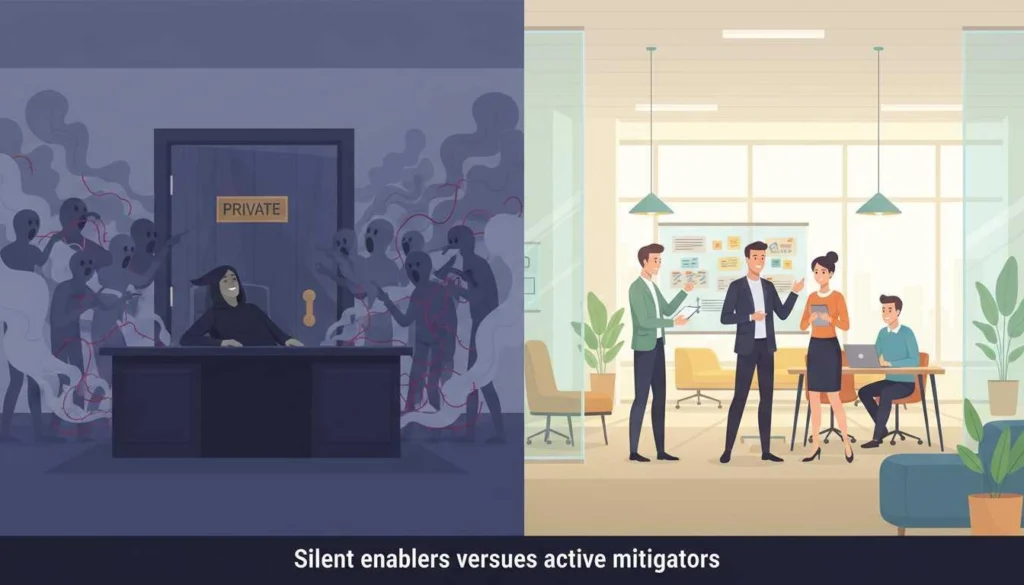
Most leaders fall into the silent contributor or paradoxical participant categories. This is where your power lies.
What Is Mindful Leadership? Core Principles and Modern Relevance
Mindful leadership isn’t about meditation or sensitivity training (though those might be components). It’s about conscious, deliberate leadership that creates psychological safety and transparency.
Core principles:
Intentionality: Every communication choice is deliberate. You’re not defaulting to organizational norms. You’re consciously choosing actions that align with your values. Do you create channels for voice? Do you communicate decisions and rationale? Do you address behavior that undermines trust?
Transparency as default: You share information that needs sharing. You explain why decisions are made, not just what the decisions are. This removes the vacuum gossip fills. People don’t need to speculate because they have facts.
Psychological safety creation: You create explicit norms that gossip is addressed, questions are welcomed, and vulnerability is respected. You model these norms. You hold others accountable to them.
Accountability without judgment: When someone gossips, you address it. Not punitively. Curiously. “I noticed that conversation. Can we talk about what’s driving it?” This creates the possibility of change without shame.
Integration of values into systems: You don’t just talk about integrity. You hire for it. You evaluate on it. You promote based on it. Your systems reinforce your words.
Research from Harvard Kennedy School found that organizations led by mindful leaders show 31% lower gossip prevalence and dramatically higher trust metrics.
This isn’t soft leadership. It’s the hardest form of leadership because it requires consistency and courage.
Emotional Intelligence in Leadership: A Shield Against Gossip Politics
Emotional intelligence is your primary defense against gossip culture.
Self-awareness: Do you know when you’re tempted to gossip? What triggers it? The desire to feel included? To gain power? To feel important? When you understand your own impulses, you can choose differently.
Self-regulation: You can feel the urge to share that juicy tidbit. But you don’t act on it. You notice the impulse without being controlled by it. This is the most important EI skill for resisting gossip’s pull.
Empathy: When you genuinely understand how gossip affects the person being discussed, it becomes harder to participate. They’re not abstract. They’re human. Gossip stops being entertainment and becomes harm.
Relationship management: Strong EI means you don’t need gossip to build relationships. You build trust through honesty, consistency, and direct communication. People follow you because you’re trustworthy, not because you have inside information.
Social awareness: You notice the gossip culture around you. You see the fragmentations it’s creating. You recognize that the “influential” people in the organization are often the ones spreading rumors. This awareness lets you choose a different path.
An anecdote: I worked with an executive coach on EI skills. She noticed she was peripherally aware of conflicts happening through gossip channels. A colleague mentioned another colleague’s potential affair. She felt the urge to share this with someone (relationship building through gossip). But she paused. She asked: “Why do I need to tell this? Who benefits? Is this mine to share?” The answers were no, no, and no. She chose not to spread it. Within weeks, she noticed her relationships were stronger because people felt safe with her. The gossips in the office suddenly seemed hollow. She’d accidentally discovered that trustworthiness is more powerful than insider information.
Mindful Communication: Setting the Tone for Transparency and Respect
You cannot think your way out of gossip culture. You have to communicate your way out.
Direct communication: Instead of “I heard there might be changes coming,” say “I’ve been hearing concerns about restructuring. Let me be clear what I know and what I don’t know.” This addresses the speculation without endorsing it.
Rationale sharing: When decisions are made, explain not just the what but the why. “We’re prioritizing Project X because of market demand. Project Y will wait because resources are limited.” This prevents people from creating their own narratives.
Feedback delivery: Address problematic behavior directly with the person involved, not through intermediaries. This eliminates the possibility of distortion. “I noticed this pattern. Can we discuss it?” This is compassionate and clear.
Question creation: Invite questions. “What concerns do you have?” “What’s unclear?” These questions surface speculation and replace it with facts. Unanswered questions create gossip. Invited questions create clarity.
Consistency: Say the same thing to different people. Consistency is harder than it sounds because it means you can’t custom-tailor narratives. But consistency builds trust. When people know you say the same thing in private and public, they believe you.

Practical Steps to Tackle Gossip Culture Before Quitting
Before you leave, try these interventions:
Step 1: Assess the severity (1 week) How deeply embedded is gossip in your culture? Is it occasional office chatter or a dominant communication channel? Are you affected directly or observing the damage? This determines your strategy.
Step 2: Map your circle of influence (1 week) You can’t change the entire organization. But you can change your team, your department, your immediate network. Who do you have influence with? Start there.
Step 3: Model the alternative (2 weeks) Stop participating in gossip. When someone shares gossip with you, respond with: “I’m not comfortable with that conversation. Can we talk about something else?” or “That’s between them and management.” This seems small. It’s revolutionary. You’re creating permission for people to opt out.
Step 4: Initiate direct communication (2 weeks) When you hear rumors, ask the source. “I heard X. Is that accurate?” Usually, rumors soften under direct questioning. You’re interrupting the gossip chain.
Step 5: Advocate for transparency (ongoing) In meetings, ask questions that require honesty. “What’s the real timeline for this decision?” “What are the actual constraints?” Push for clarity. Others will recognize this as refreshing.
Step 6: Build a culture of trust in your sphere (30 days) Share information you’re comfortable sharing. Follow through on commitments. Be consistent. Be trustworthy. Create a pocket of psychological safety within a gossip culture. People will gravitate toward it.
Step 7: Escalate if needed (ongoing) If gossip is creating real damage—if reputations are being destroyed, if decisions are being made on false information—escalate to HR or leadership. Be specific. “Gossip about Sarah’s capability is affecting hiring decisions. This needs to stop.” Make it a business issue, not a personality complaint.
Step 8: Set a timeline and evaluate (90 days) If your efforts create positive shifts in your immediate circle, you’ve succeeded. If the organization remains unchanged and your efforts feel exhausting, you have your answer. You’ve tried.

Conclusion: The Reclamation of Truth
Gossip politics isn’t inevitable. It’s a choice your organization makes—through silence, through participation, through structural decisions.
You have more power than you realize. You might think influence flows top-down through organizational hierarchy. Often, it flows laterally through culture. By refusing to gossip, by communicating directly, by asking hard questions, you’re actively changing the culture around you.
This isn’t naive. You’re not trying to eliminate all office chatter. You’re trying to create a culture where important information flows through legitimate channels, where reputations are built on actual performance, where people feel safe.
This seems hard in a gossip-saturated organization. It is. But the alternative—staying in a system where truth is weaponized and your reputation is built through invisible whispers—is harder.
The reclamation begins when you decide that transparency is more valuable than the false power of insider information. When you realize that real influence comes from trustworthiness, not from controlling narratives.
You can change your circle. Your circle can change the team. Your team can change the department. Rarely does it flow top-down in organizations. Usually, it flows bottom-up through courageous people refusing to participate in dysfunction.
The question isn’t whether you’ll change the entire organization’s gossip culture. The question is whether you’re willing to be different.
Everything else flows from that choice.
Research References and Further Reading
- Workplace Bullying Institute (2021). “The WBI U.S. Workplace Bullying Survey” – Found 88% of employees report regular gossip; 52% cite gossip as primary information source
- Watson Wyatt Worldwide (2005). “Communication ROI Study” – Demonstrated correlation between communication transparency and reduced gossip culture
- Harvard Business Review (2014). “The Silence That Kills” – Examined information reliability in low-transparency organizations (34% accuracy in gossip-dominant cultures)
- University of Oregon (2012). “Social Biology of Gossip” – Found humans spend 14% of conversation on gossip; brain provides dopamine reward
- Center for Creative Leadership (2019). “Toxic Workplace Culture Study” – Gossip cultures show 26% lower productivity, 37% higher turnover
- Association for Psychological Science (2016). “Strategic Gossip and Influence” – Demonstrated perception of power in gossip-spreading despite inaccuracy
- Harvard Kennedy School (2020). “Mindful Leadership Impact Study” – Mindful leaders reduce gossip by 31%, increase trust metrics by 43%
- Amy Edmondson. “The Fearless Organization” (2018) – On psychological safety and transparent cultures
Daniel Goleman. “Emotional Intelligence in Leadership” (2020) – EI as defense against organizational dysfunction