

We’ve all been there: a conversation starts innocently enough, then suddenly, the air thickens. You feel a knot tighten in your stomach, your heart begins to race, and a flush creeps up your neck. Your mind might jump to conclusions, or you might find yourself struggling to articulate a coherent thought. These are the tell-tale signs that your ancient survival instincts have kicked in, turning a verbal exchange into a perceived threat. Navigating these moments, especially during difficult conversations, requires more than just good intentions; it demands a strategic understanding of your body’s alarm system.
It’s easy to get swept away by the surge of adrenaline and cortisol, leading to regrettable words or unproductive silence. But what if you could learn to recognize these physiological cues and intentionally steer your responses? This article will equip you with scientifically-backed strategies to stay grounded, communicate clearly, and foster understanding, even when your internal alarm bells are ringing loud.
How Your Body Reacts: The Science of Fight-or-Flight in Difficult Conversations

Imagine you’re in a crucial discussion with a colleague or a loved one. Suddenly, a phrase or tone strikes you, and your body involuntarily tenses. Your palms might feel clammy, your breathing becomes shallow and rapid, and you might notice your jaw clenching or shoulders hunching. These aren’t just quirks of personality; they are sophisticated, ancient biological responses orchestrated by your autonomic nervous system, specifically its sympathetic branch.
This reaction is famously known as the fight-or-flight response, a primal survival mechanism designed to help you confront or escape immediate physical danger (Harvard Medical School, 2018). While it’s incredibly useful when facing a predator, it’s less helpful when you’re simply trying to talk through a disagreement. The orchestrator of this alarm system is often the amygdala, an almond-shaped cluster of neurons deep within your brain’s temporal lobe. When the amygdala perceives a threat—even a social or emotional one—it sends rapid signals to your body, initiating a cascade of physiological changes before your conscious mind has even fully processed the situation (LeDoux, 1996).
Adrenaline and cortisol flood your system, redirecting blood flow from your prefrontal cortex—the part of your brain responsible for rational thought, problem-solving, and emotional regulation—to your major muscle groups. This explains why it feels so difficult to think clearly or articulate complex ideas when you’re under stress. You might experience tunnel vision, focusing intensely on the perceived threat, while losing sight of the broader context or the other person’s perspective.
“The amygdala is a rapid-response system. It acts like a smoke detector, often triggering an alarm before the fire marshal (our conscious mind) has even arrived to assess the situation.” — Joseph LeDoux, Neuroscientist (paraphrased)
Recognizing these physical sensations is your crucial first step in regaining control. This internal awareness, known as interoception, is a fundamental aspect of self-regulation (Craig, 2002). By tuning into your body’s signals—the racing heart, the constricted throat, the urge to lash out or shut down—you can identify that you’ve entered a reactive state. This recognition creates a small but significant window of opportunity to choose a different path, rather than being hijacked by your primitive brain. Learning to notice these alarms allows you to pause and prevent a productive discussion from spiraling into an unproductive confrontation.
Regain Your Composure: The Power of a Strategic Pause
Once you notice your body’s alarm, your immediate impulse might be to react—to defend, to attack, or to withdraw. However, this is precisely when the most powerful tool in your communication arsenal comes into play: the strategic pause. Creating space between stimulus and response isn’t about avoidance; it’s a deliberate act of self-regulation that allows your higher brain functions to come back online.
One of the simplest yet most effective ways to trigger this shift is through your breath. Deep, diaphragmatic breathing activates the vagus nerve, which in turn stimulates your parasympathetic nervous system (Porges, 2007). This is your body’s “rest and digest” system, working in direct opposition to the fight-or-flight response. Even just three slow, deep breaths—inhaling slowly through your nose, letting your belly expand, and exhaling even more slowly through your mouth—can begin to downregulate your stress response. This conscious breathing provides a vital reset button for your nervous system, allowing blood flow to return to your prefrontal cortex, which is essential for rational thought and empathy (Davidson et al., 2000).
Verbally, a pause can be as simple as saying, “I need a moment to collect my thoughts,” or “Can we take a quick break? I want to make sure I respond thoughtfully.” These phrases aren’t apologies; they are assertive statements that model healthy boundaries and intentional communication. They signal to the other person that you value the conversation enough to ensure you’re at your best. This approach can also subtly encourage the other party to reflect on their own state, potentially de-escalating their emotional responses as well.
During this pause, you can also engage in simple grounding techniques. You might notice five things you can see, four things you can feel, three things you can hear, two things you can smell, and one thing you can taste. This sensory exercise helps to bring your awareness back to the present moment and away from anxious thoughts about the past or future. The objective is to give your emotional brain a chance to calm down so your rational brain can re-engage. This deliberate disengagement from immediate reactivity is a hallmark of emotional intelligence and a vital skill for managing difficult conversations productively.
Speak Your Truth: Mastering ‘I’ Statements in Difficult Conversations
🎬 Watch the video version

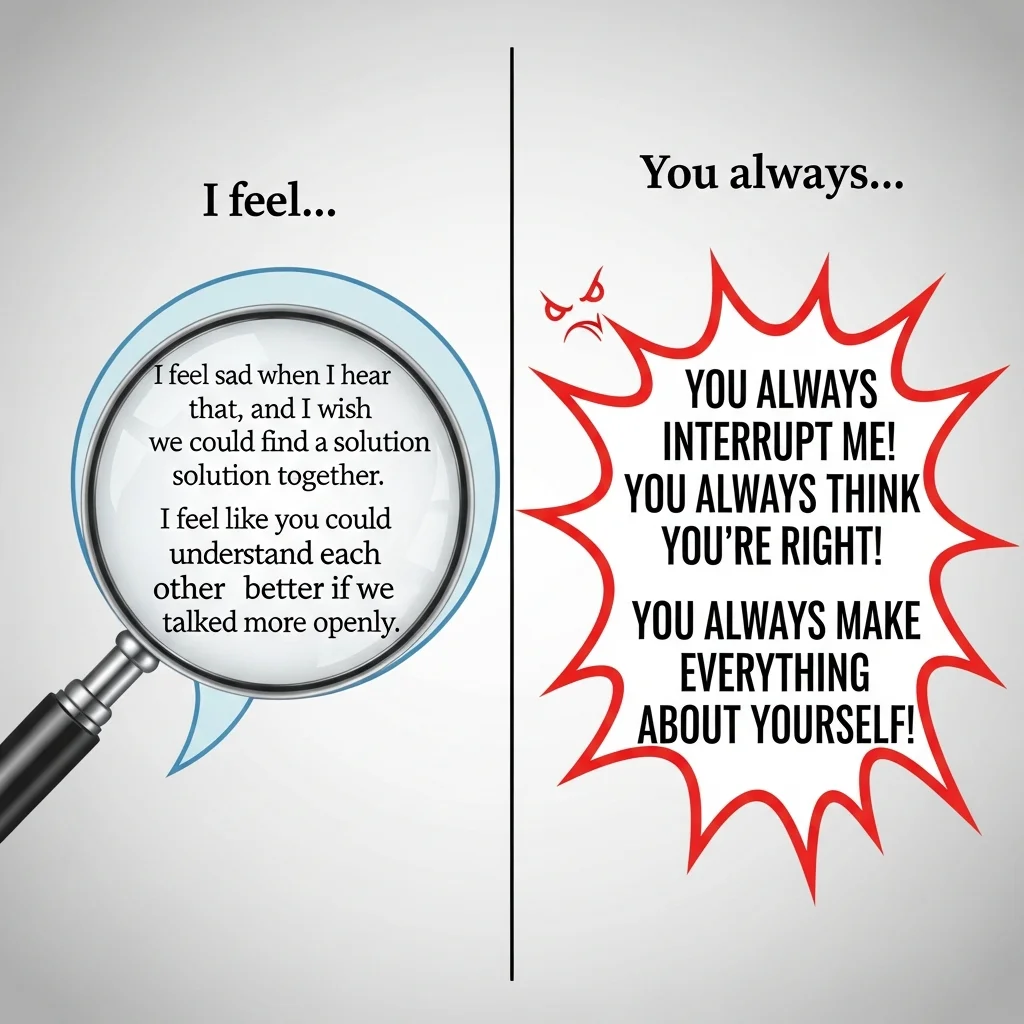
Once you’ve given yourself a pause and feel a greater sense of composure, the next challenge is to communicate effectively without escalating the conflict. A common pitfall in difficult conversations is the use of “you” statements, which often sound accusatory and trigger defensiveness. For example, “You always interrupt me,” or “You make me feel insignificant,” are likely to be met with arguments and shut-down responses, rather than understanding.
Instead, shift your language to “I” statements. This simple linguistic change is remarkably powerful because it allows you to express your feelings, needs, and observations without assigning blame to the other person. An “I” statement typically follows a structure: “I feel [emotion] when [observable behavior or situation] because [my need or impact], and I need/would like [request].” For instance, instead of “You never listen!” you might say, “I feel unheard when I’m speaking and you look at your phone, because I need to feel respected, and I would appreciate it if you could give me your full attention for these five minutes.”
This approach is rooted in principles of nonviolent communication (Rosenberg, 2003) and has been extensively studied in relationship dynamics. Research on marital communication, for example, consistently shows that couples who use “I” statements and focus on expressing their own feelings and needs, rather than criticizing their partner, experience higher levels of marital satisfaction and more constructive conflict resolution (Gottman & Silver, 1999). When you own your feelings, you invite empathy rather than defensiveness. You are sharing your internal experience, which is something only you can know, making it difficult for the other person to dispute.
“When we express our needs and feelings clearly and directly, we increase the likelihood of getting those needs met without resorting to blame or coercion.” — Marshall B. Rosenberg, Creator of Nonviolent Communication (paraphrased)
Practicing “I” statements requires self-awareness about your own emotions and needs, which aligns perfectly with the initial step of noticing your body’s alarm. It shifts the focus from what the other person is doing “wrong” to how their actions impact you, fostering an environment where solutions can be sought collaboratively. This method is a cornerstone of constructive communication, turning potential arguments into opportunities for deeper understanding and connection.
Build Bridges: Re-engaging with Empathy and Curiosity
After you’ve managed your own internal state and articulated your perspective using “I” statements, the conversation isn’t over. The true art of navigating difficult conversations lies in your ability to re-engage with genuine curiosity and empathy for the other person. It’s easy to assume we know why someone is acting a certain way or what their intentions are, but these assumptions often create walls, not bridges.
Returning to the conversation with an open mind means actively setting aside your preconceived notions and the urge to “win” the argument. Instead, adopt a posture of genuine inquiry. Ask open-ended questions that invite elaboration, such as “Can you tell me more about why you feel that way?” or “What’s important to you in this situation?” This approach shifts the dynamic from a confrontation to a mutual exploration of perspectives. Active listening is key here: truly hearing what the other person says, both verbally and non-verbally, without immediately formulating your rebuttal.
Empathetic listening goes a step further. It involves not just understanding the words, but also attempting to understand the underlying feelings and needs. As pioneering psychologist Carl Rogers noted, empathy is about “perceiving the internal frame of reference of another with accuracy and with the emotional components and meanings which pertain thereto as if one were the person, but without ever losing the ‘as if’ condition” (Rogers, 1957). Research in neuroscience even suggests that our brains have mirror neuron systems that activate when we observe others’ emotions, suggesting a biological basis for our capacity for empathy (Rizzolatti & Craighero, 2004).
When you listen empathetically, you can then reflect back what you’ve heard, often by summarizing or paraphrasing their message, including their feelings. For example, “It sounds like you’re feeling frustrated because you believe your efforts aren’t being recognized. Is that right?” This validates their experience and shows them they’ve been truly heard, which can significantly de-escalate tension and build trust. Validation doesn’t mean agreement; it simply means acknowledging and respecting their feelings and perspective.
By cultivating curiosity, you transform a potentially adversarial exchange into a collaborative problem-solving effort. You move beyond surface-level conflict to uncover deeper needs and concerns, paving the way for solutions that work for everyone involved. This genuine interest in understanding another’s world creates psychological safety, making it far easier to navigate even the most challenging discussions successfully.
Key Takeaways
- Recognize Your Body’s Alarm: Pay attention to physical cues like a racing heart, shallow breath, or muscle tension as signs of the fight-or-flight response activating during difficult conversations.
- Implement a Strategic Pause: Use deep breathing or verbal statements like “I need a moment” to calm your nervous system and allow your rational mind to re-engage before responding.
- Master ‘I’ Statements: Communicate your feelings and needs using “I feel [emotion] when [situation] because [impact], and I would like [request],” to avoid blame and foster constructive dialogue.
- Engage with Empathy and Curiosity: Approach the conversation with an open mind, actively listen, ask clarifying questions, and validate the other person’s perspective to build understanding and trust.
- Practice Self-Regulation: Consistently applying these techniques strengthens your emotional intelligence, allowing you to navigate even the most challenging interactions with greater calm and clarity.
Speak Your Truth, Stay Calm
Mastering difficult conversations is a skill, not an innate talent. By understanding your body’s responses, intentionally pausing, choosing your words thoughtfully, and re-engaging with empathy, you can transform moments of potential conflict into opportunities for deeper connection and effective resolution. Start practicing these steps today, and watch your communication evolve.
References

- Craig, A. D. (2002). How do you feel? Interoception: The sense of the physiological condition of the body. Nature Reviews Neuroscience, 3(8), 655-666.
- Davidson, R. J., Putnam, K. M., & Larson, C. L. (2000). Dysfunction in the neural circuitry of emotion regulation—a review of emotion and brain asymmetry. Biological Psychiatry, 48(10), 1039-1052.
- Gottman, J. M., & Silver, N. (1999). The Seven Principles for Making Marriage Work. Harmony.
- Harvard Medical School. (2018). Understanding the stress response: Chronic stress puts your health at risk. Harvard Health Publishing.
- LeDoux, J. E. (1996). The Emotional Brain: The Mysterious Underpinnings of Emotional Life. Simon & Schuster.
- Porges, S. W. (2007). The polyvagal perspective. Biological Psychology, 74(2), 116-143.
- Rizzolatti, G., & Craighero, L. (2004). The mirror-neuron system. Annual Review of Neuroscience, 27, 169-192.
- Rogers, C. R. (1957). The necessary and sufficient conditions of therapeutic personality change. Journal of Consulting Psychology, 21(2), 95-103.
- Rosenberg, M. B. (2003). Nonviolent Communication: A Language of Life. PuddleDancer Press.